
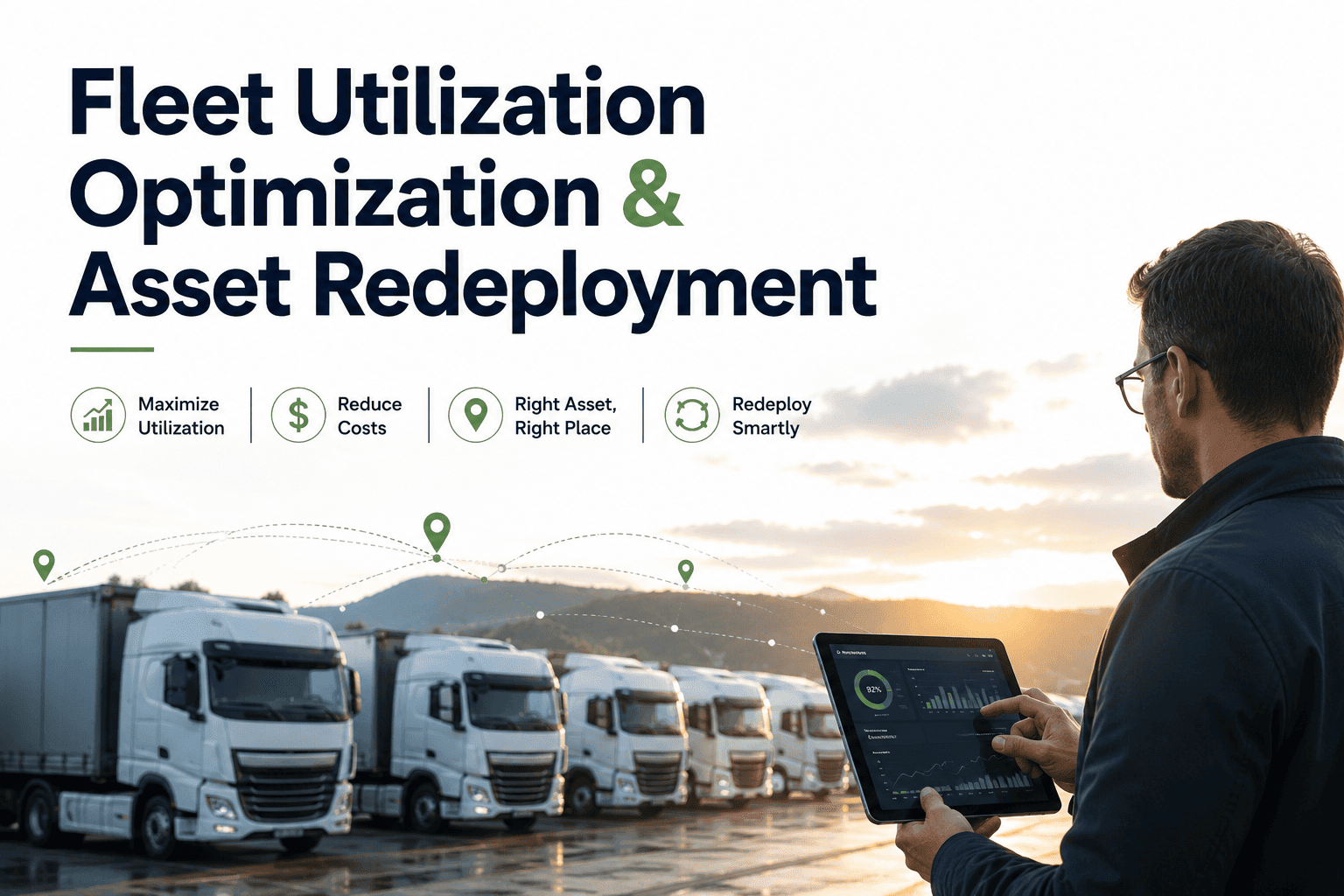
The average commercial fleet is running 14 to 22% more vehicles than its operational demand requires — carrying insurance, depreciation, and maintenance cost on assets that are not earning their capital expense. A fleet manager with 60 vehicles who could serve identical operational demand with 52 vehicles is spending $84,000 to $124,000 per year on 8 unnecessary vehicles — costs that appear nowhere in a report that only shows utilization as a fleet-average percentage. Vehicle utilization optimization requires understanding which specific vehicles are underutilized, why they are underutilized (assignment pattern vs route coverage gap vs excess fleet capacity), and whether the answer is redeployment, disposal, or operational restructuring. Oxmaint's utilization analytics module provides all three answers — per vehicle, per route, and per operational zone — continuously updated from live telematics data. Book a demo to see your fleet's per-vehicle utilization rate and right-sizing analysis built in Oxmaint.
Oxmaint calculates utilization rate per vehicle, per route, and per zone from live telematics data — identifying which vehicles are candidates for redeployment, disposal, or lease return, with the financial impact of each decision calculated automatically.
Vehicle utilization rate is calculated as: Total hours vehicle was in revenue-generating operation ÷ Total available operating hours × 100. A vehicle available for 220 hours in a month that is actually deployed for 143 hours has a utilization rate of 65%. Top-quartile commercial fleets run ≥82% utilization; fleets below 62% typically carry 15–22% excess capacity. Right-sizing analysis identifies whether underutilization reflects a temporary assignment pattern, a route coverage gap that a redeployment could fill, or genuine excess fleet capacity that should be eliminated through disposal or lease return. Oxmaint calculates utilization per vehicle, per route, and per zone from telematics data — producing a prioritized right-sizing recommendation with financial impact per action.
Understanding Fleet Utilization — Three Metrics That Matter
Fleet utilization is not a single number — it is three distinct measurements that must be tracked separately to distinguish between idle capacity that is operational (standby), idle capacity that is structural (route coverage gap), and idle capacity that is pure waste (excess fleet). Book a demo to see all three utilization metrics calculated for your fleet in Oxmaint.
The most commonly tracked utilization metric — measures what percentage of available time the vehicle is deployed. A vehicle available 10 hours/day, 5 days/week that averages 6.8 hours/day in operation has a time utilization of 68%. This metric identifies vehicles that are consistently parked during operational hours — the clearest signal of either over-fleet or assignment pattern problems. Oxmaint tracks this per vehicle, per week, with 13-week rolling average for trend identification.
Measures how efficiently miles driven produce operational value — distinguishing between miles driven on revenue-generating routes vs. deadhead miles returning empty from delivery, positioning moves, or personal use. A vehicle logging 2,800 miles per month where 620 are deadhead has a distance efficiency of 78%. Fleets with high deadhead ratios are candidates for load optimization or zone restructuring that increases revenue miles without adding vehicles. Oxmaint calculates this from GPS trip data automatically.
The most operationally meaningful utilization metric — not just whether the vehicle is moving, but whether its movement is generating revenue that justifies its cost. A vehicle at 74% time utilization running $0.58/mile cost but assigned to low-revenue routes may have a lower revenue contribution than a vehicle at 60% time utilization assigned to premium service routes. Oxmaint connects vehicle operating cost (from maintenance and telematics) to revenue-per-vehicle data from your dispatch system for this calculation.
Know Which Vehicles Are Earning Their Cost — and Which Are Just Parked Expensively
Oxmaint calculates all three utilization metrics per vehicle from telematics data — ranking the fleet from highest to lowest utilization so the right-sizing conversation starts with data, not management intuition. Book a demo to see your fleet's utilization ranking built in Oxmaint.
Right-Sizing Analysis — Four Decisions for Underutilized Vehicles
When Oxmaint identifies a vehicle consistently below the 65% utilization threshold, the analysis produces one of four recommended actions — each with a specific financial impact and a specific implementation path.
When underutilization reflects an assignment pattern problem rather than fleet excess — a vehicle consistently parked in Zone 3 while Zone 7 experiences peak-period vehicle shortages. Oxmaint's zone utilization heat map identifies geographic demand imbalances that can be resolved by reassigning existing vehicles without changing fleet size. Average utilization improvement from zone rebalancing: 18 to 26 percentage points on the affected vehicles.
When underutilization reflects shift timing rather than zone assignment — vehicles consistently parked during morning shifts but overloaded in afternoon shifts, indicating an imbalanced shift coverage model. Oxmaint's time-of-day utilization analysis identifies shift patterns that can be restructured to improve utilization without fleet size change. Most applicable in fleets with flexible scheduling where demand varies significantly by time of day or day of week.
When underutilization reflects genuine structural excess — demand has contracted and the fleet is sized for historical peak volume that no longer exists. Oxmaint identifies vehicles with persistent utilization below 40% over 13+ weeks (not seasonal or temporary) and calculates the financial case for disposal: annual cost saving (insurance + maintenance + depreciation) vs residual value recovery. Oxmaint also projects the optimal disposal timing to maximize residual value before the next depreciation step-down.
When underutilized vehicles can serve multiple departments or routes without dedicated assignment — converting from dedicated vehicle per driver to shared pool model. Pooling 3 underutilized dedicated vehicles into a 2-vehicle pool serving the same operational demand can reduce fleet size by 1 vehicle while maintaining service levels — saving $14,200 per year while requiring only operational process changes, not capital investment. Oxmaint's pool utilization tracking monitors whether the pool model is maintaining service levels post-conversion.
Utilization Analytics Dashboard — What Oxmaint Tracks
Six utilization metrics tracked per vehicle from live telematics data — the numbers that identify where your fleet is oversized, where it is correctly sized, and where demand is exceeding current capacity.
Fleet Utilization Improvement — Results at Oxmaint Customer Fleets
Our operations team had been telling us we needed 4 more vehicles for 18 months. The Oxmaint utilization report showed us 9 vehicles running below 55% utilization in Zone 4 while Zone 2 was running vehicles at 94% utilization. We redeployed 4 vehicles from Zone 4 to Zone 2 — no new procurement, no new cost. Zone 2 service complaints dropped to zero and we returned 2 leased vehicles 8 months later when the analysis confirmed we were structurally over-fleetted.
Frequently Asked Questions
Right-Size Your Fleet. Recover $84K–$124K. Serve the Same Demand with 12% Fewer Vehicles.
Per-vehicle utilization rate, zone heatmap, right-sizing analysis, and financial impact per action — all from live telematics data in Oxmaint. Analysis available within 13 weeks of integration.





.png)
-(1).png)