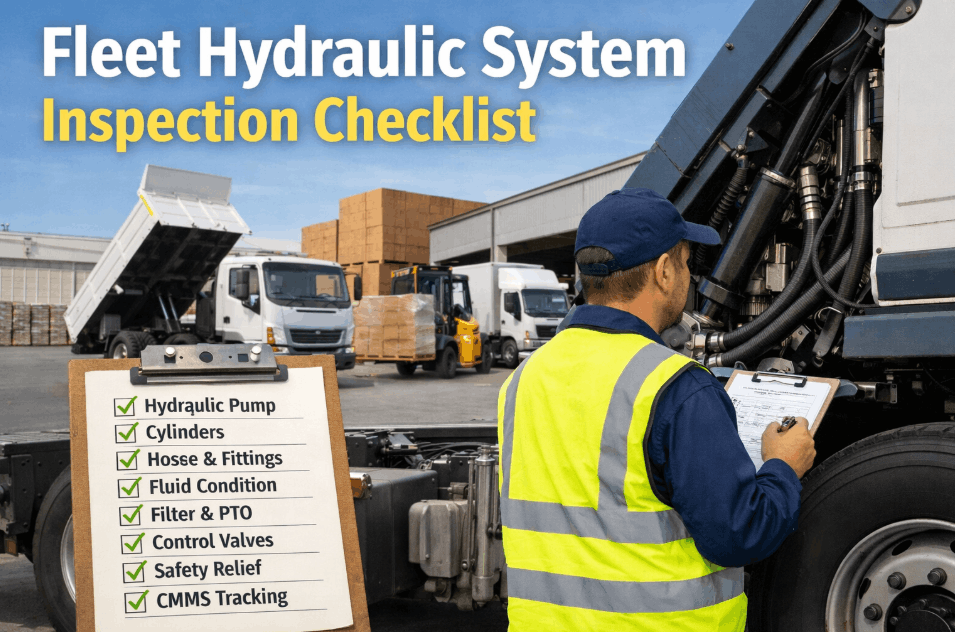
Hydraulic System Maintenance for Fleet Vehicles: Dump Trucks, Lifts, and PTOs
By Alex Jordan on March 29, 2026
Hydraulic system failures are among the most expensive events in any fleet operating dump trucks, tail-lifts, or PTO-driven equipment. Unlike engine faults, hydraulic degradation is silent — fluid contamination and seal wear progress without any dashboard warning until a hose bursts or a dump body fails to raise. At $2,200–$8,400 per failure event, the cost is almost entirely preventable with a structured PM programme. OxMaint's CMMS schedules every hydraulic PM event automatically — fluid, filters, hoses, and seals — per vehicle, per interval, without manual tracking.
Heavy Equipment · Article ·
Hydraulic System Maintenance for Fleet Vehicles: Dump Trucks, Lifts, and PTOs
Pumps, cylinders, hoses, fluid management, filtration, PTO systems, and dump body hydraulics — with CMMS-scheduled PM intervals, OBD monitoring, and predictive maintenance protocols for commercial fleet operations.
$5,800Average hydraulic system failure cost — parts, labour, and downtime combined
82%Of hydraulic failures caused by fluid contamination or missed filter/fluid intervals
−71%Hydraulic failure rate with CMMS-scheduled fluid, filter, and hose PM programme
38×Cost difference — planned hydraulic fluid service vs. pump or cylinder replacement
Hydraulic PM Intervals by Component — Your Service Reference
Every hydraulic component in a commercial fleet vehicle has a defined service interval — but most fleets track only engine oil and transmission fluid, leaving hydraulic fluid changes, filter replacements, and hose inspections to accumulate on a "when it breaks" schedule. The six component cards below show the industry-standard PM intervals for each major hydraulic system element. Severe duty operations (frequent dump cycles, high-pressure PTO use, hot operating environments) typically require 30–40% shorter intervals than the standard values shown. OxMaint creates a PM template per hydraulic component per vehicle — standard or severe duty intervals configured once, then tracked automatically.
1,000 hrs
Hydraulic Fluid
Full fluid change + sample for contamination analysis
High Priority
500 hrs
Filter Element
Return line + pressure filter replacement. Check bypass indicator.
High Priority
250 hrs
Hose Inspection
Visual for abrasion, bulge, cracking, and fitting corrosion. Replace at 5 years regardless.
Medium Priority
1,000 hrs
Cylinder Seals
Inspect rod seals for weeping. Check wiper seal condition. Pressure-test at max operating PSI.
Medium Priority
500 hrs
Pump & PTO
Check pump output pressure and flow rate. Inspect PTO engagement, shaft seal, and coupling condition.
High Priority
250 hrs
Reservoir & Breather
Check fluid level, condition, and colour. Replace breather filter. Inspect reservoir vent for blockage.
Routine
The Hydraulic Failure Cascade — How One Miss Becomes a $5,800 Repair
Hydraulic system failures rarely originate in a single dramatic event. They follow a cascade — a sequence of degradation stages where each missed maintenance action creates the conditions for the next failure. Understanding the cascade is essential for fleet engineers because it shows where the intervention points are and what the cost consequence of missing each one looks like. The five-layer stack below shows the hydraulic failure cascade from fluid contamination through to pump or cylinder replacement — each layer representing both a maintenance action that should have been taken and the consequence cost if it wasn't. OxMaint intercepts the cascade at every layer — fluid condition monitoring, filter bypass alerts, hose inspection work orders, and pressure test scheduling before the cascade reaches the expensive end.
Hydraulic Failure Cascade — 5 Stages from Contamination to Replacement
Stage 1
Fluid Contamination
Water ingress, particle buildup, or oxidation past ISO 4406 cleanliness spec. Fluid change overdue.
Contaminated fluid accelerates seal and hose liner degradation. Micro-leaks begin. Pressure drops under load.
$640
Hose + seal replacement
↓
Stage 4
Pump Wear & Cavitation
Abrasive contamination damages pump vanes/pistons. Cavitation from air ingress accelerates destruction. Output pressure drops 15–30%.
$2,400
Pump rebuild or replace
↓
Stage 5
Cylinder or System Failure
Contaminated fluid scores cylinder bore. Dump body fails to raise or hold load. Complete system flush, cylinder replacement, and recommissioning required.
$5,800+
Full system overhaul
Hydraulic Risk Scoring — Where Is Your Fleet Right Now?
Not every hydraulic system in a fleet carries the same risk at any given time. A vehicle with fresh fluid, a new filter, and recently inspected hoses is in a completely different risk profile from one that is 400 hours past its fluid change with a filter bypass indicator showing yellow. The scoring framework below lets fleet engineers assign a risk score to each hydraulic system in the fleet — generating a priority list that directs technician time to the highest-consequence gaps first.
Hydraulic System PM Compliance & Failure Risk Scoring
Fluid within interval, ISO cleanliness confirmed by sample. Filter new. Hoses inspected. Cylinder seals dry. Pump pressure at spec.
Action: Maintain schedule. Confirm next service in CMMS. No intervention required.
4
Approaching Service — Minor Indicators
Within 100 hours of next fluid or filter interval. Fluid slightly discoloured. No performance change. Hoses last inspected within 200 hours.
Action: Schedule at next PM window. No operational restrictions.
3
Overdue — Degradation Visible
100–300 hours past fluid interval. Filter bypass indicator amber. Fluid dark or milky. Possible minor cycle speed reduction noted by operator.
Action: Service within 2 weeks. Restrict high-cycle operations until complete.
2
High Risk — Performance Degradation
Over 300 hours past interval. Bypass indicator red. Pressure noticeably reduced under load. Hose chafing visible. Cylinder rod weeping.
Action: Immediate service. Inspect for component damage before fluid change. Pull from dump/lift operations.
1
Critical — Active Failure Signs
Active hose leak, dump body failure, pump noise (cavitation), or cylinder drift under load. System operating outside safe parameters.
Action: Ground vehicle immediately. Emergency inspection. Do not operate lift or dump function until cleared.
Technology Integration: PLC, OBD, Digital Twin, AI Camera, and SAP
Modern hydraulic system maintenance is being transformed by the same technology stack that drives predictive engine maintenance — with specific adaptations for the hydraulic environment. PLC integrations are particularly powerful for hydraulic systems — pressure transducers, temperature sensors, and cycle counters wired into the vehicle's PLC feed real-time hydraulic health data into OxMaint, triggering work orders when pressure drops below threshold or cycle counts exceed PM intervals. OBD-II and J1939 telematics add hydraulic fluid temperature and PTO engagement event logging. AI Digital Twin models build virtual hydraulic circuits per vehicle — predicting seal and pump degradation based on actual cycle frequency, operating temperature, and fluid sample history rather than fixed hours. AI Camera Vision enables undercarriage inspection for hose chafing and cylinder rod seal weeping at the depot overnight. SAP integrations ensure hydraulic fluid, filter elements, and seal kits are pre-ordered before the service window opens — eliminating the parts wait that inflates hydraulic repair downtime by an average of 6.8 hours.
PLC Integration
96%
Pressure threshold trigger accuracy
Pressure transducers + cycle counters feed CMMS directly. Work order fires when hydraulic pressure drops or cycle count hits PM threshold.
OBD / J1939
88%
Hydraulic fluid temp + PTO event logging
Fluid operating temp and PTO engagement cycles logged per trip. Accelerated intervals auto-applied for vehicles running high-temp PTO operations.
AI Digital Twin
84%
Seal + pump degradation prediction
Virtual hydraulic circuit per vehicle. Predicts component degradation from cycle frequency, temp history, and fluid sample data — not fixed hours.
AI Camera Vision
91%
Hose chafing + seal weep detection
Overnight undercarriage scans detect hose abrasion and cylinder rod seal weeping before next-day dispatch — not after a roadside failure.
"
We had two dump body hydraulic failures in the same quarter — both traced back to fluid contamination that had been building for months. We deployed OxMaint, set 500-hour filter intervals and 1,000-hour fluid change schedules for all 28 dump trucks. Zero hydraulic failures in the 14 months since. The fluid programme costs us about $340 per truck per year. Each of those failures cost over $6,000.
Fleet Engineer — Municipal waste management fleet, 28 vehicles, West Midlands, UK
Hydraulic Fluid Contamination — The Root Cause of 82% of Failures
Hydraulic fluid contamination is the single largest driver of hydraulic system failures in commercial fleet vehicles — responsible for 82% of pump failures, 74% of cylinder seal failures, and 91% of filter bypass events. Contamination enters hydraulic systems through three primary pathways: water ingress through the reservoir breather, particle contamination from worn components, and cross-contamination during fluid top-up with the wrong fluid specification. OxMaint tracks fluid specification per vehicle — preventing cross-contamination by alerting technicians to the correct fluid type before every top-up and fluid change event.
Hydraulic Failure Root Cause by Category — Commercial Fleet (%)
Fluid contamination / degradation
82%
Hose failure (wear, abrasion, age)
64%
Cylinder seal failure
48%
Pump wear / cavitation
38%
PTO seal / coupling failure
26%
Valve and control failure
18%
Frequently Asked Questions
How often should hydraulic fluid be changed on a dump truck?
Standard duty: every 1,000 operating hours. Severe duty (frequent dump cycles, dusty environments, high temps): every 500–600 hours. OxMaint sets intervals per vehicle duty cycle — not a fleet-wide average that under-services your hardest-working units.
What are the warning signs of hydraulic pump cavitation?
Whining or knocking noise at startup, reduced cycle speed under load, erratic cylinder movement, and foam in the reservoir. Cavitation is accelerated by low fluid level, blocked suction strainer, and high-viscosity fluid in cold conditions — all preventable with routine checks.
How does PLC integration help with hydraulic PM in fleet vehicles?
PLC-mounted pressure transducers and cycle counters feed real-time data into OxMaint — firing work orders when pressure drops below threshold or when cycle counts reach the PM interval. This replaces manual hour-logging and catches developing faults between scheduled services.
Can SAP integration help manage hydraulic parts procurement?
Yes — CMMS work orders trigger automatic purchase orders in SAP for fluid, filter elements, and seal kits before the service window opens. Parts wait time — the 6.8-hour average that inflates hydraulic repair downtime — is eliminated when procurement is automated from the PM schedule.
Schedule Every Hydraulic PM — Before the Fluid Schedules the Failure.
OxMaint tracks hydraulic fluid, filters, hoses, and seals per vehicle — PLC-integrated, CMMS-automated, and free to start.