Mixed Fleet Management: EV, ICE & Hybrid Operations Guide

By Jack Miller on April 8, 2026

mixed-fleet-management-ev-ice-hybrid-operations

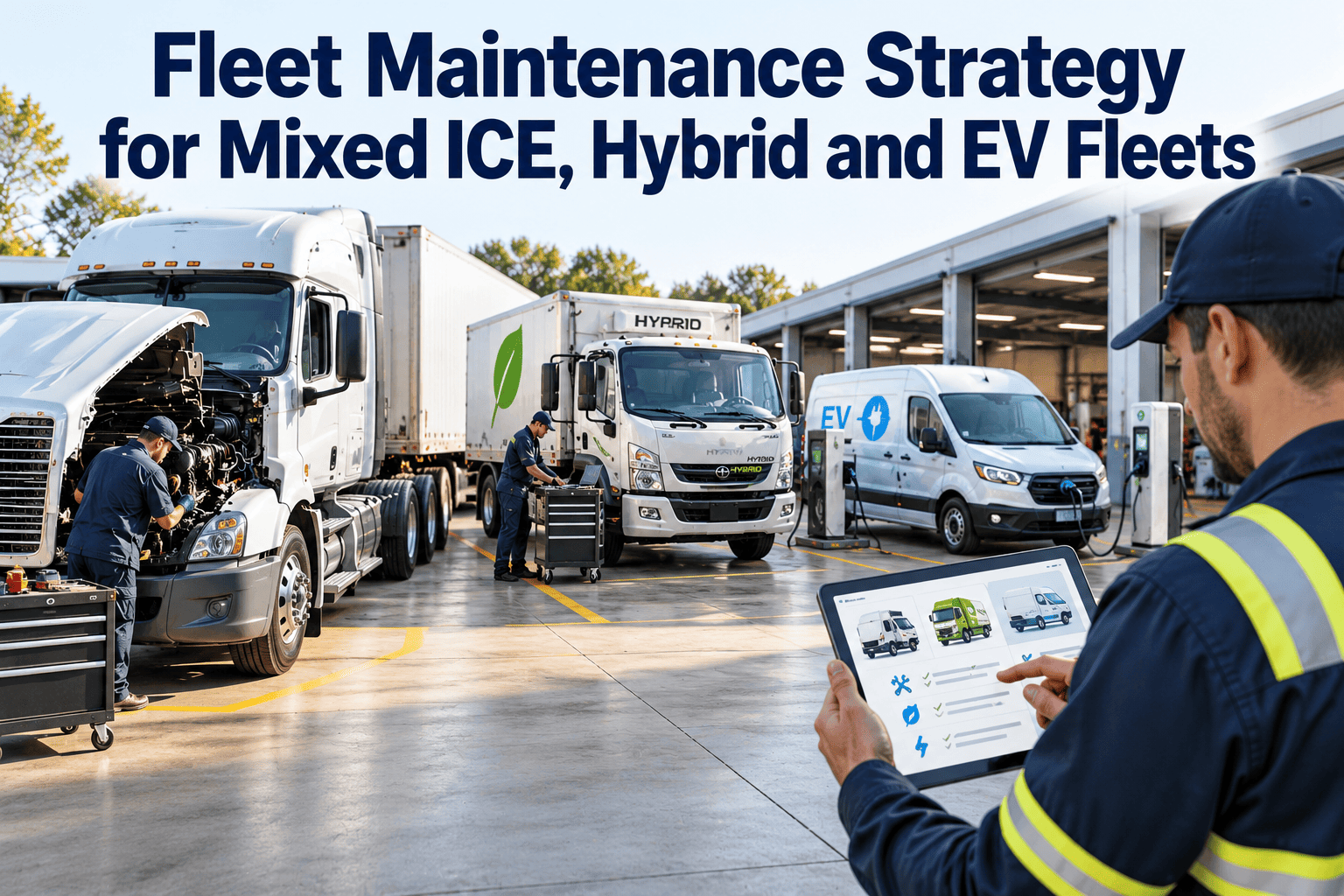
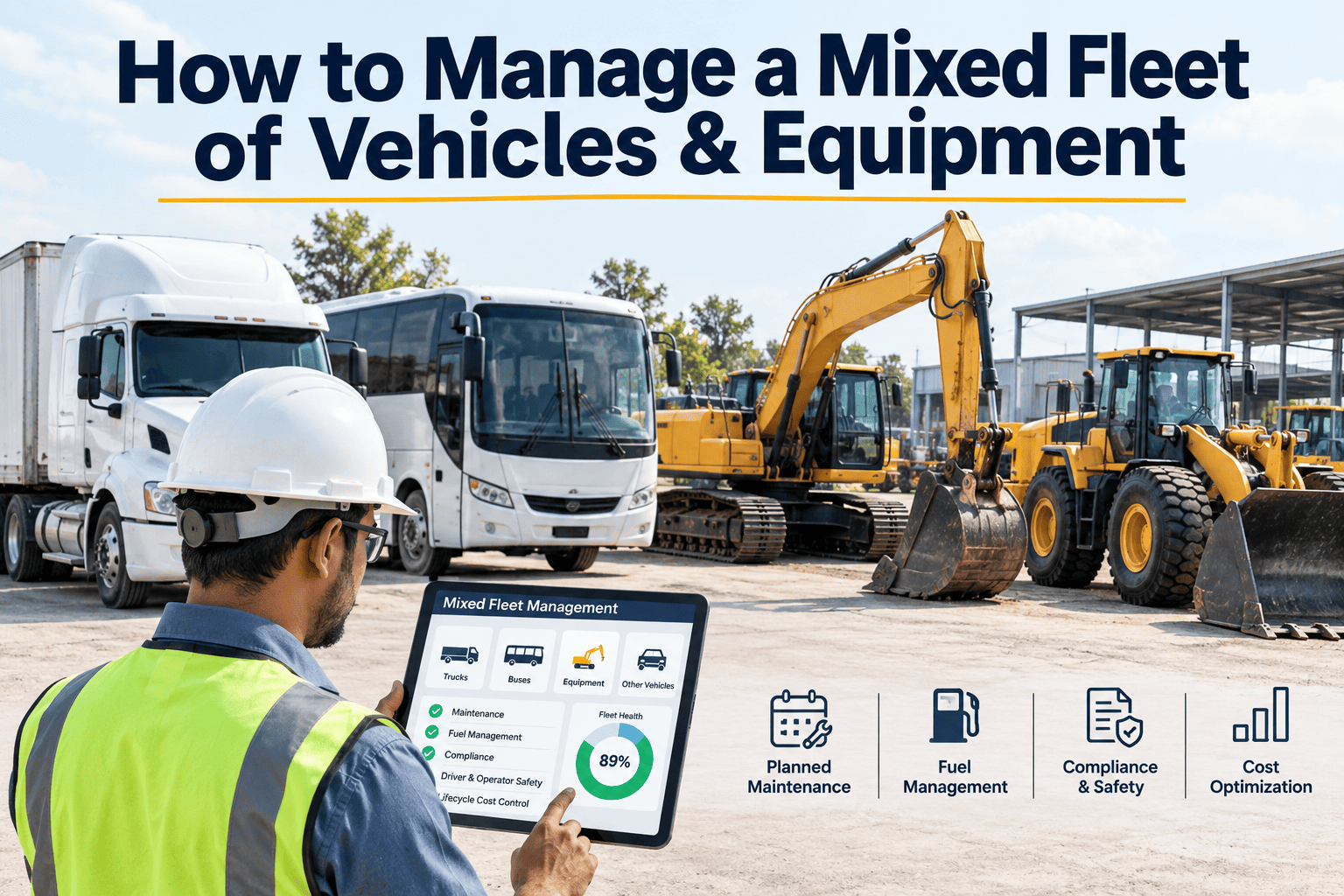
Running a mixed fleet — part electric, part hybrid, part conventional gasoline and diesel — is the operational reality for most American fleet operators in 2024 and for the foreseeable future. The challenge is not managing the EVs or managing the ICE vehicles. The challenge is managing them together: assigning the right vehicle to the right route based on range capability, scheduling maintenance that looks completely different for a battery pack vs a diesel engine, tracking fuel and energy costs in the same reporting system, and keeping a single maintenance team competent across three fundamentally different powertrain technologies. Fleets that try to solve this with separate spreadsheets for each powertrain type end up with three partial pictures and no complete one. OxMaint's unified mixed fleet dashboard manages EV, ICE, and hybrid vehicles on one platform — range-aware route assignment, powertrain-specific PM scheduling, and unified cost reporting — so the fleet manager always has the complete picture regardless of what's in the garage. Book a demo to see how fleets in transition manage both worlds.

One Dashboard. Every Powertrain. Zero Gaps.
EV · Hybrid · ICE — range-aware dispatch, powertrain PM, unified cost reporting in OxMaint
67%
Of US commercial fleets will be mixed EV/ICE by 2027 — unified management is not optional

Higher maintenance scheduling complexity for mixed fleets managed without a unified platform

22%
Cost increase from wrong vehicle-to-route assignment in mixed fleets — EV on long haul, diesel on short city routes

Three Powertrain Types — Three Completely Different Maintenance Programmes

The single biggest operational mistake in mixed fleet management is applying one PM template to all powertrains. An EV has no oil changes, no transmission fluid, and no exhaust system — but it has battery thermal management, regenerative brake inspection, and high-voltage system safety checks that do not exist on any ICE vehicle. OxMaint automatically applies the correct PM schedule to each vehicle based on powertrain type — no template confusion, no missed tasks.

PM Task
Battery EV
Hybrid
Diesel / Gas ICE
Engine oil & filter
Not required
Every 5,000–7,500 mi
Every 5,000–10,000 mi
Transmission fluid
Not required
Every 30,000–60,000 mi
Brake pad inspection
Annual (regen braking extends life)
Annual (partial regen)
Every 20,000–25,000 mi
Battery pack check
Every 12 months + SoH monitoring
Every 24 months
12V only — annual
HV cable inspection
Every 24 months — certified tech
Every 36 months
Not applicable
Thermal management
Monthly coolant level + annual flush
Annual
Every 50,000 mi
Exhaust & emissions
Not required
Annual inspection
DPF/SCR per OEM cycle
Annual state inspection
Safety only (no emissions)
Safety + OBD emissions check
Safety + full emissions test

Range-Aware Route Assignment: Getting the Right Vehicle on the Right Route

In a mixed fleet, assigning an EV to a 280-mile round-trip route when its range is 220 miles is not a range anxiety problem — it is a dispatch process failure. OxMaint's range-aware dispatch module cross-references each route's mileage and charging availability against each vehicle's current SoC and certified range before dispatch is confirmed — automatically flagging any assignment where range is insufficient and suggesting the appropriate ICE or hybrid alternative.

EV — Optimal Routes
Urban last-mile delivery (under 120 mi/day)
Fixed depot-to-depot shuttle with overnight charging
City distribution with predictable stop pattern
Airport and campus internal transfer routes
Lowest fuel + maintenance cost
Hybrid — Optimal Routes
Mixed urban/highway routes (100–250 mi/day)
Variable-length routes with unpredictable stops
Routes with limited en-route charging availability
Cold weather operations where EV range degrades
Best range flexibility
ICE — Optimal Routes
Long-haul interstate (300+ mi/day)
Remote areas with no charging infrastructure
Heavy payload applications needing max range
Emergency response requiring instant refuel
Maximum range reliability

Technology Stack for Mixed Fleet Management

Managing EV, hybrid, and ICE vehicles on one platform requires integrations that pull data from fundamentally different vehicle systems. OxMaint's mixed fleet architecture handles all three simultaneously — no separate logins, no data silos.

OBD / CAN Bus + BMS Integration
ICE vehicles report DTC fault codes via OBD-II; EVs report SoC, battery health, and thermal system status via CAN bus BMS interface. OxMaint receives both simultaneously — one dashboard showing ICE oil life alongside EV battery SoH without any manual data entry from drivers or technicians.
AI Digital Twin — Fleet Transition Modelling
AI models the optimal EV/hybrid/ICE ratio for your specific route portfolio — analysing actual route mileage distributions, seasonal range impacts, and charging infrastructure availability to calculate when adding the next EV reduces total fleet cost vs adding another ICE vehicle.
SAP Integration — Unified Cost Reporting
Diesel fuel costs, electricity costs, and maintenance costs for all three powertrain types post to SAP from a single OxMaint data source. Fleet managers see cost per mile by vehicle, by powertrain type, and by route — the comparison data that drives rational fleet transition decisions.
Unified Driver App — One Interface, All Vehicles
Drivers use the same OxMaint mobile app regardless of vehicle powertrain — DVIR pre-trip forms automatically adapt to the vehicle type assigned. EV drivers see SoC and nearest charger; ICE drivers see fuel level and nearest pump. No separate app training for different vehicle types.
22%
Cost reduction from correct vehicle-to-route assignment in mixed fleet
80%
Reduction in wrong-vehicle dispatch incidents with range-aware routing
95%
PM compliance across all powertrain types with auto-scheduled templates
40%
Faster fleet transition decisions with unified EV vs ICE cost-per-mile data
"We went from 40 EVs to 140 over 18 months while still running 210 diesel trucks. Trying to manage both with separate systems was a disaster. OxMaint gave us one dashboard — the EVs and the diesels on the same PM calendar, the same cost reporting, the same dispatch screen. Our maintenance manager said it was the first time in two years he felt like he knew what was going on."
— Director of Fleet Operations, National Parcel Delivery Company · Denver, Colorado · 350 vehicles
Frequently Asked Questions

Yes — OxMaint applies powertrain-specific PM templates automatically based on vehicle type. EVs receive battery, thermal management, and HV cable tasks; ICE vehicles receive oil change, exhaust, and fuel system tasks. One platform, no template confusion.
OxMaint's range-aware dispatch compares each vehicle's current SoC and certified range against the assigned route mileage before dispatch confirmation. If range is insufficient, the system flags the assignment and suggests an available ICE or hybrid alternative automatically.
Yes — OxMaint calculates cost per mile for each vehicle using fuel/energy cost, maintenance cost, and depreciation. Side-by-side EV vs ICE comparison by route type, season, and payload is available in the fleet analytics dashboard.
OxMaint PM work orders for HV systems include mandatory certification verification — only technicians with current HV certification logged in the system can be assigned EV high-voltage tasks. The platform enforces the safety requirement without separate workflow configuration.
OxMaint's AI models your route portfolio against EV range and charging availability, identifying which specific routes and vehicle classes are best suited for EV replacement. The transition plan output includes payback period per vehicle class based on actual cost data from your fleet.
Mixed Fleet Management — OxMaint
Every Powertrain. One Platform. Zero Gaps.
22%
cost reduction

95%
PM compliance

Free
to start today

Share This Story, Choose Your Platform!