In a study of 1,000 commercial fleet maintenance programs, one finding stood out: fleets running documented preventive maintenance checklists had 47% fewer unscheduled breakdowns than fleets with informal or verbal PM programs — even when both groups reported similar service frequency. The difference was not how often vehicles were serviced. It was whether the service was documented, consistent, and systematically tied to a specific list of items that each vehicle needed checked at each service interval. Preventive maintenance is only as effective as the checklist behind it. A technician who services the same vehicle every 5,000 miles but checks different items each time — based on what they remember or what the driver mentioned — is not running a preventive maintenance program. They are running a variable-depth inspection that misses different items each time and produces a service history too inconsistent to support CapEx decisions, warranty claims, or regulatory compliance. OxMaint's fleet PM checklist system standardizes every service across every vehicle, every technician, and every location — with digitally enforced completion, automatic next-service scheduling, and fleet-wide PM compliance visibility on a single dashboard. Sign up for OxMaint and deploy standardized preventive maintenance checklists across your entire fleet today.
Fleet Maintenance · Checklist · 2026
Preventive Maintenance Checklist for Fleets: Best Practices for Fleet Managers
A complete fleet preventive maintenance program requires four service-interval checklists — oil and fluid service, safety systems inspection, drivetrain and mechanical assessment, and compliance documentation review — each tied to specific mileage or calendar triggers and tracked for completion fleet-wide in real time.
47%
Fewer unscheduled breakdowns in fleets with documented preventive maintenance checklists vs. informal PM programs
4.8×
Higher cost for emergency repairs vs. the same work performed as scheduled preventive maintenance events
71%
Of maintenance professionals use preventive maintenance as their primary strategy — it is the industry baseline for any serious fleet program
20–40%
Maintenance cost reduction achievable by moving from reactive-dominant to PM-dominant fleet maintenance programs
The 4 Preventive Maintenance Intervals Every Fleet Needs
Fleet preventive maintenance is not one schedule — it is four service intervals, each with a specific scope, triggered at different mileage or calendar thresholds, and each essential to the others for a complete program. Running only one or two of these intervals generates systematic gaps that produce the failures a PM program is designed to prevent.
A-Service — Oil and Fluid Change
Every 5,000–10,000 miles (condition-based)
Engine oil and filter change, fluids checked and topped, visual safety check of lights and tires, consumption rates logged. Most frequent service interval. The data collected here — oil consumption rate, fluid top-up quantities, light function — feeds the condition monitoring that makes longer-interval services more effective.
Time: 45–60 min | Who: Technician
B-Service — Safety Systems Inspection
Every 15,000–25,000 miles or quarterly
Comprehensive brake inspection including pad thickness, rotor condition, and line integrity. Tire tread depth and pressure across all axles. Steering free play measurement. Belt and hose inspection. Battery load test. All lighting and safety equipment verification. Identifies items approaching or at failure threshold before they become DVIR-reportable defects.
Time: 90–120 min | Who: Senior Technician
C-Service — Drivetrain and Mechanical
Every 30,000–50,000 miles or semi-annually
Transmission fluid inspection and service, differential fluid check, U-joint inspection, driveshaft condition, wheel bearing assessment, suspension component inspection, air filter and fuel filter replacement, cooling system flush evaluation, spark plug or injector assessment per vehicle type. The deep mechanical service that prevents the mid-lifecycle failures that occur when drivetrain components pass beyond routine maintenance thresholds.
Time: 3–5 hours | Who: Senior Technician / Shop Lead
D-Service — Compliance and Lifecycle Audit
Annually or at major mileage milestones
Full condition scoring across all systems. PM schedule currency verification for all prior-year services. Regulatory documentation review: registration, permits, inspection certifications, ELD compliance. Warranty status check and service history completeness audit. CapEx evaluation: condition score vs. replacement threshold. This service generates the data that justifies fleet capital decisions to ownership groups and investors.
Time: 4–6 hours | Who: Maintenance Manager
The Complete A-Service Preventive Maintenance Checklist
The A-Service is the highest-frequency PM event — the foundation that supports all longer-interval services and the primary data collection opportunity for condition monitoring. Every item below should be completed, documented, and signed at every A-Service event, regardless of vehicle type or route profile.
Engine Oil and Filtration
Engine oil drained and measured — record quantity drained for consumption calculation
Oil filter replaced — note brand and part number on work order
Correct specification oil installed — grade and API category per asset registry specification
Oil fill quantity recorded — enables accurate consumption rate calculation at next service
Oil change interval updated — next service mileage logged in maintenance system
Consumption rate compared to baseline — flag if rate has increased by more than 30%
Consumption trend: document quarts-per-1,000-miles every service — anomaly detection requires historical baseline
Fluid Levels and Condition
Coolant level — reservoir and radiator cap (cold only). Note color and odor — amber or rust color indicates contamination
Coolant concentration — test freeze protection with refractometer at 15K-mi intervals
Power steering fluid — level and condition. Darkening indicates contamination or oxidation
Brake fluid — level only at A-service. Condition at B-service. Note level drop from last service
Windshield washer fluid — fill to full. Test spray pattern and wiper contact quality
DEF level (diesel vehicles) — fill as required. Test quality if vehicle shows SCR fault history
Fluid consumption trends across services identify developing leaks and system degradation before symptoms appear
Tires — Visual and Pressure
All tire pressures — checked cold and adjusted to placard spec. Record readings per axle
Tread depth — visual check for uneven wear patterns indicating alignment or suspension issues
Sidewall condition — no cuts, bulges, or object penetration visible
Valve stem caps — present and undamaged on all positions
Dual tire spacing — no contact between duals at any point in rotation
Tread wear indicator check — flag any tire within 2/32" of minimum for priority replacement planning
Uneven wear patterns are the first indicator of alignment or suspension issues — catch at A-service, address at B-service
Lighting and Electrical — Visual
Headlights — both low and high beam functional
Tail lights and brake lights — function confirmed by second observer or mirror check
Turn signals — both sides, front and rear, 60–120 flashes per minute
Marker and clearance lights (commercial vehicles) — all required positions functional
Dashboard warning lights — no active warning lamps illuminated after warm-up
Horn function — audible from 50 feet, activates on first press
Lighting defects found at A-service generate same-day repair work orders — preventing DVIR violations and roadside citations
B-Service Safety Systems Checklist — 8 Critical Inspection Categories
The B-Service is where most preventable breakdowns are caught — it goes deeper than the A-Service visual check into the mechanical condition of safety-critical systems that degrade gradually between services and require more than a visual inspection to assess accurately.
B1
Brake System — Full Inspection
Pad thickness measured per axle — document mm remaining against new pad thickness. Rotor surface condition — no scoring deeper than 0.060". Brake lines and hoses — no cracking, chafing, or moisture. Brake hardware — hardware replaced at pad change. Air brake systems: push rod travel measured, slack adjusters verified within spec. Brake performance test: deceleration rate recorded at 30 MPH on test surface.
B2
Steering and Suspension
Steering free play — measured with wheels straight ahead, recorded in inches. Tire rod ends, ball joints, and pitman arm — checked for play with pry bar. Shock absorbers — bounce test and visible leak check. Spring condition — no cracked leaves, no missing U-bolts. Wheel alignment check — compare to last recorded alignment. Flag if vehicle shows abnormal front tire wear pattern at A-service.
B3
Battery and Electrical System
Battery load test — record cranking voltage at load and compare to previous test. Alternator output — should be 13.5–14.5V at 2,000 RPM. Battery terminals — clean, no corrosion, tight connections. Battery age and installation date — flag batteries past 36 months for monitoring. ELD and telematics power supply — verify no voltage drop issues affecting data transmission.
B4
Belts and Hoses
Serpentine/accessory drive belt — checked for cracking, glazing, missing ribs. Timing belt/chain — checked per OEM service interval (usually 60,000–100,000 miles). Cooling system hoses — squeeze test for sponginess or hardness. Power steering hoses — no leaks at connections or hose body. Heater hoses — condition and clamp security. Flag any belt showing wear indicator depth or hose showing surface cracking.
B5
Cooling System Assessment
Coolant concentration — freeze protection tested with refractometer: -34°F minimum for most climates. Radiator and condenser — checked for debris blockage affecting airflow. Coolant hose integrity — all connections secure, no seeping at clamps. Overflow reservoir — fill level and condition. Pressure cap — tested at rated pressure with cap tester. Thermostat function — monitored through normal warm-up cycle for normal opening temperature.
B6
Exhaust and Emissions
Exhaust system — visual inspection for cracks, loose connections, or unusual odors. DPF status (diesel) — regeneration frequency reviewed. Abnormal regen frequency indicates DPF loading issue requiring attention. SCR system (diesel) — DEF quality and SCR catalyst condition. Oxygen sensor function — reviewed through diagnostic scan for pending codes. Emissions control components — function confirmed, no active emissions faults.
B7
Cab and Safety Equipment
Seat belt function and webbing condition — no fraying, retractor operation confirmed. Fire extinguisher — charge level, inspection tag current, accessible without tools. Emergency triangles — present and undamaged, 3 required for commercial. Windshield — no cracks in driver's critical vision area. Mirror alignment and condition — no cracks, secure mounting. HVAC system — heating and defrost function confirmed for winter operations.
B8
Undercarriage and Frame
Frame inspection — no visible cracks, no abnormal corrosion or impact damage. Cross-member condition — secure attachment, no cracking at weld points. Fuel tank mounting — straps secure, no chafing against frame. Exhaust mounting — hangers secure, no contact with heat-sensitive components. Underbody corrosion — document and photograph new corrosion areas for severity monitoring over time.
How OxMaint Enforces PM Checklist Completion Across the Fleet
Preventive maintenance checklists generate value only when they are completed consistently, documented accurately, and connected to the maintenance workflows that address what the checklist finds. OxMaint's PM system enforces all three requirements from a single platform.
Standardized PM Templates Per Vehicle Type
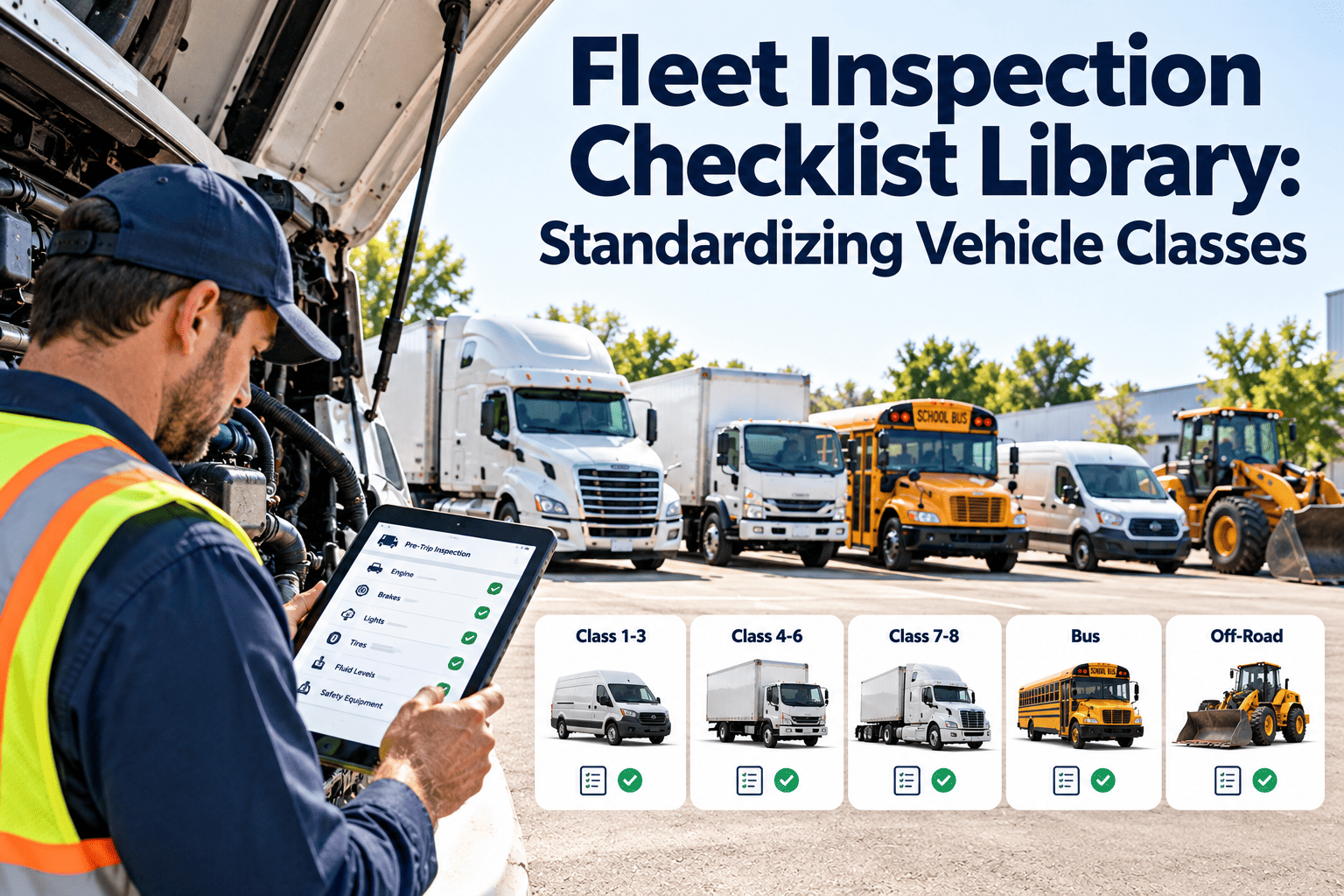
OxMaint stores separate A, B, C, and D service templates per vehicle type in the PM schedule — each with the specific items, acceptance criteria, and required input format for that vehicle class. A heavy-duty tractor A-service template differs from a light commercial van A-service template. When a PM work order is generated, the correct template is automatically assigned based on vehicle type stored in the asset registry. Every technician sees the same checklist items regardless of location or shift.
Multi-Trigger PM Scheduling
OxMaint generates PM work orders from any combination of three trigger types simultaneously: mileage (5,000-mile A-service), calendar (quarterly B-service), and engine hours (used for equipment with inconsistent mileage per day). When the first trigger is reached, the work order is generated — ensuring the most time or usage-sensitive trigger is never missed because the other trigger type has not yet been reached.
Mandatory Completion Enforcement
OxMaint's mobile work order app does not allow a PM work order to be closed with incomplete checklist items. Every item requires a pass, measurement, or defect notation before the technician can submit completion. If a defect is noted, a secondary work order is automatically generated for the repair — preventing the PM closure from creating a false "all clear" when a defect was actually found during the service.
PM Compliance Dashboard
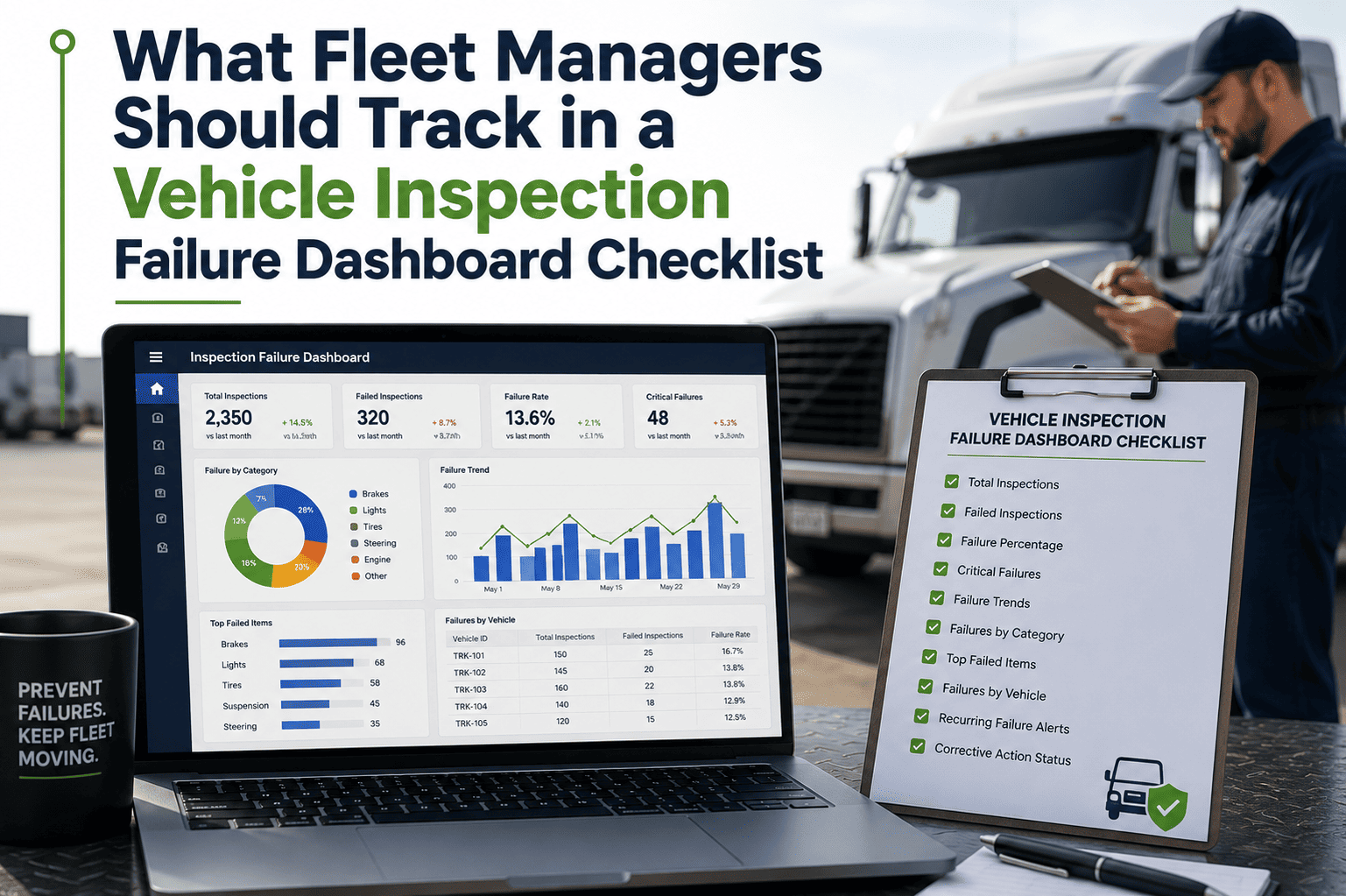
Fleet managers see real-time PM compliance rate — vehicles current on all PM intervals, vehicles within 500 miles of the next A-service trigger, vehicles overdue on any PM interval, and the overall fleet PM compliance percentage. DVIR completion and PM compliance are tracked as separate KPIs but visible on the same dashboard — giving managers a complete picture of both daily inspection compliance and scheduled maintenance currency simultaneously.
Defect-to-Repair Workflow Automation
Any item marked as defective during a PM checklist automatically creates a prioritized repair work order — before the PM work order is closed. The defect work order includes the item description, technician notation, and any measurements recorded during the PM service. If the defect is safety-critical, the vehicle's availability status updates automatically on the dispatcher dashboard until the repair work order is closed as completed.
Historical PM Record Per Vehicle
Every completed PM work order — including every checked item, every measurement, every defect noted, and every repair certification — is stored in the vehicle's permanent asset record in OxMaint. Warranty claims, insurance investigations, and CapEx evaluations that require complete PM service history are satisfied in under 60 seconds. The service history that paper-based systems fail to produce at critical moments is available immediately from any authorized device.
Standardize PM Checklists Across Every Vehicle, Every Technician, Every Location — Free to Start
OxMaint's fleet PM checklist system enforces standardized A, B, C, and D service templates per vehicle type — with digitally mandatory completion, automatic defect-to-work-order generation, multi-trigger scheduling, and fleet-wide PM compliance dashboard. Free to start. Deploys in days.
Informal PM Program vs. OxMaint Standardized PM Checklist System
47%
Fewer unscheduled breakdowns in fleets with documented PM checklist programs
Consistent, complete checklists catch the developing failures that variable-depth services miss — converting breakdowns to planned repair events at 4.8× lower cost
20–40%
Maintenance cost reduction from PM-dominant vs. reactive-dominant maintenance programs
Every percentage point shift from emergency to planned maintenance generates 4.8× cost improvement — systematic PM checklists drive this shift at fleet scale
$3K–$12K
Warranty claim value recoverable with complete PM service documentation
OEM warranty claims for engine, drivetrain, and turbocharger failures require documented PM history — OxMaint's complete records satisfy this requirement
1 wk
Typical time to deploy OxMaint PM checklists across a fleet of any size
Cloud-native deployment — vehicle registry setup, template configuration, and technician mobile app ready in days, not months
Frequently Asked Questions
What is the difference between a preventive maintenance checklist and a daily vehicle inspection — and does a fleet need both?
A daily vehicle inspection (DVIR) and a preventive maintenance checklist serve different purposes and cannot substitute for each other. The daily DVIR is completed by the driver before and after each operating day — covering safety-critical items that can change between service events: lighting, tire pressure, brake feel, steering, coupling devices, and emergency equipment. It is a compliance document under 49 CFR 396.11 for commercial vehicles and a safety gate for every day of operation. A preventive maintenance checklist is completed by a technician at specific service intervals — covering the deeper mechanical assessment that driver visual inspection cannot perform: brake pad thickness measurement, battery load testing, belt condition, fluid quality analysis, alignment indicators, and consumption rate tracking. The DVIR confirms the vehicle is safe to operate today. The PM checklist documents the mechanical work that keeps it safe to operate over the next 5,000–50,000 miles. A complete fleet safety program requires both — the daily DVIR for operational safety compliance and the PM checklist for systematic mechanical health management. OxMaint manages both in the same platform — DVIR completion tracked in real time, PM checklists enforced at every service interval, defects from both automatically routed to maintenance work orders.
Sign up free to deploy both systems from a single platform.
How should PM checklist intervals be set — and should different vehicle types have different schedules?
PM checklist intervals should be set per vehicle type based on four factors: manufacturer recommendations (the baseline for all interval setting), actual operating conditions (severe service vehicles — heavy towing, extreme temperatures, urban stop-and-go — warrant tighter intervals than the manufacturer's standard recommendation), historical failure patterns (OxMaint's work order history identifies which systems most commonly generate defects in your specific fleet on your specific routes), and regulatory requirements (DOT and FMCSA requirements establish minimum inspection frequencies for commercial vehicles). For most commercial fleets, a practical starting point is: A-service at 5,000–7,500 miles for severe-duty vehicles and 7,500–10,000 miles for standard-duty vehicles; B-service at 15,000–25,000 miles; C-service at 30,000–50,000 miles; D-service annually. Different vehicle types absolutely need different PM schedules in OxMaint — a heavy-duty tractor running 100,000 miles annually in hot climates has fundamentally different service requirements than a light commercial delivery van. OxMaint's PM system allows unlimited separate schedule templates per vehicle type, each with independent mileage, calendar, and engine-hour triggers. Setting incorrect intervals — either too frequent (wasting labor and parts on unnecessary service) or too infrequent (allowing developing failures to progress to breakdown) — is one of the most costly PM program errors. OxMaint's work order history and AI condition monitoring provide the fleet-specific data needed to optimize intervals over time.
Book a demo to see OxMaint's PM interval configuration for your fleet's vehicle mix.
How does OxMaint track PM completion and compliance across a multi-site fleet — and what does the fleet manager see?
OxMaint's PM compliance dashboard gives fleet managers three levels of visibility into preventive maintenance status across all sites simultaneously. At the portfolio level, managers see the fleet-wide PM compliance percentage — vehicles current on all PM intervals divided by total fleet size, updated continuously as PM work orders are generated and closed. This is the KPI that reflects whether the PM program is running on schedule or accumulating overdue service events across the operation. At the site level, the same metric is calculated per location — surfacing which depots or terminals are running below PM compliance targets and need management attention. Drill-down to the vehicle level shows exactly which service intervals are current, which are approaching, and which are overdue for each vehicle — with the next service mileage or date, the current odometer reading, and the gap between current and trigger visible at a glance. For multi-site fleets where vehicles move between locations and may be serviced at different depots, OxMaint's central asset registry ensures the PM schedule is tied to the vehicle, not the location — a vehicle that receives its A-service at a remote depot has that service recorded in its central OxMaint record, and the next service trigger is updated fleet-wide regardless of where the service was performed. Managers receive automated alerts when any vehicle crosses its PM due threshold — before the overdue status affects compliance metrics or creates regulatory exposure.
Sign up free to configure your fleet's PM compliance dashboard.
How does completing PM checklists in OxMaint support warranty claims and CapEx decisions?
The financial value of complete PM documentation operates through two distinct channels beyond operational maintenance quality. For warranty claims: OEM warranty coverage for major components — engines, transmissions, turbochargers, and drivetrain components — typically requires evidence of specification-compliant, interval-current maintenance history to be honored. Warranty claims denied for insufficient documentation represent $3,000–$12,000 per denied claim, and the denials most commonly happen to fleets that performed the maintenance but cannot prove it. OxMaint's PM checklist records include the service date, vehicle mileage, oil specification applied, technician attribution, and all items completed — providing the documentation evidence that warranty administrators require. A vehicle serviced in OxMaint has an instantly retrievable, complete service history from its first PM event onward. For CapEx decisions: vehicle replacement planning based on mileage alone produces systematic errors — retiring vehicles with strong remaining mechanical health and keeping vehicles whose documented service history shows accumulating multi-system degradation. OxMaint's quarterly D-service condition scoring — built from four years of A, B, and C service records, defect history, and consumption trends — converts fleet replacement from a mileage guessing exercise to an engineering-data-supported capital decision. Fleet managers can show ownership groups and investors a condition score ranking per vehicle with the service history that justifies each score — the investor-grade documentation that mileage-based replacement programs cannot produce.
Book a demo to see OxMaint's PM documentation output for warranty and CapEx support.
A PM Checklist Is Only Effective If It Is Completed the Same Way Every Time. OxMaint Guarantees That.
OxMaint's fleet preventive maintenance checklist system enforces standardized A, B, C, and D service templates per vehicle type, requires complete item-by-item documentation on every service, automatically generates repair work orders from any defect found during PM, and builds the complete service history that protects warranty claims and supports CapEx decisions. Free to start. Deploys in one week. Join 1,000+ fleets running systematic PM programs with OxMaint.