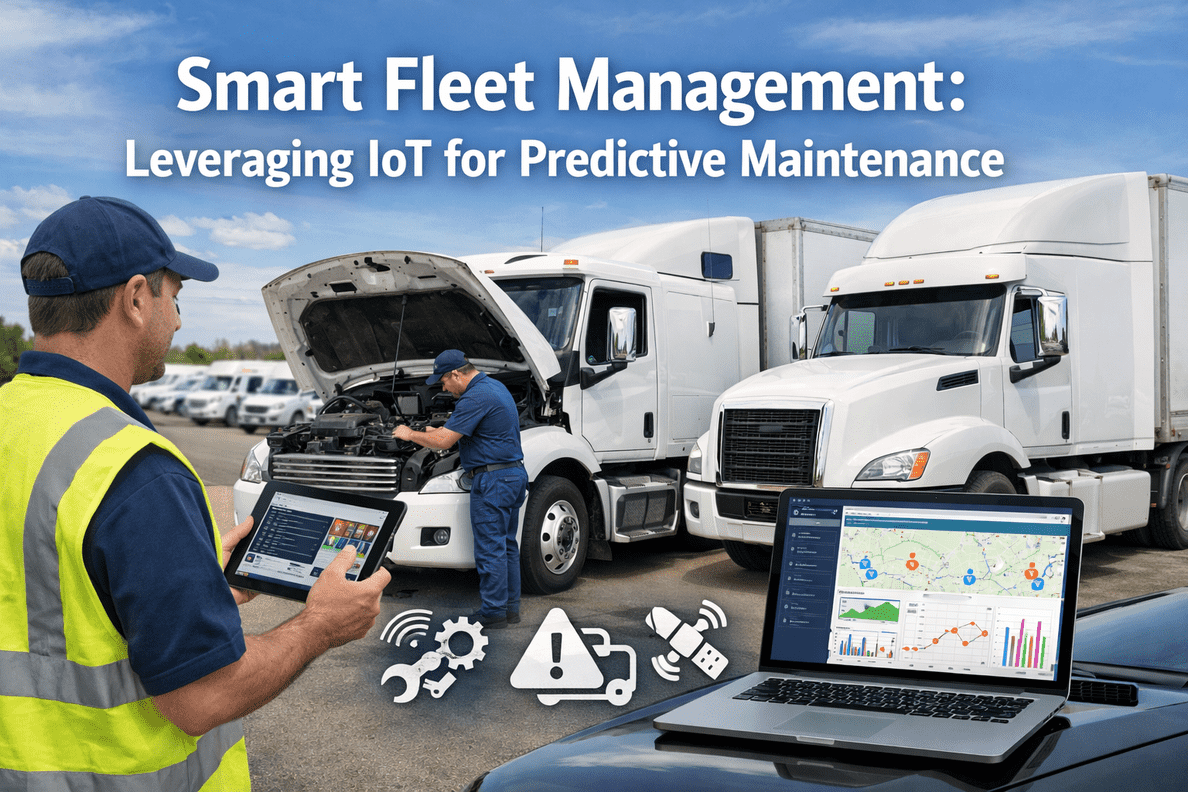
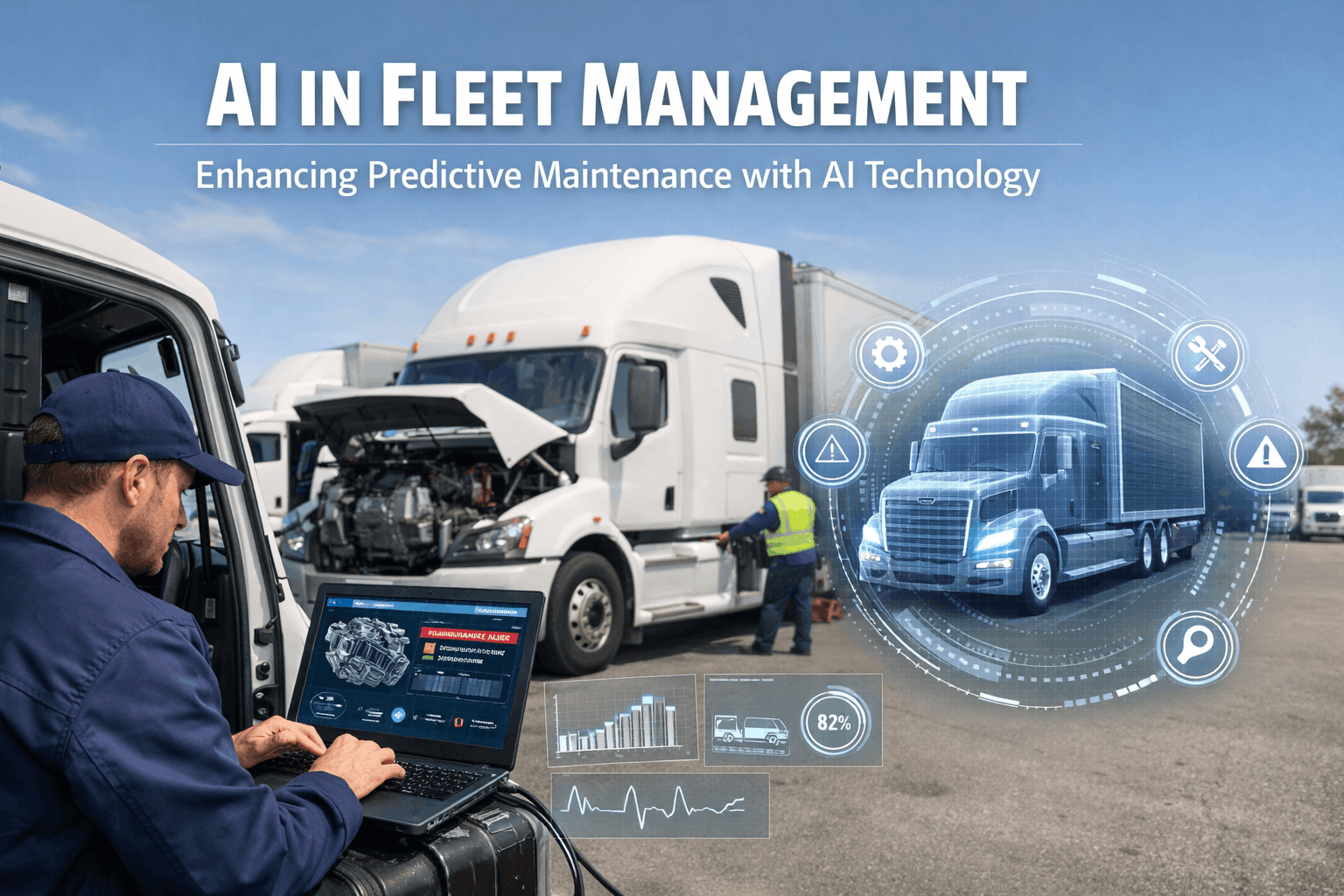
Every commercial vehicle in your fleet is generating hundreds of data points every hour — engine temperature, oil pressure, brake wear, fuel consumption, battery voltage, DPF soot load, and transmission stress patterns. Most fleets collect none of it. They maintain vehicles on fixed mileage intervals that over-service some assets and miss the failures that develop between service windows — which is exactly where the most expensive breakdowns occur. The global IoT fleet management market reached $14.5 billion in 2024 and is projected to exceed $52.8 billion by 2032, growing at 17.5% CAGR. That growth is being driven by fleet operators who have discovered that connecting vehicle sensors to a CMMS that acts on the data automatically is not aspirational technology — it is the most direct path to eliminating the unplanned downtime, emergency repair premiums, and CapEx surprises that erode fleet profitability year after year. IoT-based predictive maintenance replaces interval guesswork with continuous data streams and pattern recognition that detects developing failures 2–8 weeks before they cause a breakdown. This guide covers how it works, which sensor categories deliver the highest ROI, and how OxMaint turns IoT data into automated maintenance workflows your team can act on without adding headcount. Ready to start? Sign up for OxMaint free and connect your fleet's IoT data today.
$52.8B
Global IoT Fleet Management Market by 2032 — 17.5% CAGR
45%
Reduction in unplanned downtime events — documented in year one of IoT deployment
$2,000
Average savings per vehicle per year from IoT-driven predictive maintenance
8 Weeks
Average lead time IoT sensors provide before a critical failure — from pattern detection to alert
Connect Your Fleet's IoT Data to a CMMS That Acts On It Automatically.
OxMaint integrates with GPS telematics, OBD-II sensors, OEM vehicle APIs, and SCADA systems — pulling real-time vehicle data into automated work orders, condition-based scheduling, and fleet intelligence dashboards. No hardware lock-in. Deploys in days. Free to start.
What IoT Predictive Maintenance Actually Means for a Fleet
IoT predictive maintenance is the practice of connecting physical vehicle sensors to a software platform that continuously analyzes incoming data, detects anomalous patterns indicating developing component stress, and triggers maintenance actions before failure occurs. It operates continuously and automatically — no manual data collection, no scheduled inspection window required to catch a developing fault. Here is how it differs from every maintenance approach your fleet has used before.
Reactive Maintenance
Fix it after it breaks. Emergency repair costs run 4–8x planned maintenance rates. Average roadside breakdown generates $1,500–$3,000 in direct costs plus towing, driver downtime, lost revenue, and customer impact.
Preventive (Interval) Maintenance
Fix it on schedule. Replaces parts that still have 20–30% of their service life remaining on average. Misses failures that develop between service windows — exactly where most catastrophic failures occur.
IoT Predictive Maintenance
Fix it when sensors say to — before failure, while it is still a planned repair. Continuous monitoring detects developing patterns 2–8 weeks before failure. Work orders created automatically. No interval waste. No unexpected breakdowns.
OxMaint IoT Platform
Connects any telematics hardware or OEM factory data to a CMMS that auto-creates work orders from sensor alerts, tracks parts, forecasts CapEx, and builds the repair history that makes future predictions more accurate automatically.
8 IoT Sensor Categories That Deliver the Highest Fleet Maintenance ROI
Not all IoT sensors deliver equal value. These eight categories generate the data responsible for catching over 80% of the most expensive and most common commercial fleet failure types — covering the components that account for the overwhelming majority of unplanned breakdown events.
01
Engine Diagnostics — OBD-II and CAN Bus
Real-time monitoring of oil pressure, coolant temperature, fuel rail pressure, cylinder misfire counts, and 200+ additional engine parameters. Engine issues account for 22% of all commercial fleet breakdowns — almost entirely detectable 4–8 weeks early through cross-parameter anomaly patterns.
22% of fleet breakdowns — detectable 4–8 weeks early
02
Battery and Electrical System Monitoring
Cold cranking amps, alternator output voltage, parasitic drain patterns, and charge cycle efficiency measured continuously. Battery failures cause 38% of commercial vehicle roadside breakdowns. IoT monitoring predicts end-of-life 30–60 days before failure — eliminating the most common dispatch disruption in any fleet.
38% of roadside breakdowns — 30–60 day advance warning
03
Tire Pressure and Temperature — TPMS
Per-wheel pressure and temperature tracking in real time. 10 PSI underinflation increases fuel consumption by 3% and accelerates tread wear by 15%. TPMS alerts catch underinflation events that paper inspections miss and flag thermal anomalies indicating adjacent bearing issues.
3% fuel savings per vehicle from optimal tire inflation alone
04
Transmission and Drivetrain Telemetry
Shift hesitation timing, torque converter lockup patterns, fluid temperature, and driveshaft vibration frequency analysis. Transmission failures average $3,500–$8,000 per event. IoT telemetry detects early mechanical stress signatures 3–6 weeks before symptoms become driver-perceptible.
Converts $8,000 transmission failures into $900 fluid services
05
Brake System Sensors
Brake pad thickness sensors, pressure response time monitoring, and rotor temperature telemetry. Wear rates vary significantly by route, load, and driver behavior — making fixed-interval brake service both over- and under-serving different vehicles simultaneously. Sensor data enables per-vehicle scheduling based on actual wear.
Per-vehicle brake scheduling replaces mileage-interval guesswork
06
DPF and Emissions System Monitoring
Diesel Particulate Filter soot load, SCR catalyst efficiency, and EGR valve deposit accumulation measured continuously. DPF failures average $3,000–$6,000 per replacement and are almost entirely preventable with monitoring and scheduled regeneration cycles. High-value for urban stop-start delivery routes.
$3K–$6K DPF failures — almost entirely preventable
07
GPS and Telematics Integration
Location, speed, idle time, harsh braking, acceleration patterns, and route data combined with vehicle sensor streams. High idle-time vehicles accumulate engine hours faster than mileage reflects — meaning mileage-based service intervals systematically under-maintain the highest-wear vehicles in a mixed fleet.
Idle time data corrects the mileage-interval maintenance blind spot
08
Refrigeration and Auxiliary System Sensors
For temperature-controlled vehicles: refrigeration unit temperature, compressor pressure, door events, and APU performance. Refrigeration failures in cold chain vehicles generate cargo loss averaging $25,000–$150,000 per event. IoT monitoring converts this catastrophic tail risk into a manageable scheduled maintenance item.
$25K–$150K cargo loss risk converted to a scheduled repair
How OxMaint Converts IoT Sensor Data Into Automated Maintenance Workflows
Collecting IoT data without a CMMS that acts on it automatically is a dashboard exercise, not a maintenance program. OxMaint connects vehicle sensor streams to a maintenance platform that processes incoming data, applies configurable thresholds, and creates work orders without requiring your maintenance manager to monitor sensor feeds manually.
01
IoT Data Ingestion — Any Source, Any Hardware
OxMaint connects to GPS and telematics hardware from any provider — Geotab, Samsara, Verizon Connect, Zubie, Webfleet, and OBD-II devices from all major manufacturers. For 2015+ commercial vehicles with factory-embedded telematics, OxMaint connects directly to OEM cloud APIs from Ford, Ram, Freightliner, Peterbilt, Kenworth, Volvo, and Daimler — pulling factory sensor data without additional hardware. All streams flow into a single OxMaint dashboard with no hardware vendor lock-in.
GPS telematicsOBD-II sensorsOEM cloud APIsSCADA integration
02
Threshold Configuration and Anomaly Detection
Maintenance managers configure alert thresholds per vehicle make and model — oil pressure floors, coolant temperature ceilings, DPF soot load percentages, battery CCA minimums — either manually or by importing OEM service specifications directly. OxMaint's anomaly detection monitors incoming readings against these thresholds continuously, detecting developing trend patterns the cross-parameter correlation signatures that indicate component stress weeks before any single value individually breaches its threshold.
Configurable thresholdsCross-parameter correlationOEM spec import
03
Automated Work Order Creation
When an IoT alert crosses a configured action threshold, OxMaint automatically creates a work order pre-populated with the vehicle's service history, the specific sensor finding, parts recommendations based on historical repair records for that make and model, and the technician assignment configured for that vehicle type. The work order appears in the maintenance queue before the manager has seen the alert — eliminating the manual step from IoT alert to maintenance action.
Auto work order creationParts pre-populatedTechnician auto-assigned
04
Mobile Execution and Closed-Loop Feedback
Technicians receive work orders on the OxMaint mobile app — with IoT alert data, vehicle service history, and parts requirements visible before approaching the vehicle. They complete the inspection, log parts used, capture photos of the finding, and close the work order from mobile. The sensor data that triggered the alert and the repair that resolved it are linked in the vehicle record — building the closed-loop maintenance history that makes future alerts more accurate automatically.
Mobile executionPhoto documentationParts trackingClosed-loop learning
Fleet Maintenance: Before and After OxMaint IoT Integration
The operational gap between a reactive fleet and an IoT-connected fleet managed through OxMaint is measurable across every major maintenance KPI. The following comparison reflects documented outcomes across commercial fleet deployments on the OxMaint platform.
| Fleet Maintenance KPI |
Without IoT — Reactive / Preventive |
With IoT + OxMaint |
Improvement |
| Unplanned Downtime Events |
80+ events/year per 250-vehicle fleet — no advance warning |
44 events/year — failures caught before breakdown |
45% reduction |
| Emergency Repair Rate |
30+ emergency repairs/month at 4–8x planned shop rates |
Under 12/month — planned rate applies |
60% fewer emergency repairs |
| Fleet Uptime Rate |
92% — 8% of vehicles unavailable daily on average |
97% — 5 percentage points more vehicles available |
+5 pp uptime improvement |
| Annual Maintenance Cost |
$3M annually — no predictability or trend visibility |
$1.8M annually — 30% cost reduction documented |
$1.2M saved annually |
| Maintenance Scheduling |
Fixed mileage/time intervals — ignores actual vehicle condition |
Condition-based — service triggered by sensor data |
20–30% fewer over-services |
| Work Order Generation |
Manual — manager monitors reports, creates WOs individually |
Automated — IoT alert triggers WO without manual step |
Zero manual monitoring required |
| CapEx Planning |
Annual guesswork — no vehicle-level condition data to support it |
Rolling 5-year forecast per vehicle — condition-based |
Data-driven replacement timing |
| First-Year ROI |
No ROI measurement possible without baseline data |
220%+ documented — first prevented breakdown often covers months of cost |
Payback in 6–12 months |
45%
Unplanned downtime reduction in year one
30%
Lower total maintenance cost versus reactive baseline
$2,000
Average savings per vehicle per year
220%+
First-year ROI documented across OxMaint deployments
OxMaint IoT Fleet Management — Key Features
OxMaint is not a standalone tracking tool. It is the operational data layer that connects every aspect of fleet maintenance — from vehicle sensor streams to work orders to CapEx forecasting — into a single platform your maintenance team can manage from any device.
Hardware-Agnostic Integration
Connect telematics data from any provider. OxMaint does not sell proprietary hardware or lock you into specific devices. Existing GPS trackers, OBD-II dongles, and OEM telematics all integrate through open APIs without hardware replacement.
Automated Work Order Creation
IoT alerts trigger work orders automatically — pre-populated with vehicle history, sensor findings, parts recommendations, and technician assignment. No manual monitoring step between sensor data and maintenance action.
Condition-Based PM Scheduling
Replace mileage and calendar intervals with sensor-driven scheduling. Each vehicle receives maintenance when its actual condition data indicates it is needed — eliminating over-service waste and under-service gaps simultaneously.
Mobile-First for Technicians
Technicians scan QR codes, update work orders, log parts, capture photos, and close inspections from any smartphone. No desktop terminals. No paper forms. Every action is real-time in the fleet record.
Rolling CapEx Forecasting
OxMaint aggregates IoT data, work order history, and repair costs to generate 5-year vehicle replacement forecasting models based on actual condition scores — replacing annual budget guesswork with data-driven CapEx planning.
Multi-Site Fleet Management
Manage all depot locations under a single dashboard with site-specific configurations. IoT alerts route to the maintenance team at the vehicle's home depot automatically. Cross-site performance benchmarking included out of the box.
Your Fleet Vehicles Are Already Generating the Data. OxMaint Makes It Actionable.
Connect your existing telematics and vehicle sensors to OxMaint's CMMS — and replace manual monitoring, reactive repairs, and mileage-interval guesswork with automated work orders, condition-based scheduling, and IoT-driven fleet intelligence that delivers measurable ROI within the first quarter. No IT project. Deploys in days.
Frequently Asked Questions — IoT Fleet Management and Predictive Maintenance
Common questions from fleet managers and operations directors evaluating IoT predictive maintenance. Sign up free or book a demo to see OxMaint with your fleet's actual data.
Do we need to install new hardware on all vehicles to use IoT predictive maintenance with OxMaint?
For most modern commercial fleets, additional hardware installation is minimal or unnecessary. Vehicles manufactured from approximately 2015 onward are factory-equipped with telematics hardware broadcasting hundreds of CAN bus parameters via OEM cloud APIs. OxMaint connects directly to factory telematics from Ford, Ram, Freightliner, Peterbilt, Kenworth, Volvo, and Daimler without additional device installation. For older vehicles, OxMaint supports aftermarket OBD-II dongles (typically $50–$150 per unit) that plug into the standard diagnostic port. If your fleet already has third-party telematics from Geotab, Samsara, Verizon Connect, or Webfleet, OxMaint ingests that data directly — no hardware changes required. Most deployments are a mix of OEM factory telematics, existing third-party hardware, and a small number of OBD-II units for older vehicles — all feeding one OxMaint dashboard with no hardware vendor lock-in.
Sign up free to assess your fleet's hardware requirements, or
book a demo for a hardware-to-platform mapping review.
How quickly does IoT predictive maintenance start catching real failures — and what accuracy rate should we expect?
OxMaint's IoT predictive maintenance begins generating actionable alerts from the first days of connected data collection using a pre-trained foundational model built on industry-wide fleet maintenance data. Initial predictions in the first 2–4 weeks achieve 85%+ accuracy using this model, with accuracy increasing as OxMaint learns your fleet's specific vehicle profiles, route patterns, load characteristics, and driver behavior. Most fleets reach 90%+ prediction accuracy within 60–90 days as fleet-specific training data accumulates. Each confirmed repair feeds back into the model, improving accuracy for that vehicle and for similar vehicles across your fleet. Fleets running OxMaint IoT maintenance for 12+ months typically achieve 93–97% prediction accuracy. In most fleet deployments, the first prevented breakdown — saving $1,500–$3,000 in direct costs plus lost revenue — covers several months of platform subscription cost.
Book a demo to see a live accuracy dashboard, or
sign up free to start your fleet's baseline data collection.
What ROI should we realistically expect from IoT predictive maintenance in the first year?
Documented first-year ROI from IoT predictive maintenance fleet deployments ranges from 220% to 650%, driven by fleet size and the proportion previously running in reactive maintenance mode. The five independently measurable ROI components are: reduced emergency repair costs (4–8x rate differential on shifted repairs), eliminated roadside breakdowns ($1,500–$3,000 direct cost plus lost revenue per event avoided), extended vehicle service life (consistent condition-based maintenance documented to extend average vehicle lifespan by 18%), recovered technician productivity (planned work achieves 25–30% higher throughput than emergency repairs on the same labor hours), and reduced compliance overhead. For a 250-vehicle fleet, documented outcomes include 45% reduction in unplanned downtime events, 30% lower total maintenance cost ($1.2M annual saving from a $3M baseline), and 5 percentage point improvement in fleet uptime. Platform cost for a fleet of this size typically represents 10–15% of documented annual savings — a 6–10x return on platform investment.
Sign up free to start your deployment, or
book a demo for a custom ROI estimate using your fleet's current maintenance cost data.
How does OxMaint handle IoT predictive maintenance for electric vehicles and mixed ICE/EV fleets?
OxMaint manages mixed ICE/EV fleets from a single dashboard, with EV-specific IoT monitoring parameters configured alongside traditional vehicle sensor streams. For electric vehicles, OxMaint monitors battery state-of-health (SoH), charging cycle efficiency, thermal management system performance, regenerative braking health, motor winding temperature, and high-voltage insulation resistance. EV battery pack replacement averages $8,000–$20,000 per vehicle — OxMaint's IoT monitoring detects the charging pattern anomalies and thermal management deviations indicating accelerated degradation weeks before they appear in range performance, enabling corrective action that extends battery service life by 20–35% in documented deployments. For fleets transitioning from ICE to EV, OxMaint provides a unified maintenance platform where both vehicle types receive condition-based scheduling from the same system — eliminating the need for separate EV maintenance tools that cannot share data with your existing fleet CMMS.
Book a demo to see OxMaint's EV and mixed-fleet interface, or
sign up free to connect your first vehicles today.
Can OxMaint manage IoT predictive maintenance across a multi-site fleet with vehicles operating from different depot locations?
OxMaint is built as a multi-site platform from its core architecture. A single deployment covers all depot locations under a unified fleet health dashboard, with site-specific maintenance team assignments, work order routing, and compliance documentation per location. IoT alerts from field vehicles route to the maintenance team at the vehicle's home depot automatically, with escalation rules per alert severity. Vehicles operating away from their home depot on extended routes can be assigned to temporary maintenance locations for work order routing — keeping the maintenance action close to the vehicle's current position. The cross-site reporting layer enables fleet managers to benchmark maintenance performance between depot locations — identifying sites with the highest emergency repair rates, lowest PM completion rates, and most IoT alerts per vehicle — and deploying successful practices from high-performing sites across the portfolio.
Sign up free to configure your multi-site fleet, or
book a demo to see multi-site IoT fleet management with real data.
How does IoT predictive maintenance connect to DOT compliance and FMCSA documentation in OxMaint?
IoT predictive maintenance and DOT/FMCSA compliance reinforce each other directly in OxMaint. When an IoT alert identifies a developing brake system issue or DPF problem, the auto-generated work order links to the vehicle's compliance record — ensuring repair, parts documentation, technician attribution, and the sensor data that triggered it are all captured in the same audit trail. The 2026 FMCSA SMS overhaul has split Vehicle Maintenance into two separate CSA scoring categories, meaning maintenance documentation gaps now affect two scoring buckets simultaneously. OxMaint's IoT-driven maintenance reduces the underlying violation events (component failures, inspection defects, out-of-service orders) that generate CSA points, while ensuring every maintenance action is captured in the timestamped, searchable format DOT audits require. For annual inspection preparation, OxMaint's IoT monitoring identifies vehicles approaching inspection thresholds 30–60 days before the inspection window — enabling pre-inspection corrective maintenance that reduces first-pass failure rates.
Book a demo to see OxMaint's compliance integration live, or
sign up free to activate compliance-linked IoT monitoring today.
Smart Fleet Management Starts With Connected Data. OxMaint Closes the Loop.
65% of fleet maintenance teams plan to use AI and IoT monitoring by end of 2026. The fleets that deploy now lock in the operational advantage — lower costs, higher uptime, better compliance documentation, and data-driven CapEx planning — before competitors catch up. OxMaint is free to start, hardware-agnostic, and deploys in days. Join 1,000+ organizations already running smarter fleet maintenance.