Fleet management in 2026 demands more than intuition and spreadsheets — it requires a disciplined, metrics-driven operating model. The difference between a fleet that hemorrhages money and one that delivers consistent margins often comes down to which Key Performance Indicators are being tracked and how rigorously they are acted upon. Fuel prices remain volatile, regulatory agencies are tightening emissions and safety standards, and the cost of unplanned downtime continues to climb. In this environment, the fleet managers who outperform their peers are the ones who have built dashboards around the right KPIs — not all KPIs, but the ones that expose the root causes of waste, risk, and inefficiency. This guide distills decades of fleet operations wisdom into the 10 most critical metrics you should be monitoring in 2026, along with the benchmarks, formulas, and practical strategies to turn raw data into real cost savings. If your current reporting feels like noise, this is your signal to refocus. Ready to build a smarter dashboard? Sign up for Oxmaint and start tracking what actually matters.
The Four Pillars of Fleet Performance
Every fleet KPI falls into one of four strategic categories. Understanding these pillars helps you build a balanced scorecard that doesn't over-index on cost at the expense of safety, or on utilization at the expense of asset longevity.
Financial Efficiency
Cost per mile, total cost of ownership, and maintenance spend per vehicle. These metrics reveal where your budget is bleeding and whether your assets are earning their keep.
Asset Utilization
Vehicle utilization rate and downtime percentage. These KPIs answer the fundamental question: are your assets working hard enough to justify their existence on your balance sheet?
Safety & Compliance
Driver safety scores and preventive maintenance compliance rates. These KPIs protect your people, your reputation, and your insurance premiums from the consequences of neglect.
Sustainability & Reliability
Carbon emissions per vehicle, fuel efficiency, and mean time between failures. These forward-looking KPIs determine whether your fleet is future-proof or heading toward obsolescence.
Why Most Fleet Dashboards Fail
The paradox of modern fleet management is that most organizations collect more data than ever but understand less than they should. The problem isn't a lack of metrics — it's a lack of the right metrics presented in the right context. A dashboard that shows 40 KPIs with equal visual weight is functionally useless because it forces the manager to do the cognitive work of prioritizing. The result is "dashboard fatigue," where people stop looking at the reports entirely. The solution is a tiered approach: a primary layer of 3–4 "north star" KPIs that are visible at a glance, backed by a secondary layer of diagnostic metrics that explain why the north stars are moving. For most fleets, the north stars are cost per mile, vehicle utilization, unplanned downtime percentage, and PM compliance. Everything else is a drill-down. Want to see what a well-architected fleet dashboard looks like? Book a demo of Oxmaint's Analytics & Reporting Dashboard and experience the difference a focused view makes.
Fleet Cost Breakdown: Where Your Budget Actually Goes
Understanding cost distribution is the first step toward optimization. Here's how the average fleet's operating budget splits across major categories in 2026.
Average Fleet Operating Cost Distribution
Downtime Causes: Planned vs. Unplanned
KPI Performance: Reactive vs. Proactive Fleets
The bar charts below compare key metrics between fleets that rely on reactive, break-fix maintenance and those that have adopted a proactive, KPI-driven model. The performance gap is staggering.
Cost Per Mile Comparison by Fleet Strategy
Vehicle Downtime % by Maintenance Approach
Maintenance Spend: Before & After KPI Implementation
This side-by-side comparison shows the measurable financial impact of implementing structured KPI tracking across a 50-vehicle fleet over a 12-month period.
Annual Maintenance Cost Per Vehicle
Maintenance Type Split — Before KPIs
Maintenance Type Split — After KPIs
The 10 Fleet KPIs You Must Track in 2026
Each KPI below includes a definition, formula, benchmark, and the specific action it should trigger. This is not a theoretical list — it is a working playbook.
Vehicle Utilization Rate
Measures the percentage of time a vehicle is actively in revenue-generating service versus sitting idle. Formula: (Active Operating Hours ÷ Total Available Hours) × 100. Benchmark: 85%+ for top-tier fleets. Low utilization means you're paying insurance, depreciation, and parking on assets that aren't earning. If a vehicle consistently falls below 70%, it's a candidate for redeployment or disposal.
Cost Per Mile (or Kilometer)
The single most telling metric of fleet financial health. It aggregates fuel, maintenance, insurance, depreciation, and driver costs into one number. Formula: Total Operating Costs ÷ Total Miles Driven. Benchmark: $1.50–$2.10 for medium-duty fleets. When this number trends upward without a corresponding revenue increase, something in your operation needs immediate attention.
Fuel Efficiency (MPG / L per 100km)
Fuel typically accounts for 30–40% of total fleet operating costs. Compare fuel efficiency across vehicle classes, routes, and drivers to find optimization opportunities. A driver consistently achieving 6 MPG in a vehicle averaging 8 MPG across other drivers reveals a coaching opportunity, not a vehicle problem. Poorly maintained engines, underinflated tires, and clogged filters alone can drop efficiency by 10–20%.
Maintenance Cost Per Vehicle
Tracks total maintenance spend — parts, labor, and outsourced services — for each vehicle over a given period. Rule of thumb: when annual maintenance costs exceed 50% of the vehicle's current market value, it's time to replace. Fleets that shift from reactive to preventive strategies cut per-vehicle maintenance costs by nearly 44% on average.
Vehicle Downtime Percentage
Every hour a vehicle sits in the shop is an hour it's not generating revenue. Formula: (Total Hours Out of Service ÷ Total Available Hours) × 100. Benchmark: <10% total, <3% unplanned. Track planned and unplanned downtime separately — high unplanned downtime signals deferred maintenance, aging assets, or parts availability issues.
Driver Safety Score
A composite metric factoring in harsh braking, rapid acceleration, speeding incidents, seatbelt compliance, and accident frequency. Fleets that actively track and coach on safety scores see 20–30% reductions in accident-related costs. Beyond financials, a strong safety culture improves driver retention and protects your company's reputation.
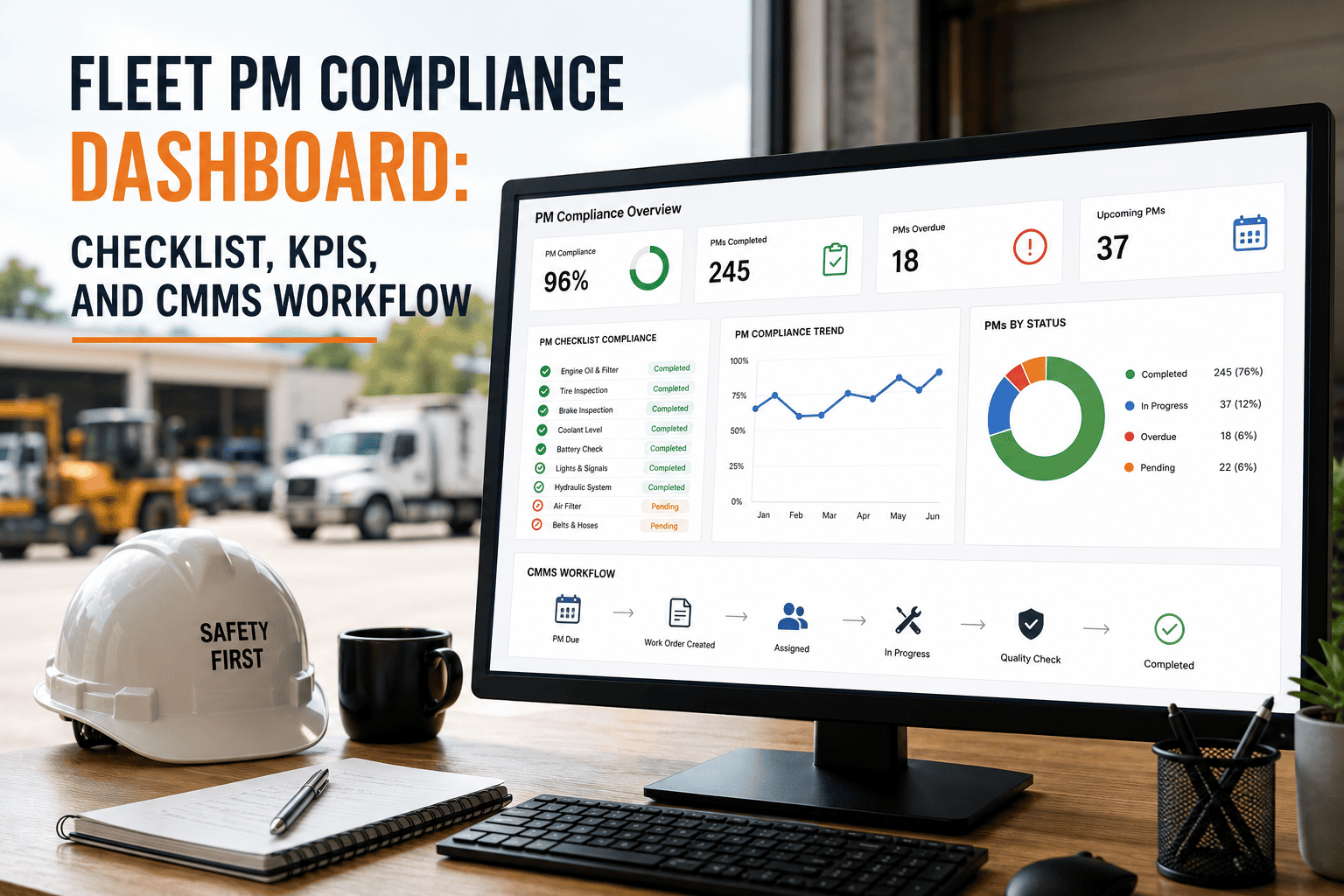
Preventive Maintenance Compliance Rate
Measures the percentage of scheduled PM tasks completed on time. Benchmark: 90%+ target. A PM compliance rate below 80% correlates with 3.5× more breakdowns. Deferred oil changes lead to engine wear, skipped brake inspections lead to failures, and missed tire rotations lead to blowouts. This is the most controllable KPI on this list. Sign ensures nothing falls through the cracks.
Total Cost of Ownership (TCO)
Captures every dollar a vehicle costs over its entire lifecycle: acquisition, fuel, maintenance, insurance, registration, depreciation, and disposal. Two vehicles with identical sticker prices can have vastly different TCOs. Fleet managers who track TCO consistently make better replacement decisions and negotiate stronger deals with OEMs and leasing companies.
Carbon Emissions Per Vehicle
Regulatory bodies in the EU, North America, and Asia-Pacific are tightening emissions standards. Tracking CO₂ per vehicle and per mile provides the baseline data for reduction targets, EV adoption business cases, and stakeholder reporting. Oxmaint connects fuel consumption data to emissions calculations automatically for audit-ready sustainability reports.
Mean Time Between Failures (MTBF)
The gold standard reliability metric. Formula: Total Operating Hours ÷ Number of Unplanned Failures. A rising MTBF means your PM strategy is working. A declining MTBF is an early warning that assets are approaching end-of-life or maintenance quality is slipping. Track by vehicle make, model, and age to identify your most and least reliable assets.
The Impact of KPI-Driven Fleet Management
Organizations that implement structured KPI tracking see a ripple effect of improvements across their entire operation. The data speaks for itself — these are industry-validated benchmarks from fleets that made the shift from reactive to predictive management.
Workable KPI Formulas & Benchmarks
Theory is useless without application. Below are the ready-to-use formulas, target ranges, and red-flag thresholds for each KPI. Print this section, pin it to your office wall, or better yet — sign up for Oxmaint and let the system calculate these automatically from your live fleet data.
Vehicle Utilization Rate
Cost Per Mile
Fuel Efficiency
Maintenance Cost Per Vehicle
Vehicle Downtime %
Driver Safety Score
PM Compliance Rate
Total Cost of Ownership
Carbon Emissions Per Vehicle
Mean Time Between Failures
Having the right KPIs is only half the equation — you also need a system that surfaces this data clearly, updates in real time, and alerts you when metrics drift outside acceptable ranges. A well-designed fleet dashboard gives you a single-screen view of fleet health, allows drill-down by vehicle, driver, or location, and provides trend analysis over customizable time periods. The key architectural principle is layering: put your "north star" KPIs (cost per mile, utilization, downtime, PM compliance) at the top, then provide one-click access to the diagnostic metrics underneath. Oxmaint's Analytics & Reporting Dashboard is built on exactly this principle — giving fleet managers the clarity they need without the noise they don't. If your current reporting tool requires you to export data to Excel before you can make a decision, you've already lost the speed advantage that real-time KPI tracking is supposed to deliver. Sign up for Oxmaint to see how a purpose-built CMMS dashboard changes the way you manage your fleet.
Frequently Asked Questions
Focus on 3–4 "north star" KPIs for daily visibility (cost per mile, utilization, downtime, PM compliance) and keep the remaining metrics as diagnostic drill-downs. Tracking too many KPIs with equal weight leads to dashboard fatigue and decision paralysis.
Planned downtime is scheduled maintenance — oil changes, brake inspections, tire rotations — performed during non-peak hours. Unplanned downtime is unexpected breakdowns that pull a vehicle from service. The goal is to maximize the ratio of planned to unplanned downtime, ideally keeping unplanned below 3% of total available hours.
Divide total operating costs (fuel, maintenance, insurance, depreciation, driver wages, tolls, registration) by total miles driven over the same period. The key is consistency — include the same cost categories every month so your trend data is reliable. A CMMS like Oxmaint automates this calculation by centralizing all cost inputs.
The most reliable signal is when annual maintenance costs consistently exceed 50% of the vehicle's current market value. Additionally, if MTBF is declining and the vehicle's cost per mile is trending significantly above fleet average, it's time to run a TCO comparison against a replacement asset.
Start Tracking the KPIs That Actually Matter
Oxmaint gives fleet managers real-time dashboards, automated PM scheduling, and cost-per-mile reporting — all in one platform. Stop guessing and start measuring.