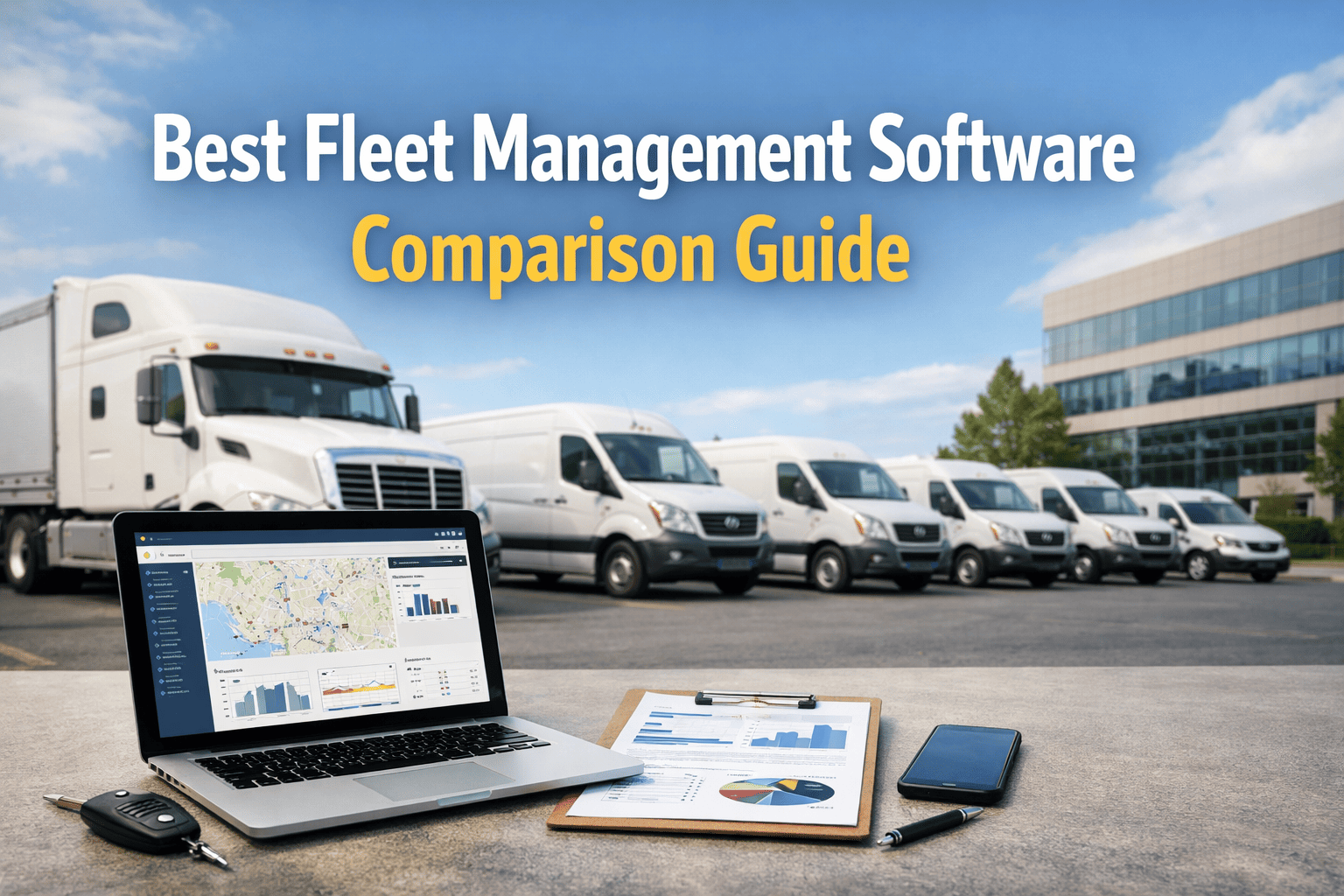
With over 300 fleet maintenance platforms on the market and the sector projected to surpass $30 billion in 2026, choosing fleet maintenance software is no longer the hard part. Choosing the right one is. Sign up for OxMaint free to see a maintenance-first fleet CMMS in action — or read the complete 2026 comparison framework below.
Fleet maintenance software plays a crucial role in helping organizations manage their vehicles, reduce operational costs, and improve efficiency. In 2026, many companies rely on advanced fleet management platforms that combine maintenance scheduling, vehicle tracking, analytics, and compliance tools. These systems allow fleet managers to monitor vehicle health, automate preventive maintenance, and track expenses such as fuel, repairs, and parts. By using cloud-based solutions, businesses can access real-time data and make faster decisions that improve fleet productivity and reduce downtime.
$30B+
Fleet software market in 2026 — growing at 16.9% CAGR through 2035
82%
Of fleet operators still rely on manual tracking — generating systematic maintenance gaps
$2,000
Cost of unplanned vehicle downtime per vehicle per day in 2026
4.8×
More expensive — emergency repairs vs. planned preventive maintenance
Experience a Cloud-Native Fleet CMMS Built for Real Operations
OxMaint combines maintenance management, asset tracking, compliance automation, and fleet analytics in a single platform. Deploy in days. See results in weeks.
What Is Fleet Maintenance Software — And Why It Matters More in 2026
Fleet maintenance software (also called fleet CMMS) centralizes preventive maintenance scheduling, work order tracking, vehicle inspections, parts inventory, and cost analytics for any organization operating five or more vehicles. It replaces spreadsheets and paper logs with automated workflows that reduce downtime, extend vehicle life, and lower repair costs. Three forces are making this category more urgent than ever in 2026.
01
AI Becomes the Baseline
Machine learning now forecasts part failures weeks in advance. Fleets using predictive maintenance report 25–40% fewer accidents and 10–15% fuel savings. In 2026, AI is no longer a differentiator — it is an expectation.
02
EV Fleet Complexity Grows
Class 8 truck orders jumped 118% in December 2025. EV adoption demands battery health monitoring, charging schedule integration, and new inspection workflows that legacy platforms were never designed to support.
03
Tech Adoption Accelerates
Technology adoption is now the top priority for 18% of fleets in Q1 2026 — up from 16% last quarter. Only 14% of small fleets currently use maintenance software, meaning early adopters gain a measurable competitive edge right now.
04
Cloud SaaS Dominates
Cloud solutions now represent 63% of fleet software revenue, growing at 18.2% annually. No infrastructure costs, real-time mobile access from any device, and no IT overhead — the on-premises deployment model is declining at every fleet size tier.
The 8 Criteria That Separate Great Fleet Maintenance Software from the Rest
Not all fleet maintenance platforms are built the same. Some excel at GPS tracking but treat maintenance as a bolt-on. Others offer strong analytics but create friction in daily technician workflows. These are the 8 non-negotiable criteria every platform must satisfy in 2026.
Maintenance Core
Preventive Maintenance Scheduling
Automated PM triggers based on mileage, engine hours, or calendar intervals — not just reminders. The system must create work orders automatically when thresholds are reached and track technician completion rates with variance reporting.
Work Order Management
Digital creation, assignment, tracking, and closure with parts usage, labor time, and cost capture per order. Full repair history per vehicle — searchable by date, technician, cost, and failure category without manual exports.
Intelligence
AI Predictive Maintenance
Machine learning analysis of telematics and sensor data to forecast failures before they occur. The best 2026 platforms auto-generate work orders from predictive alerts — closing the loop between prediction and action without dispatcher intervention.
Total Cost of Ownership Analytics
Cost-per-mile, cost-per-vehicle, and repair-vs-replace analysis across the fleet. Platforms connecting acquisition cost, depreciation, fuel, maintenance spend, and downtime hours deliver financial intelligence that reactive systems structurally cannot produce.
Compliance
Digital Inspection and DVIR
Digital Vehicle Inspection Reports, customizable checklists, ELD integration, and regulatory maintenance logs. Non-compliance penalties exceed $16,000 per violation — platforms that auto-generate audit-ready reports eliminate manual compliance overhead entirely.
Parts and Inventory Management
Real-time parts inventory linked to work orders with auto-reorder triggers and vendor management. Platforms that cannot confirm parts availability before a work order starts generate unnecessary delays and duplicate purchasing every single shift.
Operations
Fuel Management
Per-vehicle fuel consumption with idle time reporting, MPG trends by driver and route, and fuel card integration. Fuel accounts for 30–40% of total fleet operating cost — 10–15% fuel savings often covers the entire annual software subscription.
Mobile-First Technician Workflows
Native iOS and Android apps letting technicians scan QR codes, update work orders, log parts, capture inspection photos, and apply digital signatures without returning to a desktop. Platforms without true mobile architecture fail daily adoption tests consistently.
Platform Categories: 4 Archetypes and What Each Actually Delivers
The 2026 fleet maintenance landscape has four distinct platform archetypes. Choosing the wrong category for your primary operational problem is the most common and most expensive evaluation mistake fleet managers make.
GPS / Telematics Platforms
Best for: Driver behavior, location visibility, ELD compliance
Live tracking, geofencing, route replay, dashcam AI
Strong ELD/FMCSA compliance documentation
Maintenance is an add-on — PM scheduling depth is shallow
Hardware-bundled pricing — proprietary device lock-in common
Examples: Samsara, Verizon Connect, Geotab, Motive
Basic Fleet Software
Best for: Small fleets, service history logging, simple reminders
Affordable entry point — many start under $10/vehicle/month
Easy to learn — low training overhead for small teams
No TCO analytics, no predictive maintenance capability
Does not scale past 50 vehicles without data architecture issues
Examples: AUTOsist, Whip Around, Coast, Driveroo
Fleet CMMS Platforms
Best for: Maintenance depth, asset lifecycle, compliance + cost control
Full PM scheduling, work order management, parts inventory
AI predictive maintenance + automated work order creation
Hardware-agnostic — integrates with any telematics provider
Multi-site, scalable from 10 vehicles to 10,000 in one platform
Top choice: OxMaint — free tier available, deploys in days
Enterprise FMIS
Best for: Municipalities, transit agencies, 500+ vehicle operations
Deep configurability — custom workflows, ERP integration
Portfolio-level reporting across all sites and vehicle classes
3–6 month implementation timelines — heavy onboarding required
Multi-year contracts — high switching costs once deployed
Examples: RTA Fleet360, Chevin, Cetaris
Reactive vs. Preventive Maintenance: The 2026 Financial Gap
The shift from reactive to preventive maintenance is the single most impactful operational decision in fleet management. Software is the enabler of that shift. Here is what the data says about the gap between operating modes.
Reactive Maintenance
Emergency Cost
4.8× more than planned maintenance
Downtime
$2,000/day/vehicle — uncontrolled
Failure Warning
Zero — failures discovered when vehicles stop
Records
Paper logs — incomplete, unretrievable
Compliance Risk
High — $16,000+/violation exposure
Asset Lifespan
30–40% shorter — failure-driven wear accelerates
Admin Overhead
6–10 hours/week manual scheduling per manager
Annual ROI
Negative — costs compound with no control lever
Preventive with OxMaint
Maintenance Cost
30% lower — planned service replaces emergency repair
Downtime
Scheduled — vehicles in, serviced, back in operation
Failure Warning
89% AI accuracy — flags failures weeks in advance
Records
Digital — timestamped, searchable, audit-ready in one click
Compliance
FMCSA/DOT pre-configured, digital signatures, zero gaps
Asset Lifespan
Extended — condition-based, data-driven replacement decisions
Admin Overhead
Automated — work orders created, assigned, tracked without manual input
Annual ROI
$3,120/vehicle/year avg savings — payback under 8 months
Why OxMaint Leads the 2026 Fleet Maintenance CMMS Category
OxMaint was evaluated across five weighted criteria in 2026 platform reviews: AI and predictive maintenance (25%), work order management (25%), mobile experience (20%), pricing transparency (15%), and integration ecosystem (15%). Here is how it outperforms at each dimension.
AI Maintenance
Predictive Failure Detection
OxMaint's AI analyzes telematics, sensor, and repair history data to forecast failures before they occur. Anomaly detection triggers automatic work orders — no dispatcher action required. 89% failure prediction accuracy in 2025 benchmark testing.
Work Orders
Auto Work Order Generation
PM schedules auto-generate work orders when mileage, engine hours, or calendar thresholds are reached. Each work order captures parts used, labor time, cost, and technician — building a complete repair history per vehicle automatically.
Cost Control
Total Cost of Ownership Per Vehicle
Every vehicle carries a live TCO score combining maintenance spend, fuel consumption, depreciation, and downtime hours. Repair-vs-replace decisions are data-driven. Average annual savings across the OxMaint customer base: $3,120 per vehicle.
Compliance
Pre-Built Regulatory Documentation
FMCSA/DOT inspection checklists, digital DVIR, digital signatures, and one-click audit-ready exports — all included in the standard platform. Compliance records are generated as a byproduct of daily operations with no separate documentation step.
Mobile
Native Technician App
QR scanning, work order updates, parts logging, inspection photos, and digital signatures — all from the native iOS and Android app. Technicians complete full workflows without returning to a desktop. Offline capability ensures zero data loss in low-connectivity environments.
Integration
Hardware-Agnostic Telematics
OxMaint integrates with any telematics provider through open APIs — no proprietary hardware required. GPS data, OBD-II diagnostics, fuel card transactions, and ERP data all flow into OxMaint without replacing existing infrastructure.
Deployment
Live in Days, Not Months
Cloud-native architecture — no server installation, no IT infrastructure project, no hardware procurement. Most fleet operations are creating digital work orders within their first week. Full deployment takes 1–3 weeks depending on fleet size.
Scale
10 Vehicles to 10,000 — One Platform
From a single-depot operation to a multi-site portfolio, OxMaint's architecture supports fleet growth without platform migrations, data exports, or infrastructure upgrades. Free tier for small fleets, enterprise features for large operations — no scaling penalty.
$3,120
Avg. annual savings per vehicle
Fuel + maintenance + admin + compliance combined vs. manual fleet operations
30%
Maintenance cost reduction
Planned maintenance vs. reactive repair — the primary cost lever in fleet CMMS deployment
15%
Fuel cost reduction
Route optimization, idle reduction, and driver behavior monitoring — 15% of $800K annual fuel = $120K/year saved
8 mo
Typical payback period
32% of fleets see positive ROI within 6 months — 47% within the first full year of deployment
Frequently Asked Questions
What is the difference between fleet maintenance software and fleet management software?
Fleet maintenance software focuses on the mechanical health and servicing of vehicles — PM scheduling, work orders, inspection logs, parts inventory, and repair cost history per vehicle. Fleet management software is a broader category adding GPS tracking, driver behavior monitoring, route optimization, and dispatch on top of maintenance capabilities. In 2026, leading platforms offer both — but the distinction that matters is your primary problem. If unplanned downtime and maintenance cost control are your core issues, a dedicated fleet CMMS like OxMaint delivers significantly more value than a tracking platform with maintenance bolt-ons. Most OxMaint customers already have GPS hardware from an existing provider — OxMaint integrates with any telematics data through open APIs without hardware replacement.
Sign up free to test OxMaint against your actual fleet data, or
book a demo to see how it connects to your existing setup.
How much does fleet maintenance software cost in 2026?
Pricing in 2026 ranges from free basic plans to $2,000+ per month for enterprise deployments. Per-vehicle pricing typically runs $4–$50/vehicle/month. Entry-level plans average around $128/month while premium solutions reach $856/month. The three primary pricing models: per-vehicle SaaS subscription (most common — watch for rate jumps at fleet size thresholds), per-seat licensing (prices per user — problematic for large maintenance teams), and annual enterprise flat-fee licensing (typically at 500+ vehicle scale). Two hidden costs to factor beyond subscription: implementation and data migration (from $0 for self-service to $10,000+ for complex deployments) and hardware requirements (telematics-bundled platforms add $15–$45/vehicle in device costs). OxMaint offers a free tier with core maintenance features — no financial commitment required to start.
Sign up free immediately, or
book a demo for a cost projection based on your fleet size.
What are the most common mistakes fleet managers make when selecting maintenance software?
Five selection mistakes appear consistently across fleet software evaluations. First, choosing feature count over usability — a 200-feature platform that technicians won't use daily produces zero operational improvement. Second, ignoring integration requirements — your software must exchange data with telematics hardware, fuel card providers, and accounting systems. Third, underestimating implementation support — data migration, workflow configuration, and change management all require time and expertise. Fourth, selecting for today's fleet size only — platforms with per-vehicle fees that jump sharply at growth thresholds create a scaling tax that compounds as your operation expands. Fifth, evaluating total cost incorrectly — hardware requirements, implementation fees, training costs, and integration expenses must all factor into the 3-year comparison, not subscription price alone.
Sign up free to evaluate OxMaint against your actual workflows before committing.
How quickly can a fleet see real ROI after deploying fleet maintenance software?
For cloud-native platforms like OxMaint with no hardware requirements, vehicle data import, PM schedule configuration, and team training take 1–3 weeks. Most OxMaint fleet operations are creating digital work orders within their first week. For ROI: 32% of fleets implementing vehicle tracking saw positive ROI within 6 months. Quantified benchmarks from 2025 industry data: a 50-vehicle fleet spending $1,800/year on OxMaint saves $250+/month from reduced downtime alone, breaking even in under 8 months. Predictive maintenance implementations deliver 2–4× ROI within 12–24 months. The $3,120 average annual savings per vehicle across all cost categories represents 50–87× ROI vs. software cost when fully realized.
Book a demo for a custom ROI projection based on your fleet's size and current maintenance spend, or
sign up free and start tracking results immediately.
The Right Fleet Maintenance Software Pays for Itself in Months — Not Years.
OxMaint delivers AI predictive scheduling, work order management, parts inventory, compliance documentation, and total cost analytics. Free to start, deploys in days, measurable ROI within 30–90 days. Join 1,000+ fleet operations already running smarter.