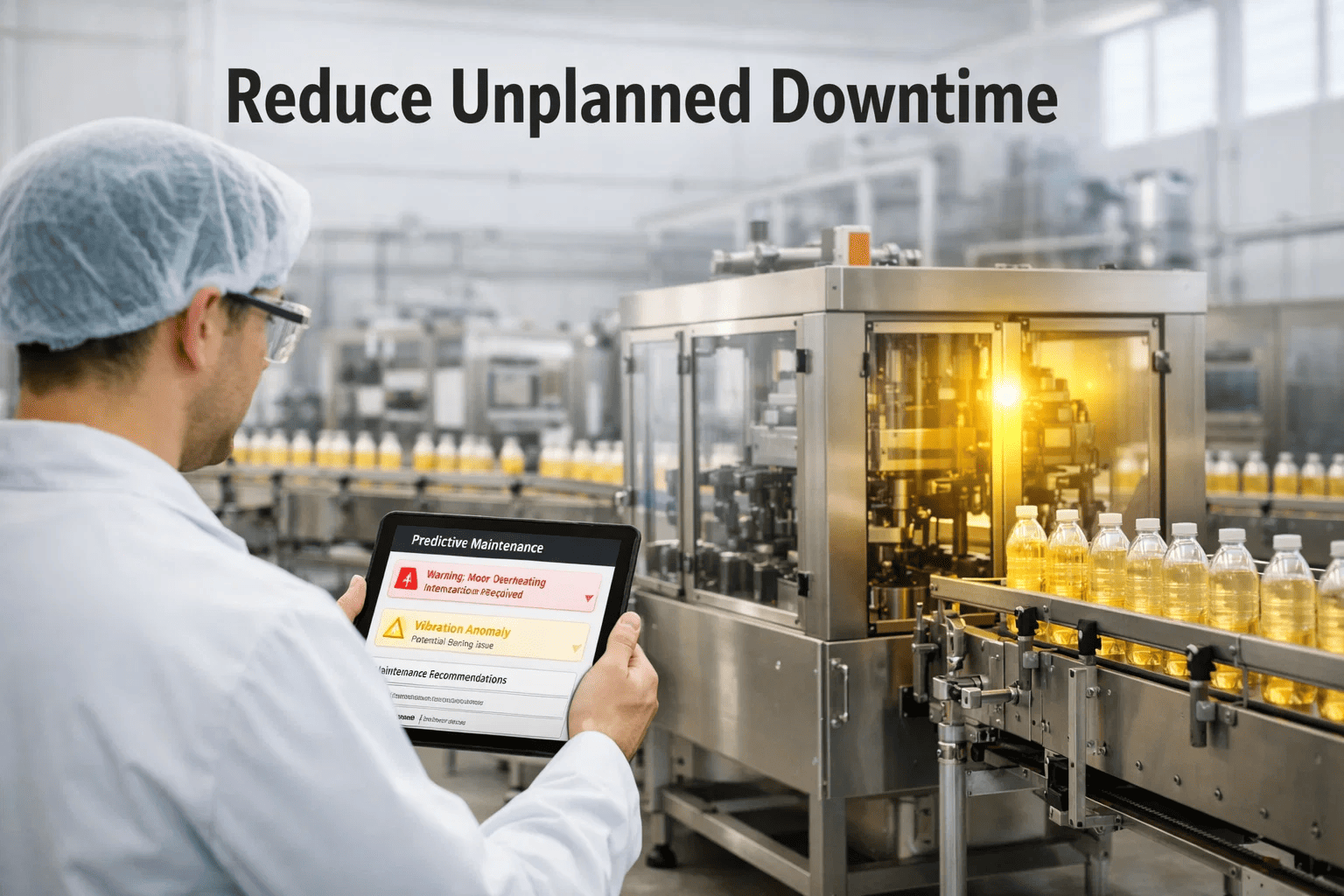
Manual sorting and spot-check inspection in FMCG production are fundamentally incompatible with the throughput rates modern lines demand — a line running 600 packs per minute cannot be quality-controlled by human visual inspection at line speed. AI-powered automated rejection systems close this gap, combining real-time vision, weight control, seal inspection, and label verification into a continuous quality gate that operates without fatigue, shift changes, or human judgment variance. Industry data shows that FMCG lines running properly configured AI rejection systems achieve defect escape rates below 0.1% — compared to 2–5% for lines relying primarily on end-of-line manual inspection. Getting from detection to zero-defect output requires more than hardware: it requires the maintenance infrastructure to keep rejection systems operating at specification. If your automated quality systems aren't backed by a structured PM program, start a free OxMaint trial and build the maintenance foundation your automated systems need — or book a demo to see how FMCG plants manage automated quality systems in OxMaint.
FMCG Quality · Automation
AI Automated Rejection Systems for FMCG Production Lines
Vision inspection, automated diversion, defect classification, and zero-defect line management — the operational and maintenance framework for AI-powered quality gates in high-speed FMCG manufacturing.
<0.1%
Defect escape rate on properly configured AI vision rejection lines
600/min
Typical FMCG line speed — impossible to inspect manually at this throughput
35%
Reduction in customer complaints after AI vision system deployment in FMCG
4–8hrs
Uptime lost per rejection system failure that halts the production line
The Automated Rejection System Architecture
Modern FMCG rejection systems are layered — multiple detection technologies feeding a central control system that makes reject decisions in milliseconds. Understanding the architecture helps maintenance teams know what to maintain and why each component is critical.
1
Detection Layer
AI vision camera inspection
Checkweigher (±0.1g accuracy)
Metal detector / X-ray
Seal integrity tester
2
Decision Engine
AI defect classification model
Multi-sensor data fusion
Product specification comparison
Reject threshold validation
3
Rejection Mechanism
Pneumatic air blast diverter
Pusher arm rejection
Reject bin with tamper evidence
Confirmation sensor verification
4
Reporting & Feedback
Reject event classification logging
Real-time OEE impact dashboard
Defect trend analysis by type
Corrective action trigger alerts
8 Defect Types AI Vision Systems Catch That Manual Inspection Misses
AI vision systems don't replace human inspectors because humans can't inspect at line speed. They replace human inspectors because AI catches defect categories that humans miss even at slower speeds — particularly pattern-level defects and multi-parameter failures occurring simultaneously.
Food Safety
Foreign Object Detection
Sub-millimeter metal, glass, and plastic particles visible in X-ray imaging, flagged and rejected before packaging.
Food Safety
Seal Integrity Failure
Micro-leaks, channel seals, and incomplete heat bonds detected through pressure differential or vision pattern analysis.
Compliance
Label Print Quality
Blurred barcodes, missing date codes, incorrect best-before dates, and unreadable allergen declarations caught at line speed.
Compliance
Fill Weight Deviation
Checkweigher catches underfill (legal weight failure) and overfill (cost loss) outside declared e-mark tolerance bands.
Quality
Print Registration Error
Misregistered packaging artwork, off-color print, or wrong film run caught by color and position comparison against master template.
Quality
Package Damage
Dents, tears, crushed corners, and delaminated surfaces that affect shelf presentation and product protection.
Quality
Missing Components
X-ray shadow analysis confirms correct product configuration within pack — missing units, incomplete counts, or wrong product type.
Quality
Wrong Product in Line
During changeover transitions, vision systems compare product appearance to current production specification and reject non-conforming items from previous run.
Why Automated Rejection Systems Fail — and How to Prevent It
An automated rejection system that runs without a PM program is a liability, not an asset. These systems fail in ways that are invisible to operators until a quality event confirms the gap. Ready to build the PM foundation your rejection systems need? Get started with OxMaint free or book a demo to see how automated quality system maintenance works in practice.
Failure Mode
Camera Lens Contamination
Dust, condensation, and product splash degrade image quality progressively. The system continues detecting — but with reduced accuracy. Detection rate drops by 15–30% before operators notice increased customer complaints.
PM Solution
Scheduled Lens Cleaning
Daily cleaning task assigned in OxMaint inspection checklist. Camera performance verified at start of shift against reference image set. Degraded images trigger immediate cleaning and re-verification.
Failure Mode
Pneumatic Reject Mechanism Wear
Air blast or pusher arm mechanisms wear over cycle count — reject timing drifts, missing the correct product position at high line speeds. System detects correctly but rejects the wrong unit.
PM Solution
Cycle-Count Based PM
OxMaint triggers PM based on production unit count, not calendar — replacing solenoids and actuators before wear affects timing. Challenge verification at start of every production run confirms rejection accuracy.
Failure Mode
AI Model Drift on New SKUs
AI vision models trained on historical product images produce false positives on reformulated or re-packaged SKUs — causing excessive rejection of conforming product or, worse, under-rejection of new defect types the model hasn't seen.
PM Solution
SKU Change Triggered Validation
OxMaint links product changeover work orders to mandatory vision system validation tasks. New SKU introduction triggers model performance verification before full production release.
Failure Mode
Reject Confirmation Sensor Failure
The confirmation sensor that verifies rejected product entered the reject bin can fail — giving the system a false "reject confirmed" signal while defective product continues on the production stream.
PM Solution
Sensor Verification Protocol
Daily pre-production challenge test physically confirms reject mechanism operation and bin receipt. Sensor calibration on PM schedule. Any sensor alarm triggers line stop and OxMaint work order automatically.
Performance Benchmarks: AI Rejection System Results
35%
Customer complaint reduction
Average after AI vision deployment in FMCG packaging lines with proper system maintenance
<0.1%
Defect escape rate target
Achievable on well-maintained AI vision lines vs. 2–5% on manual inspection lines
99.2%
System uptime requirement
Detection system availability threshold below which quality exposure exceeds acceptable risk
20%
False reject rate reduction
When AI models are properly validated per product vs. generic threshold settings
Frequently Asked Questions
What maintenance does an AI vision rejection system require?
AI vision rejection systems require layered maintenance across hardware, software, and validation dimensions. Hardware maintenance covers camera lens cleaning (daily to weekly depending on environment), lighting system replacement (LEDs degrade, affecting image quality before failure is obvious), conveyor and belt inspection, and mechanical rejection mechanism PM based on production cycle counts. Software maintenance includes AI model validation when new SKUs are introduced, performance trending against defined accuracy KPIs, and system calibration verification. Validation maintenance involves start-of-run and end-of-run challenge tests with documented pass/fail records. The most commonly neglected maintenance is the regular model performance verification — teams that treat AI vision as "set and forget" technology typically discover degraded performance only when a quality escape confirms the gap.
How do we set the right reject thresholds without excessive false reject rates?
Threshold setting is a balance between sensitivity (catching more defects) and specificity (not rejecting conforming product). The process starts with statistical analysis of your acceptable product variation — understanding the natural range of fill weights, seal appearance, and label position variation in conforming product. Rejection thresholds are set outside this natural variation range, not at the specification limit. For AI vision systems, this requires training the model on a representative sample of conforming product from your specific line, under your specific lighting conditions, across your product range. Generic factory models produce high false reject rates because they don't account for your line's natural variation. OxMaint tracks false reject rate per line as a key performance metric — increasing false reject rates signal model drift that requires retraining or recalibration before actual defect escape rates increase.
What is a rejection confirmation sensor and why is it critical?
A rejection confirmation sensor is a separate detection device — typically a proximity sensor or photoelectric sensor — positioned at or after the reject bin to confirm that a detected and rejected item actually entered the reject stream. Without this confirmation loop, the rejection system can signal "reject executed" while the item remains on the production conveyor due to a mechanical failure in the rejection actuator. For food safety purposes, this confirmation is critical: it closes the control loop and provides the evidence that detected contaminants were physically removed from the product stream. Many food safety standards now explicitly require documented confirmation sensor performance as part of the detection system validation record — a system with a functioning detection capability but an unverified rejection mechanism does not satisfy BRC or FSSC 22000 CCP requirements.
How does OxMaint support automated rejection system maintenance?
OxMaint manages each automated rejection system as an asset with a complete maintenance record. PM schedules are configured for each component type: camera cleaning on a frequency appropriate to the production environment, pneumatic mechanism PM triggered by production cycle count rather than calendar, and calibration events scheduled per manufacturer recommendation. Pre-production challenge tests become mandatory digital inspection steps with pass/fail documentation that blocks production line release until completed. Any failed challenge test or sensor alarm automatically generates a work order assigned to the qualified technician. Reject event data and false reject trends are tracked over time, giving quality managers the data to identify degrading system performance before defect escape rates increase. The complete maintenance and validation record is available for export to support BRC, SQF, and FSSC 22000 audit preparation.
Zero-Defect Manufacturing Starts With Maintained Systems
AI Rejection Systems Are Only as Good as Their Last Verified Calibration. OxMaint Ensures That Verification Happens.
Camera PM schedules. Cycle-count triggered mechanism service. Challenge test digital records. Reject event trending. Model validation workflows for new SKUs. Everything your AI quality systems need to deliver consistent performance — managed in one platform your maintenance and quality teams share.