AI Vision for Label Verification in FMCG Packaging
By Oxmaint on February 9, 2026
A major cereal manufacturer shipped 22,000 cases of a nut-free children's product with labels from a different SKU—one containing almonds. The packaging line had run a changeover 90 minutes earlier, and four label rolls from the previous product remained loaded in positions 3 and 4 of the applicator carousel. The operator verified the front-panel artwork visually, but the allergen declaration on the back panel was wrong. No one caught it. The checkweigher confirmed correct weight. The barcode scanner read a valid code—just not the right one for this product. Ten days later, the first consumer complaint arrived. Fourteen days later, the recall was announced: 22,000 cases across 3,400 retail locations, FDA Class I recall classification (reasonable probability of serious adverse health consequences), $4.8 million in direct costs, and $12 million in estimated brand damage. The mislabeled product had passed every quality check except one that didn't exist: AI vision verification that reads every character on every label on every package at line speed and confirms it matches the production order. That system costs $35,000–75,000 per line. The recall cost $16.8 million. Schedule a demo to see AI label verification in action.
The Mislabeling Crisis in FMCG Manufacturing
Label errors are the #1 cause of food recalls in the United States
40%+
Of Food Recalls
Caused by labeling and packaging errors
$10M+
Average Recall Cost
Direct + indirect brand damage
99.97%
AI Detection Rate
Vs. 92–95% for manual inspection
1,500+
BPM Capable
Full inspection at maximum line speed
This guide explains how AI vision systems verify every element on every label at full production speed—from artwork and allergen declarations to barcodes, lot codes, and expiry dates. You'll learn what the technology inspects, how it integrates with your packaging lines, and why it's becoming a non-negotiable requirement for FMCG manufacturers serious about preventing recalls. Sign up free to start digitizing your label quality program.
One wrong label. 22,000 cases. $16.8 million. AI verification prevents it. Book a demo.
Label Verification Failure Types and Their Consequences
Label errors fall into distinct categories, each carrying different regulatory, safety, and financial consequences. AI vision systems inspect for all of them simultaneously on every package—something no combination of human inspectors, barcode scanners, and checkweighers can achieve. Understanding these failure types is essential for designing an effective label verification program.
Critical Label Verification Points in FMCG Packaging
Wrong SKU / Artwork
FDA Class I Recall Risk
Label from different product applied after changeover. Allergen mismatch, nutritional information wrong, regulatory non-compliance. Average recall cost: $10M+
Barcode / QR Errors
Retail Rejection
Unreadable, wrong GTIN, check digit failure, print quality below Grade C. Retail chargebacks $500–$5,000 per incident plus shipment rejection
Date / Lot Code Errors
Traceability Failure
Missing, illegible, wrong format, or incorrect expiry/lot codes. Prevents effective recall execution, violates FDA 21 CFR 117 traceability requirements
Crooked, wrinkled, misaligned, or flagging labels. Damages brand perception, may obscure required information, triggers retail rejection
Net Weight / Content
Regulatory Violation
Declared net weight doesn't match fill weight. Violates Fair Packaging and Labeling Act. State weights and measures enforcement, fines, and product seizure
Each of these failure types has occurred in real FMCG operations, and most have triggered recalls or regulatory actions. AI vision verification inspects for all of them simultaneously on every package, providing a comprehensive label quality firewall that no other single technology can match. Start tracking label quality digitally—sign up free.
How AI Label Verification Works
AI label verification systems combine high-speed cameras, advanced OCR, deep learning classifiers, and barcode grading algorithms into a single inspection point that evaluates every element on every label in milliseconds. The system doesn't sample—it inspects 100% of production at full line speed.
AI Label Verification Process
From image capture to pass/fail decision in under 20 milliseconds
1
High-Speed Image Capture
Multiple cameras capture 360° label images at line speed. Strobe lighting ensures consistent illumination regardless of line speed or ambient conditions. Resolution sufficient to read 6-point text at 1,500+ BPM.
Trigger: Every container
2
Artwork Verification (Golden Template Match)
AI compares the captured label against the approved "golden template" for the active production order. Pixel-level comparison detects wrong SKU, color shifts, missing elements, and artwork corruption. Confirms front panel, back panel, and side panels match.
Processing: <5 ms
3
OCR Text Verification
Optical character recognition reads all printed text: product name, ingredient list, allergen declarations, nutritional facts, net weight, manufacturer information. AI verifies every character against the master specification for this SKU.
Processing: <8 ms
4
Barcode & Date Code Verification
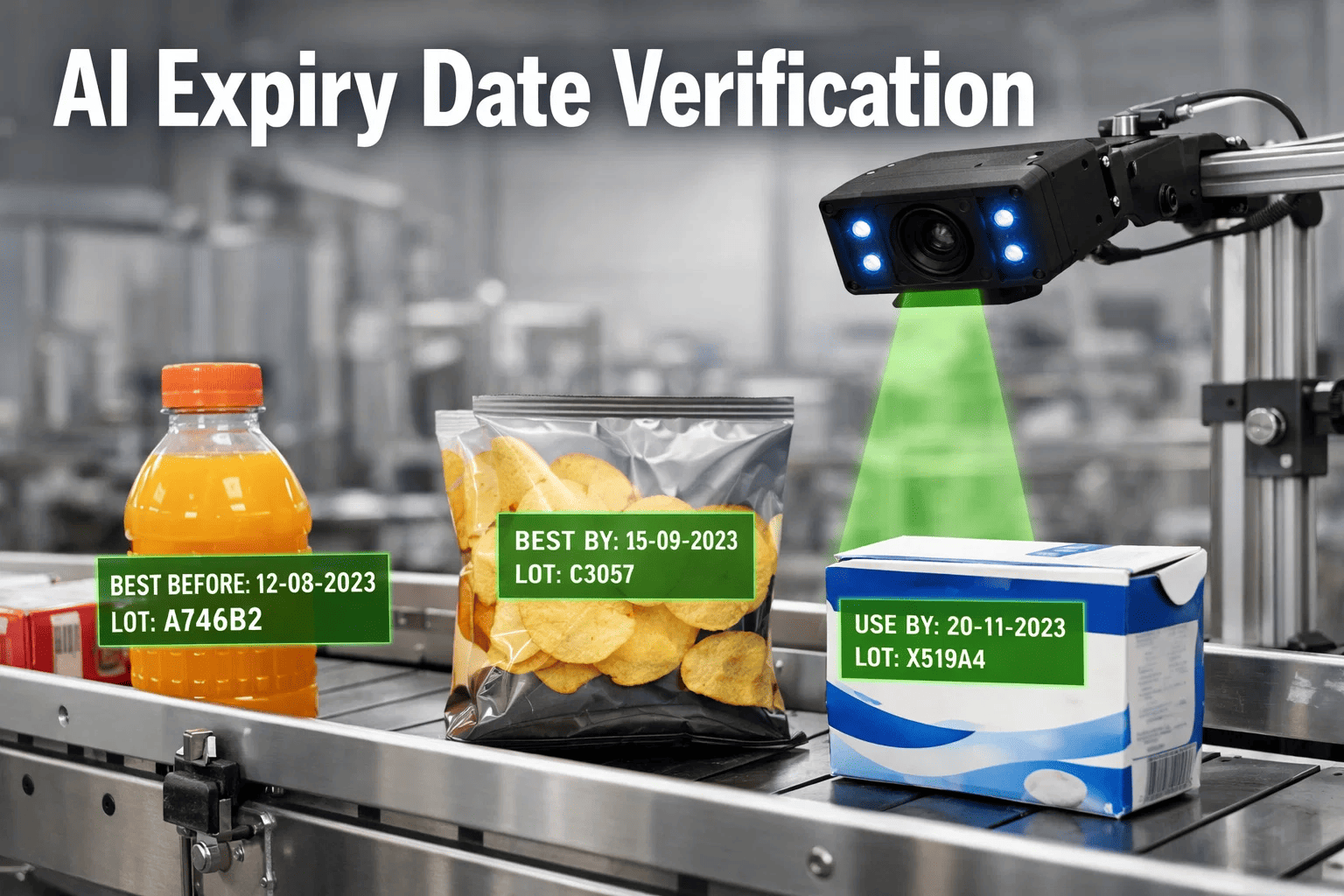
Reads and grades 1D/2D barcodes to ISO 15416/15415 standards. Verifies GTIN matches production order. Reads and validates expiry date, lot code, and production date against scheduling system. Checks print quality grade.
Processing: <5 ms
5
Placement & Quality Assessment
Evaluates label position, skew angle, wrinkles, bubbles, tears, and adhesion quality. Measures registration accuracy against defined tolerance windows. Detects partial labels, double labels, and missing labels.
Processing: <3 ms
6
Pass/Fail Decision & Reject
All inspection results aggregated. Any failure triggers immediate reject with specific failure reason logged. Images stored for quality review. Trend data feeds real-time SPC dashboards. CMMS integration generates maintenance alerts for systematic issues.
Total cycle: <20 ms per container
100% of labels inspected. 99.97% detection accuracy. Zero manual intervention required.
Every Label. Every Character. Every Package.
AI vision reads what operators can't see at 1,500 bottles per minute. Our automated label verification system eliminates mislabeling risk across your entire production floor—catching wrong SKUs, allergen mismatches, barcode failures, and date code errors before a single defective package leaves the line. Trusted by leading FMCG manufacturers running high-speed multi-SKU operations worldwide.
While every packaging line has unique characteristics, certain label failure scenarios occur consistently across FMCG operations. Understanding these patterns and how AI detection resolves them enables teams to target their highest-risk exposure points. The following scenarios account for over 85% of label-related quality incidents in FMCG manufacturing.
FMCG Label Failure Troubleshooting Matrix
Post-Changeover Wrong Label
Indicators
First containers after changeover carry previous product's label, mixed labels on multi-position applicators, operator verified wrong reference sample
Root Causes
Incomplete label roll removal from applicator, wrong roll loaded in one position of multi-roll system, label roll inventory not matched to production schedule, visual verification fails on similar artwork
AI Resolution
1. Golden template loaded automatically from production order 2. First container verified before line reaches full speed 3. All applicator positions verified independently 4. Immediate line stop on mismatch with visual alert to operator
Date/Lot Code Print Failure
Indicators
Faded, smeared, or missing inkjet print, wrong date format, incorrect lot code sequence, printer head clogging mid-run, date code doesn't match production schedule
Root Causes
Inkjet nozzle fouling, substrate incompatibility, print head distance drift, ink level low, operator entered wrong date code, printer recipe not updated for new production order
AI Resolution
1. OCR reads every printed character on every container 2. Validates date format, sequence, and content against production schedule 3. Detects print quality degradation before codes become illegible 4. Triggers CMMS maintenance alert for printer service when quality trends downward
Barcode Grade Degradation
Indicators
Retail scanners rejecting product, increasing scan failures at distribution, barcode verification grade dropping from A/B to C/D, retailer chargebacks for unscannable product
Root Causes
Print head wear on thermal transfer, ink density variation, substrate moisture affecting print adhesion, label applicator pressure inconsistency, barcode placement over container seam or curve
AI Resolution
1. ISO 15416/15415 grading on every barcode at line speed 2. Trend analysis detects quality degradation before reaching reject threshold 3. Alerts maintenance to printhead service or ribbon replacement 4. Logs grade data for retail compliance documentation
Label Placement Defect
Indicators
Labels skewed, wrinkled, flagging at edges, not centered on panel, overlapping container seam, partial application leaving exposed adhesive
Root Causes
Applicator timing drift, label roll tension variation, container orientation inconsistency, adhesive activation temperature wrong, container surface contamination affecting adhesion
AI Resolution
1. Measures label position, skew angle, and registration on every container 2. Detects wrinkles, bubbles, and flagging through surface analysis 3. Trends placement accuracy to predict applicator adjustment needs 4. Generates CMMS work order when placement variance exceeds tolerance
Label Verification Quality Control Schedule
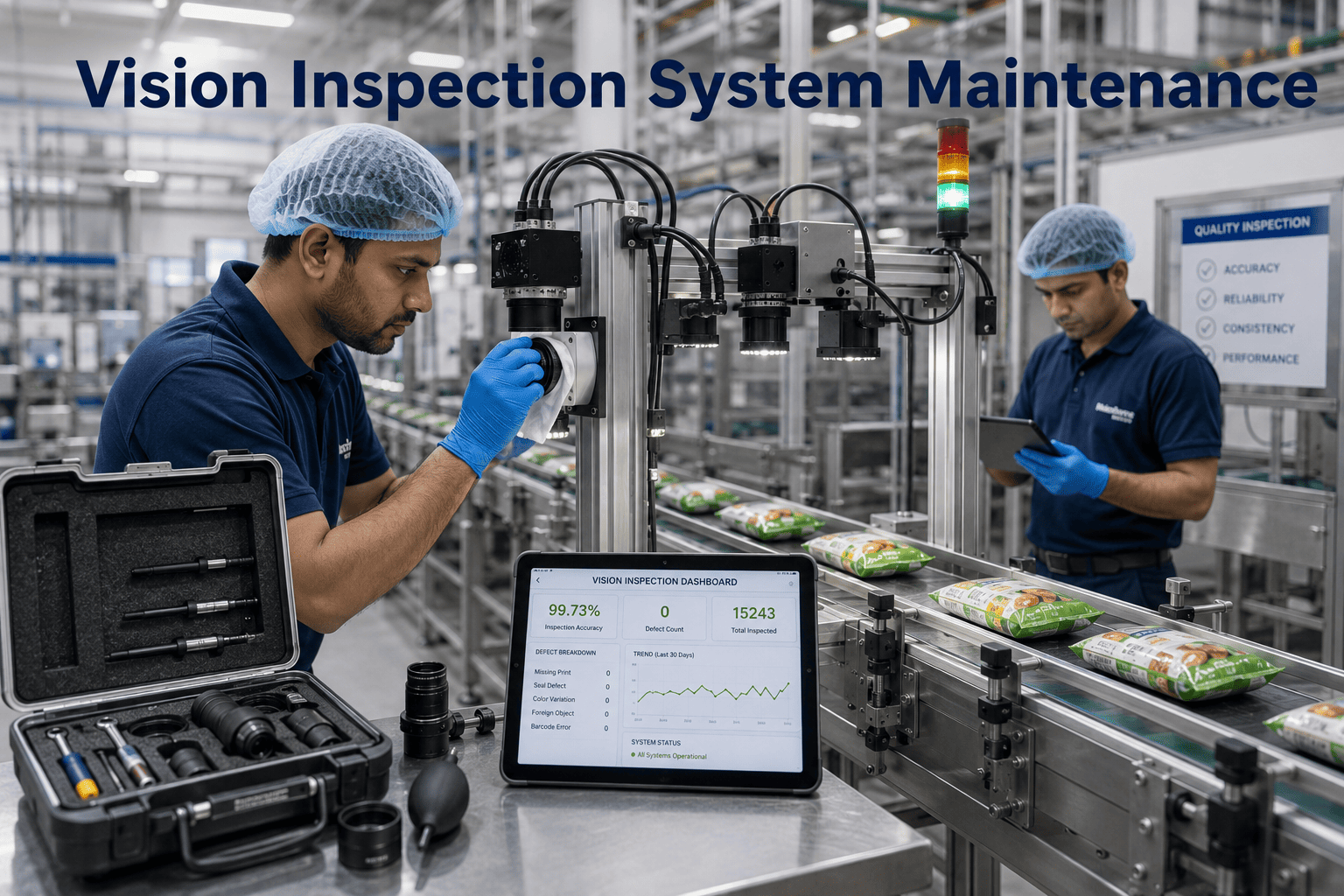
AI vision provides continuous 100% inspection, but the system itself and the broader label quality program require structured maintenance and calibration to maintain peak accuracy. The following schedule ensures your label verification system delivers consistent protection. Sign up free to automate your label quality workflow.
Label Verification System Maintenance Schedule
Recommended calibration, validation, and optimization intervals
Per Changeover
Load golden template for new SKU
Correct reference baseline
Verify first-article against approved artwork
Changeover validation
Confirm date/lot code matches schedule
Traceability assurance
Run known-defect test samples
Detection validation
Daily
Review reject log and failure categories
Pattern identification
Clean camera lenses and illumination
Image quality
Check reject mechanism operation
Defect containment
Verify barcode grade trending
Print quality monitoring
Weekly
Analyze false reject rate by failure type
Accuracy optimization
Review OCR accuracy statistics
Character recognition tuning
Calibrate lighting intensity and uniformity
Consistent detection
Audit golden template library updates
Reference accuracy
Monthly / Quarterly
Full system validation with test panel
Detection confidence
Camera/lens calibration verification
Measurement accuracy
AI model performance review and update
Continuous improvement
Compliance documentation audit
Audit readiness
ROI: The Business Case for AI Label Verification
The financial case for AI label verification is driven by two factors: the catastrophic cost of a single mislabeling recall versus the modest cost of prevention, and the ongoing operational savings from reduced waste, fewer chargebacks, and elimination of manual inspection labor.
AI Label Verification ROI Analysis
Annual value for a typical multi-line FMCG packaging operation
Recall Prevention
Elimination of mislabeling recall risk (risk-adjusted value)
$2,000,000
Retail Chargebacks
Eliminated barcode failures and label defect rejections
$180,000
Manual Inspection Labor
Replaced human visual inspection stations on each line
$145,000
Waste Reduction
Earlier detection reduces downstream packaging of defective product
$95,000
Printer Maintenance Savings
Predictive alerts prevent print quality failures and unplanned stops
$42,000
Total Annual Value:
$2,462,000+
System investment: $35,000–$75,000 per line • Payback: 2–6 weeks on recall prevention alone
Regulatory Compliance Framework
Label accuracy is mandated by multiple regulatory bodies and retail standards. AI verification provides documented evidence of compliance for every label on every package—creating an audit trail that satisfies the most rigorous inspectors.
Regulatory & Retail Label Requirements
FDA
21 CFR 101 & FALCPA/FASTER Act
Nutrition labeling accuracy, allergen declaration (Top 9), ingredient lists, net quantity, manufacturer identification. AI verifies all required elements present and correct on every package.
USDA-FSIS
9 CFR 317/381 Labeling
Meat and poultry product labeling, establishment number, inspection legend, handling statements, safe handling instructions. AI confirms all mandatory elements with OCR verification.
GS1
Barcode Standards & 2027 Sunrise
GTIN accuracy, barcode print quality grade (A/B minimum), quiet zone compliance, 2D barcode readiness for GS1 Digital Link transition. AI grades every barcode to ISO standards.
Retail
Customer-Specific Requirements
Retailer label placement specifications, private label artwork accuracy, case-level barcode requirements, promotional label verification. AI validates against customer-specific specifications.
Audit-ready documentation for every label on every package—automatically. Schedule a demo.
Frequently Asked Questions
What label elements can AI vision systems actually verify?
Modern AI label verification systems inspect virtually every element on a label simultaneously: artwork/branding accuracy via golden template comparison, all printed text via OCR (product name, ingredients, allergens, nutritional facts, net weight, manufacturer info), 1D and 2D barcode readability and grade, date codes and lot codes for content and legibility, label placement including position, skew, wrinkles, and bubbles, and regulatory compliance elements like country-of-origin and warning statements. The system verifies all elements on every package at speeds exceeding 1,500 containers per minute with 99.97% detection accuracy.
How does AI handle label verification for different container shapes and materials?
AI vision systems use multiple cameras with specialized lighting configurations adapted to each container type. Round bottles require rotational imaging or multiple cameras to capture the full label circumference. Flat-sided containers use direct imaging. Flexible pouches need controlled positioning during inspection. Shrink-sleeve labels require compensating for material distortion. The AI is trained on your specific container and label combinations during setup, learning to distinguish real defects from acceptable variation caused by container geometry. Most systems achieve consistent accuracy across containers from small vials to gallon jugs within the same production environment. Schedule a demo with your specific container samples.
What is the false reject rate, and how does it affect line efficiency?
Well-configured AI label verification systems achieve false reject rates below 0.1%—meaning fewer than 1 in 1,000 good packages are incorrectly rejected. This is dramatically better than threshold-based systems which typically produce 1–3% false rejects. The AI learns the acceptable range of normal variation for your specific labels, containers, and printing conditions, filtering out cosmetic variations that don't affect label readability or compliance. False reject rates typically decrease further over the first 4–8 weeks as the system accumulates training data from your actual production conditions. The net effect on line efficiency is positive because AI verification eliminates the manual quality checks that previously slowed production.
How does the system integrate with CMMS for maintenance-related label issues?
When AI detection identifies systematic label quality issues—like barcode grade degradation trending downward, increasing label skew on a specific applicator position, or date code print quality deteriorating—it automatically generates maintenance work orders in your CMMS. The work order includes specific diagnostic data: which applicator position, which print head, what the degradation trend looks like, and recommended corrective action. This transforms label quality from a reactive reject-and-rework problem into a predictive maintenance opportunity. Maintenance teams address the root cause before quality reaches reject thresholds, reducing both rejects and unplanned stops. Sign up free to connect label verification with maintenance workflows.
What does an AI label verification system cost, and what's the typical ROI timeline?
Per-line investment typically ranges from $35,000 to $75,000 depending on container complexity, number of cameras required, and integration scope. Annual software and maintenance costs run $5,000–12,000 per line. The ROI calculation is dominated by recall prevention: a single mislabeling recall averages $10 million+ in total costs. Even risk-adjusted (probability × impact), the recall prevention value alone justifies the investment within weeks. Add operational savings from eliminated manual inspection ($100K–$150K per line), reduced retail chargebacks ($50K–$200K annually), and waste reduction—and the system delivers 10–30x annual ROI. Most plants begin with their highest-risk line and expand based on proven results.
Your Next Label Could Be Your Next Recall—Or Your Last Worry
AI vision verification reads every character on every label on every package at line speed. No sampling. No human error. No mislabeling recalls. Join the growing number of FMCG manufacturers who have eliminated their #1 recall risk with automated label verification.