A human inspector staring at a conveyor belt running 800 units per minute has 0.075 seconds to spot a contaminant — a hair, a plastic fragment, a metal shaving, or a chemical residue that is invisible at speed. Even the best inspectors catch only 70–80% of defects under ideal conditions, and that drops to 55–65% after two hours of continuous inspection as fatigue, distraction, and visual adaptation set in. Meanwhile, a single contamination event that escapes detection costs the average food manufacturer $10M–$30M in recall expenses, legal liability, and permanent brand damage. AI-powered quality control systems close this gap entirely — achieving 99.5%+ defect detection at full line speed, 24 hours a day, with zero fatigue degradation and complete traceability for every unit inspected. This guide explains how AI vision and automated SPC are transforming contamination prevention in food processing, what they catch that humans cannot, and how to deploy them on existing production lines. Start your free trial to integrate AI vision data with your maintenance and quality workflows. Book a demo to see OxMaint's AI Vision Inspection Integration detecting live defects.
AI Vision Inspection Integration
Catch What Human Eyes Cannot — At Full Line Speed
OxMaint connects AI vision cameras directly to your CMMS — every defect triggers root cause analysis, equipment alerts, and corrective maintenance work orders automatically.
99.5%+
AI defect detection accuracy vs 70–80% for human inspectors
0.015 sec
AI inspection time per unit — vs 0.075 sec minimum for human perception
$10M+
average cost per food contamination recall — brand damage lasts years
Why Human Inspection Fails at Modern Food Processing Speeds
The core problem is physics, not competence. Modern food processing lines run at speeds that make reliable human inspection physically impossible. The human eye needs a minimum of 50–75 milliseconds to register a visual anomaly — but at 800 units per minute, each unit is visible for only 75 milliseconds. There is zero margin for the cognitive processing that turns "seeing" into "detecting." Add shift fatigue, ambient noise, repetitive motion strain, and the monotony of staring at identical products for 8 hours, and the result is a quality gate that leaks 20–40% of defects to downstream packaging and ultimately to consumers.
The performance gap is not 10–15% — it is 40–60% on night shifts and late in long runs, precisely when contamination risk is highest because equipment wear accelerates and supervision thins. Every contamination event that triggers a recall can be traced back to a moment when an inspector's attention drifted — a moment that AI systems simply do not have.
The Seven Contamination Types AI Vision Detects
AI vision systems in food processing are not single-purpose — they detect across seven contamination categories simultaneously, using different imaging technologies optimized for each threat type.
Physical Foreign Objects
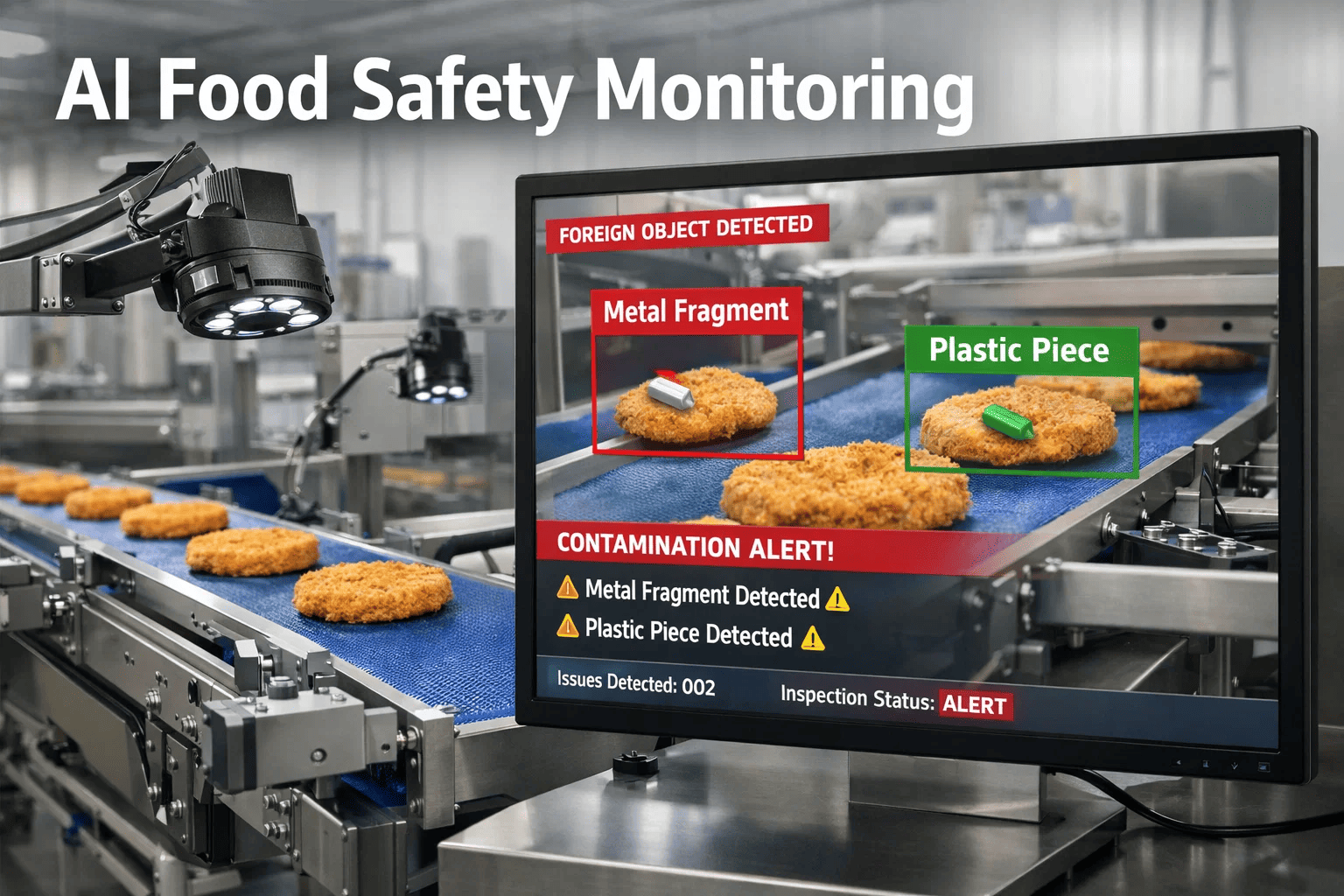
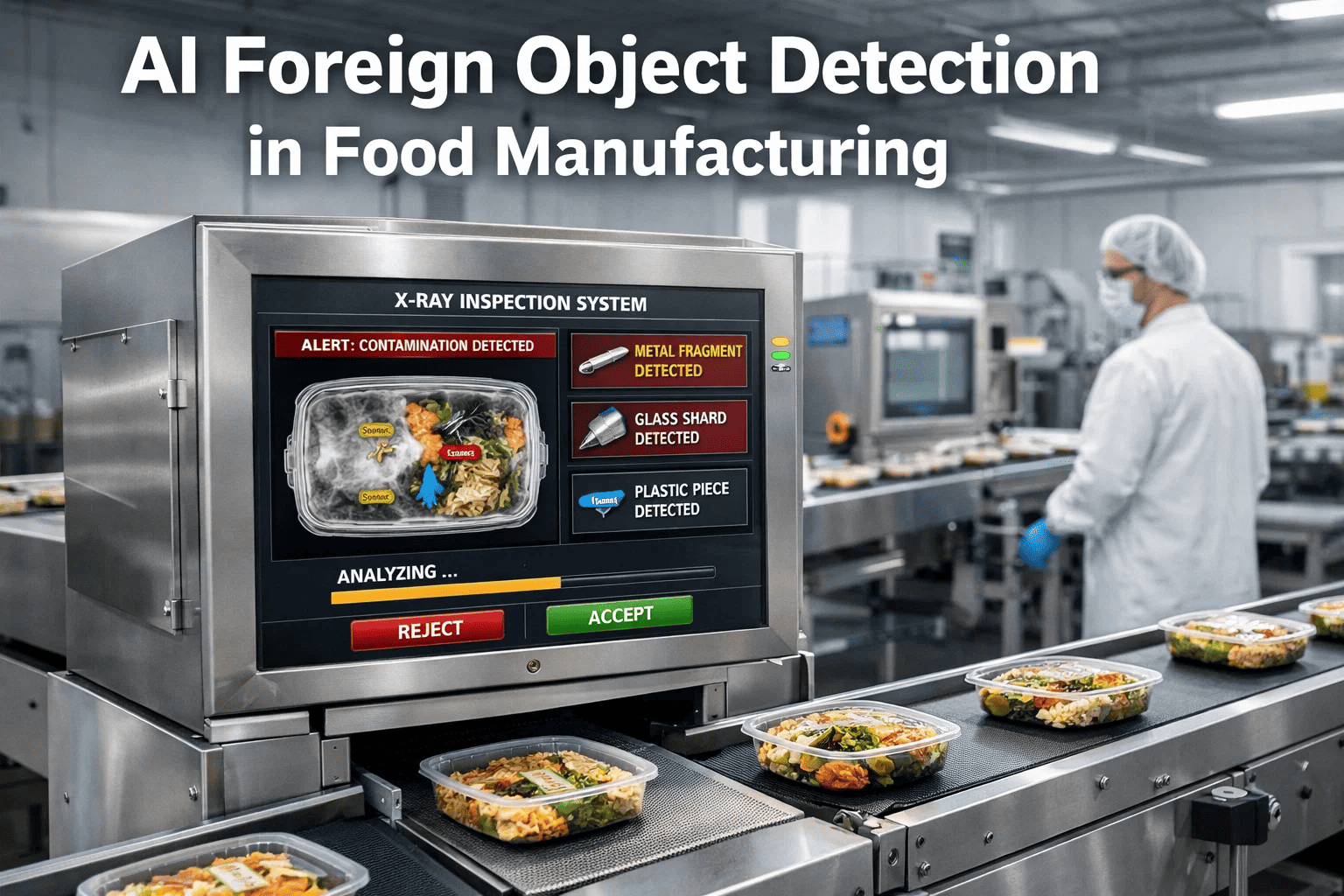
Metal fragments, glass shards, plastic pieces, bone, stone, wood, and insects. X-ray imaging detects objects as small as 0.5mm inside opaque packaging. Hyperspectral imaging identifies organic contaminants invisible to standard cameras.
X-ray + Hyperspectral
Allergen Cross-Contact
Residual allergen traces after changeover — detected through fluorescence imaging that reveals protein residue invisible to the naked eye. Catches incomplete cleaning on conveyor surfaces, filler nozzles, and mixing blades before the next SKU runs.
UV Fluorescence
Microbial Contamination Indicators
AI cannot detect bacteria directly, but identifies visual precursors — biofilm formation patterns, abnormal discoloration, moisture accumulation, and surface texture changes that correlate with microbial growth. Triggers immediate sanitation intervention.
Multispectral + AI
Packaging Integrity Failures
Micro-leaks in heat seals, incomplete closures, damaged tamper bands, and pin-hole perforations. Infrared imaging measures seal width to ±0.3mm tolerance across the full package perimeter — catching leaks that will cause spoilage or contamination post-packaging.
Infrared Imaging
Label & Compliance Errors
Wrong allergen declarations, incorrect nutritional panels, missing expiry dates, wrong-SKU labels applied after changeover. OCR reads every character on every label against the master SKU database in real time — catching errors within 3 units of a changeover.
OCR + Machine Vision
Fill Level & Weight Deviations
Underfill and overfill detection through X-ray volume measurement that works through opaque packaging — catching deviations that checkweighers miss when product density varies. Confirms inserts, scoops, and promotional items are present.
X-ray Volumetric
Cosmetic & Structural Defects
Surface contamination, color deviation (Delta-E <2.0), print registration errors, package damage from dents or crushes. Spectrophotometric analysis ensures brand consistency across every unit produced.
RGB + Spectro
The critical advantage is simultaneous multi-threat detection. A human inspector looking for foreign objects is not simultaneously checking allergen declarations and measuring seal integrity. AI vision systems run all seven detection algorithms on every unit, every time — nothing is traded off because attention is finite. This is why AI detection rates remain at 99.5%+ while human rates degrade with each additional defect type they are asked to watch for.
How AI Vision Connects to Maintenance: The Closed Loop
AI quality control is not just a quality tool — it is the most powerful equipment health sensor in your plant. When defect rates spike, the root cause is almost always equipment degradation that maintenance can fix before it produces a recall-worthy defect escape. The closed loop between vision data and CMMS transforms quality events into predictive maintenance intelligence.
1
Camera Detects Trend
Seal width drifting from 8.0mm toward 7.2mm over 200 consecutive units
2
AI Correlates Root Cause
Seal jaw temperature dropping + cycle count matches wear pattern at 89% confidence
3
CMMS Auto-Generates WO
"Replace seal jaw — projected failure in 4 hours" with parts location and priority
4
Planned Repair at Changeover
Zero unplanned downtime, zero defective product shipped, root cause documented
This closed loop is the fundamental shift AI vision enables: quality data becomes maintenance intelligence. Every defect image, every trend anomaly, every reject spike tells the maintenance team something specific about equipment health — weeks or months before catastrophic failure would have produced contaminated product reaching consumers.
Vision-to-Maintenance Closed Loop
Every Defect Tells Your Maintenance Team Something
OxMaint connects AI vision defect data directly to predictive maintenance — so seal drift triggers jaw replacement, label errors trigger labeler calibration, and fill deviations trigger nozzle inspection. Automatically.
Automated SPC: The Second Layer of AI Quality
AI vision catches individual defects. Automated Statistical Process Control (SPC) catches process drift — the gradual, invisible shift in process parameters that precedes contamination events by hours or days. Together, they create a quality system that is both reactive (catching defects now) and predictive (preventing defects tomorrow).
Sampling frequency
1 in 500 units
Every unit — 100%
Drift detection speed
Hours to days
Under 60 seconds
Out-of-control response
Operator judgment call
Auto-alert + auto-stop
Data integrity
Paper charts — gaps common
Digital — tamper-proof audit trail
Root cause correlation
Manual investigation after event
AI links drift to equipment cause in real time
Regulatory compliance
Requires manual compilation
Auto-generated reports per HACCP/SQF
The most valuable SPC capability is real-time drift detection. Manual SPC sampling at 1-in-500 means 499 units can be produced out-of-spec before the next check catches the drift. Automated SPC monitoring every unit detects process deviation within 30–60 seconds — reducing the window of at-risk production from hours to under one minute. In contamination prevention, that difference is the difference between quarantining 50 units and recalling 50,000.
The Economics: Investment vs. Recall Risk
Food manufacturers often frame AI quality control as a large capital investment. The correct frame is insurance against catastrophic loss — with the bonus of operational savings that make the insurance free.
Prevented recall exposure
$7.5M/yr
Waste/scrap reduction
$320K/yr
Inspector reallocation
$240K/yr
Complaint reduction
$180K/yr
Insurance premium savings
$85K/yr
AI vision system cost (5 lines)$180,000
Year 1 value delivered$8.3M+
46x ROI — Even Without a Prevented Recall, Operational Savings Alone Deliver 4.6x
Even if you exclude the recall prevention value entirely and only count operational savings ($825K/yr), the system pays for itself in under 3 months. The recall prevention is the real value — but it is the operational savings that make the investment decision easy because they are certain and measurable from day one.
Implementation: 8 Weeks From Camera to Production
Week 1–2
Line Assessment & Camera Design
Audit existing inspection points, identify highest-risk line, design camera positions for each contamination type. Select imaging technology per defect category. No production disruption — cameras mount beside the line.
Week 3–4
Install & Train AI Models
Install cameras, lighting, and edge processing during a planned changeover. Train AI models on your products — 500–2,000 images per SKU. System runs in shadow mode alongside human inspectors for validation.
Week 5–6
Validate & Connect to CMMS
Compare AI vs human catch rates in shadow mode — typical result: AI catches 25–40% more defects. Connect defect data feed to OxMaint for maintenance correlation. Configure automated work order triggers.
Week 7–8
Go Live & Scale
Go live with automated reject on pilot line. AI models improve continuously — accuracy rises from 99.0% to 99.5%+ as the system learns your failure modes. Plan expansion to remaining lines based on validated results.
Frequently Asked Questions
AI Vision Inspection Integration
Every Unit Inspected. Every Defect Caught. Every Root Cause Traced.
8 Weeks
to production deployment
Trusted by food and beverage manufacturing teams worldwide. No credit card required.