AI & Robotic Vision Quality Control in FMCG Manufacturing: Reduce Defects 30-45%
By Jacob on March 6, 2026
A multinational snack manufacturer in Maharashtra was shipping 14,000 units per hour through a legacy optical
inspection system that missed 23% of packaging seal defects — generating 340+ consumer complaints monthly and
triggering two retailer delistings in a single quarter. After deploying AI-powered robotic vision across three
production lines, defect escape rate dropped from 2,400 ppm to 180 ppm within 60 days — a 92% improvement. Across
the FMCG sector, AI and robotic vision quality control systems are now delivering 30–45% total defect reduction
while inspecting 100% of units at line speed, compared to human inspectors who sample 2–5% of output and miss 18–35%
of defects even within those samples. For maintenance teams, these systems create an entirely new asset category
requiring specialized upkeep — but also generate equipment health data that prevents production quality failures
before they start. Start your free trial to manage robotic
vision assets alongside your entire production line, or book a demo to see AI anomaly detection integrated with maintenance workflows.
30–45%
Total Defect Reduction with AI Vision vs Manual Inspection
99.7%
Detection Accuracy for AI Vision at Full Line Speed
$18B
Annual FMCG Losses from Quality Defects Reaching Consumers
0.02s
Per-Unit Inspection Time — Zero Production Slowdown
What Is AI-Powered Robotic Vision Quality Control?
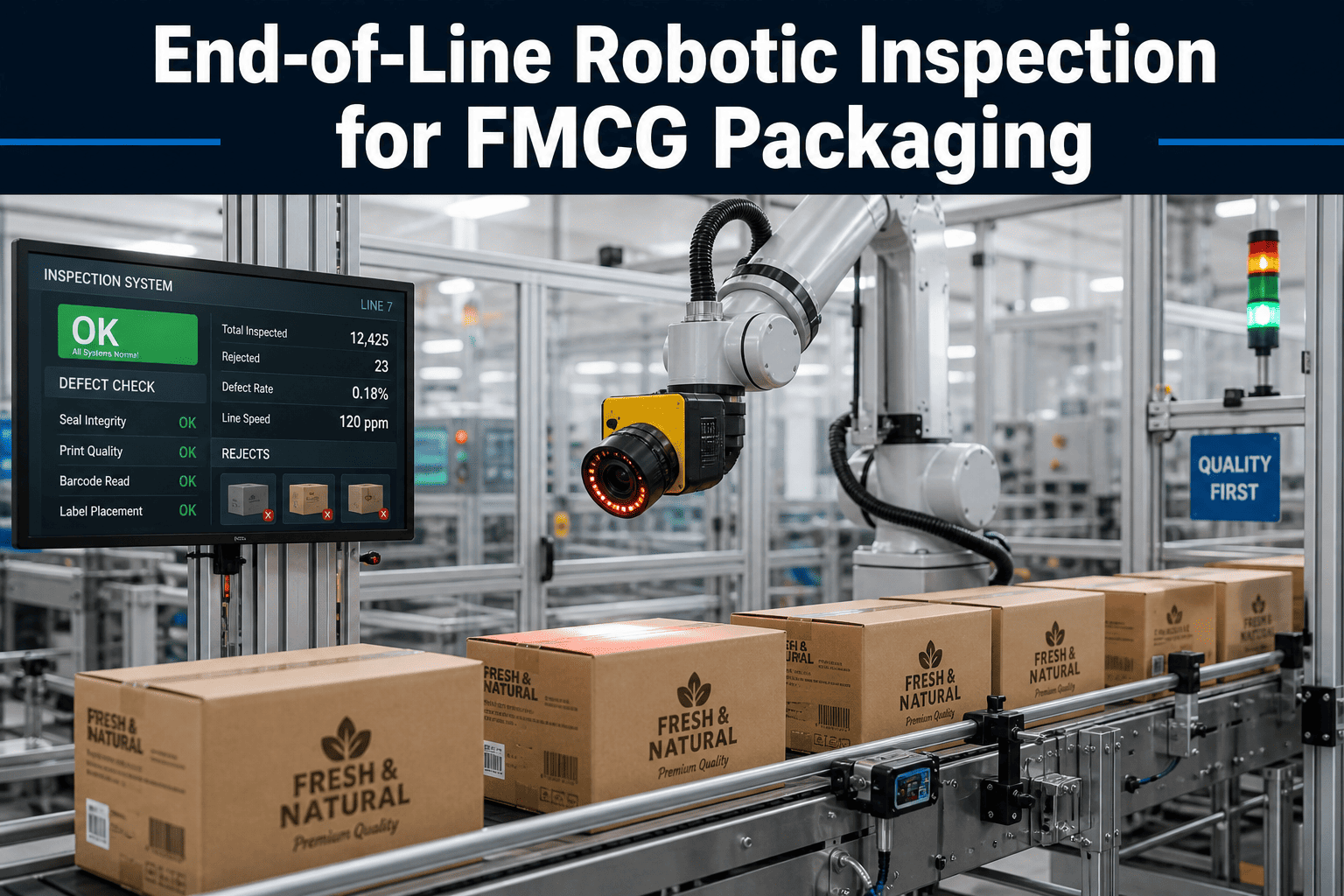
AI robotic vision quality control combines high-speed industrial cameras with deep learning algorithms deployed on
robotic inspection platforms — creating systems that see, analyze, and classify every unit on the production line in
real time. Unlike rule-based machine vision that checks against fixed templates, AI vision learns what "good" looks
like from millions of training images and detects anomalies that no human inspector or static algorithm would catch.
These systems inspect 100% of production output at speeds exceeding 1,200 units per minute, with detection accuracy
rates of 99.5–99.8% across defect categories including dimensional variance, surface contamination, label
misalignment, seal integrity, fill level, and color consistency.
Human Inspection vs AI Robotic Vision
Why manual quality control cannot keep pace with modern FMCG line speeds
Manual / Legacy Optical
Inspection Coverage
2–5% Sample Per Batch
Detection Accuracy
65–82% (Degrades with Fatigue)
Defect Classification
Binary Pass/Fail — No Root Cause
Feedback to Production
End-of-Batch Report — Hours Later
AI Robotic Vision
Inspection Coverage
100% of Every Unit at Line Speed
Detection Accuracy
99.5–99.8% (Consistent 24/7)
Defect Classification
Multi-Class with Equipment Attribution
Feedback to Production
Real-Time Alert in Under 200ms
Net Quality Improvement: 30–45% Fewer Defects Reaching
Consumers
Six Defect Categories AI Vision Catches That Human Inspectors Miss
Each defect category below has a documented miss rate for manual inspection versus AI detection. Across these six
categories, AI robotic vision eliminates the inspection gaps that generate consumer complaints, retailer
chargebacks, and brand reputation damage.
AI Vision Defect Detection Framework
Seal Integrity Failures
Human Miss Rate: 28%
Micro-channel leaks, incomplete seals, and contamination in seal zones invisible
to naked eye but detected via hyperspectral imaging at 0.1mm resolution
Label Misalignment
Human Miss Rate: 34%
Rotation variance, skew, wrinkle, and registration errors measured against 0.5mm
tolerance — AI detects cumulative drift before it exceeds spec
Fill Level Variance
Human Miss Rate: 41%
Under-fills and over-fills detected within 0.5ml accuracy using X-ray and
gamma-ray vision — catching filler nozzle degradation before compliance breach
Surface Contamination
Human Miss Rate: 52%
Foreign particle detection on product surfaces using UV fluorescence and
multi-spectral cameras — spots contamination as small as 50 microns
Color and Print Defects
Human Miss Rate: 38%
Delta-E color variance measurement, barcode readability scoring, and print smear
detection — identifying ink system degradation trends over time
Dimensional and Shape Errors
Human Miss Rate: 45%
3D vision systems measuring product geometry against CAD models — detecting
mould wear, forming die degradation, and tooling misalignment at 0.1mm
Why Quality Equipment Maintenance Is the Foundation of Defect Prevention
AI vision systems catch defects — but 78% of recurring defect patterns trace back to equipment degradation that
proper maintenance would have prevented. The most powerful quality strategy combines AI detection with predictive
equipment maintenance.
Six Equipment-Driven Quality Failures AI Vision Traces to Root Cause
!
Worn Filler Nozzles
AI detects fill variance trending upward over 3–5 days — attributing the pattern
to specific nozzle positions and triggering replacement work orders before batch rejection
!
Seal Bar Temperature Drift
Vision systems detect micro-seal failures increasing from 0.02% to 0.8% over a
shift — correlating with heat element degradation and generating PM alerts
!
Label Applicator Misalignment
Cumulative label drift of 0.3mm per 1,000 units detected by AI — indicating
bearing wear or belt tension loss in the applicator before human-visible misalignment
!
Mould Cavity Degradation
3D vision measures dimensional drift across specific cavities — identifying
which moulds need polishing or replacement 2–4 weeks before out-of-spec production
!
Conveyor Speed Instability
Vision timing analysis detects 2–3% speed variations from drive belt wear —
causing inconsistent product spacing that affects downstream filling and sealing accuracy
!
Print Head Degradation
AI color analysis detects delta-E drift in batch codes and branding elements —
triggering print head cleaning or replacement before regulatory non-compliance
How Oxmaint Connects AI Quality Data to Maintenance Action
When vision system defect data routes directly into your maintenance platform, every quality anomaly becomes a
predictive maintenance signal. Oxmaint closes the loop
between detection and prevention.
AI vision classifies every defect by type, severity, and position
Defect frequency trends tracked per equipment station
Statistical process control charts auto-generated per shift
Output: Equipment-Attributed Defect Map
02
Root Cause Attribution
Correlate defect patterns with specific machines and components
ML models identify which wear patterns produce which defects
Historical failure data refines attribution accuracy over time
Output: Predictive Quality Alerts
03
Auto-Generated Work Orders
Defect threshold breach triggers maintenance work order in Oxmaint
Work order includes defect images, trend data, and part numbers
Priority assigned by defect severity and production impact
Output: Zero Manual Reporting
04
Closed-Loop Verification
Post-maintenance defect rates measured against pre-repair baseline
Repair effectiveness scored to identify chronic vs resolved issues
Continuous model improvement from maintenance outcome data
Output: Verified Quality Recovery
ROI of AI Robotic Vision Quality Control for FMCG
The financial case combines defect reduction, complaint elimination, recall prevention, and the maintenance
intelligence that stops quality problems at their equipment source.
Annual ROI: AI Vision Quality + Maintenance Integration
89% fewer quality complaints through 100% inspection — eliminating retailer
chargebacks and delisting risk
$540K
Scrap and Rework Reduction
Early defect detection reduces waste by 35% — catching problems at source
instead of end-of-line rejection
$380K
Recall Prevention Value
Average FMCG recall costs $10M+ — AI vision reduces recall risk by 92% through
complete traceability
$920K
Maintenance-Driven Quality Savings
Equipment defect attribution prevents 78% of recurring quality issues through
targeted PM interventions
$290K
Total Annual Value Delivered
$2.13M
AI vision system investment: $250K–$500K per line. Payback achieved in 4–7 months from
complaint reduction alone.
92%
Reduction in Product Recall Risk with Full Vision Coverage
89%
Fewer Consumer Complaints After AI Inspection Deployment
78%
Recurring Defects Eliminated via Equipment Root Cause Fixes
4–7mo
Typical Payback Period for AI Vision Investment
Frequently Asked Questions
How does AI vision achieve 99.7% accuracy when human inspectors average 65–82%?
AI vision systems use deep learning models trained on 500,000–2,000,000 labeled product
images spanning every defect type encountered on the production line. These convolutional neural networks
process each unit in 15–20 milliseconds, analyzing 50+ quality parameters simultaneously — dimensions,
color, texture, label position, seal integrity, fill level, and surface condition. Unlike human inspectors
who fatigue after 20–30 minutes (reducing accuracy by 15–25%), AI maintains consistent 99.5–99.8% accuracy
across all shifts. The system also improves continuously, learning from new defect types that production
changes introduce. Start free to integrate vision
system data with your maintenance workflows.
What maintenance do AI robotic vision systems themselves require?
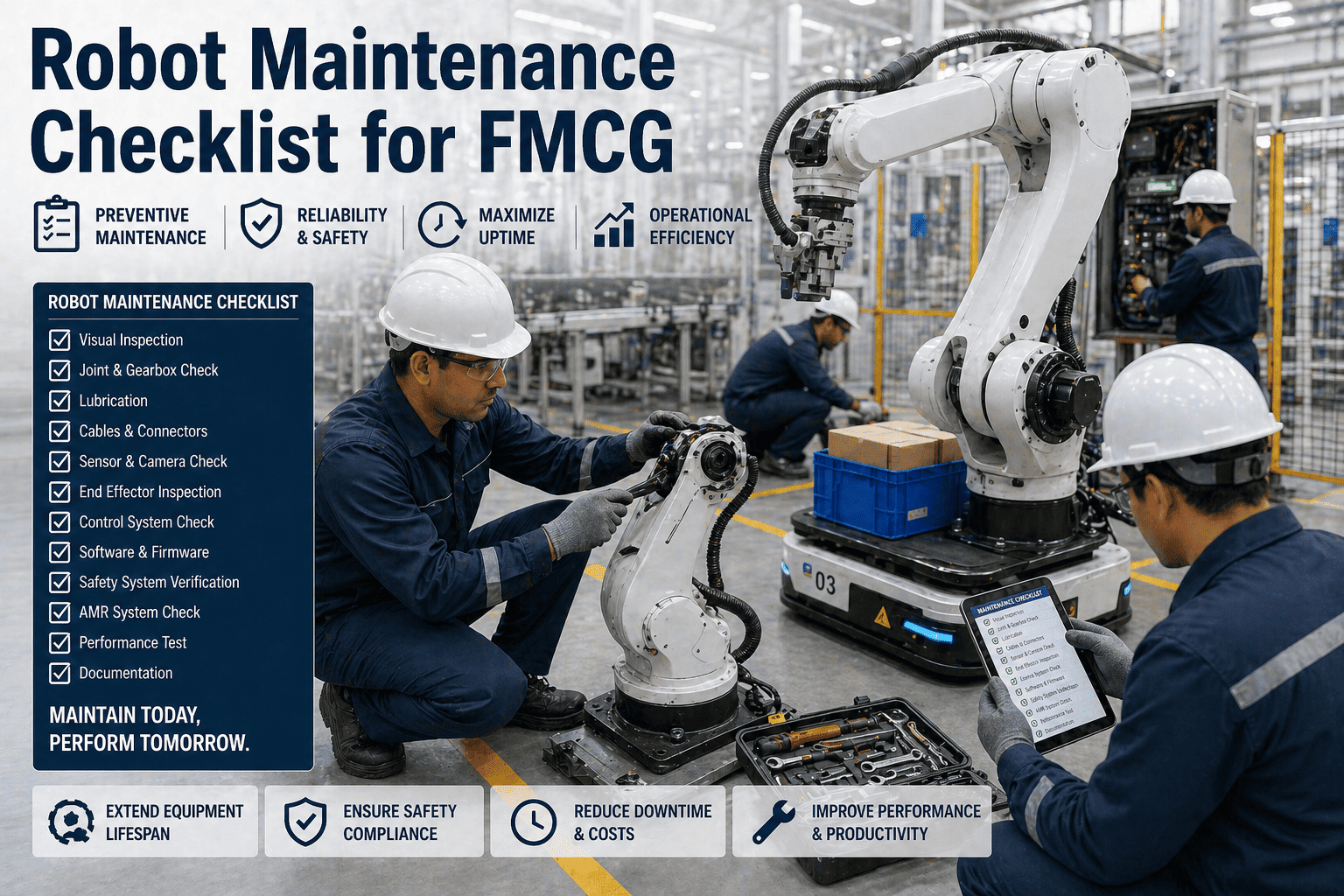
Robotic vision systems need four maintenance categories: optical cleaning (camera lenses
and lighting arrays — weekly), calibration verification (dimensional and color accuracy — monthly),
mechanical inspection (robotic arm joints, cable management, mounting stability — quarterly), and software
updates (model retraining, firmware patches — as released). Total PM time averages 2–4 hours per month per
station. Oxmaint manages these inspection assets alongside production equipment, scheduling vision system PM
during the same production gaps to minimize total maintenance downtime.
How does the system attribute defects to specific equipment stations?
AI vision systems track defect location on the product (top seal, bottom label, fill
level, surface zone) and correlate with the known equipment station sequence. When seal defects increase
specifically on sealer station 3 but not stations 1, 2, or 4 — the system attributes the pattern to station
3's heat element or pressure mechanism. Over time, machine learning models build equipment-specific defect
signatures: a particular vibration pattern in a filler produces a distinctive splash mark that the vision
system recognizes and attributes to pump bearing wear in that specific filler head.
Can AI vision detect quality problems caused by raw material variations?
AI vision systems distinguish between equipment-caused and material-caused defects by
analyzing defect distribution patterns. Equipment defects appear on specific stations — material defects
appear uniformly across all stations simultaneously. When incoming film stock has inconsistent thickness,
the vision system detects seal failures increasing across all sealers at the same time and flags a material
quality alert rather than an equipment maintenance alert. This distinction prevents unnecessary equipment
teardowns and directs quality teams to supplier management actions instead. Book a demo to see equipment vs
material defect attribution in action.
Your Vision Systems See Every Defect. Now Make Your Maintenance Team Fix the Cause.
Oxmaint converts AI vision defect data into equipment-specific maintenance actions —
so your team replaces a worn filler nozzle during a planned window instead of scrapping 4,000 under-filled
units at end of shift.



-in-fmcg-monitoring-production-quality-in-real-time.png)

