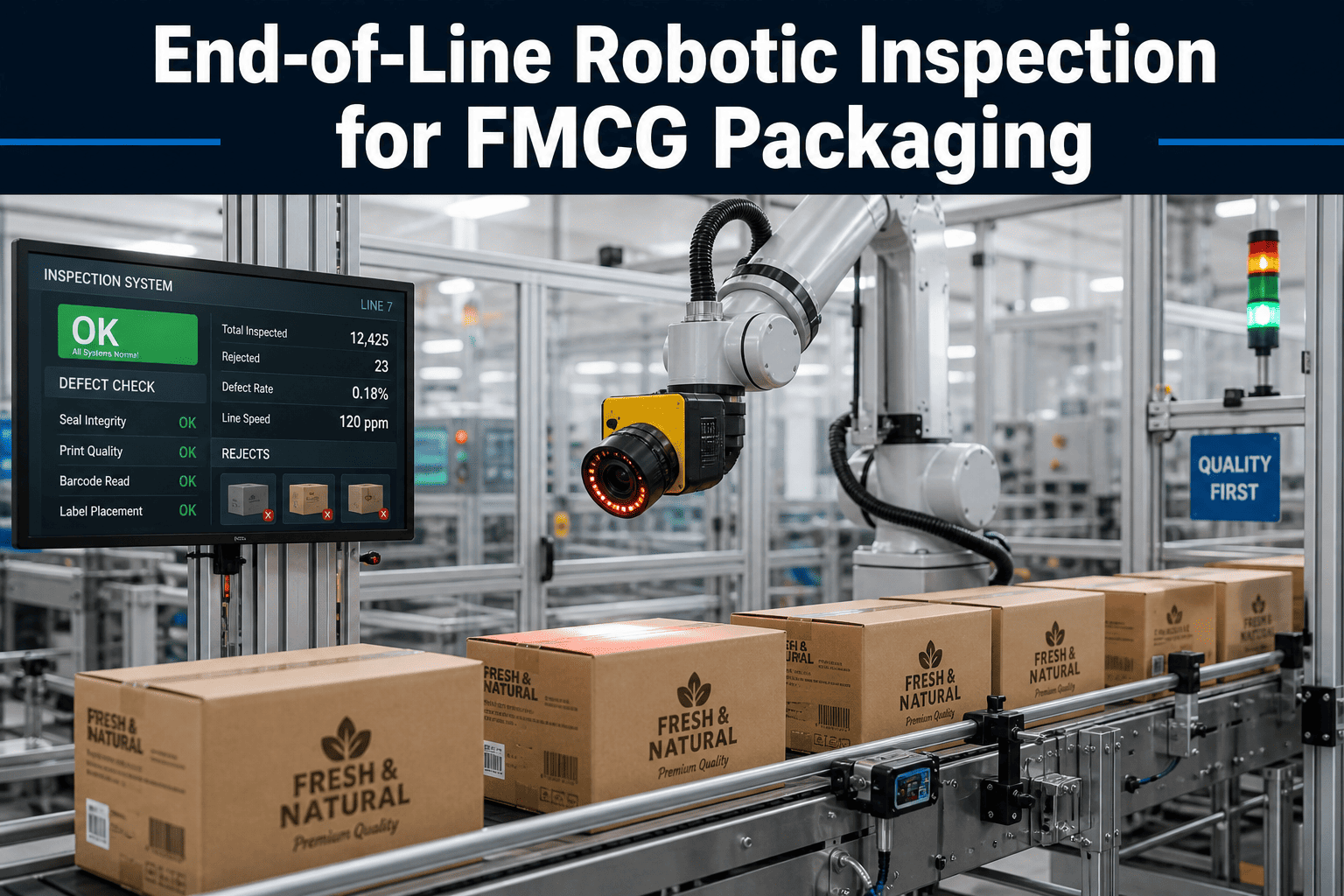
A high-speed FMCG packaging line moves 1,200 units past a quality station every minute. That gives a human inspector exactly 50 milliseconds per pack to spot a 2mm label shift, a hairline seal gap, a wrong-SKU mismatch after a changeover, or a barcode that grades B instead of A. The honest answer is that nobody can do that reliably. Sandia National Laboratories analysed decades of inspection data and found that even highly trained inspectors miss 20 to 30% of defects across virtually every task type — and labelling and packaging inconsistencies alone account for around 40% of FMCG product rejections in the US and EU. Robotic vision systems running deep-learning models now hit 99.8% defect detection accuracy at full line speed, catch surface flaws as small as 0.1mm, and cut recall events by up to 75% on documented deployments. If you want to see how OxMaint connects vision-system data to the maintenance work orders that prevent these defects from recurring, you can start a free trial or book a 30-minute walkthrough with a vision-and-maintenance specialist.
Quality Control / Robotics & Vision
Robotic Vision Quality Control for FMCG Defect Detection
Why deep-learning vision is replacing manual inspection on FMCG packaging lines — what defects it catches that humans cannot, and how maintenance discipline keeps the system honest.
99.8%
CNN vision accuracy at line speed
75%
Reduction in recall events
42%
FMCG recalls from labelling errors
0.1mm
Minimum defect size detectable
20–30%
Defects missed by human inspectors
See Vision QC + Maintenance Closed-Loop in 30 Minutes
Walk through how a defect detected at the camera triggers a root-cause work order, equipment alert, and corrective task automatically — closing the loop between quality and maintenance instead of leaving them as separate problems.
What Robotic Vision QC Actually Means in 2026
Robotic vision QC is the combination of high-resolution cameras, edge-AI compute, deep-learning models, and physical reject mechanisms that together inspect every single unit on a production line — not a 5% sample. Modern systems make accept-or-reject decisions in milliseconds at 1,000 to 1,500 units per minute, run convolutional neural networks (CNNs) trained on millions of labelled defect images, and feed results back to the line for self-correction. They are not faster human eyes — they are a different category of inspector that sees what humans physically cannot.
Layer 1
Imaging hardware
Industrial cameras, structured lighting, telecentric lenses, and sometimes infrared or hyperspectral sensors. The hardware sees the unit. Quality of imaging upstream sets the ceiling on every model downstream.
Layer 2
Edge AI compute
In 2026 most FMCG vision sits on the factory floor — Edge AI rather than cloud. Local processing returns an accept-reject decision in milliseconds, which is the only way to keep up with a 1,200-unit-per-minute filler.
Layer 3
Deep-learning models
CNNs and YOLO variants learn what defects look like from training data, then generalise to variations they have never seen. Unlike rule-based machine vision, they do not break the first time the lighting changes or a label artwork is updated.
Layer 4
Reject & feedback loop
Pneumatic pushers, robotic sorters, or air-blast rejectors divert defective units without stopping the conveyor. Defect data feeds back to MES, ERP, QMS — and to the CMMS, where it triggers maintenance work orders before a drift becomes a recall.
Defect Categories CNN Vision Catches That Humans Cannot
CNN vision is not just faster than a human inspector — it sees a different layer of reality. Each defect category below uses different imaging modes and trained models. The dimensions in italics are the physical limits humans cannot reliably resolve at production speed. Want to see this on your own packaging? Start a free trial or book a demo.
A
Labelling & Artwork Errors
Wrong-SKU labels after a changeover, allergen panel mismatches, label skew above 1mm, wrinkled artwork, expiry date errors, and barcode grade drift. Resolution typically 0.5mm or better.
Cause of ~42% of FMCG recalls
B
Seal & Closure Integrity
Heat-seal width drift, hairline seal gaps, contaminated seal lines, and cap-torque inconsistency. Infrared imaging finds micro-leaks invisible to the naked eye. Seal-width tolerance ±0.3mm.
Prevents leakage and shelf-life failure
C
Fill Level & Headspace
Underfills, overfills, foam misreads, and fill-line variation across multi-head fillers. Vision systems verify every bottle, not a sample, against the specification window for each SKU on the line.
Catches filler-head drift early
D
Surface & Print Defects
Scratches, dents, smudges on printed surfaces, fading, missing print, and registration errors across colour passes. Models reliably resolve flaws to 0.1mm at production speed.
Below human visual perception threshold
E
Foreign Body & Contamination
Hyperspectral imaging detects foreign particles and contamination invisible to standard cameras and to the naked eye. Critical in food, beverage, dairy, and confectionery production where contamination triggers immediate recall.
Prevents the most expensive recalls
F
Assembly & Component Verification
Missing components, wrong-orientation caps, missing inserts in cosmetics packs, and misaligned components in multi-pack and combo formats. Vision confirms every unit assembles correctly, not the first one tested.
Eliminates downstream rework
Why Manual Inspection Has Quietly Stopped Working
This is not a critique of inspectors — they are doing a task that human biology no longer permits at modern line speeds. The breakdown happens in six predictable places. Once a quality manager sees them all together, the case for vision QC stops being a debate.
10–12
images/sec
Human visual processing rate
Human visual processing peaks at 10 to 12 images per second. Modern packaging lines produce 20+. The arithmetic does not work — it has nothing to do with effort or training.
15%
accuracy drop by 10:30 a.m.
Visual fatigue arrives fast
Detection accuracy falls measurably after 20 to 30 minutes of continuous visual monitoring. By Friday afternoon, missed-defect rates climb steeply. Vision systems do not have Mondays or Fridays.
35%
false alarm rate
Subjective rejection
Different inspectors classify identical defects differently — studies document 35% false-alarm rates that scrap good product. Vision applies one criterion to every unit, every shift.
5%
typical sample rate
95% of units never inspected
Manual inspection rarely covers more than a sample. Vision systems inspect 100% of units at line speed — defects in the unsampled 95% no longer ship to retailers and consumers.
USD 10M+
average recall cost
Single-event exposure
FMCG recall events cost roughly USD 10 million to USD 100 million each. One prevented recall typically pays back the entire vision-system investment several times over.
75%
spike in recalls (2021)
Regulatory pressure rising
Recalls in food, beverage, and cosmetics surged 75% in 2021 — and have stayed elevated. Regulators expect 100% inspection traceability that manual systems structurally cannot provide.
How OxMaint Closes the Loop Between Vision and Maintenance
Most defect spikes are not random. They are the visible symptom of equipment drift — a worn seal jaw, a drifting filler head, a misaligned labeller, a contaminated print head. A vision system that just rejects defective units misses the underlying signal. OxMaint connects the camera output to the maintenance system, so the equipment that caused the defect gets repaired before the next shift produces more of them. To see this in your environment, start a free trial or book a demo.
1
Camera detects pattern
Seal-width drifts from 8.0mm toward 7.2mm across 200 consecutive units. The drift is invisible to a human inspector but unmistakable to a CNN tracking dimensional consistency in real time.
2
OxMaint receives the signal
The vision system pushes the trend and asset ID to OxMaint over a webhook or REST API. The system identifies the affected sealer, its maintenance history, and the responsible technician — automatically.
3
Work order raised + alerts sent
A maintenance work order is created with the defect trend, root-cause hypothesis, recommended parts, and full asset history attached. The line supervisor and shift maintenance lead are notified before the next pallet completes.
4
Repair + audit trail closed
The technician completes the repair on mobile, photos and parts logged. The vision-trend data, work order, and post-repair verification stay linked permanently — audit-ready, traceable, and feeding the next predictive model.
Manual QC vs Robotic Vision QC — The Honest Comparison
Side-by-side on the dimensions that actually matter to a quality manager and a plant manager. No marketing softening on either column.
The ROI Picture — Where Robotic Vision Pays For Itself
A documented FMCG vision deployment typically pays back in 6 to 14 months. The economics rest on four buckets, in roughly the order they appear in the financials post go-live.
Recall Prevention
USD 10M+
Average FMCG recall cost. One prevented event typically justifies the full system investment several times over. Mislabelling alone causes 42% of recalls — and is the easiest defect category for vision to eliminate.
Quality Escapes Reduced
75%
Reduction in defects that reach customers. Customer complaint volume, retailer chargebacks, and social-media risk all compress in the first quarter after go-live, before any other layer of saving lands.
Label-Error Recall Drop
45%
Documented reduction in label-error-driven recall events. OCR validation against the master SKU database catches the wrong-SKU mismatch within three units of a changeover — before a single mislabelled case reaches the pallet.
Payback Window
8–14 mo
Typical payback on FMCG packaging-line vision deployments. Faster on lines with recent recall exposure or high SKU mix; slightly slower on stable, single-SKU lines with mature inspection programmes already in place.
Frequently Asked Questions
Can robotic vision really inspect every unit at full FMCG line speed?
Yes — modern Edge AI vision systems run inspections at 1,000 to 1,500 units per minute, returning accept or reject decisions in milliseconds. The inspection is 100% coverage, not a sample. The rate-limiting factor is camera and lighting design, not the AI model.
How do CNN vision systems handle the constant artwork and SKU changes typical in FMCG?
Deep learning models generalise to variations they have not seen during training. New artwork or a label update typically requires retraining only on the new defect classes — not a full system rebuild.
Book a demo to walk through how this works for your SKU portfolio.
Does the vision system replace our quality team or work alongside them?
It works alongside them. Vision handles 100% inspection at line speed; the quality team focuses on root-cause investigation, supplier quality, and continuous improvement — the work that actually moves quality KPIs and that humans are uniquely good at.
Why does maintenance matter to a vision QC programme?
Most defect spikes are caused by equipment drift — worn seal jaws, drifting filler heads, contaminated print heads. Without a maintenance system that receives the vision signal and triggers a work order, the underlying equipment problem keeps producing defects until somebody notices.
Start a trial to see the closed loop in OxMaint.
Can vision systems integrate with our existing cameras and PLCs?
In most cases, yes — deep learning models can run on existing camera infrastructure with software upgrades and an Edge AI compute module. Reject mechanisms typically integrate with existing PLCs via standard digital outputs, and data flows up to MES, ERP, QMS, and CMMS over REST APIs and OPC UA.
What is the typical payback on a vision QC investment?
Documented FMCG payback windows fall in the 6 to 14 month range, primarily driven by recall prevention, 75% reduction in quality escapes, 45% reduction in label-error recalls, and the elimination of subjective false-alarm scrap. Lines with recent recall exposure or high SKU mix tend to fall at the faster end.
Stop Catching Defects At The Customer
A defect that reaches the consumer is a recall waiting to happen. A defect rejected at the line is just data. Robotic vision QC plus closed-loop maintenance turns every unit on your line into a defended one — and turns every drift in your equipment into a work order, before the recall.