AI-Driven Supply Chain Optimization for FMCG: Reduce Stockouts by 65%
By Jonas on March 7, 2026
A personal care manufacturer in Texas was losing $4.2 million annually to stockouts on its top 15 SKUs — not because demand was unpredictable, but because its supply chain planning ran on 90-day rolling averages that couldn't detect a promotional surge, a seasonal spike, or a competitor's out-of-stock event until 3–4 weeks after it started. By the time the replenishment signal reached the warehouse, shelves were already empty. Simultaneously, the company was sitting on $6.8 million in excess inventory of slow-moving SKUs that the same planning model kept overordering. The warehouse was full of the wrong products. AI-driven demand forecasting replaced the rolling average with a model analysing 47 demand signals — POS data, weather, promotions, social media sentiment, competitor pricing — and reduced stockouts by 62% in the first 6 months while cutting excess inventory by 34%. FMCG companies using AI supply chain tools report 65% fewer stockouts and 10–15% lower warehousing costs within the first year. Start your free trial today or schedule a 30-minute demo to see how Oxmaint's AI inventory platform works for FMCG supply chains.
Traditional vs. AI-Driven FMCG Supply Chain Performance
How AI demand forecasting and warehouse automation transform inventory accuracy, fill rates, and operating costs
Traditional / Manual Planning
Demand Forecast Accuracy
55–68% at SKU Level
Stockout Rate (Top SKUs)
8–15% of Selling Days
Excess Inventory Carrying Cost
18–25% of Inventory Value/Year
Order Fulfillment Accuracy
92–96% (Manual Pick/Pack)
AI-Powered with Oxmaint
Demand Forecast Accuracy
85–94% at SKU Level
Stockout Rate (Top SKUs)
2–5% of Selling Days (65% Reduction)
Excess Inventory Carrying Cost
8–14% of Inventory Value/Year
Order Fulfillment Accuracy
99.2–99.8% (AMR-Assisted)
Average Annual Value for a Mid-Size FMCG Operation: $2.8M–$5.4M
Why Traditional FMCG Supply Chains Can't Keep Up
FMCG supply chains face a unique challenge: high volume, low margin, short shelf life, and demand patterns that shift weekly based on promotions, weather, competitor actions, and social trends. Traditional planning tools — spreadsheet-based forecasts, safety stock buffers, and manual reorder points — were designed for stable demand environments. FMCG is anything but stable. The result: 8–15% stockout rates on top SKUs costing $3.2 million in lost sales per $100 million in revenue, while simultaneously carrying $4–8 million in excess inventory of products nobody is buying this week.
Six Root Causes of FMCG Supply Chain Failure
Backward-Looking Forecasts
55–68%
SKU-level accuracy from rolling averages — misses promotions, weather shifts, and competitor events by 3–4 weeks
No Demand Signal Integration
4+ Weeks
Lag between POS demand shift and replenishment action — shelves empty before planners react
Siloed Planning Systems
4–6
Disconnected systems for demand, inventory, warehouse, logistics — no unified optimization across the chain
Manual Warehouse Operations
92–96%
Order accuracy from manual pick/pack — each 1% error rate costs $380,000/yr in returns and corrections
Safety Stock Guesswork
$4–8M
Excess inventory from over-buffering — tied-up capital earning 0% while warehouse costs compound at 18–25%/yr
Slow Replenishment Cycles
7–14 Days
Order-to-shelf lead time — in FMCG, a 2-day stockout on a top SKU costs more than a full year of carrying cost
How AI-Driven Supply Chain Optimization Works
AI supply chain optimization isn't a single tool — it's a four-layer intelligence stack that ingests real-time demand signals, predicts future requirements at the SKU level, auto-optimizes inventory positioning, and coordinates warehouse execution through autonomous mobile robots. Each layer compounds the accuracy of the layer above it.
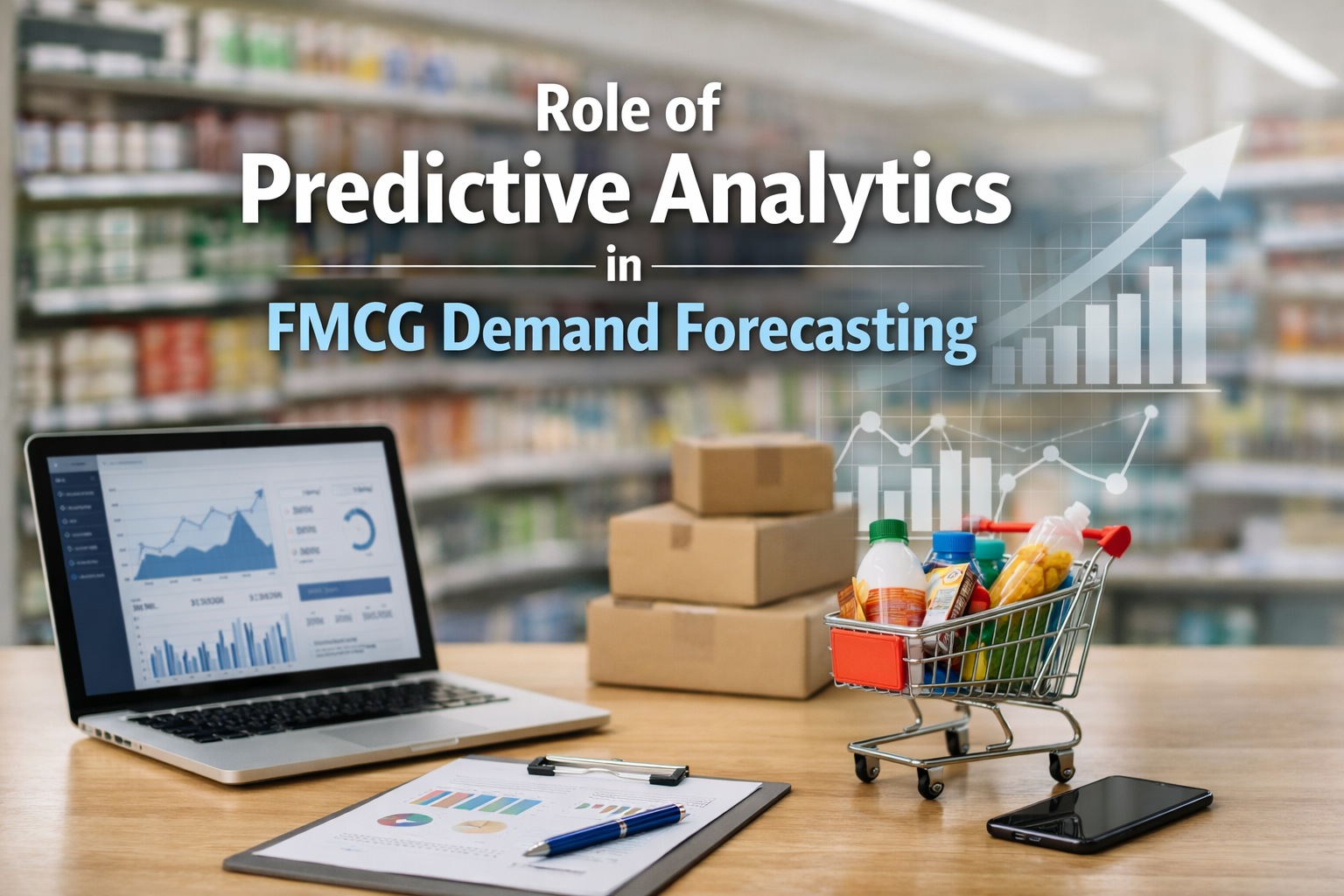
AI Demand Forecasting: The Engine Behind 65% Fewer Stockouts
Traditional forecasting uses 3–5 data inputs (historical sales, seasonality, trend). AI forecasting ingests 40–60 signals simultaneously and learns which combinations predict demand shifts for each specific SKU-location pair. The result isn't just a more accurate forecast — it's a forecast that detects demand changes 2–4 weeks earlier than human planners.
Demand Signals AI Models Ingest for FMCG Forecasting
Each signal category contributes to SKU-level prediction accuracy — weighted dynamically by product type and location
Point-of-Sale Data
Real-time scan data from retail partners — velocity, basket size, time-of-day patterns, substitution behaviour
Competitor pricing changes, stockout events, new product launches — scraped from retail APIs and price trackers
High
Social & Search Trends
Google Trends, social media mentions, viral content — early detection of demand surges 1–3 weeks ahead
Medium
Economic Indicators
Consumer confidence, fuel prices, inflation data — macro demand shifts that affect FMCG category spending
Medium
Combined SKU-Level Forecast Accuracy
85–94%
Traditional rolling-average models achieve 55–68% accuracy. Every 10-point improvement in forecast accuracy reduces stockouts by approximately 20% and excess inventory by 15%. The compounding effect across thousands of SKUs delivers millions in recovered revenue.
Your Top SKUs Are Out of Stock 8–15% of Selling Days. AI Cuts That to 2–5%.
Oxmaint's AI forecasting ingests real-time demand signals and auto-optimizes inventory positioning across your network.
The Financial Impact of AI Supply Chain Optimization
The ROI of AI-driven supply chain tools is not theoretical — it's measurable within the first quarter across four value streams that compound annually.
FEFO-optimized inventory rotation: 42% reduction in expired/damaged product write-offs
$620K
Transport Optimization
AI route planning + load consolidation: 12–18% reduction in per-unit delivery cost
$480K
Order Error Reduction
99.5% fulfillment accuracy vs. 94%: eliminated returns, re-ships, and retailer fines
$340K
Total Annual Value from AI Supply Chain
$4.87M
Platform investment: $300K–$600K/year including AI forecasting, inventory optimization, and AMR fleet management. Net ROI: $4.27M–$4.57M. Return: 8–16x. Payback: under 90 days from stockout recovery alone.
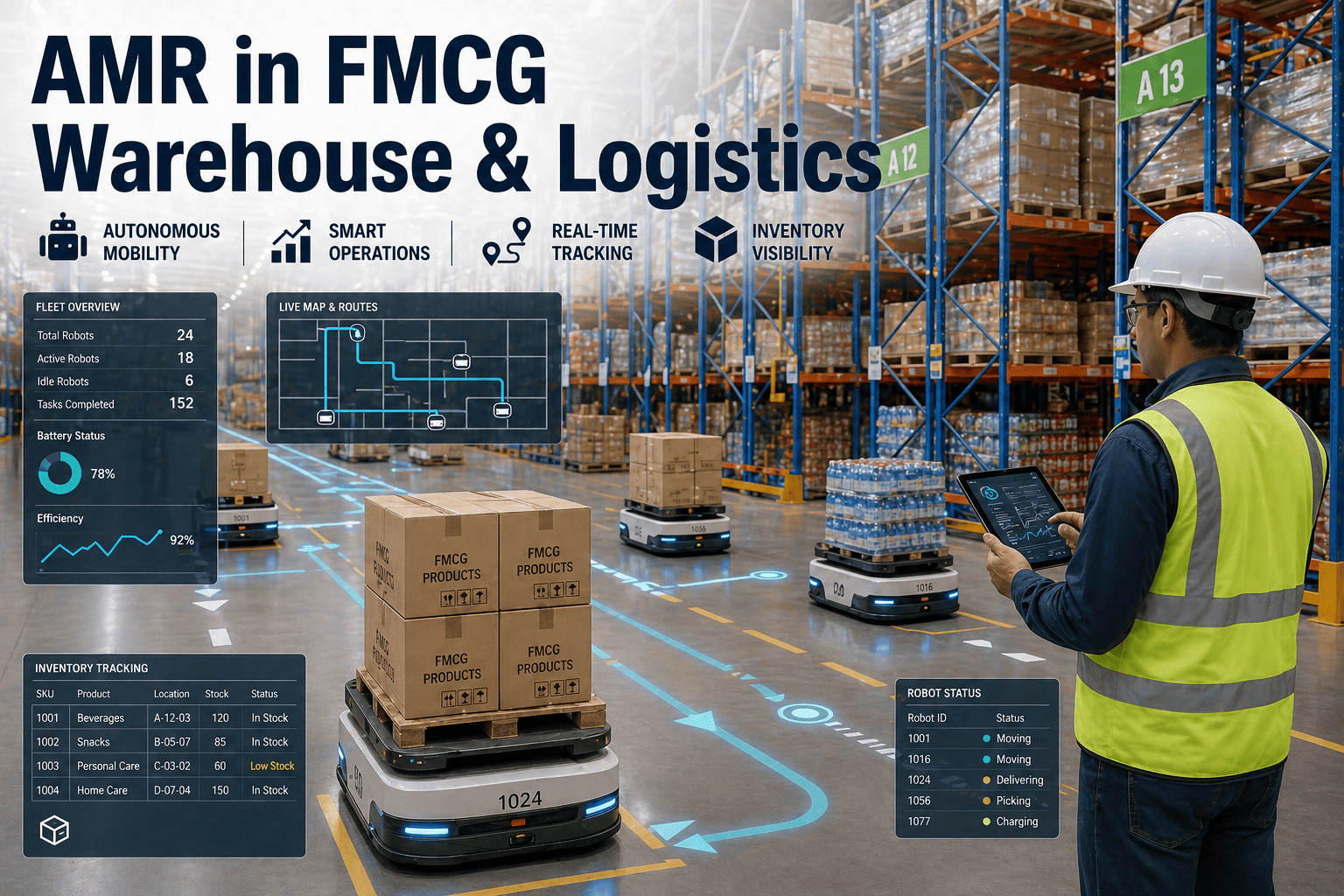
Warehouse Robotics: The Fulfillment Layer
AI forecasting decides what to stock and where. Warehouse robotics execute the physical fulfillment at speeds and accuracy levels manual operations can't match. AMRs (Autonomous Mobile Robots) are the fastest-growing segment — deployable in 4–8 weeks with no infrastructure changes.
Six AMR Capabilities Transforming FMCG Warehousing
Goods-to-Person Picking
3x Faster
AMRs bring shelves to pickers — eliminates 60% of walking time, the largest warehouse productivity killer
Pick Accuracy
99.8%
Vision-guided picking with barcode verification — each 0.1% improvement saves $38K/yr in returns
Real-Time Inventory
Continuous
AMRs scan locations during every trip — perpetual inventory count replaces annual physical counts
Dynamic Slotting
Auto-Optimized
AI repositions fast-moving SKUs to optimal pick zones daily — reduces average pick path by 40%
FEFO Rotation
42% Less Waste
First-Expired-First-Out enforced automatically — critical for short shelf-life FMCG products
Scalable Fleet
4–8 Weeks
Deploy 10–100 AMRs with no infrastructure changes — add units for peak season, redeploy in off-peak
90-Day AI Supply Chain Implementation Roadmap
Deploy AI demand forecasting and inventory optimization in 90 days — warehouse robotics can run in parallel. Schedule a demo to map this to your specific supply chain architecture.
Phased AI Supply Chain Deployment
01
Days 1–20: Connect
Integrate POS, ERP, and inventory data feeds
Baseline current forecast accuracy by SKU tier
Map stockout and overstock costs per category
Output: Data Baseline
02
Days 21–45: Train
AI model learns 12–24 months of demand patterns
Shadow mode: AI forecasts vs. current method
Configure dynamic safety stock parameters
Output: 85%+ Accuracy
03
Days 46–70: Activate
Switch to AI-driven replenishment on top 500 SKUs
Deploy AMR pilot in highest-volume DC zone
Measure stockout rate, fill rate, inventory turns
Output: $800K–$1.2M Saved
04
Days 71–90: Scale
Expand AI forecasting to full SKU portfolio
Scale AMR fleet across additional DC zones
Present ROI to leadership for enterprise rollout
Output: 8–16x ROI
Documented Results from FMCG Operations
Real outcomes from FMCG companies that deployed AI supply chain optimization and warehouse robotics.
Before & After: AI Supply Chain in FMCG Operations
Documented results from companies that deployed AI forecasting and AMR warehouse automation
Case 1: Personal Care — $200M Revenue, 4 DCs
Stockout Rate (Top SKUs)
14% → 4.8% — 66% Reduction in 6 Months
Forecast Accuracy
61% → 89% at SKU-Location Level
Excess Inventory
$6.8M → $4.5M — $2.3M Working Capital Freed
Annual Value
$3.4M (Revenue + Inventory + Waste)
Case 2: Packaged Foods — $85M Revenue, 2 DCs
Warehouse Picking Speed
120 → 340 Lines/Hour with AMR Fleet
Order Accuracy
94.2% → 99.6% — Retailer Fines Eliminated
Product Expiry Write-Offs
$1.4M/yr → $620K/yr — 56% Reduction (FEFO)
Annual Value
$1.9M (Labor + Accuracy + Waste)
Average AI Supply Chain Payback Period: Under 90 Days
Frequently Asked Questions
How quickly does AI demand forecasting improve accuracy over traditional methods?
Most FMCG companies see forecast accuracy improve from 55–68% to 80%+ within 4–6 weeks of model training, reaching 85–94% by month 3 as the AI learns promotional patterns, seasonal shifts, and SKU-specific demand drivers. The model runs in shadow mode alongside your current forecasting for 2–3 weeks before activation — so you can measure the accuracy improvement before switching. The largest gains come from promotional and weather-driven categories where traditional models consistently under- or over-forecast.
What data do we need to start AI supply chain optimization?
At minimum: 12–24 months of historical sales/shipment data at the SKU level, current inventory positions by location, and a promotional calendar. These three datasets are sufficient to train a baseline model. For maximum accuracy, add POS sell-through data from retail partners, weather data for your distribution geography, and competitor pricing feeds. Oxmaint's API connectors integrate with major ERP systems (SAP, Oracle, JDE) and retail data platforms in 2–4 weeks. Start a free trial to test data connectivity.
How do AMRs work alongside existing warehouse staff?
AMRs are collaborative — they navigate around people, follow safety protocols, and augment human capabilities rather than replacing workers. In a goods-to-person model, AMRs bring shelving units to stationary pick stations where workers select items — eliminating 60% of walking time (the largest warehouse productivity killer). Workers focus on picking, packing, and quality checks. Most facilities see 30–40% productivity improvement per worker without headcount reduction — the same team fulfills significantly more orders per shift.
What is the ROI timeline for warehouse robotics deployment?
AMR deployments typically achieve ROI within 12–18 months through labour efficiency (35% fewer pick hours), accuracy improvement (99.5%+ vs 94% manual), and reduced product damage. For FMCG operations with high order volumes and short shelf-life products, the FEFO-enforced rotation alone can justify the investment — a 42% reduction in expiry write-offs on a $1.4M annual waste figure saves $588K/year. Combined with labour savings, most FMCG warehouses see 2–3 year full payback on AMR fleet investment.
Can AI optimization work for FMCG companies with thousands of SKUs?
Yes — and it's actually more valuable at scale. AI models handle 5,000–50,000+ SKU-location combinations simultaneously, something impossible for human planners. The system auto-segments SKUs by demand pattern (fast/slow, stable/volatile, seasonal/continuous) and applies the optimal forecasting model to each segment. Start with your top 500 SKUs (which typically represent 60–70% of revenue) and expand coverage as the model proves accuracy. Most companies reach full-portfolio coverage within 6 months. Book a demo to see it modelled on your SKU portfolio.
Your Shelves Shouldn't Be Empty When Demand Is Predictable. 85% of It Is.
Oxmaint's AI forecasting predicts demand at the SKU level and auto-optimizes inventory across your network.