A cereal manufacturer in Ohio spent 14 months evaluating AI platforms. They attended conferences, received demos from six vendors, commissioned a feasibility study, and formed a cross-functional steering committee. By the time they made a decision, their competitor two states away had already deployed AI on three production lines, reduced quality holds by 41%, and was pitching the same retailers with demonstrably lower per-unit costs.
The difference was not budget or technical sophistication. The competitor ran a 90-day pilot on a single line, proved ROI with production data the CFO could verify, and expanded from evidence rather than projections. The cereal manufacturer tried to plan a perfect enterprise rollout. The competitor launched an imperfect pilot and learned its way to results. Schedule a consultation to design a risk-free AI pilot scoped to one line in your FMCG facility — 90 days to measurable results.
90
Days from deployment to verified ROI data
1
Production line required to prove concept
$0
Capital risk with performance-based pilot structure
3–5x
Typical ROI validated within pilot period
Prove AI value before committing budget. Oxmaint's 90-day pilot program delivers measurable results on a single production line with no capital risk.
Why Most FMCG AI Initiatives Stall — and How Pilots Fix It
Enterprise AI deployments in food manufacturing fail at a rate that should alarm every operations director. The pattern is consistent: ambitious scope, extended planning cycles, large upfront commitments, and organizational paralysis when early results do not match vendor projections. Pilots eliminate this pattern by constraining scope, compressing timelines, and letting production data make the case instead of PowerPoint projections.
01
The Analysis Paralysis Problem
Why Plants Stall
Average FMCG AI evaluation cycle: 8–18 months before first deployment
Cross-functional committees, vendor bake-offs, enterprise architecture reviews, and budget approval cycles consume months while competitors deploy and learn. Every month of evaluation is a month of unrealized savings from quality issues, waste, and downtime that AI could already be addressing.
18+ months: competitive disadvantage 6–12 months: typical Under 90 days: pilot approach
02
The Enterprise Rollout Trap
Scope Creep Risk
Enterprise AI deployment failure rate in manufacturing: 60–75%
Large-scope deployments attempt to solve every problem simultaneously — quality, maintenance, scheduling, energy, and compliance across all lines. Complexity multiplies, integration challenges compound, and the project collapses under its own weight before delivering any measurable value to any single area.
Pilot approach: one line, one problem, proven results, then expand
03
The Budget Objection
CFO Concern
Risk-free pilot: performance-based pricing tied to measured outcomes
CFOs rightly resist six-figure AI commitments based on vendor projections. Performance-based pilots eliminate this objection entirely. You pay based on measured results — verified quality improvements, documented waste reduction, and confirmed downtime prevention — not on promises.
If the pilot does not deliver measurable ROI, you owe nothing
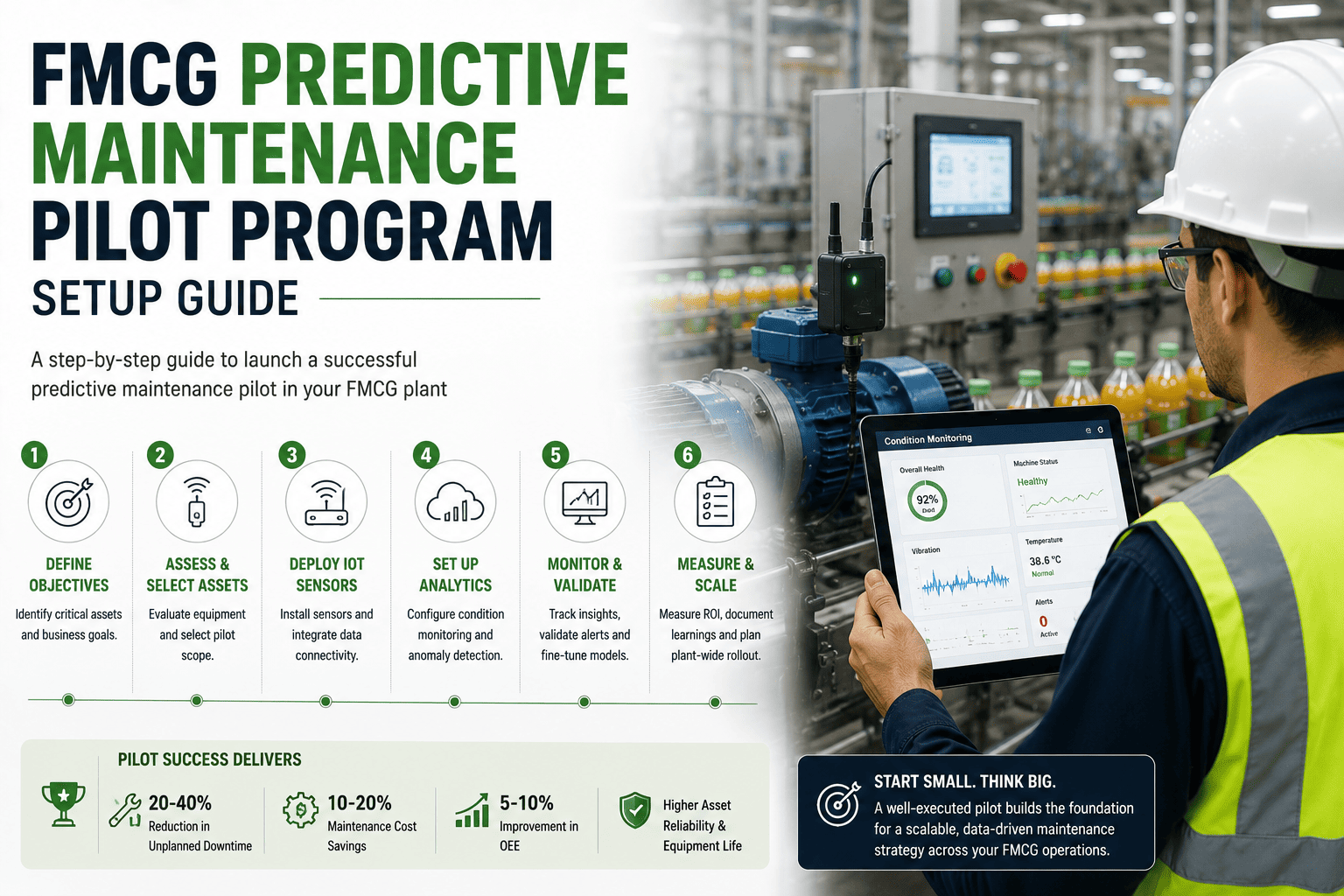
The 90-Day Pilot Framework: Phase by Phase
A structured pilot follows a proven sequence that compresses learning, minimizes disruption, and produces the data your leadership team needs to make confident expansion decisions. Each phase builds on the previous one, creating momentum rather than complexity. Sign up for Oxmaint to begin the baseline assessment that launches your 90-day AI pilot.
1
Days 1–15: Baseline and Scope
Select one production line with clear quality, waste, or downtime challenges. Install monitoring on existing equipment. Capture 2 weeks of baseline data — defect rates, yield, energy consumption, maintenance events — to establish the "before" picture AI performance will be measured against.
2
Days 16–30: AI Model Configuration
Configure AI models using baseline data — process parameter correlation, quality prediction, anomaly detection, and maintenance pattern recognition. Connect to Oxmaint CMMS for equipment health integration. Train operators on alert response protocols without disrupting production workflow.
3
Days 31–75: Monitored Operation
AI runs in production generating recommendations, catching anomalies, and logging performance data. Operators validate AI suggestions against their experience. Quality and maintenance teams review AI-generated insights weekly. System accuracy improves continuously from production feedback.
4
Days 76–90: ROI Validation and Expansion Decision
Compare pilot line performance against baseline: defect reduction, waste savings, downtime prevention, maintenance cost impact. Build the business case for expansion with actual production data — not vendor projections. Present results your CFO can verify against your own records.
What the Pilot Measures: KPIs That Prove Value
Every pilot must produce numbers your finance team can validate independently. These are not AI-generated projections — they are production metrics measured from your own equipment, quality systems, and maintenance records before and after AI deployment. Book a demo to discuss which KPIs matter most for your specific production challenges.
KPI
Quality Hold Reduction
Typically 30–50% Improvement
Quality Hold Rate = (Held Batches / Total Batches) × 100 — before vs. after AI
AI catches quality deviations in process parameters before they produce out-of-spec product. Instead of discovering quality issues at end-of-line inspection, AI alerts operators during production when conditions are trending toward defects — preventing holds rather than managing them.
Verified by comparing QA hold logs pre-pilot vs. during pilot
KPI
First Pass Yield Improvement
Typically 2–5% Gain
FPY = (Good Units First Pass / Total Units Started) × 100 — measured daily
Even small first pass yield improvements compound into significant savings at FMCG production volumes. A 3% yield improvement on a line producing 500,000 units monthly recovers 15,000 units of material, labor, and overhead cost — measurable in your existing production tracking system.
Verified by comparing production records pre-pilot vs. during pilot
AI-driven predictive maintenance detects equipment degradation patterns that precede failures. Combined with Oxmaint CMMS data, the system identifies which equipment conditions correlate with unplanned stops — generating maintenance work orders before breakdowns occur instead of after.
Verified by comparing CMMS downtime records pre-pilot vs. during pilot
KPI
Material Waste Reduction
Typically 15–35% Savings
Waste % = (Material Wasted / Total Material Input) × 100 — by category
AI identifies the specific equipment conditions, process parameters, and material properties that correlate with elevated waste. Overfill, changeover scrap, off-spec product, and packaging waste are tracked at the source — with each waste event linked to a correctable cause rather than treated as an unavoidable cost.
Verified by comparing waste logs and material consumption records
Every pilot KPI is verified from your own production data. No AI-generated projections. Real numbers your CFO can cross-check against existing records.
Pilot vs. Enterprise Rollout: The Strategic Comparison
The choice between launching a pilot and attempting an enterprise deployment is not about ambition — it is about risk management, organizational learning, and speed to value. Plants that pilot first consistently achieve better long-term AI outcomes than those that attempt full deployment from the start.
Enterprise AI Rollout
8–18 months planning before any deployment begins
$500K–2M+ upfront commitment based on projections
All lines, all processes, all problems simultaneously
ROI measured 12–24 months after investment decision
Failure is expensive and organizationally damaging
Result: High risk. 60–75% of enterprise AI projects fail to deliver projected ROI.
90-Day Pilot with Oxmaint
Deployed on a single line within 2 weeks
Performance-based pricing tied to measured results
One line, one focused problem, proven methodology
ROI validated within 90 days from production data
If it does not work, you stop — minimal exposure
Result: Low risk. Evidence-based expansion decisions from actual production data.
Measured Results from FMCG AI Pilots
Structured AI pilots in food manufacturing consistently deliver measurable improvements within the 90-day window. These results reflect verified production data from pilot deployments — not projections or estimates.
41%
Quality hold reduction within pilot period
3.8%
First pass yield improvement on pilot line
34%
Reduction in unplanned downtime events
$890K
Annualized savings projected from pilot line results
How to Select Your Pilot Line
The pilot line you choose determines how quickly you generate convincing results and how easily those results translate to expansion decisions. The best pilot line is not your worst line or your best line — it is the line where AI can deliver the most visible, measurable improvement in 90 days. Sign up for Oxmaint to run the equipment health assessment that identifies your highest-impact pilot candidate.
A
Choose a Line with Known Quality Challenges
Highest Impact
Lines with above-average defect rates, frequent quality holds, or recurring customer complaints offer the clearest before-and-after comparison. AI quality prediction on these lines produces visible improvement that quality teams, production managers, and leadership can all observe directly.
Look for: defect rate above plant average, recurring quality holds, customer complaints traceable to this line
B
Ensure Adequate Data Infrastructure
Practical Requirement
The pilot line needs sufficient data sources — PLC process parameters, quality inspection records, and maintenance history in CMMS. Lines with existing sensors, checkweighers, and vision systems provide richer data for AI models. You do not need perfect data, but you need enough for AI to identify patterns.
Minimum: PLC data, quality records, CMMS maintenance history for the line's equipment
C
Pick a Line with an Engaged Team
Success Factor
AI pilots succeed when operators and maintenance technicians actively engage with AI recommendations. Choose a line where the supervisor is open to new approaches, operators will provide feedback on AI suggestions, and maintenance staff will act on predictive alerts. Skeptical teams can be won over — but not in 90 days.
Key indicator: a line supervisor who asks questions rather than resists change
Stop Evaluating. Start Proving.
Every month of AI evaluation is a month of unrealized savings. Oxmaint's 90-day pilot deploys on a single production line, measures results against your own baseline data, and delivers the verified ROI your CFO needs to approve expansion — with zero capital risk.
The Expansion Playbook: From Pilot to Plant-Wide AI
A successful pilot does not just prove AI works — it creates the organizational knowledge, operator confidence, and financial evidence needed to expand systematically. Schedule a consultation to map the expansion path that scales pilot results without scaling risk.
From Pilot to Plant-Wide: The Expansion Timeline
Phase
Timeline
Scope
Decision Trigger
Pilot
Days 1–90
1 production line, 1 focused problem
Verified KPI improvement vs. baseline
Validation
Days 91–120
Replicate on 1–2 similar lines
Results consistent across lines and operators
Expansion
Months 5–8
All lines of same product type
Cumulative ROI exceeds expansion cost 3x+
Integration
Months 9–14
Cross-product, cross-facility deployment
Organizational AI capability established
Optimization
Month 15+
Continuous improvement, new AI use cases
AI embedded in operational culture
Each phase decision is based on measured results from the previous phase — not projections. You expand only when data supports expansion.
From pilot to plant-wide in under 12 months. Oxmaint's expansion framework scales AI results systematically — each phase justified by measured data from the previous one.
Your competitors are not waiting for perfect AI strategies. They are running pilots, proving ROI, and expanding from evidence. Oxmaint's 90-day pilot program delivers the production data your CFO needs to say yes — or the honest answer that saves you from a bad investment.
What does "risk-free" actually mean in a pilot context?
Performance-based pilot pricing means costs are tied to measured outcomes — verified quality improvements, documented waste reduction, and confirmed downtime prevention. If the pilot does not deliver measurable ROI validated against your own production records, you are not locked into an ongoing commitment. The risk shifts from your organization to the platform proving its value.
How much production disruption does a pilot cause?
Minimal. The pilot integrates with existing sensors, PLCs, and quality systems through standard industrial communication protocols. No production line modifications are required. AI runs alongside current operations, generating recommendations that operators can accept or override. The first two weeks involve data collection only — zero changes to production processes. Operator workflow changes are introduced gradually during weeks 3–4.
What if the pilot does not show the improvements we expected?
That is valuable information that saves you from a larger failed investment. An honest pilot reveals which production challenges AI can address effectively and which require different solutions. Some pilots show that the root cause of quality issues is equipment condition rather than process optimization — redirecting investment to maintenance upgrades that deliver better returns than AI alone would.
How does the pilot integrate with our existing CMMS?
Oxmaint serves as both the CMMS platform and the AI analytics layer, eliminating integration complexity. Equipment health data, maintenance history, and work order records feed directly into AI models. If you have an existing CMMS, Oxmaint can operate alongside it during the pilot period, with migration evaluated as part of the expansion decision based on pilot results.
What happens after the 90-day pilot?
You receive a comprehensive results report comparing pilot line performance against baseline across every tracked KPI. If results justify expansion, Oxmaint provides a phased deployment plan with projected ROI for each additional line based on pilot data. If results are mixed, you receive an honest assessment of which use cases delivered value and which did not — no pressure to expand beyond what the data supports.