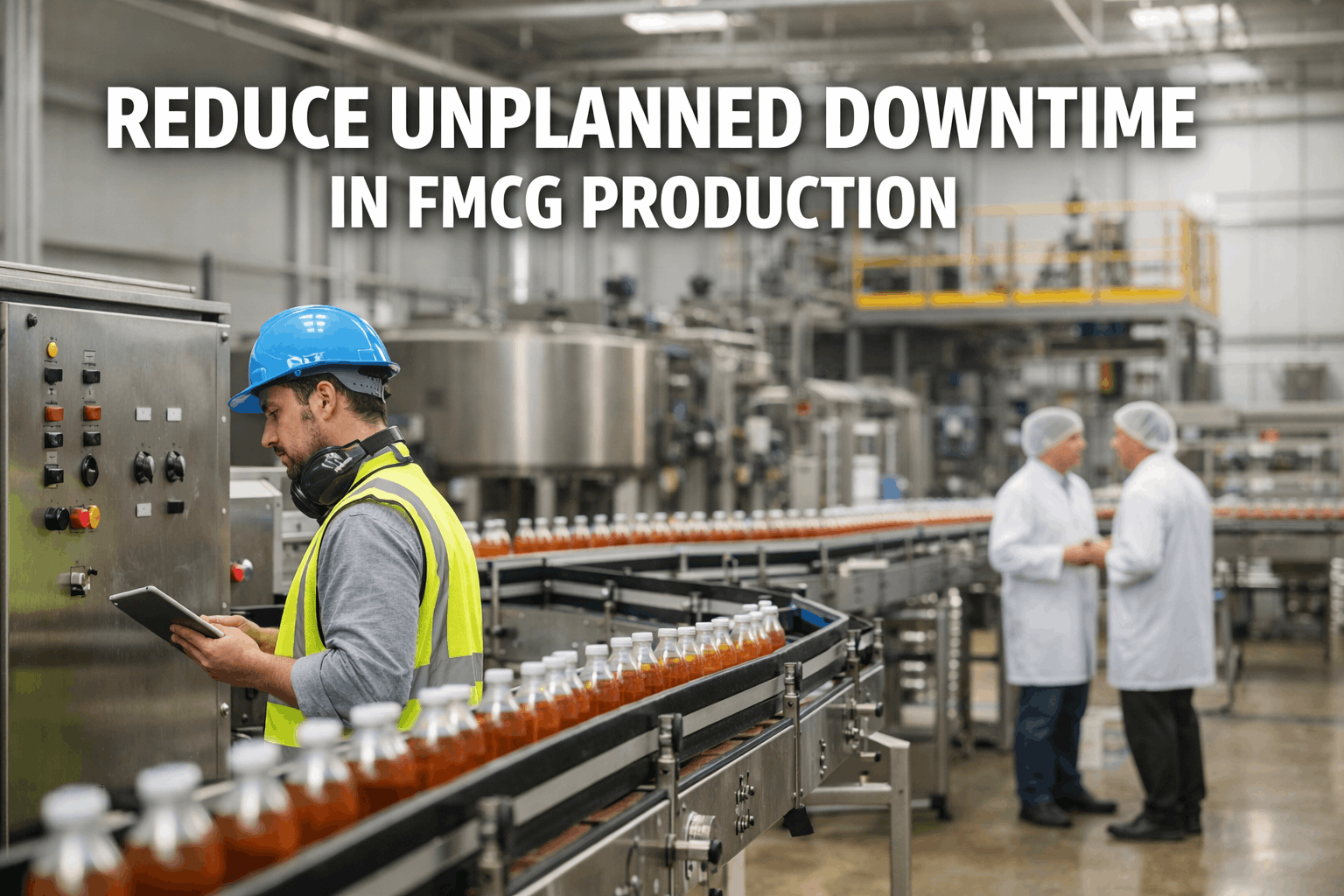
A beverage manufacturer in Georgia tracked every minute of production stoppage across three filling lines for one quarter. The total: 1,847 hours of unplanned downtime — equivalent to 77 full production days lost.
The breakdown revealed that 62% of stoppages originated from just 12 equipment failure modes that repeated month after month. Bearing failures on filler drives, seal degradation on packaging machines, conveyor motor overheating, and CIP valve malfunctions produced the same emergency work orders, the same overtime calls, the same expedited parts shipments, and the same production shortfalls every cycle.
The facility's maintenance program was not understaffed or underfunded. It was uninformed. Calendar-based PM schedules treated every asset identically regardless of operating conditions, failure history, or production load. The maintenance team replaced parts on schedule while the equipment that actually needed attention failed between intervals.
Within 14 months of deploying condition-based monitoring integrated with CMMS work order intelligence, the same facility reduced unplanned downtime 54% and improved OEE from 68% to 82%. Schedule a consultation to identify which failure modes are driving the most unplanned downtime in your FMCG production lines.
The True Cost of Unplanned Downtime in FMCG Manufacturing
FMCG production downtime costs extend far beyond the hourly rate of lost output. Every unplanned stop triggers a cascade of secondary costs that most facilities never fully quantify — expedited shipping penalties, customer fill-rate deductions, material waste from interrupted batches, overtime labor, and the hidden cost of reactive maintenance culture eroding workforce morale and retention.
The 10 Root Causes of FMCG Production Downtime
Reducing unplanned downtime requires understanding why lines stop — not just which lines stop. These 10 root causes account for over 90% of unplanned production stoppages in FMCG manufacturing, and each requires a different prevention strategy.
Strategy 1: CMMS-Driven Downtime Tracking and Root Cause Analysis
You cannot reduce what you do not measure. The foundation of every successful downtime reduction program is accurate, granular tracking of every unplanned stop — when it happened, how long it lasted, which equipment failed, what the root cause was, and what corrective action was taken. Without this data, maintenance teams respond to the loudest problem rather than the most impactful one.
Strategy 2: Predictive Maintenance with IoT Condition Monitoring
Predictive maintenance transforms the maintenance approach from calendar-based to condition-based — replacing parts when sensor data indicates they need attention, not when a schedule says it is time. For FMCG production lines, the payoff is significant: failures detected 4–12 weeks before breakdown, repairs scheduled during planned downtime rather than interrupting production, and component life extended by eliminating unnecessary replacements.
| Technology | Target Equipment | Failure Modes Detected | Lead Time Before Failure |
|---|---|---|---|
| Vibration Analysis | Motors, pumps, fans, gearboxes, filler drives | Bearing wear, imbalance, misalignment, looseness | 4–12 weeks |
| Thermal Imaging | Electrical panels, motor windings, bearings, heat exchangers | Overheating, electrical faults, insulation breakdown | 2–8 weeks |
| Ultrasonic Detection | Compressed air systems, steam traps, valves, bearings | Air leaks, valve bypass, lubrication starvation | 1–6 weeks |
| Current Analysis | Motors, VFDs, pumps | Rotor bar defects, stator faults, load changes | 3–10 weeks |
| Oil Analysis | Gearboxes, hydraulic systems, compressors | Contamination, wear metals, fluid degradation | 4–16 weeks |
Strategy 3: Autonomous Mobile Robots for Continuous Equipment Inspection
Autonomous Mobile Robots equipped with thermal cameras, vibration sensors, and visual inspection capabilities represent the 2026 frontier in FMCG equipment monitoring. AMRs patrol production floors continuously, collecting condition data from every accessible asset on every pass — detecting anomalies that manual inspection routes miss because technicians cannot be everywhere simultaneously.
- Monthly or quarterly data collection
- Varies by technician skill and time pressure
- Limited to shift availability and access
- Manual data upload from handheld instruments
- $8–15 per measurement point collected
- Daily or continuous patrol coverage
- Identical measurement conditions every pass
- 24/7 operation without staffing constraints
- Automatic real-time CMMS data transmission
- $0.50–2 per measurement point amortized
AMR deployment in FMCG plants produces the highest ROI in facilities with large production floors, repetitive equipment layouts, and multiple lines running continuously. The robots collect consistent baseline data that AI uses to detect subtle changes invisible to periodic human inspection. Book a demo to see how Oxmaint integrates AMR inspection data with CMMS work order workflows for automated condition-based maintenance.
Strategy 4: Real-Time OEE Monitoring and Loss Categorization
OEE measurement without real-time visibility produces historical reports that explain what happened last month — not actionable intelligence about what is happening right now. Real-time OEE dashboards connected to CMMS maintenance data transform downtime from a historical metric into a live management tool.
Strategies 5–10: The Complete Downtime Reduction Framework
The first four strategies address the largest downtime contributors. Strategies 5 through 10 complete the framework, targeting secondary causes that collectively account for 20–30% of remaining unplanned stops. Each strategy builds on the CMMS data foundation established through downtime tracking and condition monitoring.
| Strategy | Target Root Cause | Implementation Approach | Typical Impact |
|---|---|---|---|
| 5. Spare Parts Optimization | Extended downtime from parts unavailability | CMMS failure data drives inventory stocking levels for critical components | 30–50% reduction in parts-related downtime extension |
| 6. Standardized Work Procedures | Operator error and inconsistent troubleshooting | Mobile-accessible SOPs with step-by-step instructions and photo documentation | 15–25% reduction in operator-caused stops |
| 7. Changeover Optimization | Extended changeover and setup time | SMED analysis tracked through CMMS with target vs. actual time monitoring | 20–40% reduction in changeover duration |
| 8. Utility System Redundancy | Utility supply disruptions affecting production | Critical utility monitoring with automated switchover and backup systems | 80–95% elimination of utility-driven stops |
| 9. Maintenance Skill Development | Extended repair times from knowledge gaps | CMMS-tracked training programs tied to equipment assignments and failure codes | 20–30% reduction in mean time to repair |
| 10. Cross-Functional Reliability Teams | Recurring failures without systemic resolution | Maintenance, operations, and engineering collaborate using shared CMMS data | 40–60% reduction in chronic failure recurrence |
Implementation Roadmap: From Reactive to Predictive in 12 Months
Transforming an FMCG maintenance program from reactive firefighting to predictive reliability requires phased deployment that delivers measurable results at each stage. The roadmap below sequences initiatives so that each phase creates the data foundation required by the next. Sign up for Oxmaint to begin building the downtime intelligence that drives every strategy in this framework.