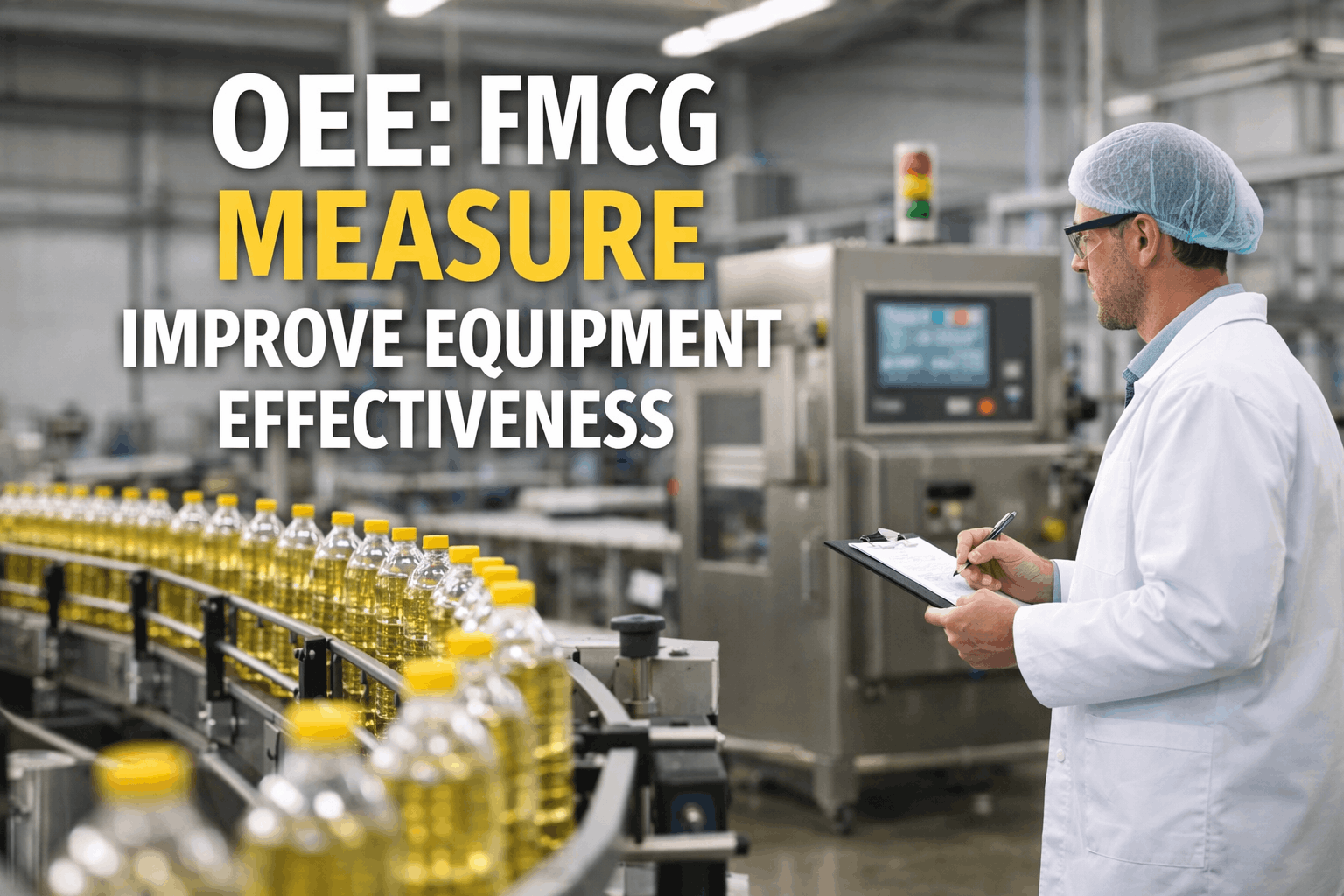
A multi-line snack manufacturer in Texas measured OEE for the first time across four packaging lines and discovered a number that shocked the operations team: 58%. The plant ran three shifts, employed experienced operators, and had never missed a major customer shipment. But when availability, performance, and quality were measured with real data instead of assumptions, the picture changed. Unplanned stops consumed 12% of available time. Speed losses from minor stoppages and reduced rates ate another 15%. Quality rejects and rework accounted for 6%.
The math was brutal: at 58% OEE on lines capable of producing $48 million annually, the plant was leaving $20 million of capacity on the table. Within 18 months of deploying structured OEE tracking integrated with CMMS maintenance data and AI-driven analytics, the same facility reached 79% OEE — recovering the equivalent of one full production shift per day without adding equipment, labor, or floor space. Schedule a consultation to benchmark your current OEE and identify the highest-impact improvement opportunities.
Why OEE Matters More in FMCG Than Any Other Industry
FMCG manufacturing operates under conditions that amplify every point of OEE loss: high-speed production lines where seconds of downtime translate to thousands of lost units, thin margins where material waste directly erodes profitability, and customer delivery windows where missed schedules trigger retailer penalties that dwarf the production cost of the lost product.
Speed Amplifies Loss
A beverage filler running at 1,200 bottles per minute loses 20,000 units in a single unplanned stop lasting 17 minutes. At high-speed FMCG rates, every minute of downtime or speed reduction compounds into significant revenue impact.
Margins Demand Efficiency
FMCG net margins of 5–12% leave zero room for waste. A 1% quality loss on a line producing $15 million annually costs $150,000 — often exceeding the entire annual maintenance budget for that line.
Customers Penalize Gaps
Major retailers impose chargebacks of $500–$5,000 per incident for missed delivery windows. When OEE losses reduce output below committed volumes, the financial impact extends far beyond the production floor.
Most FMCG plants track uptime or output volume — but not OEE. The difference matters because uptime alone hides speed losses and quality waste that silently consume 15–30% of theoretical capacity. Sign up for Oxmaint to start measuring true OEE across every production line with automated data capture that eliminates manual logging errors.
The OEE Formula: Availability × Performance × Quality
OEE multiplies three independent factors, each measuring a distinct category of production loss. Understanding each factor individually — and the specific losses within each — is the foundation for targeted improvement.
Availability — Are You Running When Scheduled?
Target: 90%+Formula: Actual Run Time ÷ Planned Production Time
Improvement Levers
Performance — Are You Running at Full Speed?
Target: 95%+Formula: (Ideal Cycle Time × Units Produced) ÷ Actual Run Time
Improvement Levers
Quality — Are You Making Good Product?
Target: 99%+Formula: Good Units Produced ÷ Total Units Produced
Improvement Levers
The Six Big Losses: Where OEE Dies in FMCG Plants
The TPM framework identifies six categories of production loss that collectively determine OEE. In FMCG manufacturing, certain losses dominate — and they're rarely the ones that get the most attention.
1. Equipment Breakdowns
Category: Availability Loss
FMCG Impact: Typically 5–15% of available time. Bearing failures, seal degradation, motor burnout, and control system faults produce the longest individual stops.
Fix: Predictive monitoring on top-5 failure assets. CMMS-driven root cause elimination of repeat failures.
2. Setup and Changeover
Category: Availability Loss
FMCG Impact: 5–20% of available time in high-SKU plants. Every product switch stops production for cleaning, adjustment, and verification.
Fix: SMED methodology. Standardized changeover procedures documented in CMMS. Target 50% reduction in first year.
3. Minor Stoppages
Category: Performance Loss
FMCG Impact: The #1 hidden OEE killer. Individually small (10–120 seconds each) but occurring 50–200 times per shift. Jams, misfeeds, sensor trips accumulate to 5–15% of capacity.
Fix: Automated stoppage counting linked to cause codes. Equipment condition restoration targeting chronic jam points.
4. Reduced Speed
Category: Performance Loss
FMCG Impact: Lines running 5–20% below rated speed due to wear, operator caution, or product-specific limitations. Often invisible because the line appears to be running.
Fix: Establish and enforce ideal cycle times per SKU. Restore equipment to design specification through targeted maintenance.
5. Startup Rejects
Category: Quality Loss
FMCG Impact: Every changeover produces waste units during ramp-up. High-SKU plants with 8–15 changeovers per day lose 2–5% of total output to startup waste.
Fix: Standardized startup recipes. First-article inspection protocols. Equipment centering procedures documented in CMMS work orders.
6. In-Process Defects
Category: Quality Loss
FMCG Impact: Weight variation, seal failures, label misplacement, and cosmetic defects. Often caused by equipment degradation that maintenance can prevent.
Fix: AI vision inspection at line speed. Equipment-to-quality correlation through CMMS data. Predictive quality models.
OEE Benchmarking: Where Does Your FMCG Plant Stand?
Moving from 60% to 85% OEE on a production line generating $15 million annually recovers approximately $3.75 million in previously lost capacity — without purchasing new equipment, hiring additional operators, or expanding floor space. The investment is in measurement infrastructure, maintenance excellence, and organizational discipline. Book a demo to see how Oxmaint calculates OEE automatically from equipment data and presents loss Pareto analysis that directs improvement effort where it generates maximum return.
Building Your OEE Improvement Program: 6 Steps
Sustainable OEE improvement requires a structured program — not a one-time measurement exercise. These six steps sequence activities so each phase builds the data foundation and organizational capability the next phase requires.
Define Ideal Cycle Times Per SKU
Establish the maximum demonstrated production rate for each product on each line. This becomes your performance denominator. Use the best sustained rate achieved under normal conditions — not theoretical machine maximum or conservative production planning rates.
Deploy Automated Data Collection
Manual OEE logging is inaccurate — operators underreport minor stoppages and estimate downtime duration. Connect PLC signals, counters, and sensors to capture start/stop events, unit counts, and reject counts automatically. Feed this data to CMMS for correlation with maintenance events.
Standardize Loss Categorization
Every stop must be coded as one of the six big losses with a specific reason code. Consistency matters more than precision in the early stages — the goal is Pareto analysis that identifies where to focus, not academic accuracy. Sign up for Oxmaint to deploy standardized downtime codes linked directly to maintenance work orders and root cause tracking.
Run Weekly Pareto Reviews
Display the top 5 OEE losses by category and cause code weekly. Assign corrective actions to specific owners with deadlines. Review completion and effectiveness the following week. This rhythm of measurement, action, and verification is the engine of continuous improvement.
Connect Maintenance to OEE Impact
Every maintenance work order should reference which OEE loss it addresses. When a bearing replacement eliminates a recurring jam on Line 3, the OEE impact is quantified and visible to leadership. This connection transforms maintenance from a cost center into a measurable value driver.
Scale from Pilot to Plant-Wide
Start with one bottleneck line. Prove the methodology, build team capability, and document results. Then expand to additional lines using lessons learned. Most FMCG plants achieve measurable OEE improvement on the pilot line within 90 days of structured tracking. Schedule a consultation to design the pilot scope for your facility.
Pro Tip: Minor Stoppages Are Your Biggest Opportunity
In most FMCG packaging operations, minor stoppages — individually lasting 10–120 seconds — collectively account for more production loss than major breakdowns. Because each stop is short, they rarely get documented. Because they're undocumented, they never get fixed. Automated stoppage counting that captures every interruption, no matter how brief, typically reveals 10–20% of hidden capacity that operators and managers didn't know existed.
Cobots and Robotics: The 2026 OEE Multiplier
Collaborative robots and AI-powered inspection systems are emerging as significant OEE improvement tools in FMCG manufacturing. Unlike traditional automation that requires extensive integration, cobots deploy alongside existing production lines to address specific loss categories.
Cobot-Assisted Changeover
Collaborative robots handle repetitive changeover tasks — tool swaps, guide rail adjustments, format part placement — while operators perform the judgment-intensive steps. Facilities using cobot-assisted changeover report 25–40% reduction in changeover duration, directly improving OEE availability.
AI Vision Quality Inspection
Camera-based inspection systems powered by AI detect defects at full line speed with 99.5%+ accuracy — catching quality issues that human inspectors miss at high production rates. Real-time defect data feeds back to equipment monitoring, identifying when equipment degradation begins producing quality drift before defect rates spike.
AMR Material Delivery
Autonomous mobile robots deliver raw materials, packaging supplies, and changeover parts to production lines on demand — eliminating the waiting time when operators leave the line to retrieve materials. Material-related idle time, a common performance loss, decreases 60–80% with AMR-supported delivery.
Frequently Asked Questions
What is a realistic OEE improvement target for an FMCG plant?
Most FMCG plants can improve OEE by 10–15 percentage points within 12–18 months of implementing structured measurement and loss elimination. A plant at 60% OEE should target 70–75% in year one, then push toward 80–85% over the following 12–18 months. The first 10 points typically come from eliminating the top 3–5 loss categories identified through Pareto analysis — these "low-hanging fruit" improvements require organizational discipline more than capital investment.
How does CMMS software improve OEE?
CMMS directly improves OEE availability by reducing unplanned downtime through predictive maintenance, optimizing PM schedules to minimize planned stops, and tracking critical spare parts to reduce MTTR. The indirect impact is equally significant: CMMS failure history reveals which equipment conditions cause speed losses and quality problems, enabling maintenance actions that improve all three OEE factors simultaneously — not just availability.
Should we track OEE manually or with automated systems?
Automated data collection is strongly recommended. Manual OEE tracking consistently underreports minor stoppages by 30–50% because operators don't log brief interruptions under 2–3 minutes. Automated systems capture every start/stop event, unit count, and reject with precise timestamps — producing accurate OEE calculations that reveal the true loss picture. Manual tracking is better than nothing for initial awareness, but automated collection is required for sustainable improvement.
What role do collaborative robots play in OEE improvement?
Cobots and robotic systems address specific OEE loss categories. Cobot-assisted changeover reduces setup time 25–40%, improving availability. AI vision inspection catches quality defects at line speed, improving quality rate. AMR material delivery eliminates operator waiting time, improving performance. These technologies complement — rather than replace — the foundational OEE practices of measurement, loss categorization, and root cause elimination through CMMS-driven maintenance.
How do we calculate the financial value of OEE improvement?
Multiply total annual line revenue by the OEE improvement percentage. A line producing $15 million annually that improves from 65% to 80% OEE recovers capacity worth $2.25 million per year — calculated as the additional good units the line can produce within the same scheduled time. This is conservative because it doesn't include reduced overtime, lower maintenance costs, fewer customer penalties, and improved material utilization that OEE improvement also delivers.
Your Equipment Is Already Telling You Where OEE Is Lost
Every unplanned stop, minor jam, speed reduction, and quality reject is a data point. Oxmaint captures that data automatically, calculates OEE in real time, and presents the loss Pareto that tells your team exactly where to focus for maximum improvement — connecting every maintenance action to its OEE impact.
No credit card required. Start measuring real OEE on your production lines today.