Autonomous Forklifts & AGVs: Scaling In-Plant Transport for FMCG Plants
By Oxmaint on February 17, 2026
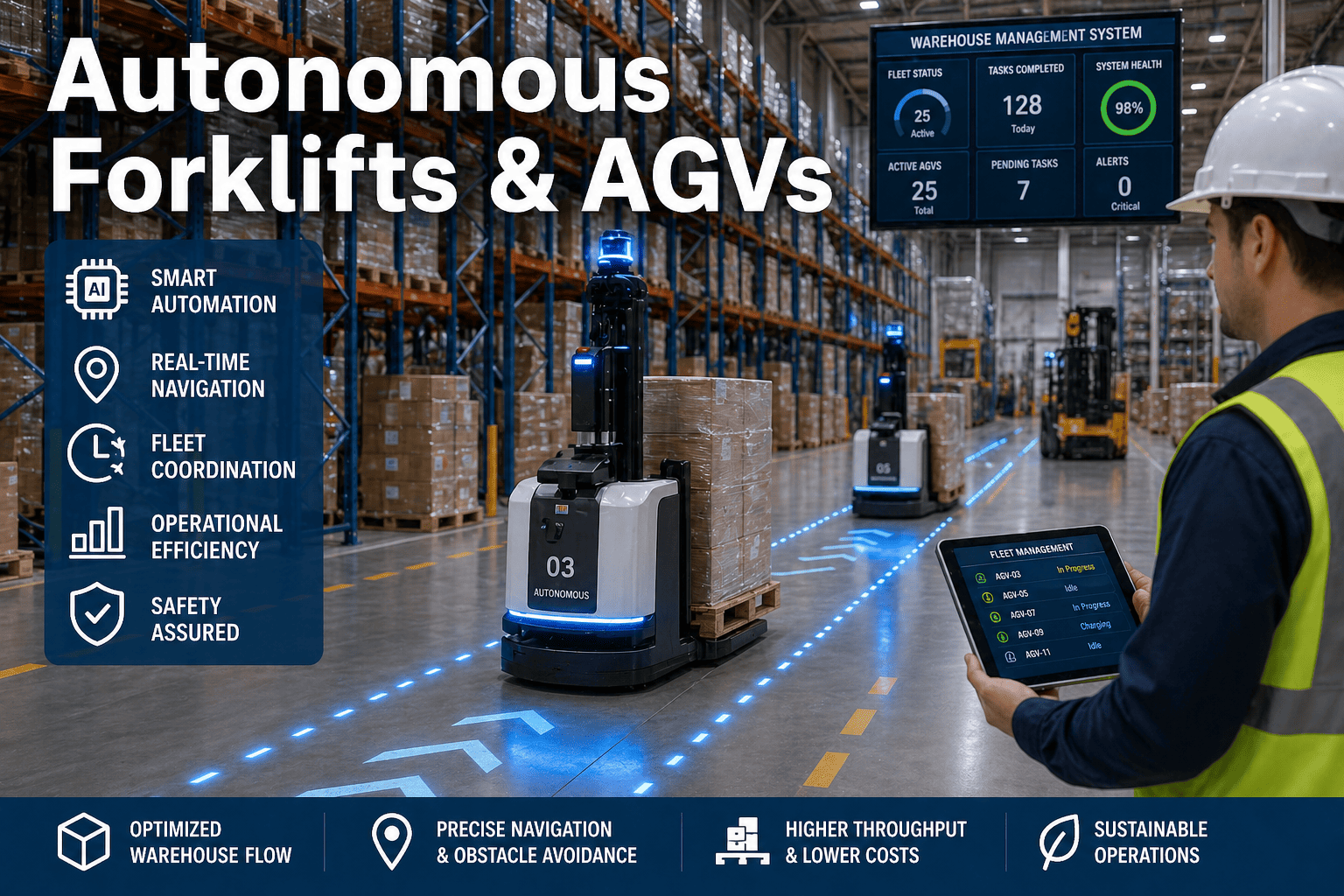
A frozen foods distribution center outside Memphis was running 14 sit-down forklifts across three shifts to move pallets between production end-of-line, cold storage staging, and outbound dock doors. Driver turnover was 74% annually — the combination of freezer exposure, repetitive routes, and third-shift scheduling made the positions nearly impossible to staff consistently. When the plant deployed eight autonomous forklifts on the four highest-volume transport lanes and kept six manned units for irregular tasks, pallet moves per hour increased 28%, product damage incidents dropped 62%, and the fleet operated continuously through shift changes with zero handover gaps. The metric that justified the CFO's approval was maintenance cost: the manned fleet averaged $4,800 per unit per month in unplanned repairs from operator-induced damage — forks through racking, dock leveler collisions, mast impacts on overhead structures. The autonomous fleet averaged $1,100 per unit per month with CMMS-scheduled preventive maintenance on SLAM sensors, drive motors, and battery systems. Schedule a demo to see how Oxmaint manages autonomous fleet maintenance and route scheduling, or sign up now to start tracking your fleet in minutes.
Why Autonomous Forklifts Are Reshaping FMCG In-Plant Logistics
FMCG plants move thousands of pallets per shift across production floors, cold storage, staging areas, and dock doors. Manual forklift operations are the single largest source of in-plant product damage, worker injury claims, and unplanned maintenance spend. Autonomous forklifts and AGVs eliminate operator-induced variability while running 18–22 hours per day without shift-change gaps, fatigue decline, or overtime premiums. But the fleet itself becomes a high-value asset portfolio that demands structured maintenance — and that is where most deployments underperform.
28%
more pallet moves per hour with autonomous forklifts on high-volume lanes
62%
fewer product damage incidents vs. manned forklift operations
77%
lower per-unit maintenance cost with CMMS-integrated preventive programs
Your fleet runs 22 hours a day — your maintenance tracking should too. Oxmaint manages every autonomous forklift, AGV, and manned unit in one platform with route-based PMs and sensor health monitoring.
Autonomous Vehicle Types for FMCG In-Plant Transport
Each transport profile demands a different vehicle type — and each vehicle type creates distinct maintenance requirements that CMMS tracking must address separately.
Autonomous Counterbalance Forklifts
Full-size units handling up to 2,500 kg pallets via SLAM navigation (3D LiDAR). No magnetic tape or reflectors required. Match manned throughput on repetitive routes while eliminating $4,800/unit/month in operator-induced damage.
Autonomous Pallet Jacks
Low-profile units for tight aisles and short-haul lanes — end-of-line to accumulation, staging to wrapping stations. 1,200–2,000 kg capacity. Lower capital cost makes them the entry point for most autonomous fleet deployments.
Unit-Load AGVs
Fixed-path carriers following magnetic tape or embedded wire at consistent speeds. Excel on dedicated production-to-warehouse corridors. Lower sensor complexity means lower maintenance, but zero route flexibility.
Autonomous Tow Tractors
Pull trains of carts through production areas on scheduled milk runs. One tow tractor replaces 3–4 individual forklift trips by consolidating multi-station deliveries aligned to production consumption rates.
How Fleet Scheduling Optimizes Every Pallet Move
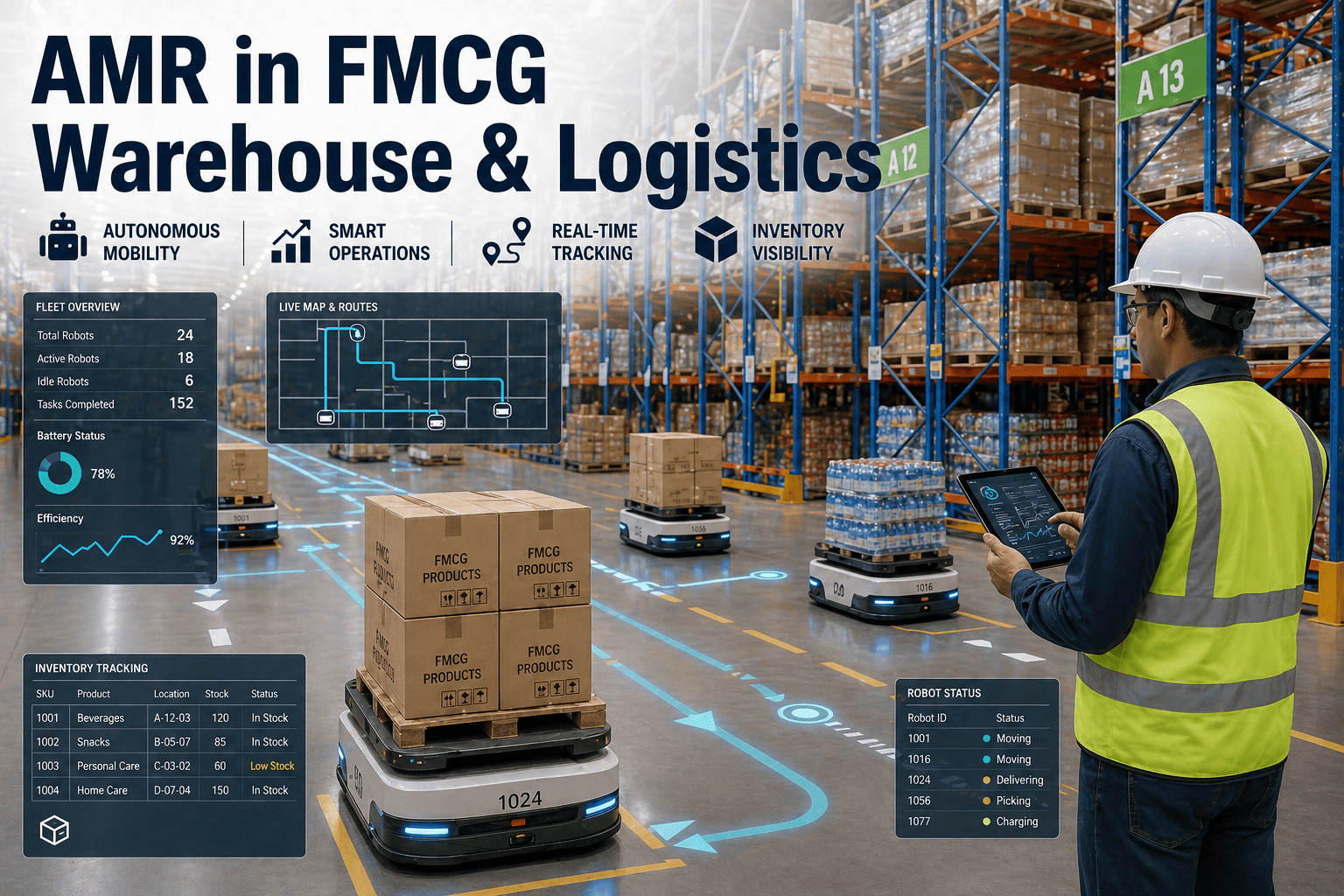
Autonomous fleets do not improve throughput just because they drive themselves — they improve throughput because fleet management software optimizes every movement based on real-time demand, vehicle availability, battery state of charge, and facility traffic patterns. Book a demo to see how fleet scheduling integrates with Oxmaint's maintenance workflows.
1
Transport Request Ingestion
WMS, MES, or production system issues a pallet move request — origin, destination, priority, weight class, and time window. The fleet manager queues the request against all active and pending tasks.
2
Vehicle Assignment and Route Calculation
The scheduler assigns the nearest available vehicle with sufficient battery charge and payload capacity, then calculates the optimal route considering current traffic, blocked zones, and charging queue positions.
3
Dynamic Traffic Management
As vehicles move, the fleet manager continuously reroutes to avoid congestion at intersections, dock doors, and staging areas. Priority rules ensure production-critical moves are never blocked by lower-priority transfers.
4
Battery and Maintenance Integration
Fleet software routes vehicles to charging stations during natural idle windows — not when the battery dies mid-run. Vehicles approaching PM thresholds are flagged and routed to the service bay during low-demand periods automatically.
Schedule a free demo with our fleet management specialists. We will show you how Oxmaint automates work orders, tracks vehicle health, and reduces fleet downtime for your specific FMCG operation.
Autonomous forklifts and AGVs run 18–22 hours per day in FMCG plants. Every subsystem accumulates wear faster than calendar-based PM schedules anticipate. The fleets holding 96%+ availability track components against operating hours, distance traveled, and cycle counts — not calendar dates alone.
SLAM Sensors — LiDAR, Cameras, EncodersLiDAR cleaning every 500–1,000 operating hours. Camera calibration monthly. Encoder verification with tire changes. Navigation accuracy drop causes unplanned traffic blockages. Failure cost: $2K–$8K per incident.
Battery Systems — Li-ion Packs and ChargingCapacity fades below 80% between 2,000–3,000 charge cycles. Cell imbalance above 0.1V requires reconditioning. Charging contact corrosion in wet/cold environments. Failure cost: $8K–$20K per pack replacement.
Drive Motors and Steering SystemsService every 3,000–6,000 operating hours for motors, 1,000–2,000 hours for steering calibration. Current draw trending upward at constant speed indicates degradation. Failure cost: $3K–$12K including downtime.
Safety Systems — Scanners, Bumpers, E-StopsWeekly scanner cleaning, monthly safety function verification, annual ANSI/ITSDF B56.5 compliance certification. Contaminated scanners cause false stops or missed detection. Failure cost: $10K–$100K+ OSHA penalties.
Tires and Load-Handling AttachmentsTire inspection every 2,000 hours or by tread depth. Fork crack inspection every 12 months per OSHA 1910.178. Uneven wear changes height reference and fork alignment accuracy. Failure cost: $1K–$8K per replacement set.
Fleet Performance Metrics That Matter
Tracking the right KPIs across your autonomous fleet turns maintenance from guesswork into data-driven decision-making. Here are the critical metrics every fleet manager should monitor in their CMMS.
96%+
Fleet Availability
Operational hours vs. total available hours — directly correlates to throughput and pallet move capacity
$1,100/mo
Autonomous Unit Cost
Per-unit maintenance cost with CMMS-scheduled PMs vs. $4,800/mo for manned fleet damage repairs
<4 hrs
MTTR
Mean time to repair — measures technician response, parts availability, and diagnostic speed
80%+
Battery Health
Charge capacity vs. rated spec — predicts pack replacement timing and optimizes charging schedules
0 / quarter
Safety Incidents
Personnel detection events and near-misses — validates scanner calibration and safety system integrity
12–18 mo
ROI Payback
Time to recover investment through labor savings, damage elimination, and maintenance cost reduction
Create your free Oxmaint account and start tracking today. Register every forklift and AGV as a tracked asset, configure operating-hour PMs, and build your fleet dashboard in minutes.
The difference between managing a forklift fleet with reactive repairs versus a CMMS-integrated autonomous program is the difference between absorbing damage costs and eliminating them.
Manned Fleet / Reactive Maintenance
$4,800/unit/month in operator-induced damage repairs
74% annual driver turnover creating constant training gaps
Shift-change handover gaps losing 30–45 minutes per transition
Fatigue decline reduces throughput 15–20% into third shift
No subsystem-level maintenance tracking on individual vehicles
7–12% unplanned fleet downtime
Autonomous Fleet + Oxmaint CMMS
$1,100/unit/month with CMMS-scheduled preventive maintenance
Zero operator dependency — continuous 18–22 hr/day operation
No shift-change gaps — fleet runs through transitions automatically
Consistent throughput at any hour with no fatigue variability
Every sensor, motor, battery, and safety system tracked individually
96%+ fleet availability with preventive PMs
Bring Your Entire Fleet Under One Roof
Oxmaint manages autonomous forklifts, AGVs, and manned units in a single platform — with operating-hour PMs, sensor health monitoring, battery lifecycle tracking, safety compliance work orders, and fleet-wide analytics that connect maintenance discipline directly to transport throughput.
Most FMCG plants achieve full autonomous fleet integration within 14–20 weeks when maintenance infrastructure is built in parallel with vehicle deployment and route commissioning. Schedule a demo and our team will map this roadmap to your facility's specific requirements.
Weeks 1-4
Facility Assessment & Lane Selection
Map all transport lanes, traffic patterns, and pallet move volumes. Identify highest-ROI lanes for autonomous deployment. Audit floor conditions, clearances, and charging infrastructure needs.
Weeks 5-10
Vehicle Deploy & Route Commission
Install autonomous forklifts and AGVs, map SLAM environment. Commission routes with traffic rules, priority zones, and charging stations. Integrate fleet manager with WMS/MES for automated dispatch.
Weeks 8-14
CMMS Setup & PM Activation
Register every vehicle and subsystem in Oxmaint. Configure operating-hour PMs for sensors, batteries, motors, and safety systems. Build spare parts catalog with min/max levels and auto-reorder.
Weeks 14-20
Production Ramp & Optimization
Ramp autonomous lanes to full production volume. Calibrate PM intervals against actual wear and operating data. Optimize routes based on throughput data and congestion patterns.
Best Practices for Autonomous Fleet Maintenance
Based on successful autonomous fleet deployments across FMCG manufacturing, cold storage, and distribution operations, here are the practices that separate high-performing fleets from those struggling with constant vehicle downtime.
01
Track by Operating Hours, Not Calendar
Calendar-based maintenance over-services idle vehicles and under-services busy ones. Trigger PMs by actual operating hours, pallet cycles, or distance traveled. A forklift running 20 hours/day needs service in weeks, not months.
02
Register Every Subsystem Independently
Do not track the forklift as one asset. Register the LiDAR, battery pack, drive motor, steering actuator, and safety scanner as separate child assets — each with its own PM schedule, failure history, and spare parts catalog.
03
Pre-Position Spares for Critical Components
LiDAR units, battery packs, and safety scanners have 4–8 week lead times. Set min/max inventory levels in your CMMS with auto-reorder triggers. A $2K spare on the shelf beats a $15K throughput loss waiting for delivery.
04
Build Cold Storage PM Offsets
Vehicles transitioning between cold storage and ambient environments face accelerated sensor fogging, battery capacity reduction, and connector corrosion. Tighten service intervals by 30–40% for cold-rated fleet units.
The biggest mistake in autonomous fleet management is treating the vehicles like IT equipment. They are industrial machines running 20 hours a day in demanding environments — they need the same rigorous PM discipline as any production-critical asset, just with a sensor and software layer on top.
— Distribution Operations Director, National FMCG Manufacturer
Your Fleet Moves Pallets 22 Hours a Day. Your Maintenance System Should Track Every Hour.
Oxmaint gives your maintenance team complete visibility into every autonomous forklift, AGV, and manned unit on the floor. From operating-hour work orders and battery lifecycle tracking to safety compliance documentation and fleet analytics — everything lives in one mobile-friendly platform.
Can autonomous forklifts operate in cold storage environments?
Yes — most manufacturers offer cold-rated units for environments down to -25°C. However, cold storage introduces accelerated maintenance requirements: LiDAR lens fogging during temperature transitions, battery capacity reduction at low temperatures, hydraulic fluid viscosity changes, and condensation on electrical connectors. CMMS tracking must account for these factors with tighter service intervals on affected subsystems. Book a demo to discuss cold storage fleet maintenance planning.
What safety standards apply to autonomous forklifts in FMCG plants?
ANSI/ITSDF B56.5 governs driverless industrial trucks in the US, requiring documented risk assessments, validated personnel detection, periodic safety function testing, and operator training for anyone in the same space. OSHA 1910.178 applies to the forklift itself regardless of driver presence. Oxmaint auto-generates compliance work orders for scanner validation, bumper testing, E-stop verification, and annual safety certification with audit-ready documentation.
How does Oxmaint differ from the vehicle OEM fleet dashboard?
OEM dashboards show vehicle status — location, battery level, current task, and fault codes. Oxmaint treats every vehicle as a maintainable asset with defined subsystem service intervals, spare parts catalogs, work order workflows, and compliance schedules. When the OEM dashboard shows a fault, Oxmaint already has the work order created with the right parts, procedures, and technician assignment. Oxmaint also manages your manned forklifts alongside autonomous units — your entire fleet, not just the robots. Sign up free to start building your unified fleet program.
What ROI should we expect from autonomous forklift deployment?
Most FMCG plants see payback in 12–18 months based on labor cost reduction, damage elimination, throughput increase, and maintenance cost reduction. Multi-shift plants see faster payback because autonomous units operate continuously without overtime, shift-change gaps, or fatigue incidents. The single largest savings category is damage elimination — FMCG plants with manned fleets average $4,000–$6,000 per unit per month in collision-related repairs that autonomous units eliminate entirely.
Can we mix autonomous and manned forklifts in the same facility?
Yes — and most plants do. The optimal deployment puts autonomous units on the highest-volume, most repetitive routes and keeps manned units for irregular tasks: non-standard pallet sizes, outdoor yard operations, variable dock conditions, and ad-hoc production support. Fleet management software coordinates both vehicle types with unified traffic rules. Oxmaint manages both in one asset register with appropriate PM schedules for each.