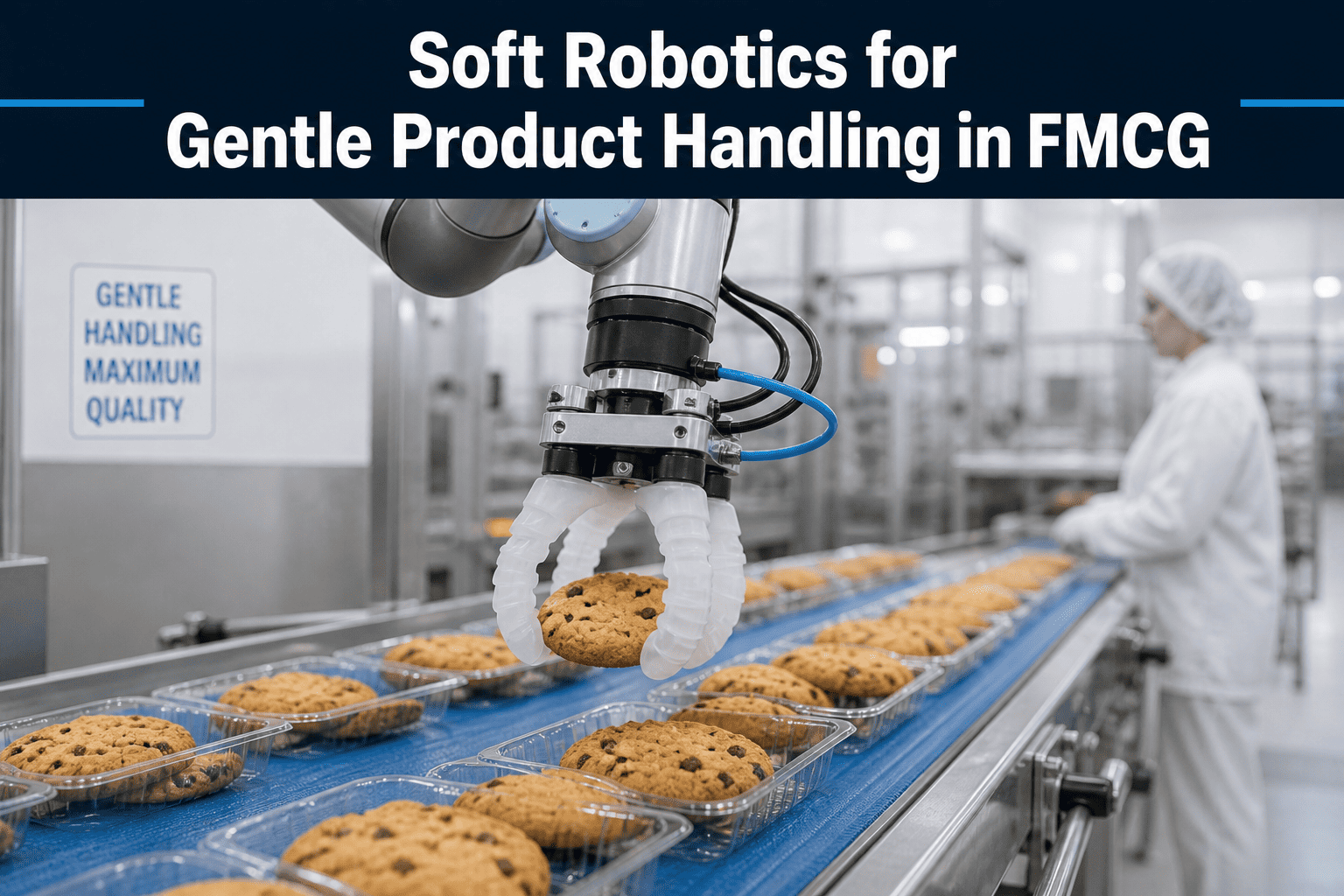
Bakery lines, fresh produce packing, and confectionery automation share one problem that rigid industrial robots cannot solve: the product damages before the robot does anything wrong. A chocolate truffle crushed by a steel gripper, a brioche loaf deformed by a pneumatic arm, a punnet of raspberries bruised by a vacuum pad — these are not edge cases. They are daily production losses that FMCG manufacturers have accepted for years as the cost of automation. Soft robotics ends that trade-off by bringing flexible, compliant, food-safe gripping to automated lines — handling the most delicate products at production speed without damage. If your gentle-product lines are still running manual pick-and-place because rigid robots cannot be trusted with your product, read on — and when you are ready to track soft robotic performance inside a live CMMS, start a free trial with Oxmaint or book a demo to see how it connects to your production data.
Robotics & Automation · FMCG Gentle Handling
Soft Robotics for Gentle FMCG Product Handling
Flexible grippers and compliant robotic systems that handle bakery, confectionery, and fresh produce at production speed — with zero product damage.
3–8%
Typical product damage loss on manual gentle-product lines
0.2%
Product damage rate achieved by soft robotic handling systems
60%
Labour cost reduction on gentle-product packing lines
$180K
Annual product waste savings for a mid-size bakery line
Track Soft Robotic Performance Inside Your CMMS
Oxmaint connects soft robotic system data to real-time OEE tracking, preventive maintenance schedules, and GMP-ready audit records — so your gentle handling lines perform as reliably as your rigid automation.
What Is Soft Robotics?
Soft robotics refers to robotic systems built from compliant, flexible materials — silicone, pneumatic bladders, shape-memory polymers — rather than rigid metal and plastic. Unlike conventional industrial robots that grip objects with fixed force, soft grippers conform to the shape of whatever they contact, distributing pressure evenly across the product surface. The result: automation that handles fragile, irregular, and variable-size products without causing damage — finally making automation viable for the food categories that rigid systems could never safely handle.
Technology
Pneumatic Soft Grippers
Air-inflated silicone fingers that wrap around irregular product shapes. Grip force proportional to air pressure — fully adjustable for product weight and fragility.
Technology
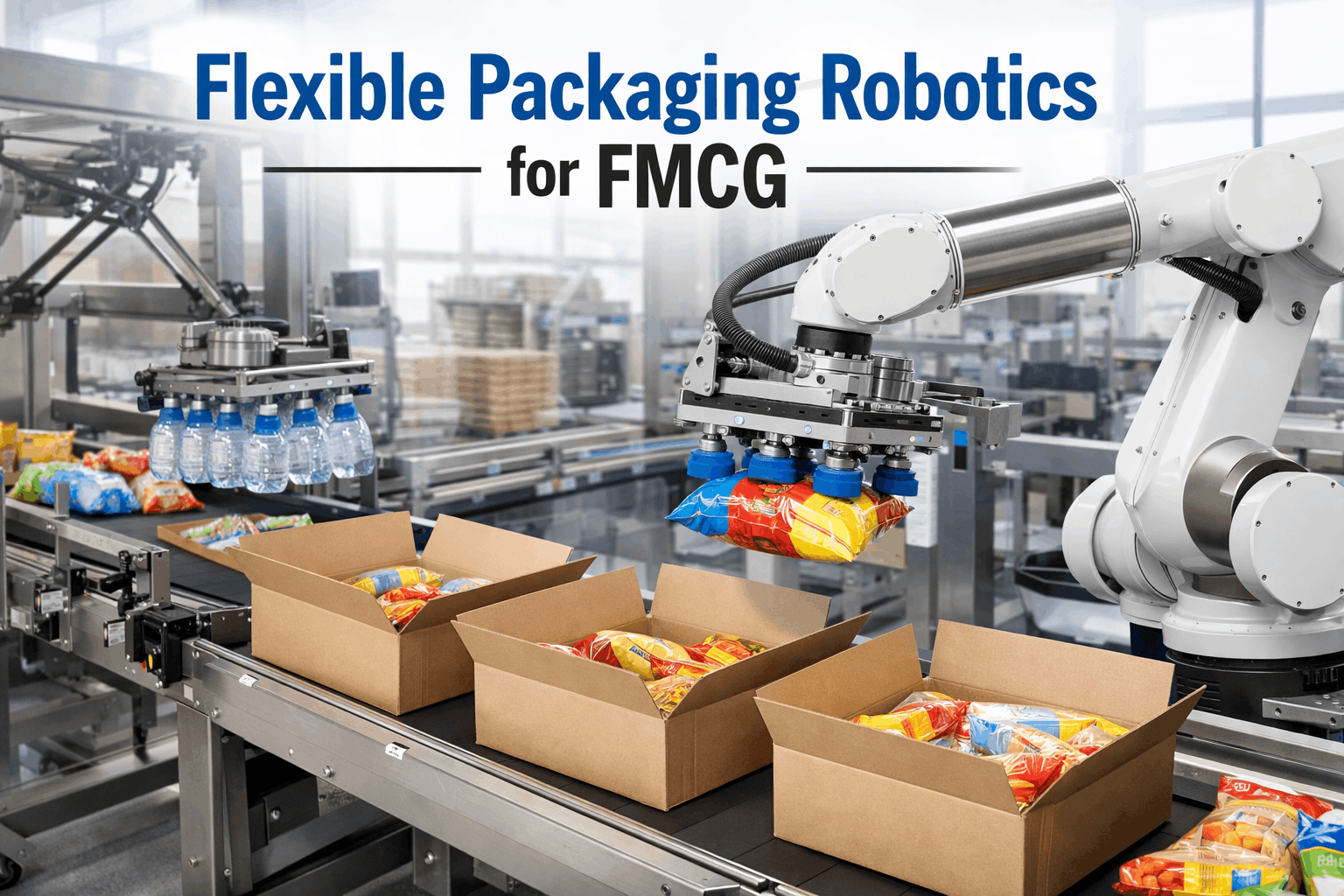
Adaptive Suction Cups
Flexible foam or silicone suction pads that conform to non-flat surfaces. Used for bakery items, confectionery trays, and fresh produce punnets with uneven top surfaces.
Technology
Electroactive Polymer Grippers
Electrically-actuated polymer fingers with sub-millimetre grip precision. Handles very small or very delicate items — individual chocolates, soft cheese pieces, single berries.
Technology
Granular Jamming Grippers
A membrane filled with granular material that vacuum-locks around any shape. Universal gripper for the widest range of product sizes and shapes on mixed lines.
Where Rigid Robots Fail in FMCG — and Soft Robots Step In
Bakery
Bread, Rolls & Pastries
Challenge: Irregular shape, soft crust, cracks under point pressure from rigid grippers.
Soft fix: Pneumatic conforming gripper distributes load across crust surface — no deformation at 40 picks per minute.
Confectionery
Chocolates & Soft Sweets
Challenge: Temperature-sensitive, surface-finish-critical, crushes under 50g of excess force from rigid jaws.
Soft fix: Electroactive fingers with 0.5g force resolution — picks chocolates at full tray-packing speed with zero surface marking.
Fresh Produce
Berries & Soft Fruits
Challenge: Bruises at 200g pressure, highly variable shape and ripeness — every piece is different.
Soft fix: Adaptive suction with pressure sensing rejects under-ripe and over-ripe items — handling 98% of fruit without bruising.
Dairy
Soft Cheese & Yogurt Pots
Challenge: Deformable packaging, wet exterior surfaces, and lidding integrity concerns under rigid pressure.
Soft fix: Conforming suction gripper engages lid perimeter without applying pressure to the deformable pot body.
How Oxmaint Supports Soft Robotic Lines
Preventive Maintenance
Gripper Wear Scheduling
Soft gripper membranes fatigue over time — typically 500,000 to 2 million cycles. Oxmaint tracks cycle counts per gripper and triggers replacement work orders before failure occurs on the line.
OEE Tracking
Damage Rate in OEE Quality
Product damage events feed into Oxmaint's OEE quality metric at the line level — making damage rate visible as a production efficiency number, not just a waste figure.
GMP Compliance
Food-Safe Maintenance Records
Gripper sanitisation, material certification, and maintenance records are stored in Oxmaint with digital signatures — meeting BRC and FSSC 22000 food safety documentation requirements.
Changeover
Gripper Change Managed in CMMS
When a product changeover requires a different gripper type, Oxmaint raises the changeover task, assigns the technician, and records the gripper swap against the asset — full SMED-ready documentation.
Spare Parts
Gripper Inventory Management
Oxmaint tracks gripper stock levels by type and size. When stock drops below minimum, a procurement work order triggers automatically — no more production stops due to a missing gripper.
IoT Integration
Pressure Anomaly Detection
Pressure sensors on pneumatic grippers feed real-time data to Oxmaint. Anomalous pressure readings — indicating membrane fatigue or seal failure — trigger immediate maintenance alerts before product damage occurs.
Manual Handling vs Soft Robotics — Head-to-Head
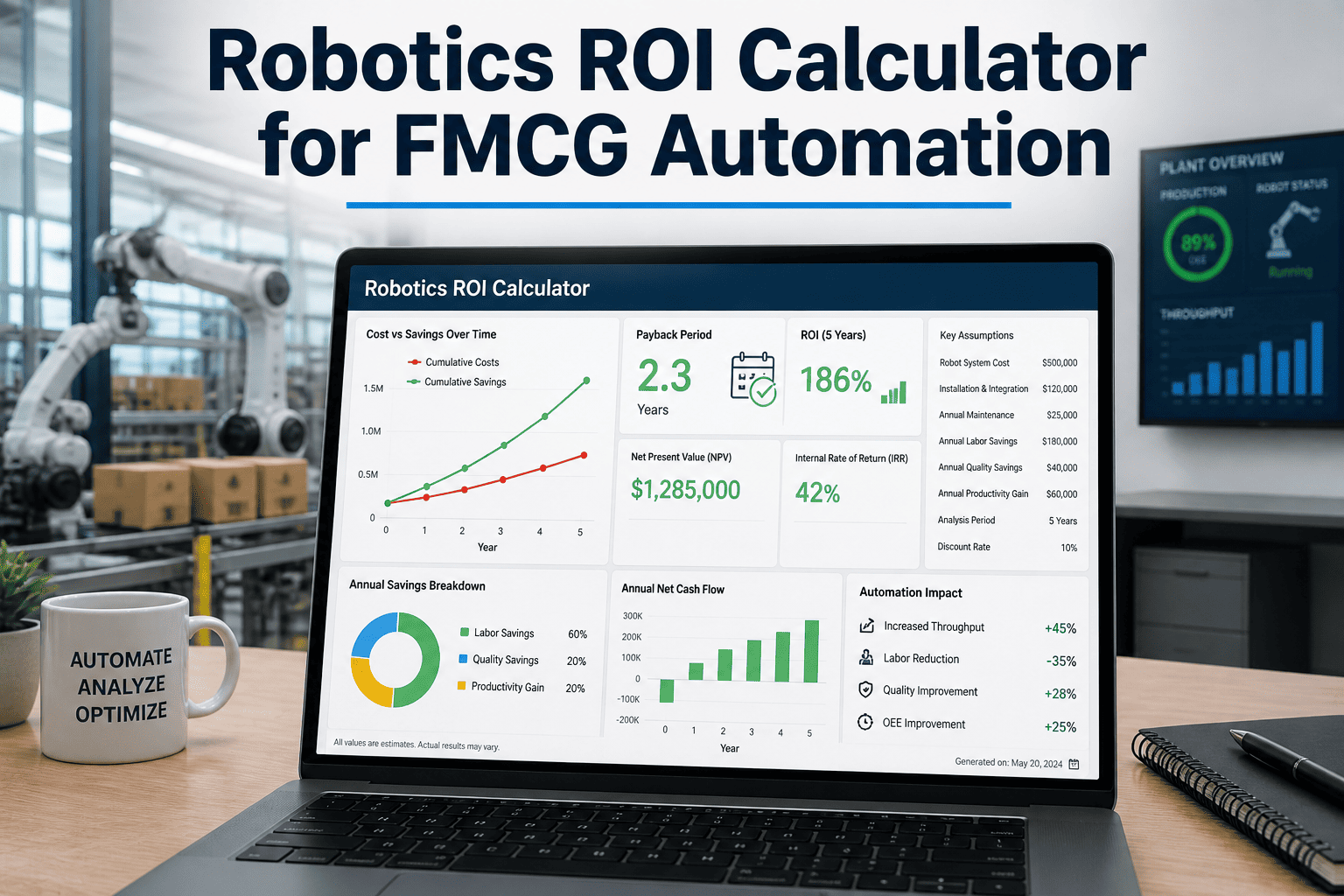
ROI on Soft Robotics Investment
0.2%
Damage Rate vs 3–8% Manual
A mid-size bakery running 2 tonnes per shift saves $180K annually in product waste alone
60%
Labour Cost Reduction
From 4–8 FTE per shift to 0.5 FTE oversight — critical in high-wage markets like Australia and Germany
2yr
Typical Payback Period
Calculated across waste reduction, labour savings, and elimination of food safety incidents from human handling
24/7
Consistent Performance
No fatigue, no shift variability, no contamination risk — production quality identical at 6 AM and 6 AM the following day
The numbers make the case — but the decision requires confidence that your soft robotic systems will be maintained as reliably as the investment demands. Oxmaint builds that confidence with proactive maintenance scheduling, gripper wear tracking, and real-time OEE visibility. Start a free trial to connect your first soft robotic asset today, or book a demo to see how gripper cycle tracking works in practice.
Frequently Asked Questions
How long do soft gripper membranes last before needing replacement?
Soft gripper membrane life varies by material and application: silicone pneumatic grippers typically achieve 500,000 to 2 million cycles before replacement is needed; electroactive polymer systems last 1 to 3 million cycles; granular jamming systems require membrane checks every 200,000 cycles. Oxmaint tracks cycle counts per gripper unit and triggers a preventive replacement work order at 80% of the rated life — ensuring replacement happens in scheduled downtime, not during production.
Can soft robots handle size variation in natural products like produce?
Yes — this is one of soft robotics' primary advantages over rigid systems. Natural products like strawberries, tomatoes, and mushrooms vary significantly in size, weight, and surface texture between harvests and even within the same harvest. Soft grippers with pressure feedback sensors automatically adjust grip force and contact area to accommodate variation — accepting product within a defined size range and rejecting outliers. Most produce handling systems achieve 94 to 98% pick success rates across natural product variation.
Are soft robotic grippers approved for food contact use?
Reputable soft robotic gripper manufacturers produce food-contact-approved versions of their systems using FDA-compliant silicone, EPDM, or other food-safe elastomers. These materials meet EU Regulation 10/2011 and FDA 21 CFR standards for direct food contact. Oxmaint stores material certification documentation, sanitisation records, and maintenance history against each gripper asset — providing the complete food safety evidence chain required for BRC Global Standard and FSSC 22000 certification audits.
What maintenance does a soft robotic system require compared to rigid robots?
Soft robotic systems require different maintenance profiles than rigid robots: more frequent membrane and seal inspections (weekly vs monthly), regular sanitisation of food-contact surfaces (daily or per-shift), and cycle-based gripper replacement rather than scheduled lubrication. The total maintenance workload is comparable but more frequent. Oxmaint schedules all soft robotic PM tasks automatically — daily sanitisation checklists, weekly seal inspections, and cycle-triggered replacement orders — ensuring soft robotic lines receive the proactive maintenance they need to maintain their handling precision.
Start a free trial to set up your first soft robotic PM schedule, or
book a demo to see the full maintenance workflow.
Your Delicate Product Lines Deserve Better Than Manual Handling
Oxmaint connects soft robotic system performance to real-time OEE, gripper wear tracking, and food-safe maintenance documentation — so your gentle handling automation performs as reliably as your investment demands. No implementation fees. Live in 30 days.