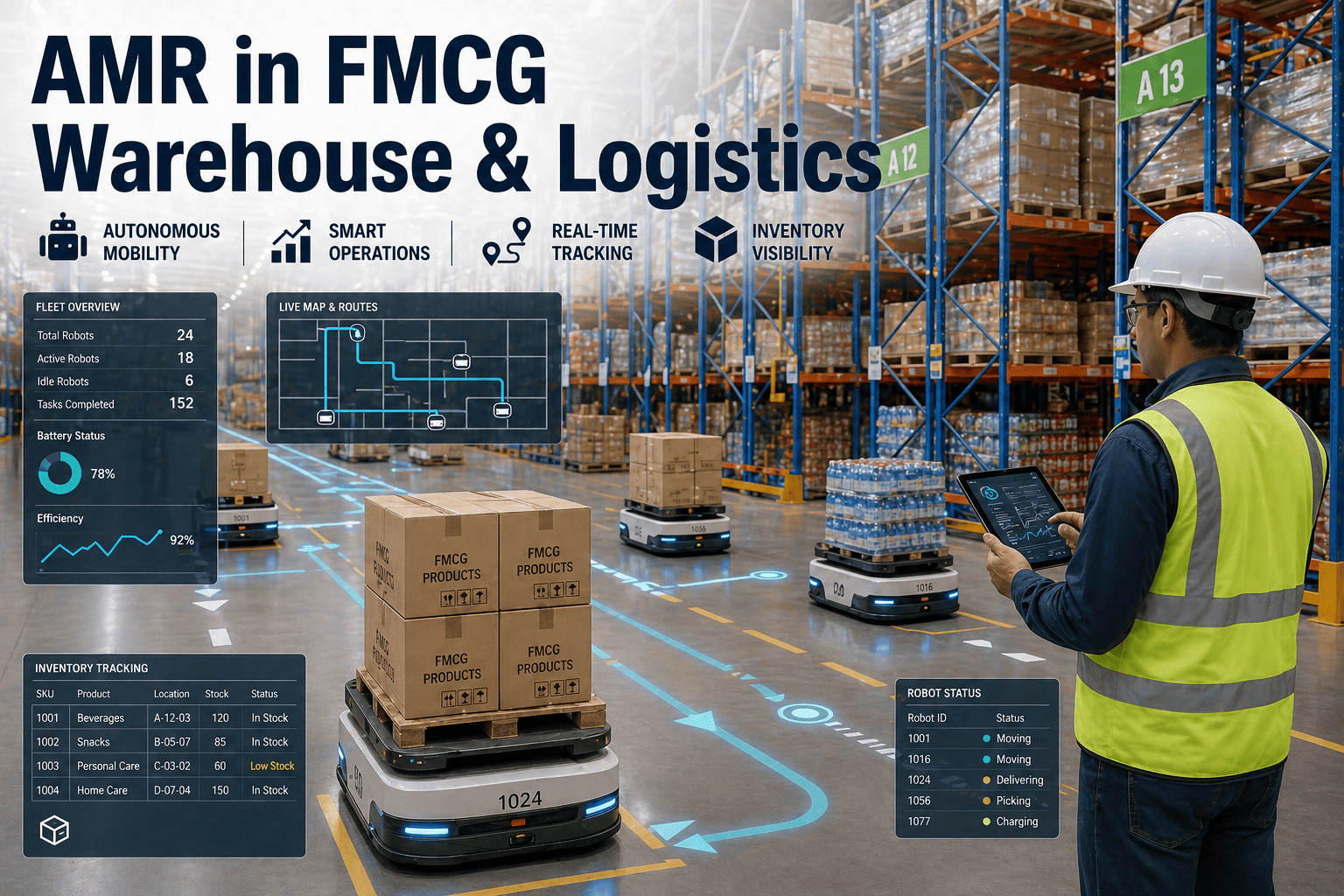
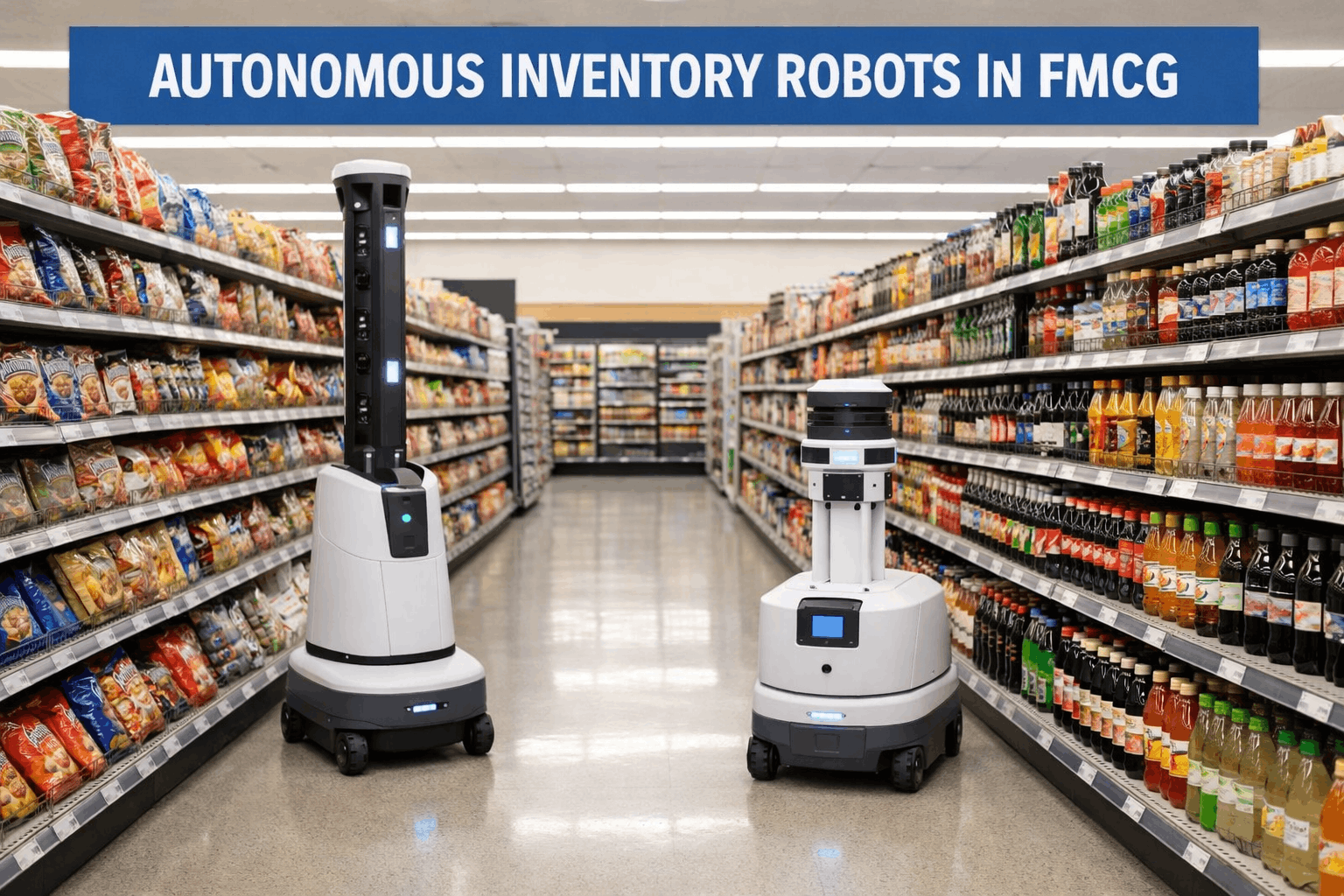
Walk into a modern FMCG distribution centre at 2 a.m. and you will see something that did not exist five years ago — fleets of autonomous mobile robots gliding past empty aisles, picking, transporting, and slotting product while a skeleton crew of three people manages a building that used to need fifty. AMR adoption inside FMCG warehouses is no longer a pilot exercise. The autonomous mobile robot market crossed USD 5 billion in 2026 and is growing at roughly 15 to 17% per year, with warehouse and logistics use cases driving the largest share of that demand. The pressure points are familiar to anyone running an FMCG operation — labour shortages, e-commerce-driven SKU explosion, sub-24-hour delivery promises, and shrinking peak windows that simply cannot be staffed manually anymore. If you want to see how OxMaint manages AMR fleets, work order routing, and uptime across multi-site FMCG operations, you can start a free trial or book a demo with a specialist who has rolled out AMR maintenance programmes across global FMCG groups.
FMCG Warehouse Automation / Robotics & AMR
Autonomous Mobile Robots for FMCG Warehouse & Logistics Operations
A practical, no-fluff look at how AMR fleets are reshaping FMCG picking, transport, and inventory — and how to keep them running at the uptime your fulfilment promises depend on.
USD 5.18B
Global AMR market size in 2026
15.3%
CAGR for AMR through 2031
40%
Reduction in manual handling reported
80%
Of large warehouses now automating
See AMR Maintenance and Uptime Inside OxMaint
Walk through a live multi-site dashboard that tracks every AMR by serial number — battery cycles, sensor calibration, drive-system condition, and per-unit work order history. We will model your fleet against your current downtime and pick rates in 30 minutes.
What an AMR Actually Is — And Why It Is Not an AGV
Most warehouse managers still use AMR and AGV interchangeably. They are not the same thing, and the difference shows up directly in throughput, layout flexibility, and total cost. An AMR is a mobile robot that uses on-board sensors, SLAM-based mapping, and AI-driven navigation to move freely around a dynamic environment — without floor magnets, painted lines, or fixed paths. The fleet adapts to a layout change overnight. An AGV needs the floor re-tracked.
AMR
Adaptive, sensor-driven, free-roaming
LiDAR plus vision, on-board compute, dynamic path planning, fleet management software. A new pick face, a parked pallet, or a re-laid aisle does not require infrastructure changes — the robot re-routes around it within seconds.
Reconfigure in hours, not weeks
AGV
Fixed-path, infrastructure-bound
Magnetic strips, wires, or painted lines guide the unit along pre-defined routes. Cheaper at unit level, but every layout change means tearing up floor markings and re-commissioning the entire route network.
Layout change is a project, not a tweak
Where AMRs Are Earning Their Keep Inside FMCG Warehouses
An AMR is not a single application — it is a platform that absorbs the repetitive, distance-heavy tasks that wear out human pickers and forklift drivers. Across FMCG operations, six use cases now account for the majority of fleet hours.
01
Goods-to-Person Picking
Robots bring shelves to a stationary picker. Walking time collapses from 60 to 70% of a pick shift to under 10%. Locus Robotics fleets have crossed 3 billion picks with reported productivity doubling to tripling on integrated lines.
2x to 3x picker productivity
02
Pallet & Case Transport
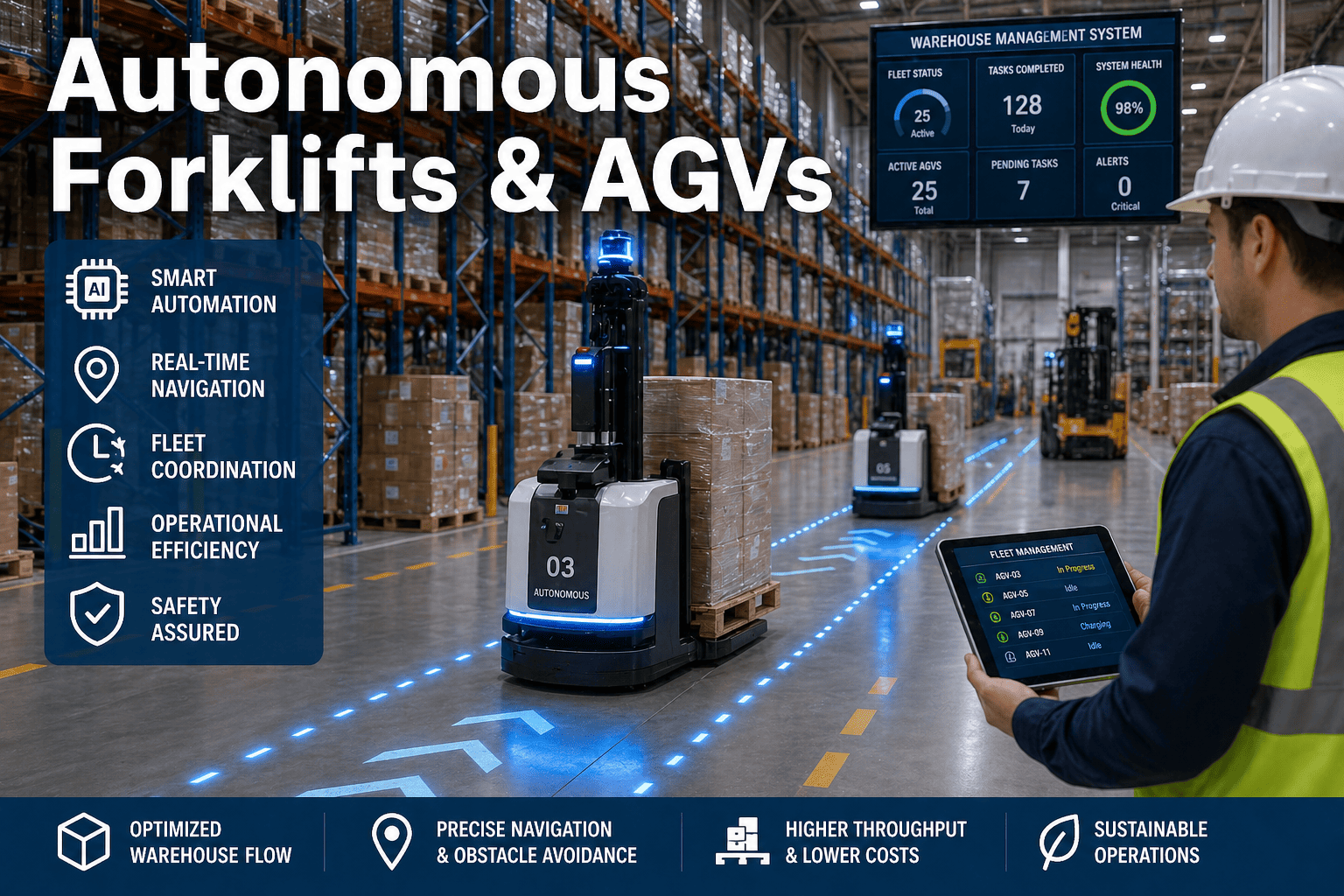
Self-driving forklifts and tugger AMRs move pallets between receiving, putaway, replenishment, and shipping lanes. Pre-shift bottlenecks at the dock door disappear when transport is decoupled from forklift driver availability.
24/7 transport without driver hire
03
Replenishment to Pick Faces
FMCG demand spikes empty pick faces fast. AMRs handle the steady flow of full-case replenishment from reserve to active locations on schedule, eliminating the picker walks back to reserve that destroy shift productivity.
Pick-face stockouts reduced significantly
04
Inventory Cycle Counting
AMRs equipped with RFID readers and overhead cameras roam aisles overnight, automatically validating slot quantities and flagging exceptions. Cycle counts that took five people a week now run continuously in the background.
Continuous cycle counts overnight
05
Sortation & Order Consolidation
Sorting AMRs route picked totes to dispatch lanes by carrier, route, and cut-off time. Consolidation that used to need a dedicated pack-out zone with conveyors flexes dynamically with daily order shape.
Throughput scales with demand
06
Cross-Dock & Returns Flow
Returns and cross-dock create unpredictable peaks. AMR fleets handle the surge without permanent labour commitments, and free up forklifts for the work where weight and reach actually require them.
Flexible labour without flex hiring
FMCG Warehouse Pain Points — Why Manual Operations Are Hitting a Wall
Operations leaders are not adopting AMRs because robotics is fashionable. They are adopting them because the manual model is breaking under load. These are the specific points where it cracks first — and where AMR fleets pay back fastest. Want to see how OxMaint helps multi-site FMCG operators get on top of their fleets, start a free trial or book a demo with the team.
Labour Scarcity & Turnover
Warehouse labour turnover routinely exceeds 40 to 50% annually in FMCG markets. Recruitment, onboarding, and ramp-up costs are a permanent line item that AMR fleets quietly remove from the budget.
40 to 50% annual turnover
SKU Explosion & Mix Volatility
FMCG SKU counts have grown 3 to 5 times in the last decade as e-commerce private labels, regional variants, and trade-pack formats multiply. Fixed conveyor automation cannot keep up; AMRs flex without re-engineering.
3x to 5x SKU growth
Sub-24-Hour Delivery Pressure
Same-day and next-day delivery commitments compress order cut-offs to minutes. Manual picking simply does not move fast enough during peak windows without doubling the headcount that does not exist to hire.
Cut-offs measured in minutes
Safety & Injury Costs
Material handling causes a high share of warehouse injuries — strains, slips, and forklift incidents. AMR-augmented operations have reported up to 80% reduction in handling injuries on integrated lines.
Up to 80% fewer handling injuries
Inventory Accuracy Drift
Manual cycle counting falls behind during peak weeks. Inventory accuracy slips, picks short, and customer service deteriorates — which then triggers expedited freight and emergency replenishment costs that compound.
Accuracy drops during peaks
Fleet Downtime Without Visibility
A four-hour AMR outage during a peak shift can stall an entire pick wave. Without structured fleet maintenance and per-unit work order history, the same failure modes recur across the estate, quarter after quarter.
Hours of outage per peak shift
How OxMaint Keeps an FMCG AMR Fleet Running
An AMR fleet is only as productive as its uptime. Battery health, LiDAR calibration, drive-wheel wear, and cycle counts all degrade silently — and a single missed PM is enough to take a unit offline mid-shift. OxMaint is the maintenance layer underneath the fleet management software, designed for multi-site FMCG operators who manage dozens to hundreds of robots across different brands. To see it in your environment, you can start a free trial or book a demo.
Per-Unit Asset Tracking
Every Robot, Every Cycle, Every Sensor
Each AMR is registered by serial number with firmware version, install date, payload class, and cell assignment. Cycle counts, battery state-of-health, and sensor calibration history sit on a single asset record that the floor team and the auditor see the same way.
Cycle-Based PM Triggers
PM Driven by Cycles, Not Calendars
PM tasks fire when the robot reaches its OEM-defined cycle threshold — not on a fixed monthly date. Lubrication, drive inspection, and gripper changes happen when the asset has earned them, eliminating both over-maintenance and missed intervals.
Battery & Charging Health
Opportunity-Charging Discipline
Battery cycles, depth-of-discharge, and charge-station performance are tracked per pack. Deep discharge events below 15% trigger alerts; pack replacement is scheduled before degradation eats into shift productivity instead of after.
Sensor Calibration Logs
LiDAR & Vision Integrity Confirmed
Weekly LiDAR cleaning, monthly sensor-to-chassis alignment, and post-collision recalibration tasks are scheduled and signed off by competent technicians. Map drift and docking errors that compound across a fleet are caught at the source.
Multi-Site Fleet Visibility
One Dashboard Across Every DC
Operators running 3, 10, or 50 distribution centres see harmonised KPIs — fleet uptime, mean time between failure, PM compliance — on the same dashboard. Best-performing site practices become the corporate standard, not site-specific tribal knowledge.
Mobile Work Orders
Technicians Work Where the Robots Are
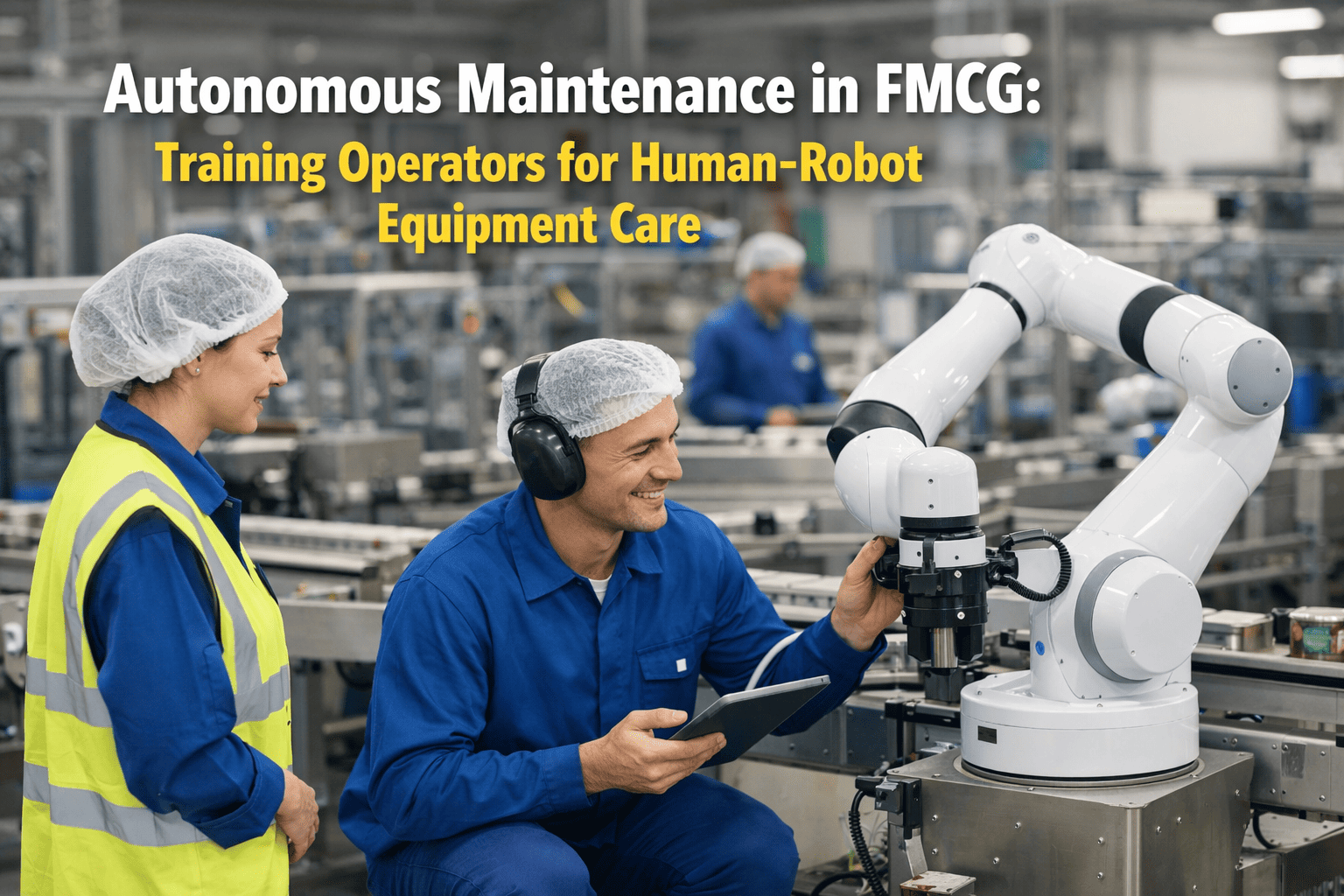
Field techs scan an AMR, see its full history, complete the PM checklist, capture photos, and close the work order from the floor. Offline sync handles dead spots in racking aisles. Mobile adoption inside FMCG warehouses on OxMaint runs above 90%.
Manual Material Handling vs AMR-Driven Operations
Side-by-side, the gap is wider than most operations leaders realise — particularly when you cost in turnover, peak surge labour, and safety incidents alongside throughput.
The ROI Stack — Where AMR Investment Actually Pays Back
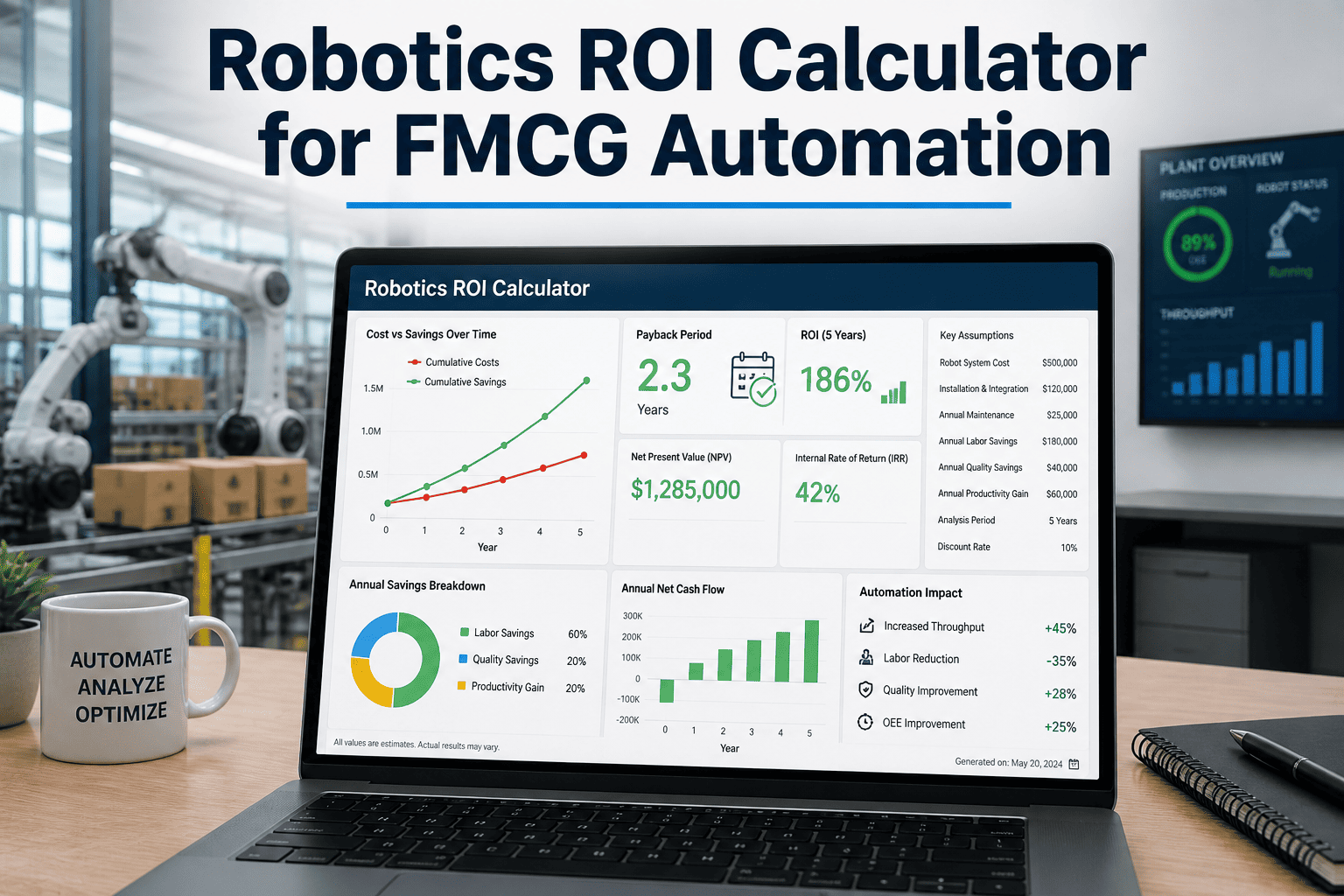
A defensible AMR business case does not rest on a single number. It stacks four layers of savings, each of which appears in a different month after go-live. Get the stack right and the payback window typically lands in the 12 to 24 month range for FMCG operations.
L1
Direct labour displacement
Goods-to-person picking eliminates the 60 to 70% of pick time that walkers spend walking. Not every role disappears, but headcount needed to hit the same throughput drops materially. This is the saving the CFO models first — and the one that materialises within months one to three.
2x to 3x picker productivity
L2
Inventory accuracy & shrink reduction
Continuous cycle counts replace periodic physical inventories. Mis-picks drop, expediting freight drops, and customer dispute charges drop with them. The savings are unspectacular per shift and decisive across a quarter — typically the second layer to confirm in financials.
Single-digit-percent shrink reduction
L3
Safety & insurance impact
Reduced manual handling and forklift exposure compress recordable incidents. Insurance premia and workers-compensation reserves follow with a one to two year lag. For multi-site portfolios, this is a six- to seven-figure annual line at full deployment scale.
Up to 80% fewer handling injuries reported
L4
Fleet uptime & maintenance optimisation
This is the layer that quietly defends the entire stack. Fleets without structured PM degrade — battery packs die early, LiDAR drifts, drive wheels wear unevenly, and unit MTBF collapses. OxMaint-managed fleets keep the units that justified the investment running at the uptime the financial model assumed.
Up to 70% downtime reduction with structured PM
The Four-Phase AMR Adoption Playbook for FMCG
FMCG operators running multi-site distribution networks do not deploy AMRs everywhere at once. The pattern that consistently works is a four-phase rollout that proves the model on one site, locks the configuration, and waves it across the network with the maintenance discipline already in place.
Phase 1
Pilot one DC, one use case
Pick a representative DC and one application — typically goods-to-person picking on the highest-velocity zone. Stand up the fleet, register every unit in OxMaint, and capture baseline KPIs against the manual line.
Outcome by day 90Baseline + measurable lift
Phase 2
Lock the maintenance template
Codify the PM schedule, sensor-calibration cadence, battery management protocol, and safety verification routine into a reusable template. Every subsequent site inherits the template — eliminating site-by-site bespoke build.
OutcomeRepeatable rollout package
Phase 3
Wave-deploy across regions
Roll the template to DCs in waves of three to six, grouped by region or service area. Each wave runs roughly 60 to 90 days. Multi-site dashboards light up as waves complete and best-performing site practices feed back into the template.
Outcome10+ DCs live in 12 months
Phase 4
Layer predictive & second-use cases
With clean data flowing across all sites, layer predictive battery analytics, anomaly detection on drive systems, and second-use applications — replenishment, cycle counting, returns flow. This is where the fleet earns its compounding return.
OutcomeSecond-wave ROI on top of base
Frequently Asked Questions
How long does it take an AMR fleet to start producing return on investment?
For FMCG warehouse picking and transport, payback windows typically land between 12 and 24 months. The first quarter delivers labour productivity. Months four to nine deliver inventory accuracy and safety reductions. Beyond that, fleet uptime discipline through structured maintenance defends the financial model.
Start a free trial to model the comparison.
Do AMRs replace forklifts entirely or work alongside them?
Both. AMRs handle the high-frequency, lower-weight, predictable transport flows. Forklifts continue to do what they are best at — heavy pallets, dock door work, and reach-truck putaway in narrow aisles. The right answer for most FMCG DCs is a hybrid fleet, with AMRs absorbing the labour-intensive flows that wear out drivers and pickers.
What does it actually take to maintain an AMR fleet across multiple sites?
Per-unit asset registers, cycle-based PM triggers, battery health tracking, weekly LiDAR cleaning, drive-system inspections, and post-collision recalibration are the non-negotiables. OxMaint runs all of this on one platform with mobile-first technician execution.
Book a demo to walk through it for your fleet size.
Can AMRs handle the mix volatility typical in FMCG warehouses?
Yes — AMR fleets are software-defined, so adapting to SKU mix changes, seasonal peaks, and new pick faces happens through configuration rather than infrastructure changes. This is the single biggest reason FMCG operators choose AMRs over fixed conveyor automation when SKU counts are growing.
What happens if an AMR breaks down mid-shift during peak?
A well-managed fleet has spare capacity built in. The fleet management software re-routes work to other units, and OxMaint raises a critical work order with the failure code, location, and full asset history attached. Mean time to repair drops because the technician arrives with the right context and parts already requested.
How does OxMaint integrate with the fleet management and WMS software we already run?
OxMaint integrates via REST APIs and pre-built connectors with major WMS, fleet management, and ERP platforms. Asset records, work orders, and maintenance history pass cleanly between systems. Telemetry from robot controllers and SCADA feeds cycle counts and condition data into the OxMaint asset record in real time.
Your Fleet Is Only as Good as Its Uptime
AMRs deliver the productivity, scalability, and safety that FMCG operations need to keep their delivery promises. The financial model only holds if every unit on the floor stays running at the cycle count the business case assumed. OxMaint is the maintenance layer that protects that assumption — across one DC or fifty.