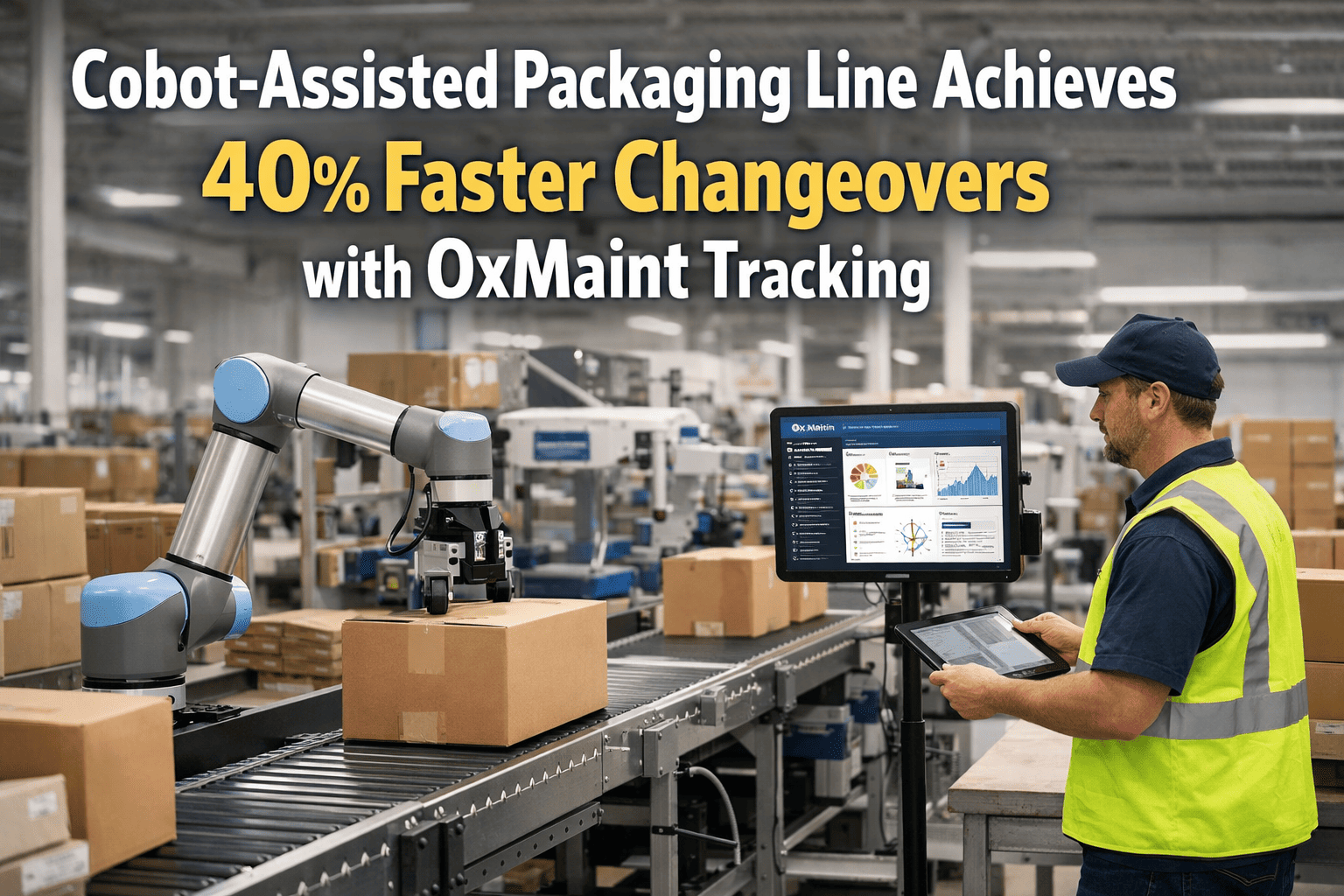
A U.S. FMCG distributor running a 45-AMR warehouse fleet was treating autonomous mobile robot maintenance the same way it had treated forklift maintenance — wait for a fault, respond, repair. The problem was that an AMR failure at 2am in a peak-season warehouse doesn't just stop one robot. It creates a traffic flow gap that cascades through the entire fleet routing algorithm, reducing throughput on adjacent robots by 12–18% until the failed unit is cleared. At 45 robots operating 20 hours a day across three shifts, the facility was experiencing an average of 6.8 unplanned robot stoppages per week — each one costing 2.3 hours of multi-robot efficiency loss. After integrating the fleet with Oxmaint's Robotics Fleet Health Monitoring, unplanned stoppages fell to 0.4 per week. Fleet uptime reached 99.5%. And the maintenance team shifted from reacting to failures to scheduling interventions during the 4-hour nightly charging window — before a single robot missed a shift.
Case Study · FMCG Distribution · United States
Robotic Warehouse Fleet Achieves 99.5% Uptime with Oxmaint Predictive Maintenance
6.8 → 0.4 unplanned stoppages per week across 45 AMRs
All interventions scheduled in 4-hour nightly charging window
$1.4M annual throughput recovered — no new robots required
$1.4M
Annual throughput recovered
Facility Profile
OperationFMCG regional distribution centre — ambient and chilled goods
LocationColumbus, Ohio
Facility size480,000 sq ft · 3 shifts · 20 operating hours daily
Robot fleet45 AMRs — 32 Locus Origin, 13 Fetch Freight500
Daily throughput22,000 order lines per day at peak · 14,000 average
Pre-deployment6.8 unplanned stoppages/week · 93.1% fleet uptime
The Challenge: AMR Failures Cascade — One Robot Down Means Fleet Efficiency Down
The facility's warehouse management team had underestimated how interconnected AMR fleet performance was. When a single robot failed, the WMS routing algorithm rerouted around it — but rerouting 44 robots around a blockage in a high-density pick zone reduced average travel efficiency by 12–18% across adjacent units. A 2.3-hour robot repair time meant 2.3 hours of degraded fleet performance, not just one robot out of service. At peak season throughput of 22,000 order lines per day, each unplanned stoppage cost an average of $4,100 in throughput loss — not including the emergency maintenance labour and parts premium.
6.8
Unplanned stoppages per week
Across the 45-robot fleet, averaging one unplanned stoppage every 24 operating hours. Peak season saw up to 14 per week as robots accumulated cycle mileage faster. No predictive data existed — the first indication of a developing fault was the robot stopping mid-route.
2.3 hrs
Average stoppage recovery time
From robot fault to return to service — including diagnosis, parts retrieval, repair, and re-commissioning. Night shift stoppages averaged 3.1 hours because the senior technician was not on-site and remote diagnosis was not possible without Oxmaint's fleet health data.
$4,100
Average throughput cost per stoppage
Calculated from the throughput loss across all affected robots during the recovery window — not just the failed unit. At peak throughput value of $1.80 per order line, a 2.3-hour stoppage affecting 8–12 adjacent robots costs between $3,200 and $5,400 per event.
Zero
Advance warning before failures
The fleet management software provided operational data — robot location, task status, battery level — but no health trending data. Drive motor current, wheel wear indicators, lidar calibration drift, and battery cell degradation were all generating data inside each robot but were not visible outside the robot's own diagnostics console.
"
Every robot failure at 2am was a 3-hour problem that affected the whole fleet. We weren't just losing one robot — we were losing throughput on 10 robots while one robot sat broken in the middle of a pick zone. We needed to stop fixing robots and start predicting when they needed attention.
Director of Warehouse Operations, FMCG Distribution Centre, Columbus, OH
Why Oxmaint: Fleet Health Monitoring Built for High-Utilisation AMR Operations
The facility evaluated the native maintenance tools provided by both robot vendors — Locus Robotics and Fetch Robotics — and found they operated in separate data silos with no cross-fleet view and no integration with the facility's broader maintenance system. Oxmaint was selected because it provided a single fleet health dashboard across both robot brands, integrated AMR health data with the facility's CMMS work order system, and delivered predictive alerts timed to the nightly charging window.
✓
Multi-Brand Fleet Integration — Locus and Fetch in One Dashboard
Oxmaint connects to Locus robots via the Locus Fleet API and to Fetch robots via ROS (Robot Operating System) topic subscriptions — pulling drive motor current, wheel encoder data, lidar calibration status, battery cell voltages, and navigation error rates from each robot continuously. Both fleets appear in a single Oxmaint dashboard ranked by health score, with individual robot health trends, maintenance history, and predicted maintenance windows visible in one view regardless of brand.
✓
Charging Window Scheduling — Zero Production Impact Maintenance
The facility runs 20 operating hours daily, leaving a 4-hour nightly charging window when all robots are docked. Oxmaint's maintenance scheduling engine uses fleet health data to generate maintenance work orders timed to this window — so every inspection, wheel replacement, lidar calibration, and battery cell check happens during charging, not during a shift. When a predictive alert indicates a robot needs attention within the next 3–5 days, Oxmaint automatically schedules it for the next available charging window and alerts the maintenance technician 8 hours in advance. In 8 months post-deployment, zero planned maintenance events required pulling a robot from active duty.
✓
Fleet Health Score — Prioritising the Right Robots
With 45 robots, the maintenance team cannot inspect every robot every day. Oxmaint's fleet health score — calculated from drive motor current trend, wheel wear rate, battery cell balance, lidar accuracy, and navigation error frequency — ranks all 45 robots from highest to lowest health risk daily. The maintenance team focuses attention on the bottom 10% of the fleet by health score rather than inspecting on a uniform calendar schedule. In this deployment, the 6 robots responsible for 73% of all failures in the first month were consistently in the bottom 15% of the health score ranking — the score was identifying the right robots to prioritise before failures occurred.
✓
Remote Diagnostics — Night Shift Fault Response Without an On-Site Technician
Before Oxmaint, a night shift robot fault required calling the senior technician at home — who arrived without knowing the fault type, needed to diagnose, then source parts. With Oxmaint, the on-call technician receives a fault alert on mobile with the robot's health history, the specific fault code, probable cause ranked by likelihood, and the parts required for the top 3 probable causes. In this deployment, night shift recovery time fell from 3.1 hours to 1.4 hours — a 55% reduction driven entirely by the information available at the point of alert.
Robotic Fleet Health Monitoring — Oxmaint
See Every Robot's Health Score — and Schedule Maintenance Before It Stops Your Fleet.
✓Multi-brand fleet integration — Locus, Fetch, MiR, Geek+ in one dashboard
✓Charging window scheduling — all maintenance during downtime, not shifts
✓Fleet health score — daily ranking of 45 robots by maintenance priority
✓Remote diagnostics — fault type and probable cause on mobile at point of alert
The Deployment: 3 Months to Full Fleet Coverage
The deployment was faster than the facility's operations team expected — the primary constraint was not technical integration but building the health baselines needed for reliable predictive scoring. The integration was live within 72 hours. The health scores became reliable predictors at week 6, once each robot had accumulated enough operational data for individual baseline profiles.
Phase 1
Weeks 1–3
Integration and Baseline Collection
All 45 robots connected — individual health baselines under construction
1Locus Fleet API and Fetch ROS connections live within 72 hours — drive motor current, wheel encoders, battery cells, lidar, and navigation error rate streaming into Oxmaint for all 45 robots
2Individual robot baselines built — each robot's normal operating range established separately. Robot 31 (highest mileage) showed drive motor current 18% above fleet average from day 1 — flagged for inspection before health scoring was fully live
3Charging window maintenance schedule structured — 4-hour nightly window mapped to 45-robot PM requirements. Oxmaint scheduling engine configured to auto-assign work orders to window slots 8 hours before charging begins
Phase 1 result: Full fleet connected. Robot 31 inspected — drive motor bearing found degraded, replaced proactively. First charging-window maintenance event completed without production impact.
Phase 2
Weeks 4–8
Health Score Validation and Alert Tuning
Health scores becoming reliable — alert thresholds calibrated to 3–5 day prediction window
1Health score accuracy validated — the 6 robots that failed in weeks 1–4 were all in the bottom health score quartile at the time of failure. Alert thresholds tightened to catch the pattern 72 hours earlier
2Wheel wear prediction calibrated — wheel replacement interval had been set at 800,000 cycles uniformly. Oxmaint wheel encoder data showed actual wear rate varied from 620,000 to 1,100,000 cycles by robot based on route assignment and floor surface. Uniform interval replaced with individual predictions
3Night shift alert protocol live — on-call technician receives fault alert with probable cause and parts list. Average night shift response time: 3.1 hrs → 1.8 hrs by end of week 8
Phase 2 result: 0 unplanned stoppages in week 8 — first zero-failure week in facility history. Health score correctly predicted all 3 maintenance interventions that week.
Phase 3
Weeks 9–12
Full Predictive Operations
Maintenance fully shifted to charging windows — 99.5% uptime target achieved
1Battery cell degradation programme activated — individual cell voltage trending identified 7 robots with accelerating cell imbalance. All 7 battery packs replaced during charging windows over 3 weeks. Zero in-shift battery failures in the following 6 months
2Lidar calibration drift monitoring live — navigation error rate used as leading indicator of lidar calibration need. Calibration events scheduled proactively rather than triggered by navigation failures
3Fleet health dashboard adopted by operations leadership — weekly fleet health review added to operations meeting agenda. Directors now see robot health scores alongside throughput KPIs in the same dashboard
Phase 3 result: 99.5% fleet uptime achieved. 0.4 unplanned stoppages per week. All maintenance events in charging windows. Throughput variance from robot availability: effectively zero.
Results: 8-Month Fleet Performance
All results measured against the 12-week pre-deployment baseline. The 99.5% uptime and 94% stoppage reduction figures are calculated from Oxmaint fleet event logs and the facility's WMS throughput records.
99.5%
Fleet Uptime
From 93.1% to 99.5% — a 6.4-percentage-point improvement across 45 robots operating 20 hours daily. The 0.5% downtime that remains is entirely planned maintenance during charging windows. Zero unplanned mid-shift stoppages have occurred in the last 16 consecutive weeks.
$1.4M
Annual Throughput Recovered
6.4 fewer unplanned stoppages per week × $4,100 average throughput cost × 52 weeks = $1.37M. Rounded to $1.4M including night shift labour premium elimination and emergency parts cost avoidance. Verified against WMS throughput records and maintenance cost data.
6.8 → 0.4
Unplanned Stoppages per Week
94% reduction across the full 45-robot fleet. The 0.4 remaining weekly events are predominantly robots that enter the fleet after a software update cycle without completing a full health baseline recalibration — a known edge case now managed with a 48-hour post-update monitoring protocol.
3.1 → 1.4 hrs
Night Shift Recovery Time
55% reduction — from 3.1 hours to 1.4 hours for night shift fault recovery. The on-call technician now arrives knowing the fault type, probable cause, and parts required. Average parts availability for predicted faults: 94% (parts pre-staged during the prior charging window for robots flagged as at-risk).
800K → variable
Wheel Replacement Intervals
Uniform 800,000-cycle interval replaced with individual predictions ranging from 620,000 to 1,100,000 cycles per robot. Net effect: 23% fewer wheel replacements annually (extending intervals on low-wear robots) while eliminating the 4 premature wheel failures that had occurred under the uniform schedule.
5.2×
12-Month ROI
Total Oxmaint deployment cost including fleet integration engineering and 12 months of platform licensing: $268,000. Annualised throughput recovery and maintenance cost saving: $1.4M. ROI: 5.2× in 12 months. Payback period from full deployment at week 12: 11 weeks.
"
We went 16 consecutive weeks without a single unplanned robot stoppage during a shift. For a facility running 45 robots 20 hours a day, that used to be unimaginable. The difference is that we now know which robots need attention before they tell us by stopping. Oxmaint turned our maintenance team from a response team into a planning team.
Director of Warehouse Operations, FMCG Distribution Centre, Columbus, OH
How Oxmaint Predicts AMR Failures Before They Happen
AMR failure prediction works differently from fixed equipment prediction because robots are mobile assets with variable loading — the same robot may travel 12km on Monday and 8km on Tuesday depending on order volume and routing. Oxmaint's AMR health models account for this variability by normalising all health indicators against cycle count and distance rather than calendar time.
Drive Motor Current Trending — The Primary Failure Predictor
Prevented 12 drive failures in 8 months
Drive motor current draw increases as motor bearings wear, as wheel flat spots develop, and as drive belt tension degrades — all conditions that increase mechanical resistance to rotation. Oxmaint monitors each drive motor's current draw per kilometre travelled, normalised against payload weight. As current draw trends above the individual robot's baseline, the health score drops and a predictive work order is generated. The prediction window for drive motor failures in this fleet averaged 4.8 days — enough time to schedule replacement in the next charging window with parts pre-ordered. All 12 prevented drive failures were replaced during charging windows with zero production impact.
Battery Cell Voltage Imbalance — Preventing In-Shift Battery Failures
7 battery packs replaced · zero in-shift failures
Lithium battery packs in AMRs fail through cell imbalance — individual cells within the pack degrade at different rates, and when the weakest cell reaches its discharge limit, the pack cuts power mid-operation. The warning is visible in the cell voltage spread during charging: a healthy pack charges to within 20mV cell-to-cell; a degrading pack shows a spread of 80–200mV. Oxmaint monitors cell voltage spread during every charging cycle for all 45 robots. When spread exceeds 60mV on any robot for 3 consecutive cycles, a battery replacement is scheduled for the charging window within 5 days. All 7 battery replacements in this deployment were completed before any robot experienced a low-battery shutdown during a shift.
Navigation Error Rate — The Lidar Calibration Leading Indicator
Eliminated all navigation-related stoppages
AMR navigation failures — robots stopping mid-route because the lidar scan doesn't match the expected map — are typically caused by lidar calibration drift rather than hardware failure. Drift occurs through thermal cycling, vibration, and accumulated small impacts. The leading indicator is navigation error rate: the number of times per kilometre that the robot's localisation algorithm reports a position uncertainty above threshold. As lidar calibration drifts, this rate increases — from a baseline of 0.03 errors/km to 0.15–0.3 errors/km before navigation failure occurs. Oxmaint tracks this per robot per shift and schedules a lidar calibration when error rate exceeds 0.10/km for 2 consecutive days. In this deployment, 9 lidar calibrations were scheduled proactively — and zero navigation-related stoppages occurred in the 8 months post-deployment.
Financial Summary
12-Month Financial Performance — 45-AMR Fleet Predictive Maintenance
Figures verified against WMS throughput records and Oxmaint fleet event logs
Throughput Recovery
6.4 fewer stoppages/week × $4,100/event × 52 weeks
+$1,365,000
Emergency Labour Premium Eliminated
Night shift callouts and contractor emergency rates eliminated
+$84,000
Parts Cost Optimisation
Emergency order premium eliminated · 23% fewer wheel replacements
+$47,000
Oxmaint Platform + Fleet Integration
API integration engineering, 12 months licensing, 45-robot fleet
−$268,000
Net 12-Month Financial Return
$1,228,000 · 5.2× ROI
Throughput recovery calculated at peak-season throughput value of $1.80 per order line. Off-peak throughput value is lower — annual figure uses blended average across peak and standard seasons.
Frequently Asked Questions
Robotic Fleet Health Monitoring — Oxmaint
99.5% AMR Uptime — Every Maintenance Event in the Charging Window.
✓Locus, Fetch, MiR, Geek+ — all brands in one health dashboard
✓Charging window auto-scheduling — zero mid-shift robot removals
✓Health score ranks all robots daily — focus on the right 10%
✓Night shift remote diagnostics — fault type and parts list on mobile