Capturing Tribal Knowledge: How CMMS & AI Preserve FMCG Maintenance Expertise
By spencer on March 9, 2026
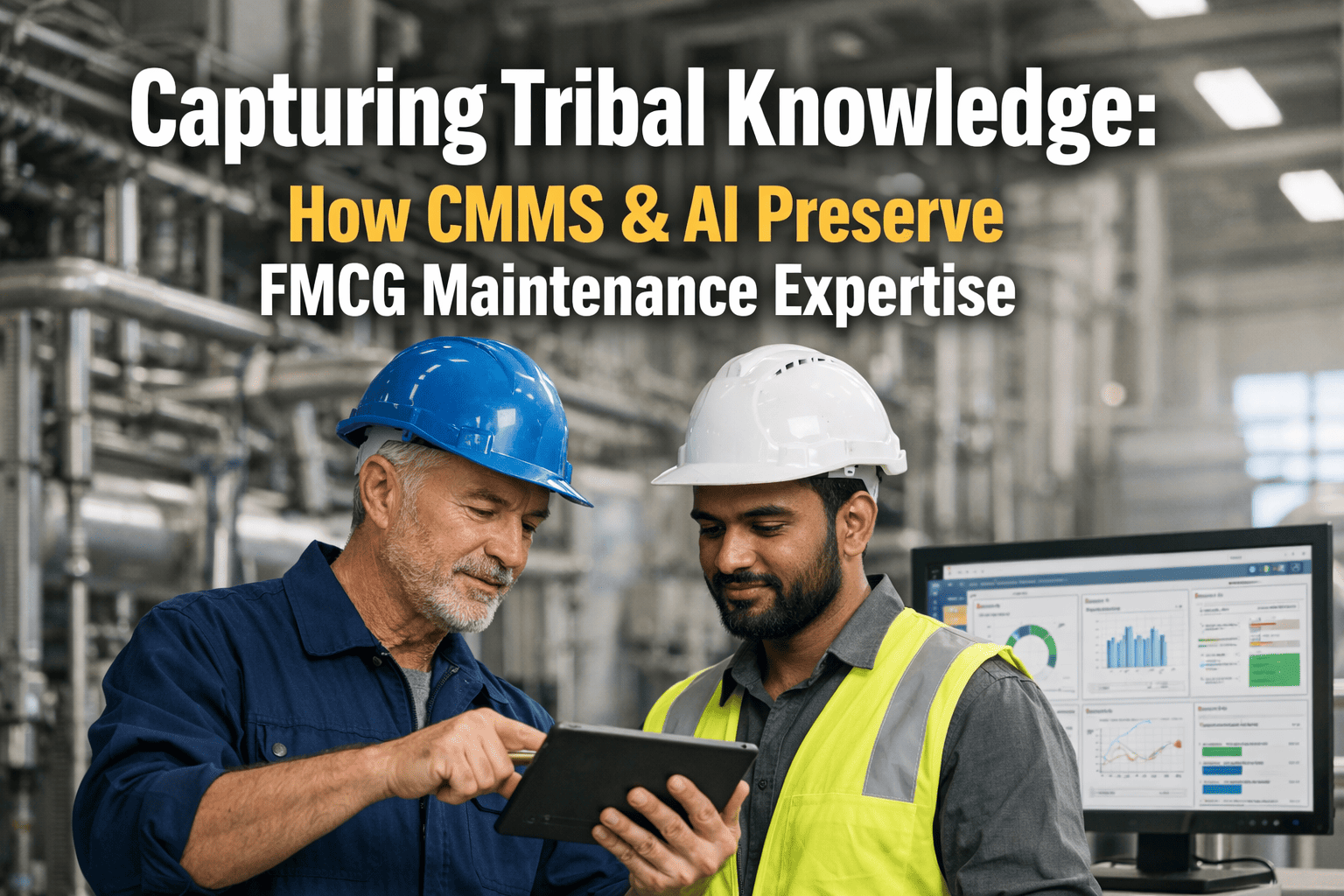
When a master technician with 28 years of experience retires, they take more than muscle memory with them — they take the undocumented fault patterns, the machine quirks, the vendor workarounds, and the diagnostic shortcuts that no procedure manual ever captured. In FMCG manufacturing, this tribal knowledge is the invisible infrastructure holding maintenance performance together. By 2030, the industry will lose 50% of its experienced technician workforce to retirement. Plants without a systematic knowledge capture strategy will see mean time to repair increase by 40–60% as institutional expertise walks out the door. Oxmaint's Knowledge Base and AI Documentation features give FMCG maintenance teams the tools to extract, structure, and preserve that expertise before it leaves — turning individual brilliance into shared, searchable, replicable institutional knowledge. Start your free trial to begin capturing your team's expertise, or book a demo to see AI knowledge documentation in action.
50%
of Experienced FMCG Maintenance Technicians Retiring by 2030
40–60%
Increase in MTTR When Tribal Knowledge Leaves Without Capture
62%
of Critical Maintenance Knowledge Exists Only in Individual Technicians' Heads
3.2x
Longer Fault Resolution Time for Technicians Without Institutional Knowledge Access
Oxmaint's AI Documentation and Knowledge Base capture institutional expertise through normal work execution — no separate knowledge transfer programme required.
What Is Tribal Knowledge and Why Does It Matter in FMCG Maintenance?
Tribal knowledge is the accumulated operational expertise that experienced technicians carry but rarely document — the fault patterns, workarounds, and diagnostic sequences that exist only in individual memory. In FMCG plants, this knowledge often represents decades of machine-specific learning that determines whether a line stops for 20 minutes or 4 hours. Book a demo to see how Oxmaint structures and preserves the expertise your team has built over decades.
Tribal Knowledge vs Captured Knowledge
The gap between what exists in your CMMS and what exists only in your technicians' heads
The Gap: 62% of Critical Maintenance Expertise Is Currently Tribal
The Six Categories of FMCG Maintenance Tribal Knowledge
Not all tribal knowledge is equal. The most operationally critical categories are those that directly impact fault resolution speed and unplanned downtime frequency. Understanding which knowledge categories are most at risk in your plant determines where to prioritise capture effort first. Start your free trial to run a knowledge gap analysis across your asset register, or book a demo to see how Oxmaint surfaces your highest-risk knowledge gaps automatically.
Six Categories of At-Risk Tribal Knowledge in FMCG Plants
Machine-Specific Fault Patterns
High Risk
Asset-specific failure signatures that experienced technicians recognise before formal fault codes appear — vibration patterns, temperature anomalies, and sound changes that predict failure 2–4 hours in advance.
Undocumented Workarounds
High Risk
Practical fixes developed over years that bypass known design limitations — the sequence of steps that resolves a recurring jam in under 8 minutes vs the 45-minute procedure in the manual.
Vendor and Parts Intelligence
Medium Risk
Which supplier delivers on time, which compatible part actually performs, which OEM component fails early — knowledge built through 10+ years of procurement experience that is never written down.
Intermittent Fault Diagnosis
High Risk
Diagnostic sequences for faults that appear under specific operating conditions — temperature, product changeover, line speed — that can only be reproduced when a senior technician knows exactly where to look.
Safety-Critical Procedures
Critical Risk
Non-standard isolations, confined space entry sequences, and plant-specific permit procedures developed through incident history that experienced technicians follow instinctively but rarely document.
Operational Context
Medium Risk
The relationship between production conditions and maintenance requirements — which assets need extra attention after a product changeover, which lines run hot at end of shift, and why certain PMs matter more at certain times.
How AI and CMMS Capture and Preserve Maintenance Tribal Knowledge
Effective knowledge capture requires more than asking technicians to write things down. It requires a system that makes documentation the path of least resistance — capturing expertise through normal work execution, structuring it automatically, and surfacing it to the right person at the right moment. Book a demo to see how Oxmaint's AI documentation layer captures knowledge as your team works.
Four-Layer Knowledge Capture Architecture in Oxmaint
AI-Assisted Work Order Documentation
Layer 01 — Capture
AI prompts technicians to document fault cause and resolution at work order close. Voice-to-text capture reduces friction on the floor. AI structures free-text notes into searchable symptom-cause-remedy format automatically. Photo and video attachments linked to asset history. Every repair becomes a knowledge record — without a separate documentation step.
Standardised Job Plan Library
Layer 02 — Structure
Senior technician procedures converted to structured step-by-step job plans with asset-specific variations captured separately from generic procedures. Parts, tools, and safety requirements embedded in each step. Version control keeps procedures current as equipment evolves — institutional procedures any technician can follow, on any shift.
AI Troubleshooting Guides
Layer 03 — Intelligence
Historical work order data used to build symptom-based diagnostic trees automatically. AI identifies patterns across hundreds of similar faults that no individual technician could synthesise manually. Guides surface contextually when a technician raises a WO for a specific asset — and update continuously as new fault resolutions are recorded.
Structured Knowledge Base
Layer 04 — Retention
Asset-linked knowledge articles searchable by symptom, fault code, or asset. Pre-retirement knowledge elicitation sessions structured by Oxmaint templates. Technician rating system surfaces most-trusted articles first. Gap analysis identifies assets with no documented knowledge records — a living institutional memory that grows over time.
Your best technician retires in 18 months. Oxmaint captures their expertise through normal work execution — so every work order closed becomes a knowledge record that survives retirements.
Standardised Job Plans: Converting Tribal Knowledge Into Replicable Procedures
The highest-leverage knowledge capture activity for most FMCG plants is converting the undocumented procedures of senior technicians into structured, asset-specific job plans. A well-structured job plan eliminates the 35–50% of repair time variation that comes from each technician approaching the same fault differently. Start your free trial to begin building your job plan library, or book a demo to see Oxmaint's job plan builder in action.
What a Best-Practice FMCG Maintenance Job Plan Contains
Symptom Trigger
Right Plan, Right Fault
The precise conditions under which this job plan applies — fault codes, sensor readings, observable symptoms, or specific operating conditions. Removes ambiguity about when to use the procedure.
Safety Pre-Requisites
Zero Safety Assumptions
Asset-specific isolation requirements, permit types required, PPE specification, and any known hazards unique to this asset — including plant-specific workarounds for known design limitations.
Parts and Tools List
No Mid-Job Parts Delays
Exact parts required with stock codes, quantities, and preferred suppliers noted by experienced technicians — including compatible alternatives that work when OEM stock is unavailable.
Step-by-Step Procedure
First-Time Fix Rate 85%+
The exact sequence developed by the most experienced technician — including the non-obvious steps that less experienced technicians skip, causing rework or repeat failures within 48 hours.
Verification Checks
No Premature Return to Service
The post-repair checks that confirm the fix is complete — sensor readings, functional tests, and run-up procedures that only experienced technicians know to perform before returning to production.
Known Failure Modes
Fewer Repeat Callouts
The secondary failures commonly found when performing this repair — parts that should be checked and replaced proactively, based on years of experience with this asset's failure patterns.
Pre-Retirement Knowledge Transfer Programme
For plants facing imminent expertise loss, a structured pre-retirement elicitation programme accelerates knowledge capture in the 6–18 months before a senior technician leaves. This is not a voluntary knowledge-sharing exercise — it is a structured extraction programme with scheduled sessions, prioritised assets, and defined deliverables. Book a demo to see how Oxmaint's pre-retirement templates structure the capture process from day one.
Structured extraction timeline for FMCG plants facing senior technician departures
Month 1: Asset Triage
Identify top 20 assets where the departing technician holds unique expertise. Rank by production criticality and knowledge gap risk. These become the capture priority list.
Priority Asset List
Months 2–3: Job Plan Elicitation
Weekly 2-hour structured sessions — technician talks through procedures on priority assets while a planner captures and structures into Oxmaint job plan format. Target: 3–5 job plans per session.
30–50 Job Plans
Month 4: Fault Library Build
Review of technician's historical WO records — AI extracts fault patterns and builds troubleshooting guides for recurring faults. Shadow sessions on live repairs capture real-time diagnostic sequences.
Fault Pattern Library
Month 5: Validation and Gaps
Junior technicians execute job plans against expert observation. Gaps identified, procedures refined. Knowledge base articles reviewed and rated by the departing technician before final sign-off.
Validated Procedures
Month 6: Handover and Go-Live
Full knowledge base activated in Oxmaint. Junior technicians complete guided repairs using captured procedures. Remaining gaps logged for ongoing capture. Departing technician available for escalations.
Live Knowledge System
Based on Oxmaint customer programmes. Plants with dedicated maintenance planner resource and active CMMS usage achieve upper-range preservation rates. Starting 12 months before departure improves outcomes significantly.
Senior technician leaving in under a year? Oxmaint's pre-retirement knowledge capture templates and AI documentation tools give you a structured programme to preserve 75–85% of critical expertise before it walks out the door.
ROI of Systematic Knowledge Capture in FMCG Maintenance
The return on knowledge capture investment is measured in MTTR reduction, first-time fix rate improvement, and the elimination of the productivity cliff that typically follows a senior technician's departure. Start your free trial to build your knowledge base, or book a demo to see how Oxmaint quantifies your current knowledge gap risk.
Annual ROI of Systematic Knowledge Capture
FMCG plant — 150–300 employees — packaging and filling operations
MTTR Reduction
47% reduction in mean time to repair when technicians have structured troubleshooting guides — 2 incidents/week × 1.8hr saved × $420/hr production loss
$78,500
First-Time Fix Rate Improvement
83% FTFR with AI-assisted job plans vs 61% without — 22% fewer repeat callouts eliminating 85+ additional repair events per year
$64,000
New Hire Ramp Time
6 months faster to 80% productivity — 3 new hires/year × 6 months × $8,200/month productivity gap cost
$147,600
Retirement Knowledge Loss Prevention
Avoiding the 40–60% MTTR increase following unmanaged senior technician departure — 1 departure per 2 years, 24-month impact period
$190,000
Knowledge Base Investment
Oxmaint platform, AI documentation tooling, initial job plan capture programme, and ongoing training record management
$35K–$55K/yr
Net Annual Value of Systematic Knowledge Capture
$280K+ 6–8x ROI
Results based on Oxmaint customer programmes across FMCG plants. Upper-range outcomes achieved by plants with dedicated maintenance planner resource, structured pre-retirement capture programmes, and active CMMS work order documentation disciplines.
Knowledge Capture KPIs: Measuring Your Knowledge Base Health
Knowledge capture is only valuable if it results in a living, growing system that technicians actually use. These KPIs measure both the completeness of your knowledge base and its adoption by the maintenance team. Book a demo to see all six KPIs tracked live in Oxmaint — or start your free trial to begin building your knowledge base today.
Six Knowledge Base Health KPIs for FMCG Maintenance Teams
Job Plan Coverage Rate
Target: 80%+
Percentage of critical assets (A and B class) with at least one documented job plan for their top three recurring fault types. Below 40% signals knowledge capture has not started in earnest.
WO Documentation Rate
Target: 90%+
Percentage of closed work orders with a documented fault cause and resolution note. Every undocumented WO close is a knowledge capture miss. Below 60% means knowledge is not being accumulated.
Knowledge Base Usage Rate
Target: 65%+
Percentage of work orders where a technician accessed a knowledge article or job plan before or during execution. Low usage signals poor search experience or lack of awareness — not necessarily poor content.
First-Time Fix Rate
Target: 85%+
Percentage of repairs completed without a return visit within 5 working days for the same fault. The primary outcome metric for knowledge quality — if fixes repeat, knowledge is incomplete or not being used.
Knowledge Gap Score
Target: Zero Critical Gaps
Number of critical assets with zero documented knowledge records. Oxmaint surfaces this automatically — any asset generating repeat WOs with no associated job plan is a knowledge gap and a downtime risk.
New Hire Ramp Time
Target: 4–6 Months
Time for a new technician to reach 80% of experienced technician performance. Plants with structured knowledge bases achieve this in 4–6 months vs 18–24 months without — a 12–18 month productivity gap eliminated.
What percentage of your critical assets have zero documented knowledge? Oxmaint's gap analysis surfaces every asset with no job plans, no troubleshooting guides, and no documented fault history — before the expertise that fills those gaps retires.
How do you capture tribal knowledge from technicians who don't want to document?
Resistance to documentation is almost always a friction problem, not a motivation problem. Technicians who have spent 20 years fixing machines are not reluctant to share knowledge — they are reluctant to fill in forms after a 10-hour shift. Oxmaint reduces documentation friction through voice-to-text capture, AI-assisted structuring of free-text notes, and pre-built templates that require minimal input. The most effective approach is to make knowledge capture happen during normal work execution rather than after it — capturing fault details at work order close rather than in a separate knowledge transfer meeting. Plants using Oxmaint's AI documentation see WO documentation rates increase from 38% to 87% within 60 days without any change to incentive structures.
Which assets should be prioritised for knowledge capture first?
Start with the intersection of two criteria: assets with the highest production criticality (A-class assets on the critical production path) and assets where one or two specific technicians hold the majority of the repair knowledge. These are your highest-risk knowledge concentration points — single points of failure in your human expertise infrastructure. Oxmaint's knowledge gap analysis automatically identifies which critical assets have the fewest documented procedures, the most repeat faults, and the smallest number of qualified technicians — creating a prioritised capture list without manual assessment. Book a demo to see the knowledge gap report for your asset register.
How does AI help with maintenance knowledge capture compared to traditional documentation?
Traditional documentation requires technicians to translate tacit, procedural knowledge into structured written form — a cognitively demanding task that most technicians are neither trained nor motivated to perform. AI bridges this gap in three ways. First, it processes unstructured inputs — voice notes, free-text descriptions, photos — and structures them into searchable, asset-linked records automatically. Second, it identifies patterns across hundreds of historical work orders that no individual technician could synthesise manually, building troubleshooting guides from collective experience. Third, it prompts contextually — surfacing relevant knowledge articles when a technician raises a work order for a specific asset, reducing the need to search and increasing adoption. The result is a knowledge base that grows continuously through normal operations rather than requiring dedicated knowledge transfer sessions.
Can knowledge capture reduce new hire onboarding time in FMCG maintenance?
Dramatically. The primary reason new technicians take 18–24 months to reach full productivity is that they must rebuild institutional knowledge through trial and error — making the same diagnostic mistakes that experienced technicians learned to avoid years ago. A structured knowledge base short-circuits this process. When a new technician raises a work order for an unfamiliar asset, Oxmaint surfaces the troubleshooting guide built from 200 previous repairs on that machine — giving them immediate access to the diagnostic sequences that took their predecessor three years to develop. Plants with structured knowledge bases consistently report new hire ramp times of 4–6 months for standard fault types.
How does Oxmaint help manage knowledge capture across a multi-site FMCG operation?
Oxmaint centralises knowledge base management across all sites — storing asset-specific job plans with version control, tracking knowledge gap scores per site, linking work orders to job plan usage records, and identifying which sites have the highest concentration of undocumented tribal knowledge risk. For multi-site operations, it provides a single dashboard showing knowledge base coverage, documentation rates, and first-time fix rates across every facility. Book a demo to see how knowledge management works across multiple FMCG production sites.
Knowledge Management for FMCG Maintenance
Build a Maintenance Knowledge Base That Outlasts Your Best Technicians
Oxmaint's Knowledge Base and AI Documentation give FMCG maintenance teams the tools to capture, structure, and preserve institutional expertise — so every technician on every shift has access to the knowledge that currently lives in just two or three heads.
AI-Assisted Work Order Documentation — Voice-to-Text, Structured Automatically
Standardised Job Plan Library with Asset-Specific Procedure Versioning
AI Troubleshooting Guides Built From Historical WO Pattern Analysis
Pre-Retirement Knowledge Elicitation Templates and Structured Programmes
Knowledge Gap Analysis — Automatic Identification of Undocumented Critical Assets
Multi-Site Knowledge Dashboard — Coverage, Usage, and First-Time Fix Rate by Facility