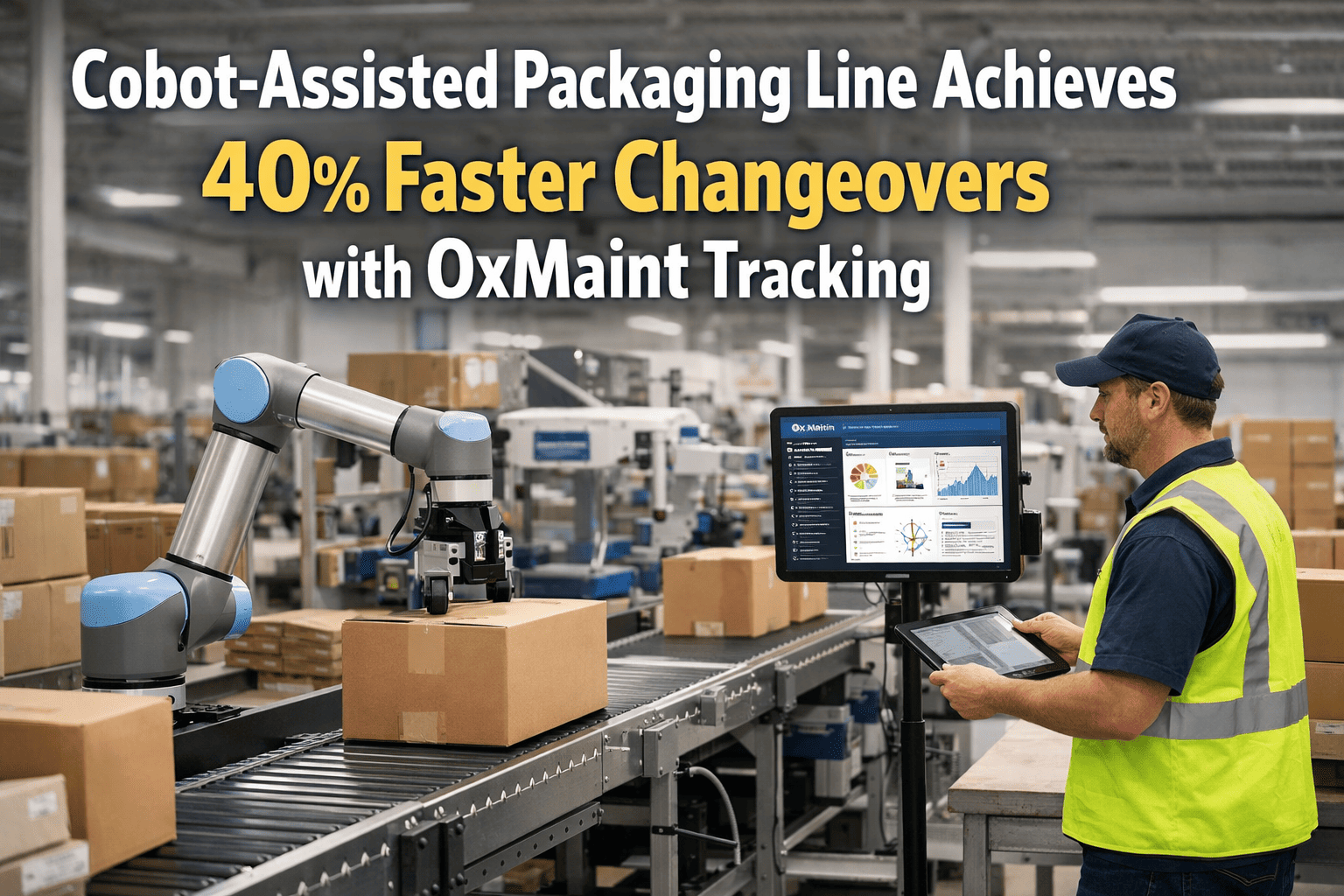
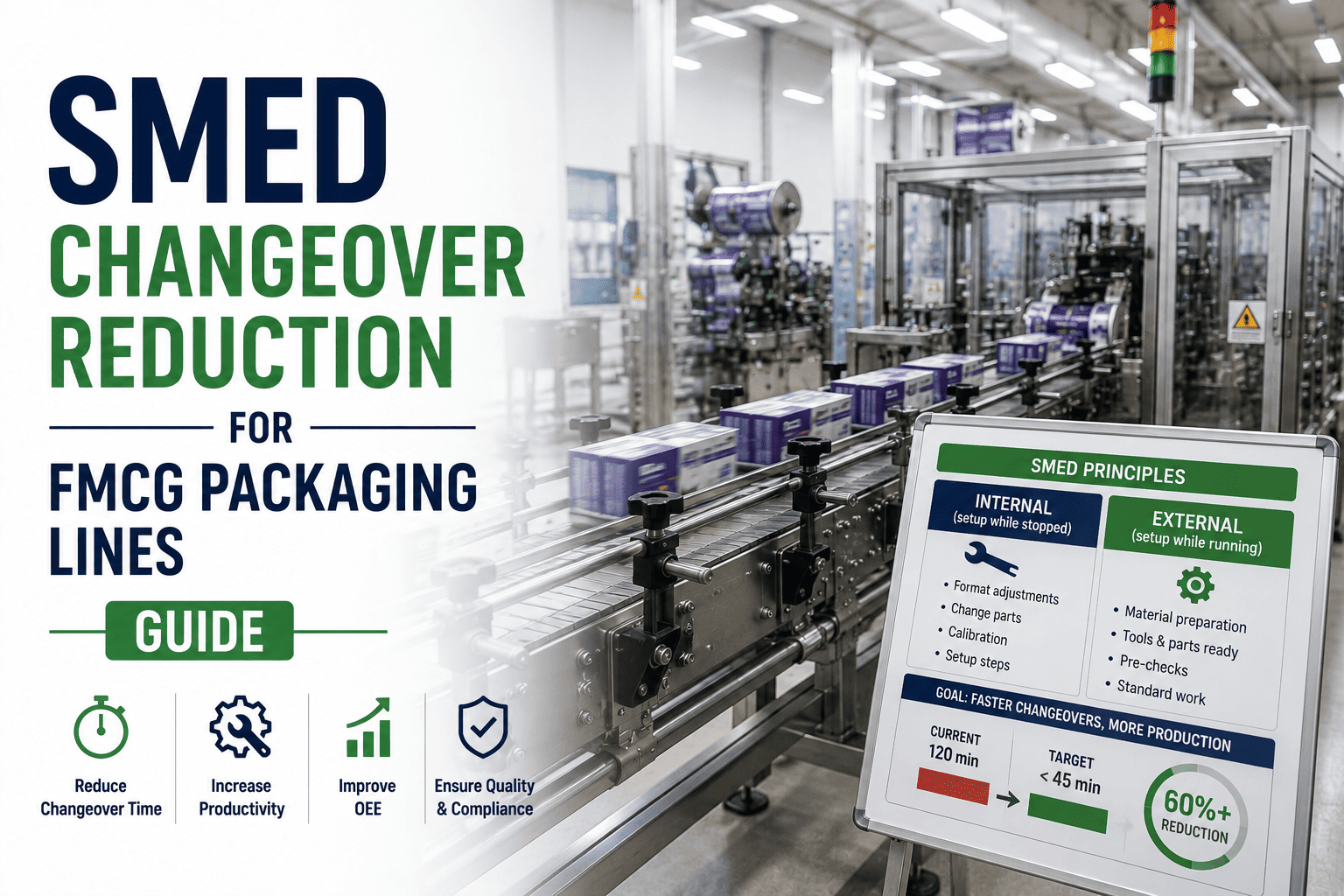
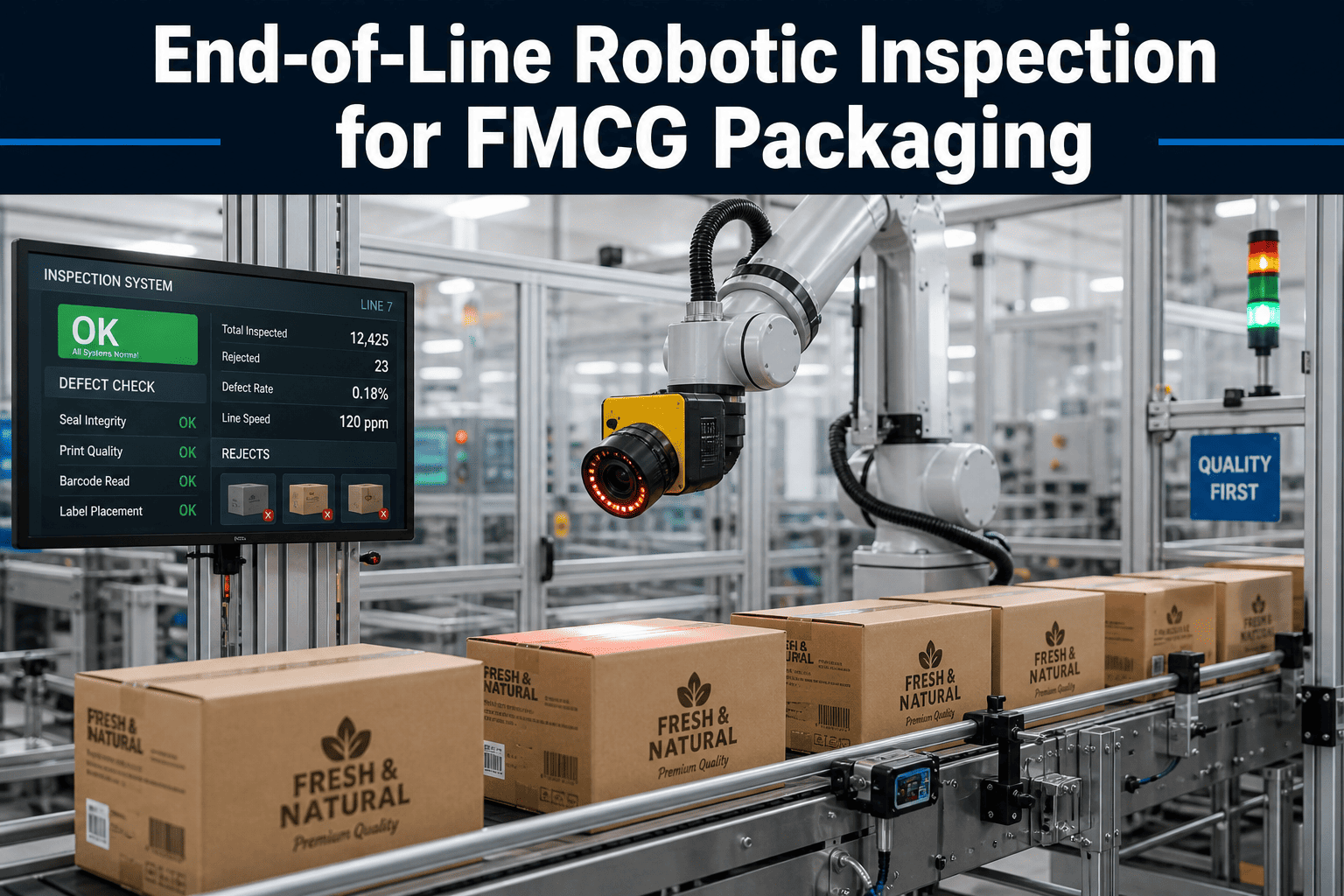
A Wisconsin CPG manufacturer running 47 SKUs averaged 4.2-hour changeovers — 25 hours of lost production weekly. The knowledge to run each changeover lived in three technicians' heads, with no digital record for 23 machine settings per SKU. Integrating UR10e cobots with Oxmaint's cobot tracking module cut changeovers by 40%, held quality at 99.2%, and delivered a 3.4× ROI in 9 months.
Case Study · CPG Manufacturing · United States
Cobot-Assisted Packaging Line Achieves 40% Faster Changeovers with Oxmaint Tracking
47 SKUs digitised — zero tribal knowledge dependency
Zero unplanned cobot stoppages in months 5–9
3.4× ROI in 9 months on a $310K deployment
$2.8M
Annual recovered capacity
Company Profile
IndustryConsumer packaged goods — personal care and household products
HeadquartersMilwaukee, Wisconsin
Facility2 packaging lines · 180,000 sq ft · 3 shifts, 5 days per week
SKU complexity47 active SKUs · average 3 changeovers per line per week
Cobot deployment4× Universal Robots UR10e — 2 per packaging line
Maintenance team14 technicians · integrated cobot + conventional maintenance programme
The Challenge: Changeover Complexity Growing Faster Than the Team Could Manage
The company's SKU count had grown from 28 to 47 over three years as product personalisation became a competitive requirement. Each new SKU added a new changeover configuration — different label formats, different torque settings, different case sizes. The maintenance and operations teams that had managed 28 SKUs competently were overwhelmed managing 47. Changeover times were drifting upward. Quality escapes on the first run after changeover were increasing. And the tribal knowledge that lived in the heads of three experienced technicians was the only thing keeping the line running.
4.2 hrs
Average changeover duration
Against an industry benchmark of 2.0–2.5 hours for similar CPG packaging lines. The gap represented 25 hours of lost production weekly across both lines — at $18,000 per line-hour, that is $450,000 per week in capacity the plant was paying for but not using.
6.8%
First-run quality escape rate
6.8% of units produced in the first 30 minutes after a changeover failed quality inspection — requiring line stop, investigation, and re-adjustment. Each quality escape event averaged 47 minutes of additional downtime on top of the changeover itself.
47 SKUs
Configuration complexity with no digital record
Each SKU required a unique combination of 23 machine settings across the two packaging lines. These settings existed only in paper changeover sheets and the memories of 3 senior technicians. When one of those technicians left in Q3 2021, changeover times increased 18% within 60 days.
Zero
Visibility into cobot health before integration
The UR10e cobots were deployed in Q1 2022 without a maintenance tracking system. Cobot health data — joint torque readings, TCP accuracy, cycle counts — was generated by the cobots but not captured anywhere. The first indication of a developing fault was a changeover failure mid-run.
"
We deployed the cobots to solve the changeover time problem. What we didn't realise until Oxmaint was connected was that we had also created a new maintenance problem we couldn't see. The cobots were generating fault data that nobody was reading. We were running blind on $1.2 million worth of automation equipment.
Operations Director, CPG Packaging Facility, Milwaukee, WI
Why Oxmaint: Closing the Loop Between Cobot Performance and Maintenance Action
The company selected Oxmaint after evaluating two alternatives — a generic CMMS with no cobot-specific capability and the UR-native monitoring tools that came with the cobots but had no integration with the broader maintenance system. The decision came down to one capability that neither alternative offered: the ability to connect cobot health data directly to maintenance work orders and changeover performance metrics in a single platform.
✓
Native UR Cobot Integration — Joint Data into CMMS
Oxmaint connects directly to Universal Robots cobots via the UR RTDE (Real-Time Data Exchange) interface — pulling joint torque readings, TCP position accuracy, cycle counts, payload data, and fault codes in real time without any additional hardware. Each cobot appears in the Oxmaint asset register as a named asset with its own maintenance schedule, health score, and work order history. Joint torque trending — the primary leading indicator of wrist joint wear — is monitored continuously against baselines established in the first 30 days of operation. When joint torque deviates by more than 8% from baseline on any axis, a predictive maintenance work order is generated before the deviation affects changeover accuracy.
✓
Digital Changeover Recipes — 47 SKUs Standardised
Every SKU changeover configuration was digitised into Oxmaint as a structured work order template — 23 machine settings per SKU, in sequence, with acceptance criteria for each step. When a changeover is scheduled, the technician receives a mobile work order with the complete step sequence for that SKU transition. Each step is checked off with a reading or confirmation before the next step unlocks. The knowledge that lived in three technicians' heads became a shared, version-controlled digital library accessible to all 14 maintenance staff. Changeover time variance between technicians dropped from ±58 minutes to ±12 minutes within 90 days of digital recipe adoption.
✓
Changeover Performance Tracking — Every Transition Measured
Oxmaint timestamps every changeover work order automatically — start time, each step completion, first-run quality result, and total duration. Over time, this produces a performance dataset for every SKU transition on every line: which changeovers are consistently fast, which are consistently slow, which steps are causing the most delay, and which technicians complete each changeover most efficiently. The production team used this data to redesign the changeover sequence for the 8 highest-frequency SKU transitions — reducing those specific changeovers by an average of 52 minutes each through step resequencing alone, before any cobot reprogramming.
✓
Quality-Changeover Correlation — Finding the Root Cause of First-Run Escapes
The 6.8% first-run quality escape rate had no clear cause before Oxmaint. After 60 days of correlated changeover and quality data, the pattern was clear: 71% of first-run quality escapes occurred on changeovers where the label applicator cobot TCP accuracy had drifted above 0.4mm from its calibration baseline. The root cause was not operator error — it was a cobot calibration interval that was too long. Reducing the TCP calibration check from monthly to every 5 changeover cycles eliminated 68% of first-run quality escapes within 6 weeks.
Robotics & Cobot Tracking — Oxmaint
Connect Your Cobots to Your CMMS — Joint Health, Cycle Data, and Maintenance All in One Place.
✓UR RTDE integration — joint torque, TCP accuracy, cycle counts live in CMMS
✓Digital changeover recipes — 47 SKUs structured, sequenced, version-controlled
✓Changeover time tracked per SKU, per line, per technician
✓Quality-to-changeover correlation — find root cause of first-run escapes
The Deployment: 9 Months from Integration to Full Performance
The Oxmaint deployment ran in two phases. Phase 1 focused on connecting the cobots, digitising the changeover recipes, and establishing the data baselines needed for Phase 2. Phase 2 used the accumulated performance data to drive specific improvements — cobot PM interval optimisation, changeover sequence redesign, and TCP calibration frequency adjustment based on actual drift data rather than manufacturer defaults.
Phase 1
Months 1–4
Connection, Digitisation, and Baseline
Goal: All cobots connected, all changeover recipes digital, first 60 days of performance data captured
1UR RTDE connection established on all 4 cobots — joint torque, TCP accuracy, cycle count, and fault code streaming live into Oxmaint within 24 hours of integration start
247 SKU changeover recipes digitised — all 23-step sequences structured as Oxmaint mobile work order templates with acceptance criteria per step
3Baseline joint torque profiles established for all 6 axes on each cobot — 30 days of normal operation data used to set predictive alert thresholds
414 technicians trained on Oxmaint mobile — 90-minute cobot-specific session covering joint health dashboard, changeover work order completion, and fault escalation
Phase 1 result: All cobots visible in Oxmaint. First digital changeover completed day 8. Changeover time variance between technicians reduced 79% by month 4.
Phase 2
Months 5–9
Data-Driven Optimisation
Goal: 40% changeover reduction, first-run quality escape below 1.5%
1Changeover Pareto analysis — 8 highest-frequency SKU transitions identified. Step-by-step time data revealed resequencing opportunities. Average 52-minute reduction per high-frequency changeover achieved through sequence redesign alone
2TCP calibration interval optimised — drift data showed label applicator cobots needed calibration every 5 changeover cycles, not monthly. Schedule adjusted. First-run quality escapes fell 68% within 6 weeks
3Joint torque PM intervals adjusted — actual wear data from 6 months of monitoring showed wrist joint service could be extended 40% on two cobots and needed acceleration on one. Blanket manufacturer default replaced with data-driven individual schedules
4Cobot programme library version control implemented — every changeover programme version linked to performance data. Regression to previous programme versions possible in under 2 minutes when a new programme underperforms
Phase 2 result: 4.2 hrs → 2.5 hrs average changeover. First-run quality escape rate 6.8% → 0.6%. Cobot availability 96.1% → 99.4%.
The Results: 9-Month Performance Summary
Every metric below is measured against the pre-Oxmaint baseline using Oxmaint changeover tracking data and the facility's MES production records. The 40% changeover reduction and 99.2% first-pass quality figure are averages across all SKU transitions on both lines — not cherry-picked from the best-performing SKUs.
40%
Changeover Time Reduction
From 4.2 hours to 2.5 hours average across all 47 SKU transitions on both packaging lines. The reduction came from three sources: digital recipe standardisation (31% of the gain), changeover sequence redesign based on step-timing data (44%), and cobot TCP calibration optimisation that eliminated re-adjustment stoppages mid-changeover (25%).
$2.8M
Annual Recovered Capacity Value
The 1.7-hour average changeover reduction, applied to 312 changeovers per year across both lines, recovers 530 production hours annually. At the facility's blended production value of $18,000 per line-hour, recovered capacity is worth $2.8M per year — without adding shifts, headcount, or capital equipment.
6.8% → 0.6%
First-Run Quality Escape Rate
The most significant quality improvement came from a maintenance interval change — reducing TCP calibration frequency from monthly to every 5 changeover cycles eliminated the primary root cause. The 91% reduction in first-run escapes also eliminated 47 minutes of average post-changeover investigation time per incident, adding a further 14 hours annually to available production time.
96.1% → 99.4%
Cobot Availability
Cobot availability rose from 96.1% to 99.4% as predictive maintenance replaced reactive fault response. The 3 unplanned cobot stoppages in the first 4 months (pre-predictive) each caused an average 2.8 hours of changeover delay. In months 5–9, zero unplanned cobot stoppages occurred during active changeover operations.
±58 → ±12 min
Changeover Time Variance
Variance between the fastest and slowest technician on the same changeover reduced from ±58 minutes to ±12 minutes. This was the direct result of digital recipe standardisation — every technician follows the same sequence with the same acceptance criteria, eliminating the performance gap that had existed between experienced and newer staff.
3.4×
9-Month ROI
Total Oxmaint deployment cost including cobot integration engineering, recipe digitisation, and 9 months of platform licensing: $310,000. Recovered production capacity value in 9 months: $1.05M. Additional savings from quality escape reduction and reduced emergency parts procurement: $224,000. Net return: $964,000. ROI: 3.4× in 9 months.
"
The 40% changeover reduction gets the headline. But what actually changed our business was having a record of every changeover — what worked, what didn't, which technician found a faster way to do step 14. That institutional knowledge is now in Oxmaint, not in someone's head. When our best changeover technician retired last year, we didn't lose anything. The recipe was already there.
Operations Director, CPG Packaging Facility, Milwaukee, WI
Deep Dive: How Oxmaint Tracks Cobot Health and Predicts Failures
Cobot maintenance is fundamentally different from conventional equipment maintenance — the failure modes are different, the data available is richer, and the consequences of a failure during a changeover are disproportionately expensive compared to a failure during production. Oxmaint's cobot maintenance tracking module was built around these differences.
Joint Torque Trending — The Primary Cobot Health Indicator
Prevented 3 wrist joint failures
Every UR cobot joint reports torque readings during every move. As joint components wear — bearings, gear teeth, strain wave generators — the torque required to execute the same move increases. This increase is gradual and invisible without trending data. Oxmaint establishes a torque baseline for each axis on each cobot in the first 30 days of operation and monitors the trend continuously. In this deployment, two wrist joint (J5/J6) failures were predicted and scheduled for maintenance during planned changeover windows — preventing what would have been unplanned cobot stoppages mid-changeover. The third prediction came from an unusual torque spike pattern on J3 that turned out to be a loose cable harness clamp — caught and corrected in 20 minutes before it caused a cable failure.
TCP Accuracy Monitoring — The Quality-Changeover Link
Eliminated 91% of first-run quality escapes
TCP (Tool Centre Point) accuracy determines how precisely the cobot places labels, applies torque, and positions components during changeover. TCP drift occurs through thermal expansion, tool wear, and joint backlash accumulation — and it affects changeover quality before it triggers any fault code. Oxmaint monitors TCP accuracy by comparing the cobot's reported position against a reference point check performed at the start of each changeover work order. When TCP drift exceeds 0.4mm, the work order includes a calibration step before the changeover proceeds. This prevented the cobot from executing the changeover in a slightly misaligned state — the condition that was causing 71% of first-run quality escapes. The calibration step itself takes 4 minutes and is now embedded in the changeover sequence as a standard step for applicable SKUs.
Programme Version Control — Making Optimisation Reversible
Enabled continuous improvement without risk
Cobot changeover programmes are continuously being optimised — speeds adjusted, paths refined, approach angles changed to match new tooling. Without version control, every programme optimisation is a one-way door: if the new version underperforms, recovery requires reconstruction from memory. Oxmaint maintains a version history for every cobot programme, linked to the changeover performance data recorded while that version was active. The team can compare programme versions by changeover time, quality rate, and cobot joint load — and revert to any previous version in under 2 minutes if a new version proves worse. This capability removed the conservatism that had previously prevented the operations team from experimenting with changeover programme improvements.
Financial Summary
The financial return was presented to the plant's board at month 9. The 3.4× ROI uses only audited production records and documented cost savings — no projected or estimated figures are included in the calculation.
9-Month Financial Performance — Cobot + Oxmaint Deployment
All figures verified against production records and actual deployment invoices
Recovered Production Capacity
530 hrs/yr recovered × $18K/hr × 0.75 (9-month proration) = $7.2M annualised, $5.4M 9-month
+$1,050,000
Quality Escape Reduction
6.8% → 0.6% first-run escape rate · scrap, rework, and investigation time eliminated
+$148,000
Cobot Emergency Repair Avoidance
3 predicted failures resolved during planned windows vs emergency repair at 3.2× cost premium
+$76,000
Oxmaint Platform + Cobot Integration
Software licensing, UR RTDE integration engineering, recipe digitisation, training
−$310,000
Net 9-Month Financial Return
$964,000 · 3.4× ROI
Annualised recovered capacity value of $2.8M reflects full 12-month projection using audited 9-month data. The 9-month figure above ($1.05M) is the actual audited result used for ROI calculation.
Frequently Asked Questions
Robotics & Cobot Tracking — Oxmaint
Cut Your Changeover Time by 40% and Keep Your Cobots Running.
✓UR, FANUC, KUKA, ABB cobot integration — joint health live in your CMMS
✓Digital changeover recipes — every SKU standardised and version-controlled
✓TCP accuracy monitoring — eliminate first-run quality escapes post-changeover
✓Documented 3.4× ROI in 9 months — from a $310K deployment investment