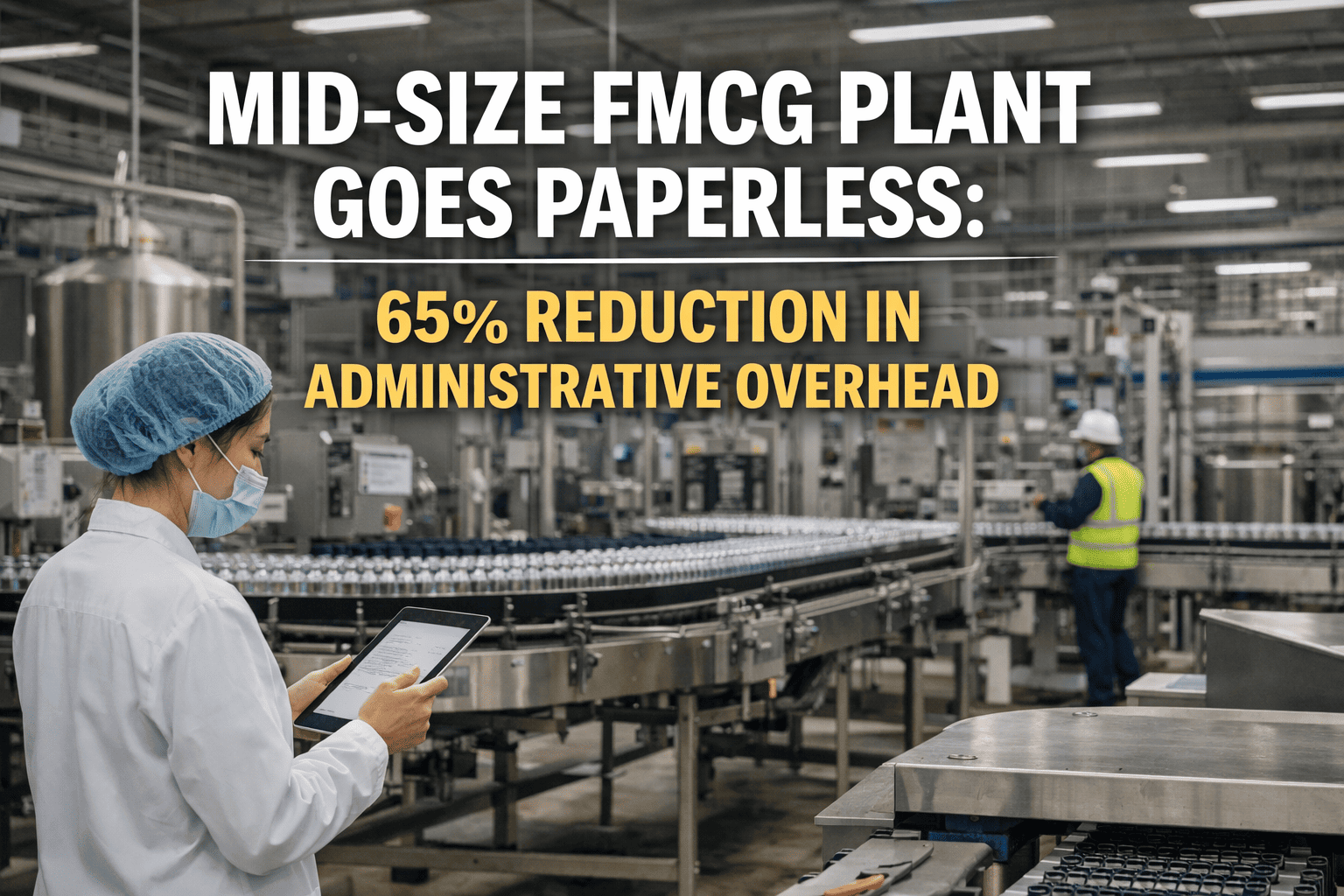
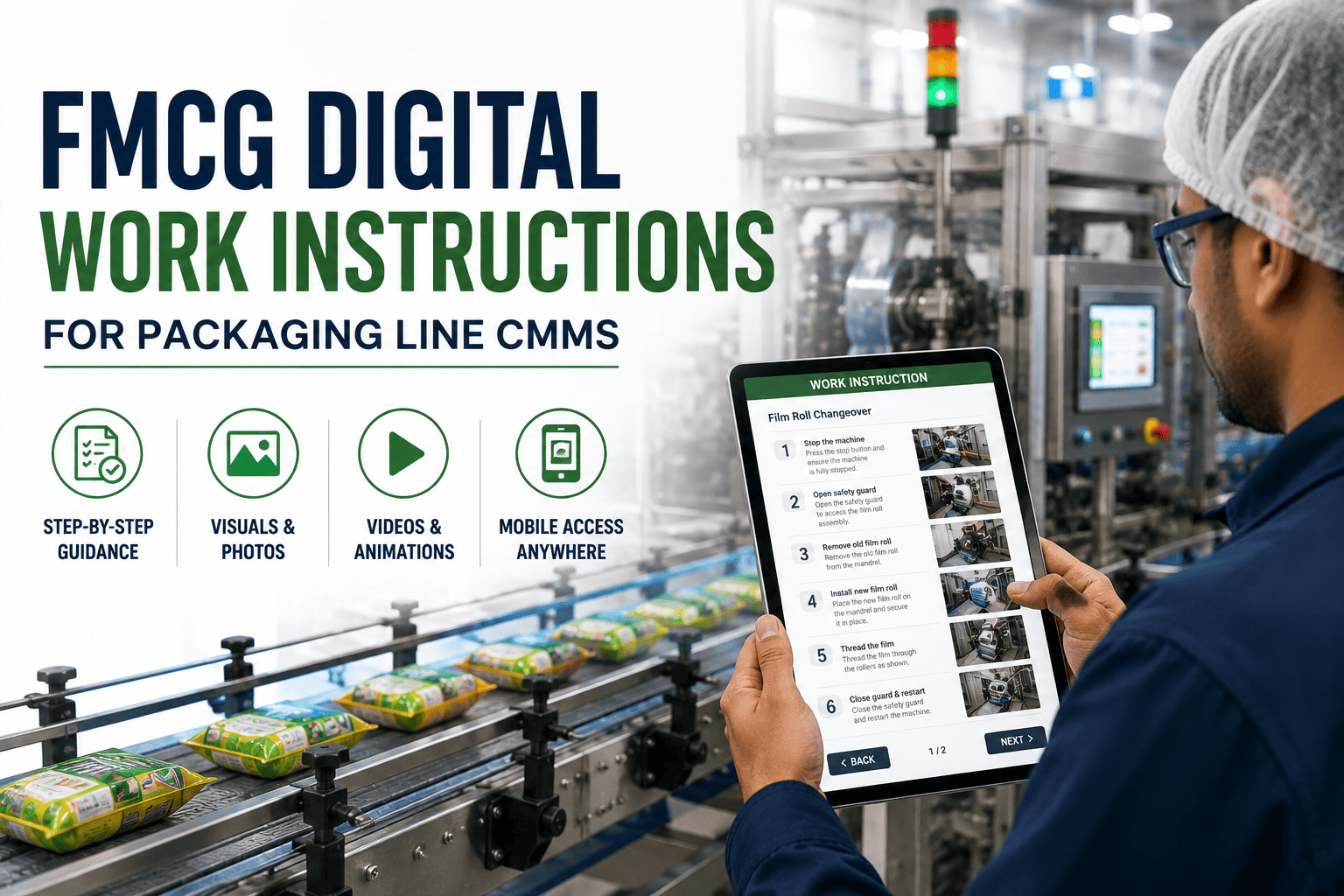
In early 2023, the Maintenance Manager at a mid-size FMCG plant in the East Midlands calculated how many hours per week her team spent on paperwork rather than maintenance. The answer — 14 hours per technician per week — was worse than she expected. OxMaint's Mobile CMMS was deployed across the 340-person plant. Ten months later: 65% reduction in administrative overhead, 40% improvement in work order completion rates, and the first BRC audit in plant history with zero documentation citations.
Case Study · Digital Transformation · United Kingdom
Mid-Size FMCG Plant Goes Paperless: 65% Reduction in Administrative Overhead
How a UK food manufacturing plant eliminated paper-based maintenance, cut admin overhead by 65%, and improved work order completion rates by 40% — in 10 months with OxMaint Mobile CMMS.
65%
Admin overhead reduction
40%
Work order completion lift
14 hrs
Weekly paperwork saved per tech
Zero
Documentation citations at BRC audit
Company Profile
IndustryFMCG food manufacturing — ambient grocery, condiments, and meal components
LocationEast Midlands, United Kingdom
FacilitySingle site, 220,000 sq ft, BRC Issue 9 Grade A certified
Equipment380 registered assets across processing, packaging, and utilities
Production6 production lines, 3 shifts per day, 310 production days per year
Workforce340 employees · 18 maintenance technicians · 4 supervisors
The Challenge: Paper Was Costing More Than the Team Realised
The plant had run on paper-based maintenance for over a decade. The system worked — in the sense that things got fixed and audits got passed. But the cost of paper was invisible because it was built into every working day so gradually that no one had ever totalled it up. When the Maintenance Manager ran the numbers, the picture was stark.
14 hrs
Weekly per-technician paperwork burden — time spent on admin rather than maintenance
Work orders printed at the start of each shift, completed in the field by hand, returned to the office, manually entered into a spreadsheet, and filed in ring binders. For 18 technicians, 14 hours per week each equalled 252 hours of administrative labour every week — equivalent to 6.5 full-time technician days doing nothing but paperwork.
58%
Work order completion rate — 42% of scheduled PM tasks not completed on time
With no real-time visibility into task status, supervisors had no way to identify which work orders were falling behind until the end of the shift when paper forms were collected. By that point, a missed PM task was already overdue. Escalation was manual, reactive, and inconsistent across shifts.
3 days
Time to assemble compliance documentation before each BRC audit
Three days before every BRC audit, the Maintenance Manager and a QA assistant would spend the entire time pulling paper records from binders, cross-referencing against the PM schedule, and assembling the documentation pack. In the previous audit cycle, the auditor cited two documentation gaps — not because the work hadn't been done, but because the records couldn't be found in time.
18 mo
PM schedule spreadsheet was out of date — new equipment never added, retired equipment never removed
The PM schedule lived in a shared Excel file that the maintenance team had stopped trusting. New equipment installed during a production line upgrade 18 months earlier had never been added. Three pieces of equipment decommissioned the year before were still generating work orders. No one had time to maintain the schedule — they were too busy executing it.
"
When I told the plant director that each of our 18 technicians was spending 14 hours a week on paperwork, he didn't believe me. We went through it together — printing, completing, collecting, typing, filing. Every step. It was 14 hours. We were paying skilled maintenance technicians to be typists.
Maintenance Manager, Mid-Size FMCG Plant — East Midlands, UK
Why OxMaint: The Selection Decision
The plant evaluated three mobile CMMS platforms. The evaluation focused on three requirements that previous failed digitisation attempts had demonstrated were non-negotiable.
✓
Mobile-First — Works Without Reliable Wi-Fi Coverage
The plant had Wi-Fi dead zones in the cold store, the loading bay, and two of the six production line areas. A previous digitisation attempt with a competitor platform had failed because technicians lost their work when connectivity dropped mid-task. OxMaint operates with full offline functionality — work orders are completed locally on the device and sync when connectivity is restored. This was a non-negotiable requirement that eliminated two of the three evaluated platforms.
✓
Adoption Without Training Resistance — Simple Enough for Non-Technical Users
The maintenance team's average age was 47. Several technicians had been on the site for over 20 years and were openly sceptical of digital tools after a previous ERP rollout that the team still referred to as "the disaster." OxMaint's mobile interface was tested with three technicians who self-identified as resistant to new technology. All three completed their first work order on the app without any assistance within 8 minutes of being handed the device. That outcome determined the platform selection.
✓
BRC Issue 9 Audit Trail Out of the Box — No Custom Configuration Required
The QA manager required that maintenance records produced by the CMMS satisfy BRC Issue 9 without additional manual formatting or export processing. OxMaint's compliance module produces maintenance records with electronic signatures, timestamps, and asset-level traceability that satisfy BRC requirements directly. No post-processing, no reformatting, no separate documentation step. The complete PM record for any asset is accessible in under 2 minutes.
Paper Out. Productivity In. Start Today.
OxMaint Mobile CMMS eliminates paper work orders, delivers real-time supervisor visibility, and produces BRC-compliant maintenance records — with full offline functionality for every corner of your plant.
The Deployment: From Paper to Paperless in 10 Months
Deployment was sequenced to build adoption confidence before expanding scope. The team had learned from the failed ERP rollout that a big-bang rollout that disrupts everyone simultaneously kills adoption. OxMaint was introduced to one team, in one area, with visible quick wins — then expanded as those wins became visible to the rest of the site.
01
Asset Registration
All 380 production and utilities assets registered in OxMaint with QR code labels applied. Historical service records from paper binders digitised and uploaded against each asset. Completed in 3 weeks without production interruption.
02
PM Schedule Rebuild
PM schedule rebuilt from scratch in OxMaint — old spreadsheet discarded. 18 months of equipment changes reconciled. New equipment added, decommissioned equipment removed. 247 active PM tasks configured with correct intervals and assignments.
03
Pilot Team Onboarding
4 technicians from Line 1 onboarded first — the team selected as the most receptive to change. Average time from device handover to first completed mobile work order: 11 minutes. Zero paper work orders issued to the pilot team from day 1.
04
Visible Quick Win
By week 6, the pilot team's PM completion rate had risen from 61% to 89%. This result was shared at the site-wide maintenance team meeting — it was the single most effective adoption tool for the subsequent phases.
✓Phase 1 outcome: Complete digital asset register live. PM schedule current for first time in 18 months. Pilot team completion rate 61% → 89% in 6 weeks.
01
Full Team Onboarding
All 18 technicians onboarded in two cohorts of 7. The pilot team's results were used as the training case study. The two previously sceptical senior technicians completed their first work orders independently without escalating for help.
02
Paper Eliminated
Paper work order printing stopped at month 5. The printer in the maintenance office — previously running 180+ sheets per day — was switched off. The ring binder filing system was archived. No technician requested a paper fallback.
03
Supervisor Dashboard
Maintenance supervisors gained real-time visibility into work order status across all three shifts for the first time. Overdue tasks visible within minutes of becoming overdue — not discovered at end-of-shift paper collection.
04
Admin Hours Recovered
By month 7, the weekly admin burden per technician had fallen from 14 hours to 5.2 hours — a 63% reduction. The Maintenance Manager's personal weekly admin reduced from 22 hours to 7 hours. Both numbers continued to improve as the team built confidence with the system.
✓Phase 2 outcome: All 18 technicians on mobile. Paper work orders eliminated. Technician admin hours down 63%. Work order completion rate site-wide: 94%.
01
Compliance Module Activated
OxMaint compliance module configured for BRC Issue 9 requirements — all PM records include electronic signatures, timestamps, and asset traceability. QA manager confirmed records satisfy BRC requirements without additional formatting.
02
Corrective Action Workflow
Corrective action work order workflow configured — any deficiency found during PM inspection automatically raises a corrective action with mandatory four-field closure: root cause, immediate action, preventive action, and sign-off. Open CA count visible on dashboard.
03
BRC Audit — Zero Citations
BRC audit at month 9. Documentation prepared in under 2 minutes for every record requested. Zero documentation citations — the first clean audit in 4 years. Auditor commented that the maintenance record system was "exemplary."
04
Full Performance Confirmed
At month 10: admin overhead down 65%, work order completion rate at 98%, PM schedule compliance at 96%, and the three-day audit prep exercise permanently eliminated from the calendar.
✓Phase 3 outcome: First zero-citation BRC audit in 4 years. Admin overhead down 65%. Work order completion 98%. Audit prep: 3 days → under 2 minutes.
The Results: 10-Month Performance Summary
Reduction in Administrative Overhead
Per-technician weekly admin hours from 14 to 4.9. Maintenance Manager personal admin from 22 hours to 7.7 hours. Total weekly admin hours saved across the team: 165 hours — equivalent to 4 full working days of maintenance capacity recovered per week.
Work Order Completion Rate at Month 10
From 58% to 98% — a 40-point improvement driven entirely by visibility. Real-time dashboard meant supervisors could identify and reassign overdue tasks within minutes rather than discovering them the following morning in paper form collection.
BRC Documentation Citations
First zero-citation BRC audit in 4 years. All previous citations had been documentation gaps — the work was done but records couldn't be located in time. With OxMaint, every record is searchable and retrievable in under 2 minutes.
To Retrieve Any Compliance Record
The 3-day pre-audit documentation assembly exercise was permanently eliminated. Any PM record, corrective action, or inspection certificate is searchable by asset, date, or technician and exportable in under 2 minutes.
PM Schedule Compliance at Month 10
From an unmeasured baseline (the old spreadsheet couldn't track completion accurately) to 96% on-time PM completion — verified against the OxMaint schedule. Deferred tasks have documented risk assessments and rescheduled completion dates.
12-Month ROI
165 recovered maintenance hours per week at blended technician cost, plus audit preparation cost eliminated, plus reduced reactive maintenance from improved PM compliance — against full OxMaint implementation cost. 6.2× return in year one.
"
The BRC auditor asked how long it would take to retrieve the PM records for our pasteurisers for the previous 12 months. I said two minutes. She looked slightly disbelieving. I pulled them up on screen while she was still writing her question down. She wrote "exemplary" in her notes. That moment was worth the entire implementation cost on its own.
Maintenance Manager, Mid-Size FMCG Plant — East Midlands, UK
Financial Summary
12-Month Financial Return — Paperless CMMS Deployment
All figures calculated against documented pre-deployment baselines and post-deployment OxMaint data
Technician Admin Hours Recovered (65% reduction)
165 hrs/week × 48 working weeks × $32/hr blended cost = $253,440
+$253,000
Audit Preparation Eliminated (3 days × 2 staff × 4 audits/year)
24 person-days × $280/day fully loaded = $6,720 direct; $45K contractor preparation eliminated
+$52,000
Reactive Maintenance Reduction (PM compliance 58% → 96%)
Estimated 8% reduction in reactive callouts × $420K annual reactive maintenance spend
+$34,000
Paper, Printing, and Filing Consumable Costs Eliminated
180 sheets/day × 310 days × paper + ink + filing supplies + storage
+$9,000
OxMaint Platform Investment (12 months)
Annual licence, implementation, mobile devices (shared pool), and training — 380 assets
−$56,000
Net 12-Month Financial Return
$292,000 · 6.2× ROI
Calculation uses conservative estimates for reactive maintenance reduction and excludes productivity improvements from faster work order assignment and reduced supervisor time in task chasing — both represent additional Year 2 value.
Frequently Asked Questions
Mobile CMMS — OxMaint
Stop Paying Skilled Technicians to Do Paperwork.
OxMaint replaces paper work orders with mobile sign-offs, gives supervisors real-time completion visibility, and produces BRC Issue 9-compliant records exportable in under 2 minutes — for plants with 50 assets or 5,000.
<2 min
BRC record retrieval