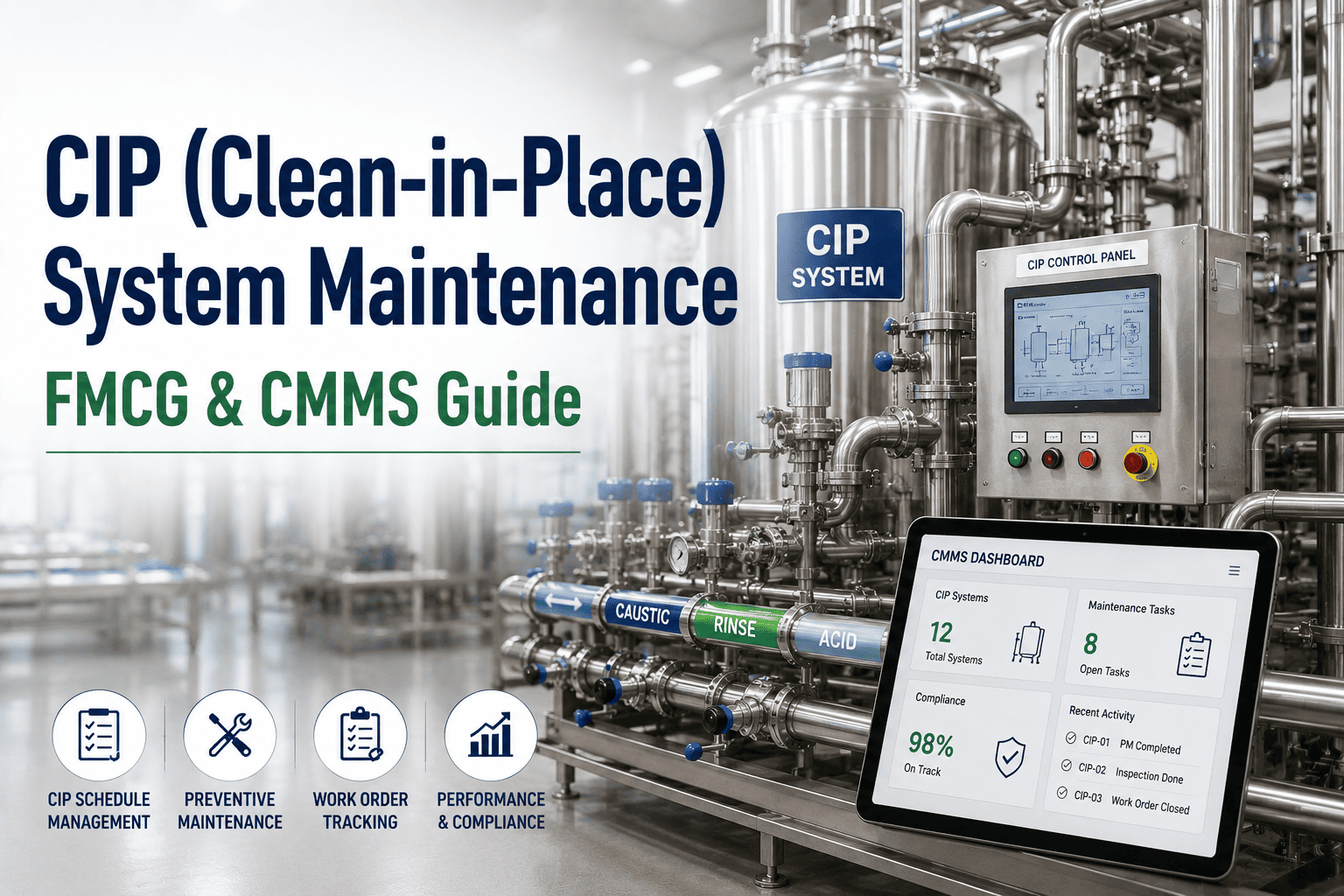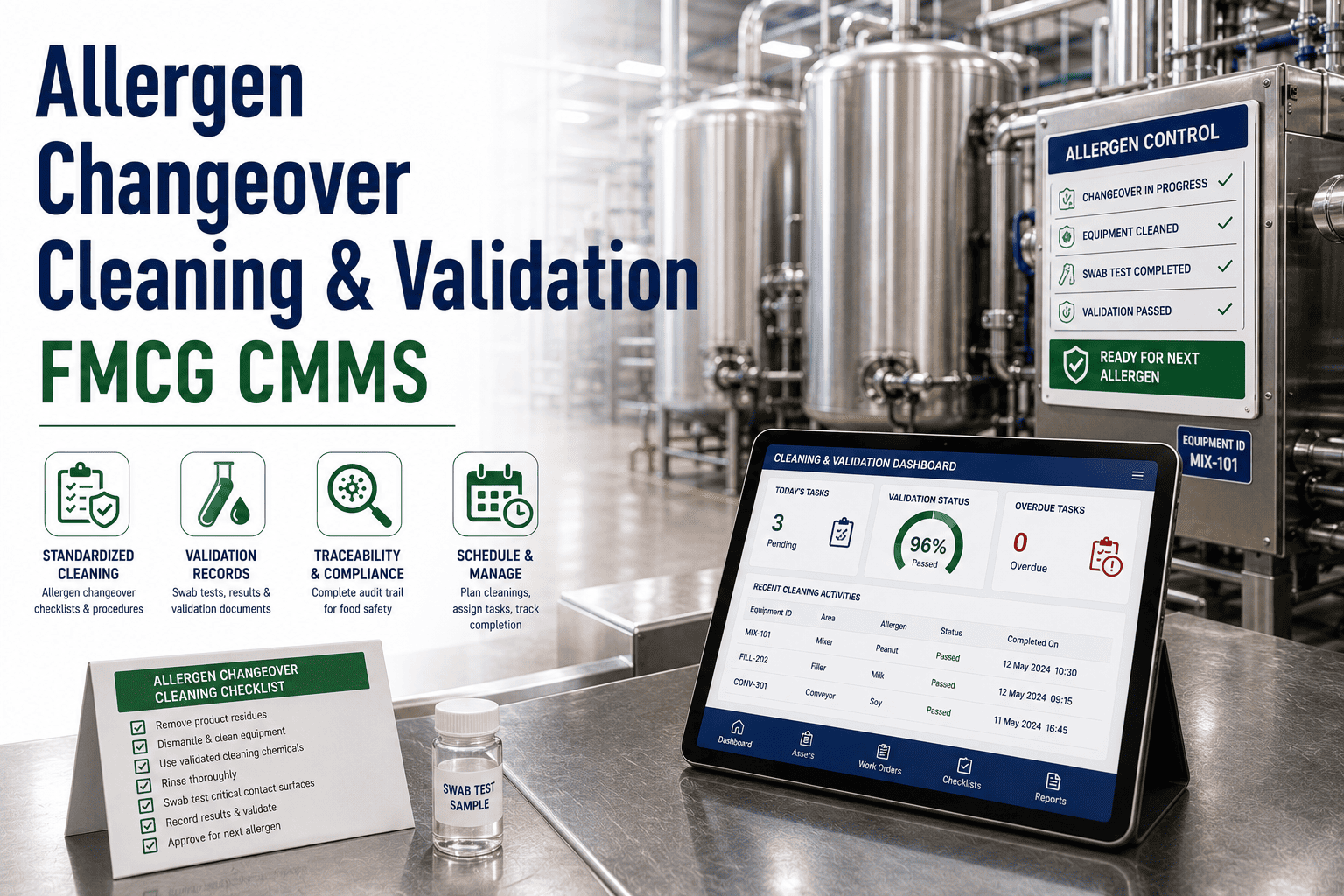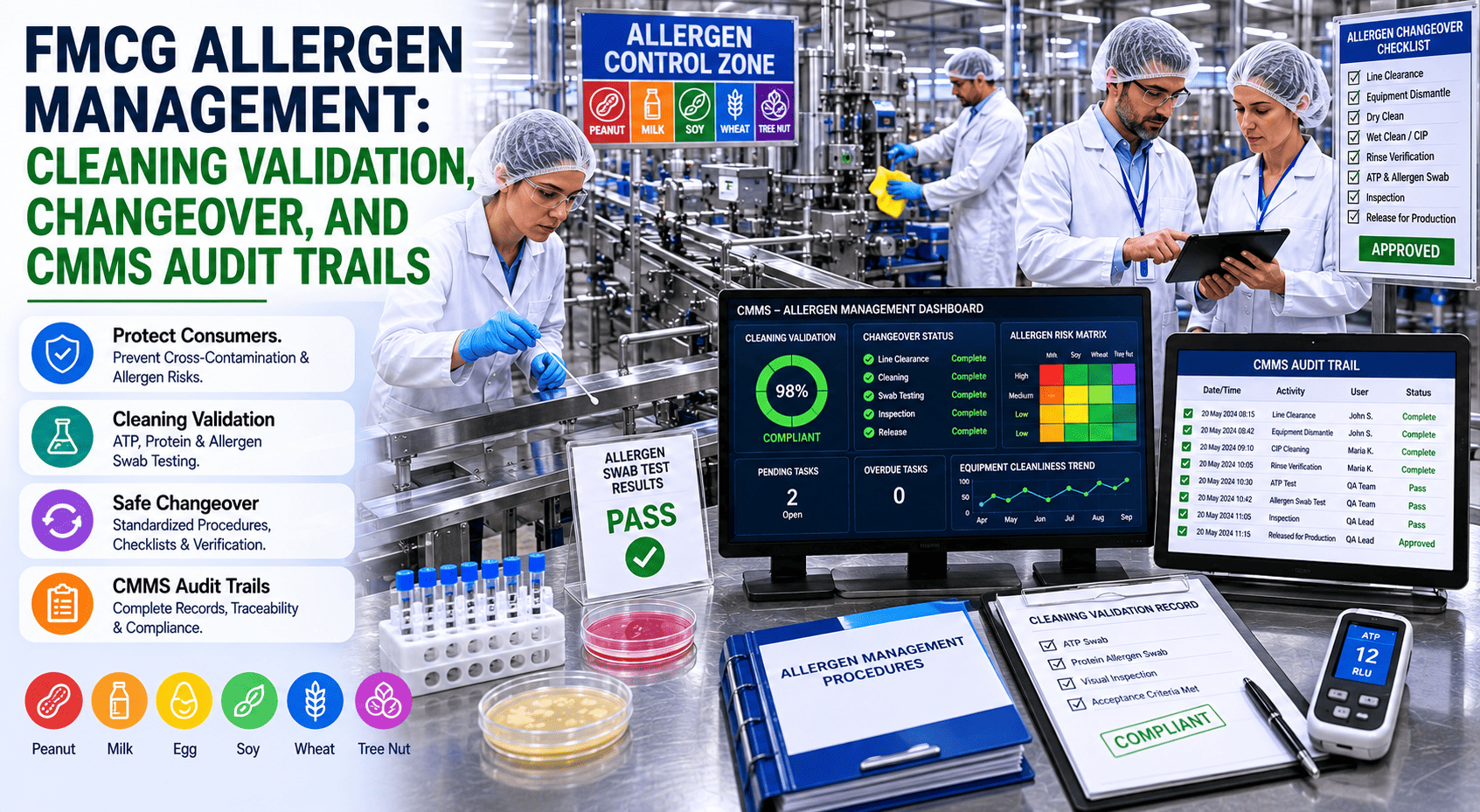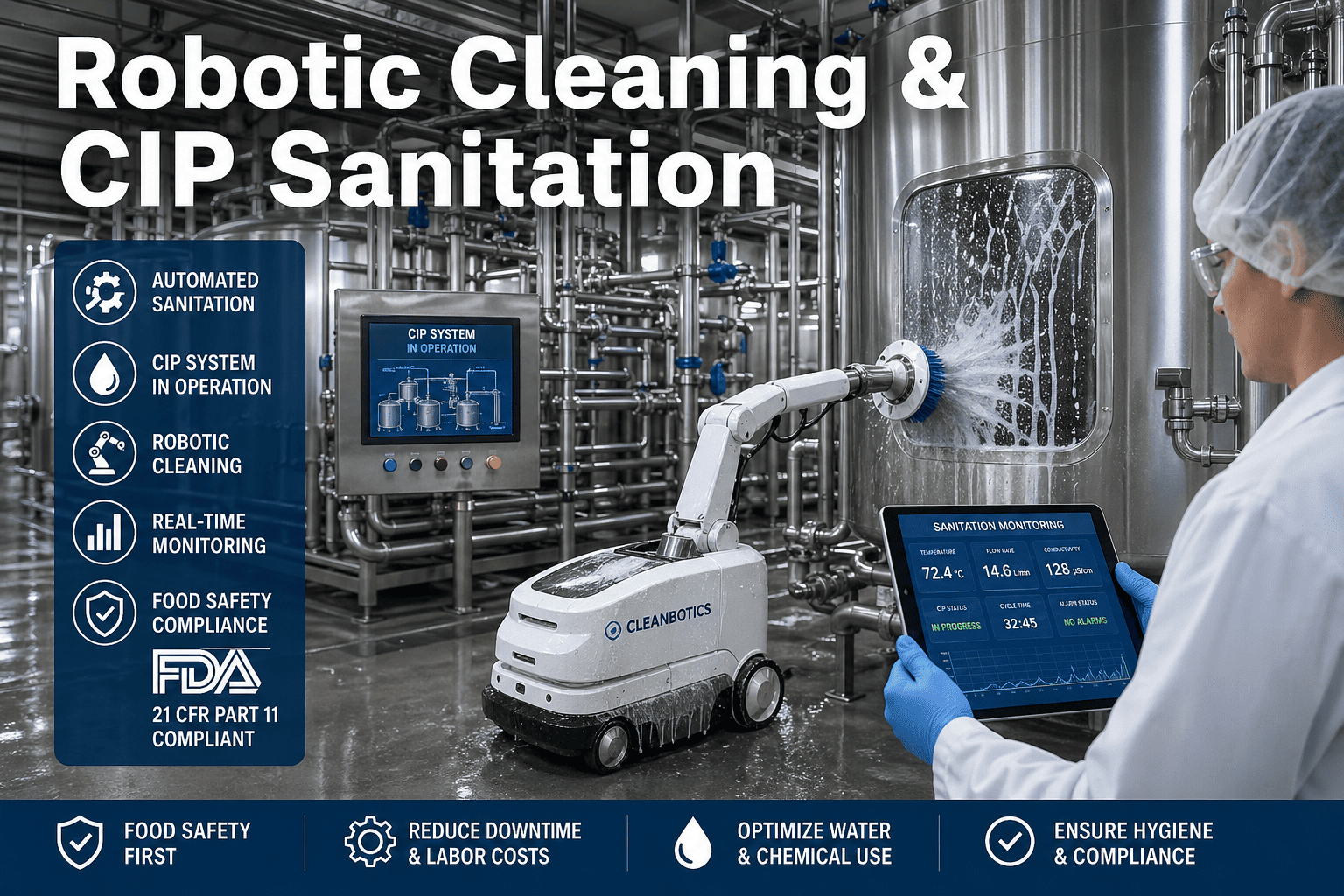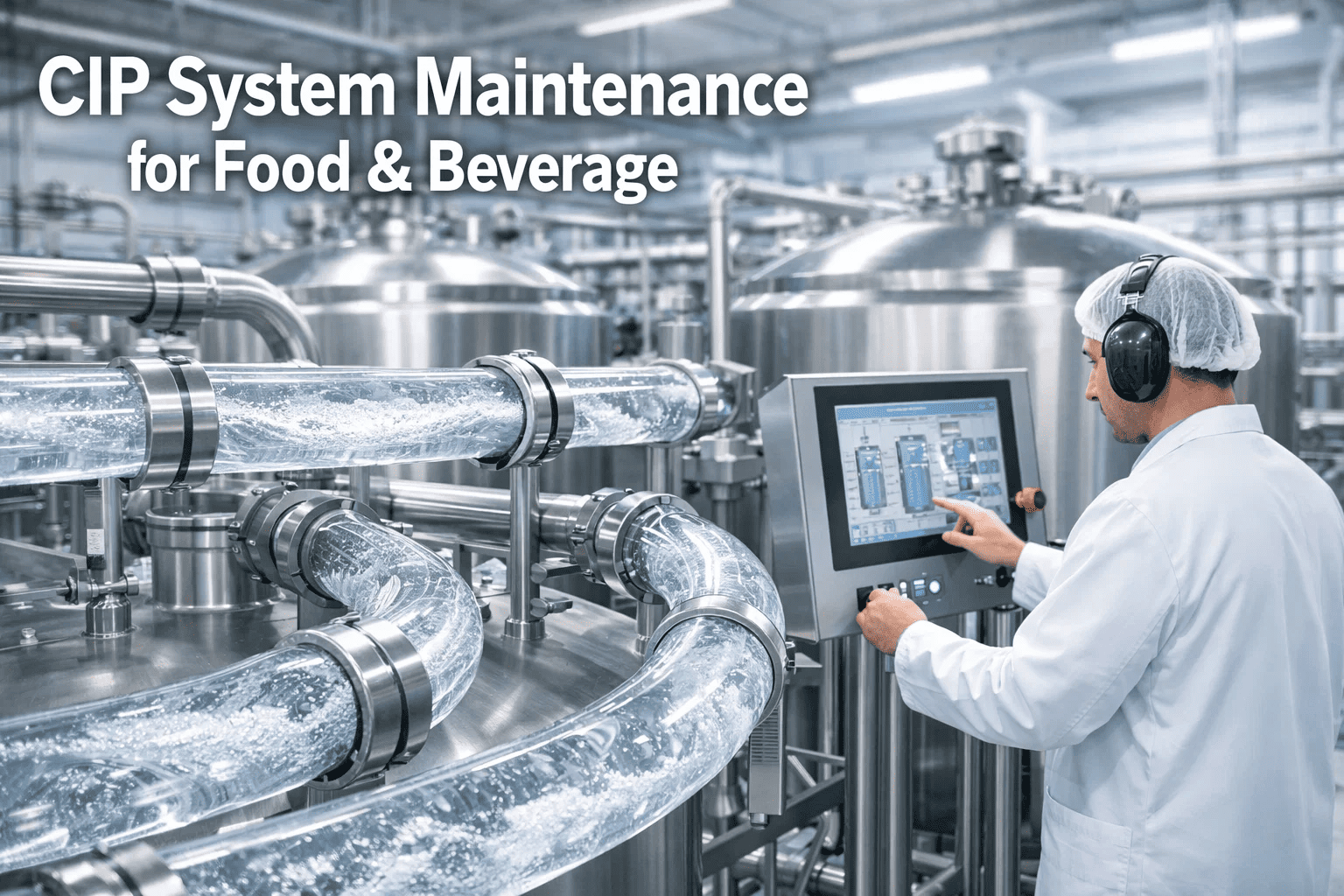
Every food and beverage plant relies on Clean-in-Place systems to remove product residue, biofilm, and microbial contamination from processing equipment without disassembly — yet 60–80% of microbial contamination events in food plants are directly linked to inadequate or failed CIP performance. The consequences are severe: a single CIP failure can cost a facility over $125,000 in lost production, emergency repairs, product disposal, and potential regulatory action. CIP systems are not self-maintaining — spray balls clog, chemical dosing drifts, temperature sensors lose calibration, pump seals degrade, and valve actuators fail. Without structured preventive maintenance, CIP systems silently lose their ability to clean effectively, creating food safety risk that is invisible until a contamination event or failed audit exposes it. Facilities transitioning from reactive to CMMS-driven CIP maintenance report 40% reduction in unplanned CIP downtime, 25–35% savings in energy and chemical consumption, and 3–5x extension of spray device and valve service life. Start a free trial to build structured CIP maintenance programs in Oxmaint, or book a demo to see CIP compliance management in action.
Your CIP System Is Only as Safe as Its Last Maintenance Event
Oxmaint structures your CIP maintenance program — spray device inspections, chemical dosing calibration, temperature and flow sensor verification, pump and valve PM schedules — into digital work orders that generate audit-ready evidence every cleaning cycle.
What Is CIP and Why Does Maintenance Determine Its Effectiveness?
Clean-in-Place is a method of cleaning the interior surfaces of processing equipment — pipes, tanks, fillers, pasteurizers, heat exchangers — without disassembly, using a controlled sequence of water rinses, chemical solutions (caustic, acid, sanitizer), heat, and flow velocity to remove product residue, allergens, and microbial contamination. The cleaning is only as effective as the four critical parameters that must be maintained within validated ranges: Time, Temperature, Chemical Concentration, and Flow Rate (TACT). When any one of these parameters drifts outside its validated range — because a temperature sensor has lost calibration, a dosing pump is under-delivering, or a spray ball is partially clogged — the CIP cycle completes but does not actually clean to the required standard. This creates invisible food safety risk that accumulates silently until a positive environmental swab, a failed product test, or a contamination incident exposes the problem. Start a free trial to configure TACT parameter monitoring in Oxmaint.
The 6 Critical CIP Components That Require Structured PM
CIP system effectiveness depends on six interconnected component groups — failure in any one compromises the entire cleaning cycle. Each component has specific maintenance requirements, inspection frequencies, and failure indicators that must be tracked in your CMMS to prevent the silent degradation that causes contamination events. Book a demo to see how Oxmaint structures CIP component PM programs.
Spray Balls and Spray Devices
Spray balls clog with mineral deposits, product residue, and biofilm — creating shadow zones where cleaning solution never reaches. Weekly visual inspection, quarterly spray pattern testing, and annual replacement of static spray balls prevents the most common single cause of CIP failure. Clogged spray devices account for 28% of all CIP-related contamination events.
Temperature Sensors and Probes
RTDs and thermocouples in CIP circuits must be calibrated monthly against traceable standards. A 5°F calibration drift below target reduces caustic cleaning effectiveness by 25–30%. Oxmaint tracks calibration schedules, records calibration certificates, and alerts when instruments approach due dates — eliminating the calibration gaps that auditors consistently find.
CIP Supply and Return Pumps
Centrifugal CIP pumps degrade gradually — impeller wear reduces flow rate below validated thresholds without triggering alarms. Quarterly pump performance verification (flow rate at rated pressure), monthly seal inspection, and vibration monitoring prevent the slow pump degradation that silently compromises cleaning velocity.
Chemical Dosing Systems
Diaphragm dosing pumps, conductivity probes, and chemical injection points require weekly verification against validated concentration targets. Dosing pump diaphragm wear causes progressive under-dosing at 2–5% per month — a 6-month unchecked drift can reduce chemical concentration 30% below validated minimum, creating systematic under-cleaning across every CIP circuit.
Automated Valves and Actuators
Mix-proof valves, butterfly valves, and seat-lift valves control CIP circuit routing. Seal degradation causes cross-contamination between product and CIP circuits. Actuator failures cause incomplete valve positioning that creates dead legs where cleaning solution stagnates. Monthly valve stroke testing and annual seal replacement prevent the routing failures that contaminate product with cleaning chemicals.
Flow Meters and Conductivity Probes
Flow meters verify cleaning velocity; conductivity probes verify chemical concentration and rinse completeness. Both instruments drift over time and require quarterly verification against reference standards. A flow meter reading 1.8 m/s when actual flow is 1.2 m/s creates a false sense of cleaning adequacy — the system reports "pass" when the circuit is actually under-cleaned.
CIP Maintenance: Before and After CMMS Implementation
CIP Maintenance ROI: What Structured Programs Deliver
Frequently Asked Questions
How often should CIP spray balls be inspected and replaced?
Static spray balls should be visually inspected weekly for clogging and mineral buildup, spray pattern tested quarterly, and replaced annually or whenever spray pattern testing shows coverage gaps. Rotary spray heads require monthly mechanical inspection of bearing and rotation mechanism in addition to spray pattern verification. Facilities processing high-mineral water or sticky products (dairy, sauces) may need more frequent inspection. Oxmaint tracks spray device condition history and alerts maintenance teams when replacement intervals approach based on actual degradation patterns rather than fixed calendars. Start a free trial to set up spray device PM tracking.
What CIP maintenance records do food safety auditors expect to see?
BRCGS, SQF, FSSC 22000, and FDA auditors expect documented evidence of: scheduled PM completion for all CIP components, sensor calibration records with traceability to national standards, chemical concentration verification logs with date/time/operator, spray device inspection records with photos, valve seal replacement records, and corrective actions taken when CIP parameters deviated from validated ranges. Paper-based systems consistently generate audit findings because records are incomplete, unsigned, or not retrievable during the audit walk. Oxmaint generates all of these records automatically as part of the digital work order workflow. Book a demo to see audit-ready CIP documentation.
Can IoT sensors improve CIP maintenance effectiveness?
Yes — IoT-integrated CIP monitoring represents the highest-impact maintenance improvement available. Continuous monitoring of flow rate, temperature, conductivity, and turbidity during every CIP cycle provides real-time verification that all TACT parameters are within validated ranges. When sensors detect parameter drift (flow rate dropping below 1.5 m/s, temperature failing to reach target, conductivity showing incorrect concentration), Oxmaint auto-generates a maintenance work order with the specific parameter, deviation magnitude, and affected CIP circuit identified — enabling corrective action before the next production run begins on under-cleaned equipment.
How does CIP maintenance differ between dairy, beverage, and processed food plants?
The maintenance principles are identical — protect TACT parameters through structured PM — but the specific soil types create different maintenance emphasis. Dairy plants deal with protein and fat-based soils that require higher caustic temperatures (180°F) and more aggressive spray device maintenance due to rapid mineral fouling. Beverage plants face sugar-based soils with lower temperature requirements but higher biofilm risk requiring more frequent sanitizer verification. Processed food plants encounter complex mixed soils that require multi-stage CIP with both caustic and acid cycles — doubling the number of components requiring PM. Oxmaint supports industry-specific CIP PM templates for all food and beverage sub-sectors.
Protect Every CIP Cycle With Structured, Auditable Maintenance — Built in Oxmaint
Food and beverage manufacturers across the USA, UK, Australia, UAE, and Germany use Oxmaint to maintain CIP system effectiveness — with scheduled component PM, sensor calibration tracking, chemical dosing verification, and complete audit-ready documentation generated automatically from every maintenance event.