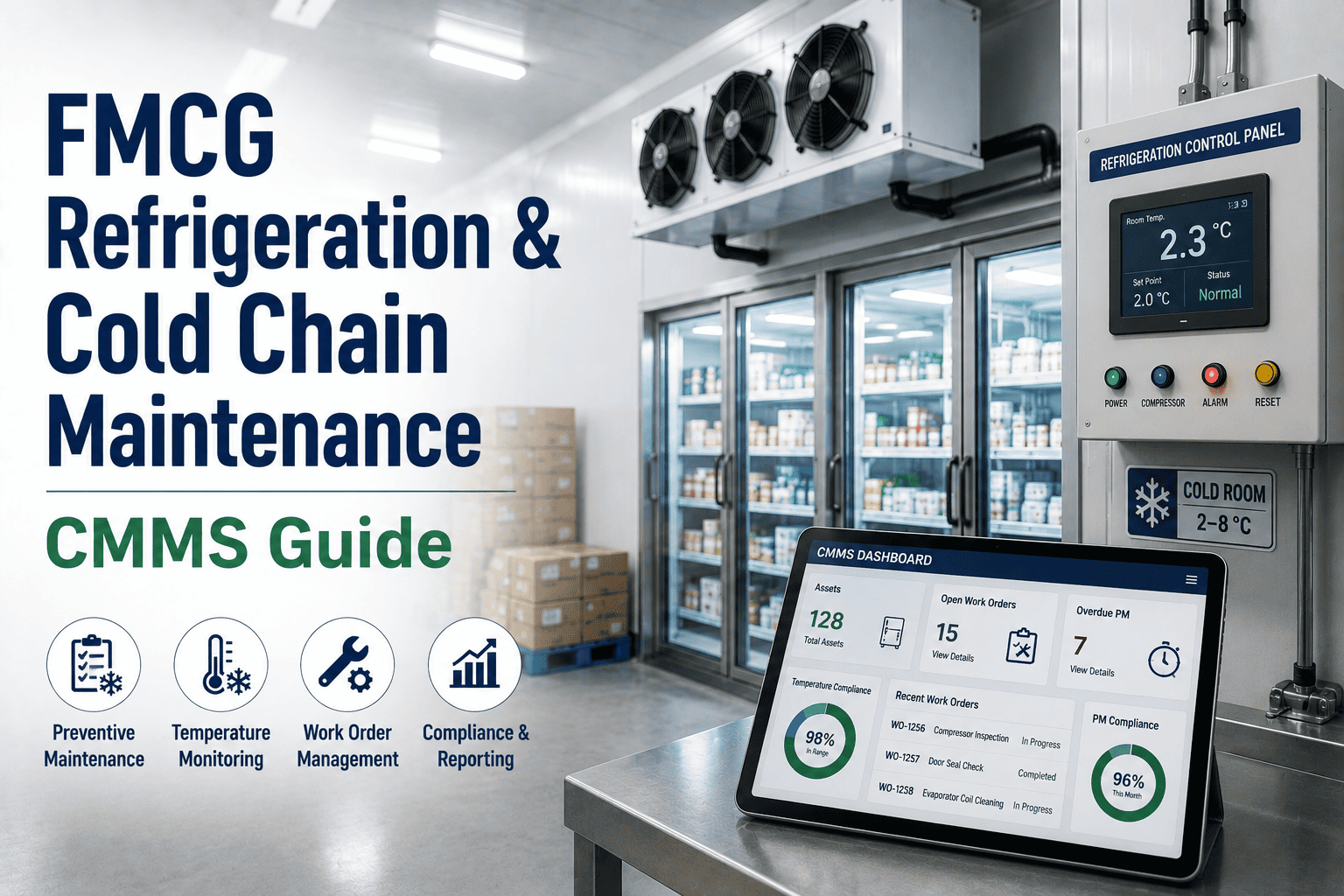
Cold Chain Maintenance for FMCG Protecting Product Quality from Factory to Shelf
By Jonas on March 5, 2026
A frozen food distributor in Gujarat lost ₹4.7 crore in a single weekend when three warehouse compressors failed sequentially — each unit had shown rising discharge pressures for eleven weeks, logged but never reviewed. 18 tonnes of frozen products crossed the critical -18°C threshold and entered the danger zone for 9 hours before the overnight shift discovered the failure. Across FMCG cold chains, the World Health Organization estimates that 40% of perishable food is lost due to inadequate cold chain infrastructure, with equipment maintenance failures accounting for 62% of temperature excursion events. Plants deploying structured cold chain maintenance programs reduce spoilage losses by 34–52% and temperature excursion incidents by 78% within the first operating year. Start your free trial today and begin monitoring every refrigeration asset in your cold chain. Schedule a 30-minute demo with our FMCG cold chain specialists.
Reactive vs. Predictive Cold Chain Maintenance
How structured refrigeration maintenance eliminates the equipment failures that destroy perishable product
Reactive / Calendar-Based
Temperature Excursion Detection
After Product Damage Is Already Done
Average Spoilage Cost per Event
₹15L–₹4.7Cr Depending on Scale
Compressor Health Visibility
Annual Service — No Trending Data
Regulatory Compliance Evidence
Manual Logs — Gaps & Inconsistencies
Predictive / IoT-Driven Maintenance
Temperature Excursion Detection
2–6 Weeks Before Critical Failure
Average Spoilage Cost per Event
₹0 — Prevented at Equipment Level
Compressor Health Visibility
Continuous Pressure, Temp & Vibration Trending
Regulatory Compliance Evidence
Digital Audit Trail — Real-Time & Verifiable
Average Annual Cold Chain Loss Prevention: 34–52% Spoilage Reduction
Six Equipment Failure Modes That Destroy FMCG Cold Chains
These six refrigeration and cold storage failure categories account for 91% of temperature excursion events in FMCG operations. Each failure mode produces measurable degradation signatures that predictive maintenance catches weeks before product is compromised. Oxmaint monitors every cold chain asset continuously.
Six Cold Chain Failure Modes Behind FMCG Product Loss
Compressor Degradation
34%
Of cold chain failures — worn valves, refrigerant leaks, bearing wear causing gradual cooling capacity loss
Condenser Fouling
22%
Dust, debris, and scale buildup reducing heat rejection by 20–40%, forcing compressors into overload
Evaporator Ice Buildup
18%
Failed defrost cycles, degraded heaters, or timer malfunctions blocking airflow and raising zone temperatures
Door Seal Deterioration
₹8L+/yr
Cracked gaskets allowing warm air infiltration — increasing energy consumption 15–25% per degraded seal
Sensor Calibration Drift
Silent
Temperature sensors reading 2–4°C below actual — product stored above safe limits without any alarm
Refrigerant Charge Loss
Critical
Slow leaks reducing cooling capacity over months — systems compensate until catastrophic breakdown occurs
Six Critical Cold Chain Maintenance Strategies for FMCG Operations
Maintaining cold chain integrity requires a multi-layered approach targeting every component that can cause temperature excursions. Each strategy below addresses a specific failure pathway and delivers measurable protection within weeks of implementation. Plants using Oxmaint track all six strategies from a single dashboard.
Dock seal and strip curtain condition verification scheduled
Protection: 15–25% Energy Saved
How Maintenance Management Protects the Cold Chain: Four-Stage Defense
Cold chain protection follows a structured four-stage defense that converts refrigeration equipment condition data into temperature risk scores and triggers interventions before product safety is compromised. Oxmaint connects maintenance workflows directly to temperature monitoring systems.
Four-Stage Cold Chain Protection System
01
Asset Risk Mapping
Classify every cold chain asset by failure impact
Map product-to-temperature sensitivity tiers
Establish redundancy and backup capacity gaps
Output: Cold Chain Risk Register
02
IoT Condition Monitoring
Real-time compressor pressure and vibration trending
Multi-zone temperature with drift detection algorithms
Refrigerant charge tracking with leak rate alerting
Cold Chain Equipment Degradation: What Predictive Monitoring Catches
Each refrigeration component demonstrates unique stress signatures before product-damaging failures occur. Schedule a demo to see these detection models applied to your cold chain equipment.
Predictive Detection Windows by Cold Chain Risk Category
What monitoring systems detect and how far ahead they predict temperature excursion risk
Head pressure rising, condensing temperature delta increasing, compressor runtime extending per cycle
2–8 Weeks
Refrigerant Leak
Charge level declining, superheat rising, suction pressure dropping below normal operating band
1–6 Weeks
Evaporator Ice Buildup
Air-on/air-off temperature differential widening, defrost cycle duration increasing, fan current rising
1–4 Weeks
Sensor Calibration Drift
Multi-sensor cross-reference deviation, control response lag, zone temperature inconsistencies
Per Calibration Check
Temperature Excursion Events Preventable
78%
The remaining 22% of excursions typically result from external power failures or extreme ambient conditions beyond equipment capacity — mitigated by backup power and redundancy planning.
Every Temperature Excursion Started With an Equipment Warning Someone Missed
Oxmaint monitors compressor health, refrigerant levels, and zone temperatures continuously — triggering work orders before your cold chain breaks and product is destroyed.
FMCG facilities where predictive maintenance intercepted refrigeration failures that would have triggered massive product losses under traditional reactive maintenance programs.
Documented Cold Chain Saves in FMCG Plants
Real temperature excursion events prevented through predictive refrigeration monitoring
Catch 1: Compressor Valve Failure — Dairy Cold Store
What Monitoring Detected
Discharge pressure declining 8% over 4 weeks with compressor runtime extending 22% per cooling cycle
Prediction Lead Time
6 Weeks Before Cooling Capacity Would Drop Below Safe Threshold
Planned Repair Cost
₹1.2L (Valve Plate Replacement During Low-Load Window)
Avoided Product Loss
₹2.8Cr (42 tonnes of dairy products across 3 cold rooms)
Catch 2: Sensor Drift — Frozen Snack Warehouse
What Monitoring Detected
Primary zone sensor reading -22°C while cross-reference sensors showed -18.4°C — 3.6°C drift undetected for months
Prediction Lead Time
Immediate Upon Cross-Reference Algorithm Deployment
Combined Cold Chain Value Protected from Two Catches: ₹3.25Cr Saved
ROI of Predictive Cold Chain Maintenance for FMCG
The financial case extends beyond spoilage prevention. Energy savings from optimized refrigeration, extended equipment life, and regulatory compliance confidence multiply the value of every maintenance investment.
78% reduction in temperature excursion events — avg ₹85L per event prevented across cold rooms
₹1.2Cr
Refrigeration Energy Savings
Clean condensers, optimized defrost cycles, sealed doors — 18–28% reduction in compressor energy consumption
₹38L
Compressor Life Extension
Condition-based maintenance extends compressor MTBF by 40–60% — deferred CapEx on replacements
₹52L
Compliance & Audit Efficiency
Digital temperature records and maintenance trails reduce FSSAI audit prep from 2 weeks to 1 day
₹12L
Insurance Premium Reduction
Documented predictive maintenance program reduces cold storage insurance premiums by 10–18%
₹8L
Total Annual Value Delivered
₹2.3Cr
Program investment: ₹15L–₹30L/year. A single prevented spoilage event pays for 3–8 years of the program.
Implementation: 90 Days to Cold Chain Intelligence
Start with the highest-risk refrigeration assets. Prove value with the first prevented excursion. Expand across all cold chain nodes. Schedule a demo to map the roadmap for your facility.
First FSSAI audit passed with digital documentation
Output: 78% Risk Cut
04
Year 1+: Optimize
Full cold chain coverage across all storage nodes
AI models refining degradation predictions continuously
Energy optimization delivering additional cost reductions
Output: 15x+ ROI
Overcoming Common Cold Chain Maintenance Barriers
Every FMCG plant faces obstacles connecting refrigeration maintenance to product protection. These proven solutions accelerate the path from reactive to predictive cold chain management.
Six Common Barriers and How FMCG Plants Overcome Them
Maintenance-QA Disconnect
Solved
Shared platform gives maintenance, QA, and cold chain managers unified visibility into refrigeration health
Manual Temperature Logs
Solved
IoT sensors with digital logging replace clipboard rounds — continuous data with zero recording gaps
Refrigeration Skill Gaps
Solved
Guided work orders with step-by-step procedures enable general technicians to perform routine cold chain tasks
24/7 Monitoring Cost
Solved
Automated alert escalation replaces manual overnight checks — mobile notifications to on-call technicians
Multi-Site Inconsistency
Solved
Centralized platform ensures identical cold chain protocols across all warehouses and distribution centres
Budget Justification
Solved
A single prevented spoilage event pays for 3–8 years of program cost — energy savings alone fund operations
Frequently Asked Questions
Prioritize compressors serving your highest-value product zones first. A single compressor failure in a blast freezer storing ₹2–5Cr of frozen product creates catastrophic loss within hours. Next, focus on evaporators in high-humidity environments where ice buildup is most aggressive, and condensers in dusty or outdoor locations where fouling accelerates. Initial IoT sensor deployment costs ₹3–8L and protects against ₹50L–₹5Cr per excursion event. Sign up free to start building your cold chain priority list.
IoT temperature sensors feed real-time data into the maintenance platform. When a zone temperature deviates from its setpoint band — or when equipment parameters like compressor discharge pressure indicate developing problems — the system auto-generates prioritized work orders with diagnostic context. Technicians receive mobile notifications with specific equipment details, location, and recommended corrective actions based on the degradation pattern detected.
Predictive maintenance detects equipment degradation patterns 1–12 weeks before they cause temperature excursions. A compressor showing rising discharge pressure will eventually lose cooling capacity. A condenser with increasing fouling will eventually force the system into overload. By monitoring these leading indicators and triggering intervention during planned maintenance windows, the system prevents the breakdown that would destroy product. The 78% prevention rate reflects excursions where degradation patterns were detectable in advance.
Oxmaint provides continuous temperature records for every cold zone, timestamped maintenance records for all refrigeration assets, sensor calibration verification logs, refrigerant charge tracking with leak rate documentation, and complete corrective action records with before/after verification. When an FSSAI inspector asks for the temperature history of a specific cold room over the past 90 days — the answer is instant, complete, and audit-grade.
A single prevented spoilage event pays for 3–8 years of program cost. Against ₹15L–₹30L annual investment, preventing one excursion event worth ₹50L–₹5Cr delivers 3–33x ROI. Even without a spoilage event, energy savings from optimized refrigeration (₹20L–₹40L/year), extended compressor life (₹30L–₹50L/year), and audit efficiency gains deliver payback within 6–10 months. Book a demo and we will model ROI using your actual cold chain data.
Your Compressors Are Talking. Your Sensors Are Drifting. Start Listening Before Product Pays the Price.
Oxmaint converts refrigeration equipment data into actionable alerts and auto-generated work orders — so your team fixes a ₹1.2L valve during a planned window instead of losing ₹2.8Cr of dairy product overnight.