Condition Monitoring Technology for FMCG Equipment
By Jack Edwards on April 10, 2026
Most FMCG equipment does not fail suddenly. It degrades — gradually, across weeks or months, along specific physical mechanisms that are detectable long before the failure event itself. Condition monitoring technology exists to detect those mechanisms early, giving maintenance teams time to intervene on their own schedule rather than the equipment's. The challenge for plant managers is not whether to use condition monitoring. It is which technology to apply to which asset — because vibration analysis, thermography, oil analysis, and ultrasonic inspection each target fundamentally different failure modes. Applying the wrong technology to an asset is as costly as applying no technology at all. A motor bearing does not reveal its wear through thermal imaging nearly as clearly as through spectral vibration analysis. A lubrication system will not reveal degraded oil through acoustic monitoring. This guide maps each technology to its correct application, so your condition monitoring program generates real intelligence — not just data volume. Start a free trial to see how Oxmaint integrates condition monitoring data into your asset health scoring, or book a demo to see CM-triggered work orders in action.
Condition Monitoring Technology for FMCG Equipment
Matching the right detection method to the right failure mechanism — every time
6 wksAdvance warning time achievable with vibration analysis on rotating FMCG equipment
40%Reduction in maintenance costs when CM programs are correctly matched to asset failure modes
70%Of FMCG equipment failures are detectable through condition monitoring before the failure event
4.8xCost premium of emergency reactive repairs vs. CM-triggered planned interventions in food manufacturing
Make Every CM Reading Count in Your CMMS
Oxmaint ingests condition monitoring data from your sensors and CM tools — turning readings into asset health scores, maintenance triggers, and traceable work orders.
What Is Condition Monitoring in FMCG Manufacturing?
Condition monitoring (CM) is the practice of continuously or periodically measuring physical parameters of operating equipment — vibration, temperature, oil quality, acoustic emission — to assess its current health state and predict future failure without stopping the machine. In FMCG plants, where production continuity is directly tied to revenue and food safety compliance, CM programs are the difference between managing your maintenance calendar and being managed by your equipment. The key principle is fault-specific: each monitoring technology detects specific failure mechanisms. An effective CM strategy selects the right tool for each asset type. Start a free trial and plug your CM data into Oxmaint's asset health framework today.
The Four Core Condition Monitoring Technologies for FMCG
Matched to failure mechanisms, not just asset types
Technology 01
Vibration Analysis
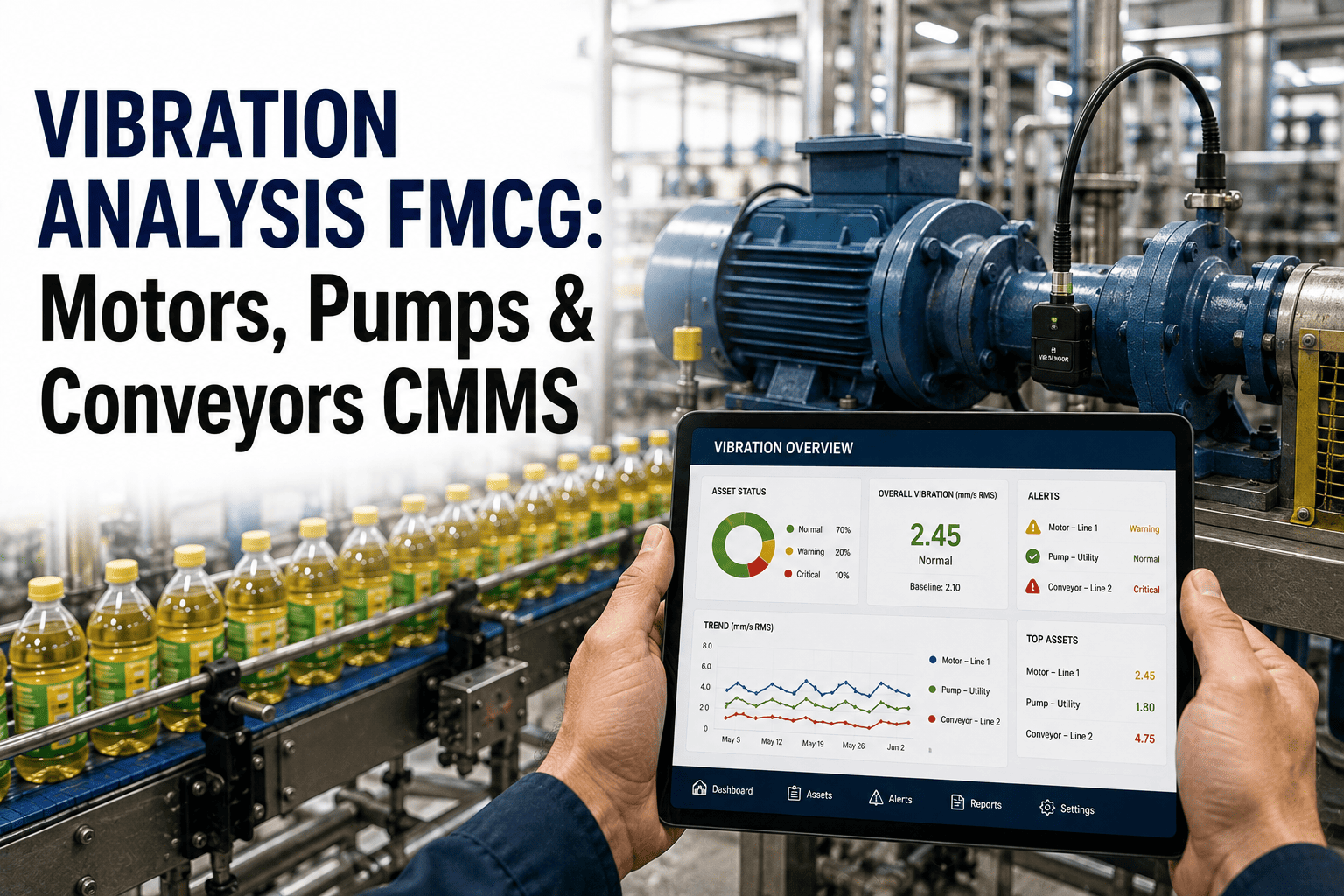
The gold standard for rotating equipment. Vibration spectra reveal bearing wear, imbalance, misalignment, looseness, and gear mesh faults with precision unavailable to any other technology.
Best Applied To
MotorsPumpsGearboxesConveyorsFansCompressors
Detects bearing faults up to 6 weeks in advance
Technology 02
Infrared Thermography
Thermal cameras reveal hot spots in electrical panels, switchgear, motor windings, and mechanical joints — identifying resistance faults, poor connections, and overload conditions before they cause fires or shutdowns.
Identifies up to 80% of electrical failure precursors
Technology 03
Oil & Lubrication Analysis
Laboratory or in-line oil analysis measures contamination, viscosity degradation, and metallic wear particles — providing an early warning of internal component wear inside gearboxes, hydraulic systems, and journal bearings.
Best Applied To
GearboxesHydraulic SystemsJournal BearingsCompressorsTurbinesCIP Systems
Detects internal wear 30–90 days before catastrophic failure
Technology 04
Ultrasonic Acoustic Detection
Ultrasonic instruments detect the high-frequency sound of compressed air leaks, steam trap failures, bearing lubrication deficiencies, and early electrical arcing — conditions that are invisible to visual and thermal inspection at equivalent severity.
Best Applied To
Steam TrapsCompressed Air SystemsValve LeaksBearing LubricationElectrical DischargeTank Integrity
Air leak detection saves 20–30% of compressed air utility costs
Technology Selection: Which CM Method for Which FMCG Asset?
From raw sensor reading to resolved work order — fully connected
Data Integration
IoT and SCADA Connectivity
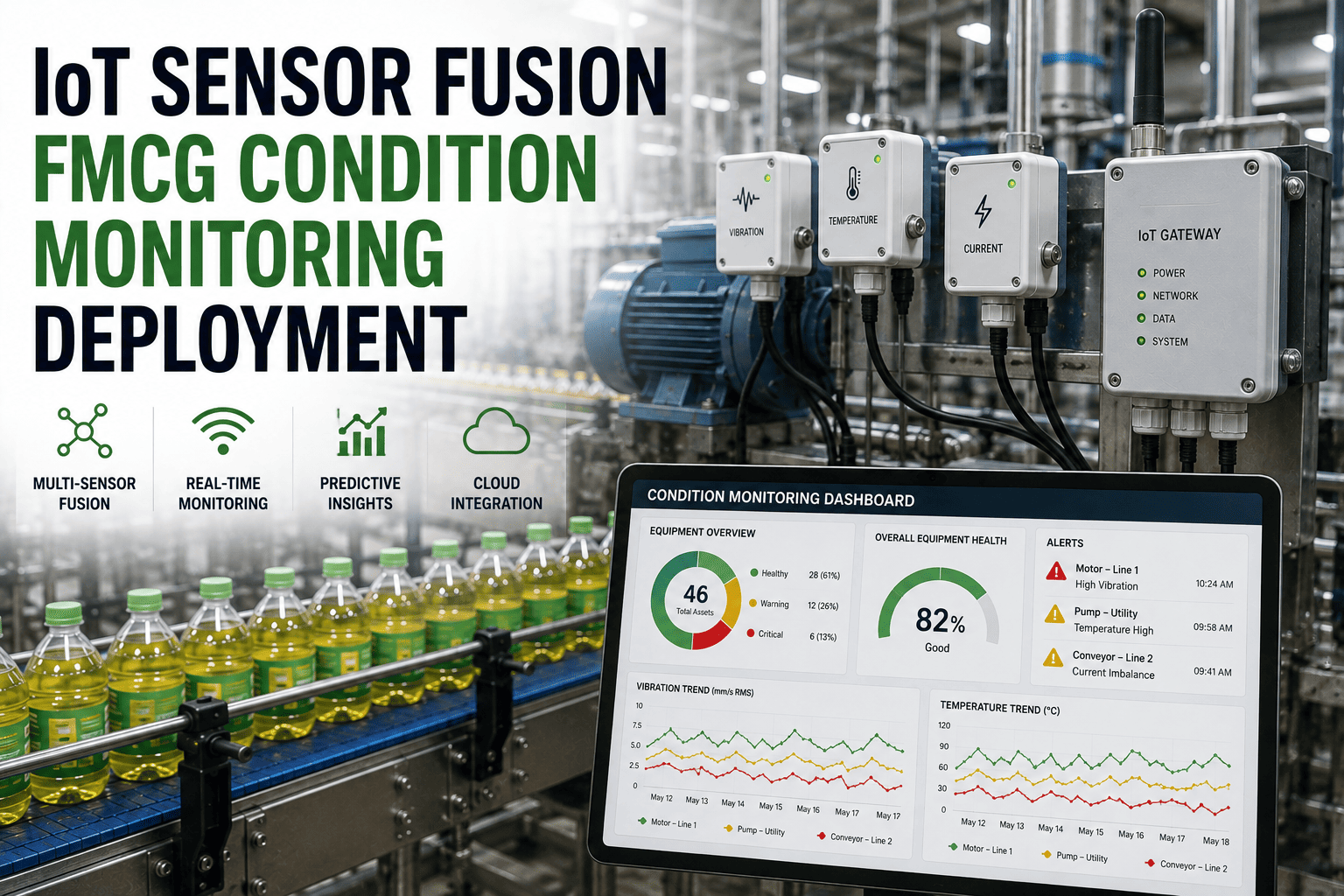
Connects to vibration, thermal, ultrasonic, and oil quality sensors via API, MQTT, or OPC-UA. CM readings update asset health scores automatically in real time.
Asset Intelligence
Condition Scoring Per Asset
Every asset receives a condition score based on CM readings, maintenance history, and age. Your team sees the whole picture — not just individual readings in isolation.
Automation
Threshold-Triggered Work Orders
When a CM reading crosses a defined threshold, Oxmaint auto-generates a work order with asset details, fault category, recommended SOP, and required parts — ready immediately.
Trend Analysis
Historical Reading Trend Tracking
Multi-reading trend graphs reveal whether a parameter is stable, slowly degrading, or accelerating — giving maintenance teams the lead time they need to plan interventions.
Compliance
Audit-Ready CM Documentation
Every CM reading, alert, and work order carries a timestamp, technician ID, and resolution record. GMP, BRC, and FSMA audit packs are generated in one click.
Forecasting
CapEx Trigger From CM Trends
Accelerating degradation trends in CM data feed directly into Oxmaint's 5–10 year CapEx model — so replacement budget arrives in the plan before the asset reaches end of life.
The ROI of a Well-Matched CM Program
70%
Failures Detectable Before Occurrence
7 in 10 FMCG equipment failures can be predicted using the right CM technology correctly applied
30%
Reduction in Overall Maintenance Cost
CM programs reduce total maintenance spend by eliminating unplanned repairs and over-scheduled PMs
20–30%
Compressed Air Savings via Ultrasonic
Leak detection surveys typically find enough waste to offset the entire ultrasonic program cost in year one
5x
Longer Bearing Life With Proper Lubrication CM
Ultrasonic-guided lubrication eliminates both under- and over-greasing, dramatically extending component life
Stop Measuring Without Acting. Connect Your CM Program to Oxmaint.
Condition monitoring data is only valuable when it drives a maintenance action. Oxmaint is the platform that closes the loop — from sensor reading to work order to asset history — without manual effort in between. Take a free trial today.
What is the most important condition monitoring technology for FMCG plants?
Vibration analysis is the highest-value technology for most FMCG plants because the majority of critical equipment involves rotating machinery — motors, pumps, gearboxes, fans, and conveyors. Vibration analysis can provide up to 6 weeks of advance warning on bearing and gear faults, giving maintenance teams ample time for planned intervention. Thermography is the second priority, particularly for electrical infrastructure and steam systems.
How does oil analysis help with gearbox maintenance in food manufacturing?
Oil analysis monitors wear particle concentration and composition, viscosity degradation, contamination levels (water, particles, and process chemicals), and additive depletion. In gearboxes, increasing iron or copper particle counts in the oil signal internal wear up to 30–90 days before a failure event. In food-grade applications, oil analysis also verifies that food-safe lubricants are not degraded or cross-contaminated — an important GMP compliance element.
Can ultrasonic monitoring detect bearing lubrication problems?
Yes. Ultrasonic instruments are highly sensitive to the acoustic signature of bearing lubrication state. An under-lubricated bearing produces a characteristic high-frequency signal that indicates friction, while a correctly lubricated bearing has a lower, smoother acoustic profile. This allows technicians to lubricate only when the bearing actually needs it — preventing both under-greasing (which causes wear) and over-greasing (which causes seal and motor failures).
How does Oxmaint help manage a multi-technology condition monitoring program?
Oxmaint provides a unified asset record for each piece of equipment that can receive CM readings from multiple technologies simultaneously — vibration, thermal, oil quality, and acoustic data all linked to the same asset profile. Threshold alerts are configurable per technology and per asset. Historical trends are viewable in one dashboard, and all CM-triggered actions are tracked through a complete work order trail. This gives plant managers a single source of truth for each asset's condition, regardless of how many monitoring methods feed into it.