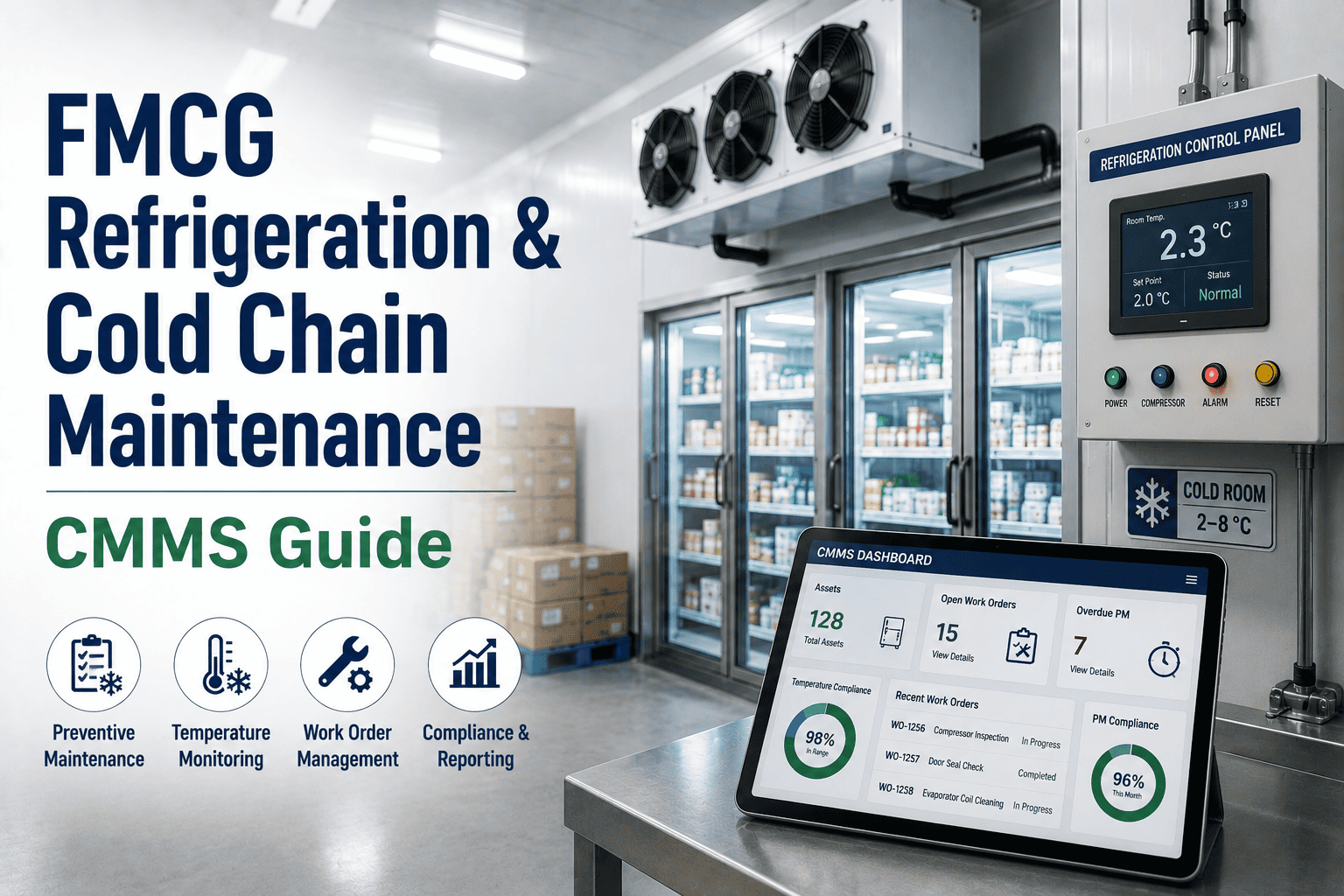
A frozen food manufacturer in Gujarat lost $340,000 in a single weekend when a compressor failure went undetected for 11 hours overnight, raising cold storage temperature from -18C to -4C across two chambers holding 180 tonnes of product. The compressor had been showing elevated discharge pressure and rising current draw for 3 weeks — warning signs that a $200 vibration sensor or a weekly manual pressure check would have caught. Instead, the first alert came when a warehouse operator noticed frost melting off the door seals at 6 AM Monday morning. By then, 180 tonnes of product required disposition review, 62 tonnes were condemned, and the plant spent 4 days restoring chamber temperatures while production backed up on the loading dock. Cold chain failures in FMCG are not equipment failures — they are maintenance failures. Every compressor, condenser, evaporator, and control system in your refrigeration plant announces its deterioration weeks before failure through pressure trends, temperature drift, current draw changes, and vibration signatures that structured PM programmes detect and IoT sensors monitor continuously. Start your free trial to connect refrigeration sensors to automated maintenance alerts. Book a demo to see OxMaint's IoT Sensor Integration and Edge AI module protecting cold chain assets.
IoT Sensor Integration & Edge AI
Your Cold Chain Should Never Depend on Someone Noticing Melting Frost
OxMaint connects to refrigeration IoT sensors — temperature, pressure, vibration, current — and uses Edge AI to detect compressor degradation weeks before failure, automatically generating maintenance work orders before product is at risk.
$340K
average cost of a single cold chain failure event at a mid-size FMCG facility
92%
of refrigeration failures are preceded by 2–6 weeks of detectable warning signs
35–50%
energy reduction achievable through refrigeration maintenance optimization
The Five Refrigeration Components That Protect Your Cold Chain
A cold chain refrigeration system has five critical component categories. When any one fails, product temperature rises — and the clock starts on a food safety event that compounds in cost every hour it goes undetected. Understanding these components, their failure modes, and their early warning signatures is the foundation of a refrigeration PM programme that prevents loss instead of documenting it.
Compressors
Bearing wear, valve plate erosion, oil breakdown, motor winding degradation. Failure means total loss of cooling capacity. Warning signs appear 2–6 weeks before seizure: rising discharge pressure, elevated current draw, increasing vibration at bearing frequencies, oil analysis showing metal particles.
PM: Vibration analysis weekly, oil analysis quarterly, suction/discharge pressure trending daily, motor current logging continuous.
Condensers
Fin fouling from dust, debris, and biological growth reduces heat rejection capacity by 15–40%. System compensates by running compressor harder and longer — increasing energy consumption 20–35% while gradually losing the ability to maintain target temperature on peak-load days.
PM: Visual inspection weekly, coil cleaning monthly (high-dust) or quarterly (clean environments), condenser approach temperature check weekly.
Evaporators
Ice buildup from failed defrost cycles insulates the coil, reducing heat transfer by 25–50%. Air circulation drops as ice blocks fin spacing. Chamber temperature rises gradually — 0.5–1.0 degrees per day — slow enough to avoid alarm thresholds but fast enough to create food safety risk within a week.
PM: Defrost cycle verification daily, coil inspection weekly, drain pan and drain line clearing weekly, fan motor current check monthly.
Expansion Valves and Refrigerant Circuit
TXV hunting or stuck position causes superheat instability — either flooding the compressor with liquid (damage risk) or starving the evaporator (reduced capacity). Refrigerant leaks reduce system charge gradually, degrading performance 5–15% before low-pressure alarms trigger.
PM: Superheat/subcooling check monthly, refrigerant leak detection quarterly (electronic sniffer), sight glass check daily, TXV response verification quarterly.
Controls and Temperature Monitoring
Temperature sensor drift, controller relay failure, defrost timer malfunction, and alarm system failure. The most dangerous failure mode: a temperature sensor reading 2–4 degrees colder than actual, causing the system to maintain a temperature that appears compliant but is not.
PM: Sensor calibration check monthly against certified reference, alarm function test weekly, controller relay test quarterly, backup power test monthly.
Temperature Drift: The Silent Cold Chain Killer
The most expensive cold chain failures are not sudden compressor seizures — they are slow temperature drifts that stay below alarm thresholds for days or weeks while product quality degrades invisibly. A freezer chamber set to -18C that drifts to -14C over 10 days will not trigger a -10C alarm, but every hour above -18C accelerates ice crystal growth, texture degradation, and microbial activity in the stored product.
Day 1–3
-18C to -17C
Condenser fouling begins reducing heat rejection
IoT pressure trending detects rising head pressure
Day 4–7
-17C to -15C
Compressor running 15% longer cycles to compensate
Current monitoring flags elevated amperage trend
Day 8–14
-15C to -12C
Evaporator icing from extended run cycles reduces airflow
Temperature trending catches slow rise pattern
Day 15+
-12C to -8C
Compressor overheating, thermal protection cycling on/off
High-temperature ALARM finally triggers
The financial difference between detecting at Day 3 and detecting at Day 15 is enormous. At Day 3, the fix is a condenser cleaning that takes 30 minutes and costs nothing. At Day 15, the fix is a condenser cleaning plus an evaporator defrost plus a compressor inspection plus a full product disposition review of every lot stored in the chamber for the past two weeks — a $50K–$340K event that was entirely preventable.
24/7 Cold Chain Monitoring
Detect Temperature Drift at Day 1 — Not Day 15
OxMaint's IoT integration monitors compressor pressure, current draw, evaporator temperature, and chamber conditions continuously. Edge AI detects drift patterns that predict failure days or weeks before alarms trigger — generating maintenance work orders while the fix is still cheap and the product is still safe.
The Refrigeration PM Schedule That Prevents Cold Chain Failures
This schedule covers industrial refrigeration systems used in FMCG cold storage, blast freezing, and chilled distribution — including ammonia, CO2, and HFC-based systems.
IoT Sensor Architecture: What to Monitor and Where
IoT sensors transform refrigeration maintenance from calendar-based inspections to condition-based monitoring — detecting the earliest signs of degradation in real time instead of waiting for a weekly visit. The sensor investment for a 4-chamber cold storage facility is $8K–$15K and pays for itself with the first prevented temperature excursion.
Compressor Vibration
Mounted on compressor bearing housing
Tri-axial accelerometer — detects bearing defects, valve issues, and imbalance at bearing-specific frequencies
Alert: velocity exceeds 4.5 mm/s baseline
Discharge Pressure
Compressor discharge line
Pressure transmitter — rising trend indicates condenser fouling, overcharge, or non-condensable gases in the system
Alert: pressure rises 10%+ above seasonal baseline
Motor Current
CT clamp on compressor supply
Continuous current monitoring — rising amperage indicates increasing mechanical load from wear, low refrigerant, or fouled heat exchangers
Alert: current exceeds 110% of baseline FLA
Chamber Temperature
Multiple points per chamber (air + product core)
Wireless sensors at 30-second intervals — detects slow drift that stays below alarm threshold but indicates system degradation
Alert: 0.5C drift from setpoint sustained 4+ hours
Door Open Duration
Magnetic contact on chamber doors
Tracks door open time per event and cumulative per shift — excessive open time is the #1 cause of evaporator icing and temperature excursions
Alert: door open >3 minutes or cumulative >45 min/shift
Condensate Drain Flow
Evaporator drain pan outlet
Flow/no-flow sensor confirms defrost water is draining — a blocked drain refreezes on the coil and compounds ice buildup each defrost cycle
Alert: no flow detected during defrost cycle
The ROI: What Refrigeration Maintenance Saves
Product loss prevention
$340K/event
Energy optimization (35–50%)
$65K/yr
Compressor life extension
$32K/yr
Refrigerant leak prevention
$18K/yr
Regulatory compliance assurance
$22K/yr
Annual PM + IoT sensor programme cost$22,000
Annual value + risk prevention$137K/yr + $340K/event
One Prevented Cold Chain Event Pays for 15 Years of Refrigeration Maintenance
The energy savings alone justify the maintenance programme. Refrigeration typically consumes 40–60% of a cold storage facility's total electricity bill. A condenser operating with 30% fouling forces the compressor to consume 20–35% more energy — costing $30K–$65K per year in excess electricity on a mid-size facility. Monthly condenser cleaning eliminates this waste entirely at a labour cost of $200–$400 per month.
Implementation: 45-Day Cold Chain Maintenance Programme
Week 1–2
Refrigeration Asset Census and Baseline Assessment
Register every compressor, condenser, evaporator, expansion valve, and control panel as individual CMMS assets. Record nameplate data, refrigerant type and charge, and current operating parameters. Baseline vibration, pressure, and temperature for each system. Identify deferred maintenance.
Week 3–4
Fix Critical Findings and Deploy IoT Sensors
Clean all condensers. Fix any refrigerant leaks found during baseline. Calibrate all temperature sensors. Install IoT sensors on critical compressors (vibration, current, pressure) and in all chambers (temperature, door contact). Connect sensors to OxMaint for automated alert-to-work-order generation.
Week 5–6
Build PM Schedule and Configure Edge AI Alerts
Create daily, weekly, monthly, and quarterly PM templates for each component category. Configure Edge AI drift detection thresholds based on baseline data. Set escalation rules: drift alert to maintenance lead, high-temp alert to plant manager, critical alarm to emergency call list. First full PM cycle executed and documented.
Frequently Asked Questions
IoT Sensor Integration & Edge AI
Protect Every Degree. Prevent Every Excursion. Save Every Tonne.
92%
failures detectable early