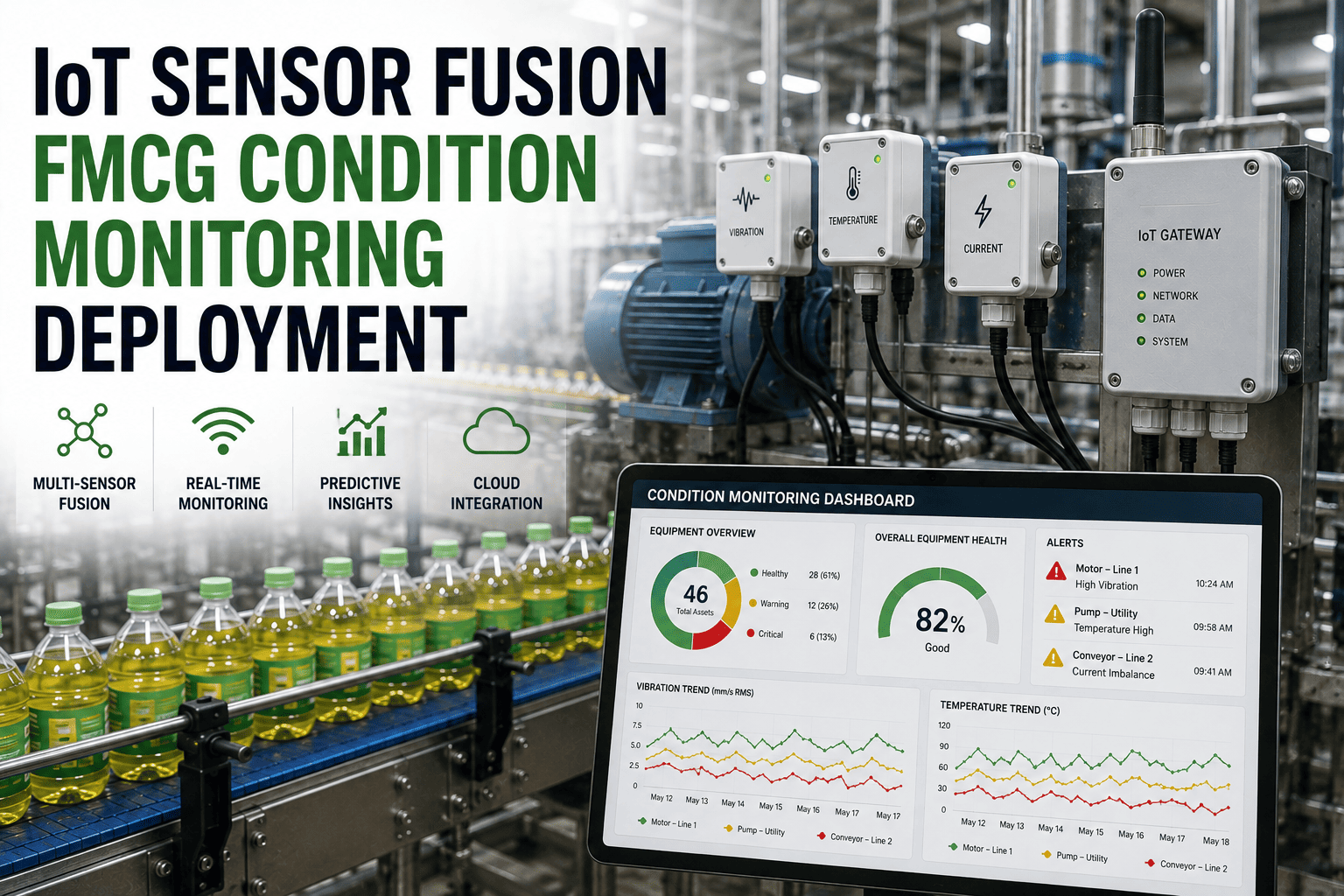
In FMCG plants, equipment failure does not announce itself in advance. A conveyor bearing degrades silently. A filling machine overheats before anyone notices. A compressor vibrates at a frequency that signals imminent collapse — and the only way to catch it early is to listen continuously. IoT sensor networks are the ears and eyes of a modern production floor. When deployed correctly, they transform isolated machines into a connected intelligence layer that gives maintenance teams and plant managers real-time visibility into every critical asset. The global IoT sensors market reached $17.5 billion in 2024, and FMCG is one of its fastest-growing verticals — because downtime in a food or beverage plant does not just cost money. It costs compliance, shelf life, and customer trust. Start a free trial and connect your first sensor network in under a day, or book a demo to see live FMCG sensor dashboards.
30–50%
Reduction in unplanned downtime through vibration and thermal sensor early warning
$17.5B
Global IoT sensors market in 2024, with FMCG among the fastest-growing verticals
25%
Average OEE improvement at plants with full IoT monitoring integration
20–30%
Energy cost savings from smart sensor-driven equipment monitoring programs
See Your Plant's Sensor Data Live
Oxmaint connects to your IoT devices and surfaces real-time equipment health on one dashboard — no complex integration required.
What Is an IoT Sensor Network in FMCG Production?
An IoT sensor network is a distributed system of smart sensors installed at critical points across your production equipment — motors, conveyors, compressors, filling heads, packaging lines — that continuously collect and transmit operational data to a central platform. In FMCG, this data typically covers vibration frequency, surface temperature, ambient humidity, current draw, and run-time cycles. The moment a reading drifts outside a defined threshold, an alert fires. No manual inspection. No waiting for a breakdown. Your maintenance team acts on data, not guesswork. Start a free trial to see how Oxmaint ingests sensor data and triggers work orders automatically.
Vibration
Bearing & Motor Health
Detects mechanical wear in rotating equipment up to 6 weeks before failure. Essential for motors, pumps, and gearboxes on production lines.
Temperature
Thermal Condition Tracking
Monitors heat buildup at critical components. Abnormal thermal signatures indicate friction, overload, or electrical faults before they escalate.
Humidity
Environmental Compliance
Critical in food-grade production zones. Prevents moisture-related spoilage and ensures GMP-compliant ambient conditions around sensitive equipment.
Current & Power
Load & Efficiency Tracking
Measures electrical consumption in real time. Sudden current spikes signal mechanical stress, while gradual increases indicate efficiency degradation over time.
Why FMCG Plants Cannot Afford Manual Monitoring
Manual walk-rounds catch maybe 15% of developing failures. The rest are invisible until a machine stops the line. In a fast-moving production environment running 18-hour shifts with razor-thin margins, that gap is not acceptable. IoT sensor networks close it entirely. Book a demo to see how Oxmaint surfaces sensor-driven alerts directly into work orders.
Blind Spots Between Rounds
Technicians walk rounds every 4–8 hours. Equipment failure can develop and complete in under 60 minutes — entirely undetected.
Subjective Observations
Manual inspection quality varies by shift, technician experience, and fatigue levels. Sensor data is objective, consistent, and timestamped every second.
No Trend Visibility
A human walking past a motor cannot see that its vibration frequency has increased 12% over 30 days. Sensors create trend data that predicts the future.
Compliance Risk
FMCG operations face strict food safety and environmental audits. Manual logs are incomplete and inconsistent. Sensor networks generate automatic, audit-ready records.
How Oxmaint Turns Sensor Data Into Maintenance Action
Collecting sensor data is only half the equation. The other half is doing something with it. Oxmaint connects to your IoT infrastructure and immediately puts that data to work — triggering alerts, assigning work orders, and building the equipment history your team needs to make better decisions. Start a free trial and link your first IoT sensor to a work order in minutes.
Step 1
Threshold Breach Detected
Vibration, temperature, or humidity crosses the defined limit. The sensor transmits the anomaly reading with a timestamp to Oxmaint in real time.
Step 2
Automated Alert Triggered
Oxmaint fires an instant notification to the assigned technician and supervisor. Alert severity is classified (warning, critical, or emergency) based on deviation magnitude.
Step 3
Work Order Auto-Generated
The system creates a work order pre-populated with asset details, sensor readings, fault category, and recommended SOP — ready for the technician to pick up on mobile.
Step 4
Technician Completes Task
Technician arrives, reviews the sensor history, performs the repair, and closes the work order with photos, parts used, and resolution notes — all in the mobile app.
Step 5
Asset Record Updated
The repair event is logged to the asset's full maintenance history. Trend data updates automatically, refining future threshold recommendations using accumulated context.
Step 6
Manager Reviews Dashboard
Plant manager views OEE impact, MTTR, and sensor-triggered work order frequency by asset — enabling data-driven decisions on PMs, replacements, and CapEx.
Reactive vs. IoT-Enabled Predictive Monitoring
| Monitoring Area |
Reactive (No IoT) |
IoT-Enabled (With Oxmaint) |
| Failure Detection |
Found after breakdown occurs |
Detected 2–6 weeks before failure |
| Inspection Frequency |
Manual walk-rounds every 4–8 hrs |
Continuous, 24/7 automated monitoring |
| Work Order Creation |
Manually created after complaint |
Auto-generated on threshold breach |
| Downtime Impact |
4–12 hours emergency repair |
30–60 min planned intervention |
| Repair Cost |
Emergency rates, 4.8x planned cost |
Scheduled, planned, budget-controlled |
| Compliance Records |
Incomplete manual logs |
Automated, timestamped, audit-ready |
| OEE Visibility |
End-of-day reporting only |
Real-time per-line OEE dashboards |
| Energy Monitoring |
Monthly utility bills only |
Per-asset consumption tracking live |
ROI Snapshot: What IoT Monitoring Delivers
40%
Fewer Emergency Work Orders
Plants using IoT-triggered PMs see a 40% drop in reactive callouts within 6 months
15–25%
OEE Improvement
Real-time production analytics identify micro-stoppages that shift-level managers miss
6 wks
Advance Failure Warning
Vibration signatures detect bearing wear up to 6 weeks before catastrophic failure
4.8x
Emergency vs. Planned Cost Ratio
Every emergency repair costs 4.8x more than a planned, sensor-triggered intervention
Connect Your Production Floor to Real-Time Intelligence
Stop flying blind between manual inspections. Oxmaint integrates with your IoT sensors and SCADA systems to give your team a live, actionable view of every machine — so failures become planned events, not emergencies.
Frequently Asked Questions
What types of sensors work best for FMCG production monitoring?
Vibration sensors are the most widely deployed for rotating equipment health. Temperature sensors are critical for thermal monitoring of motors, compressors, and cold chain equipment. Humidity sensors are essential in food-grade production zones. Current monitoring sensors track electrical load and identify efficiency degradation. Most modern deployments use wireless sensors (LPWAN, Wi-Fi, or 5G) for flexibility across the production floor.
How does Oxmaint connect to existing IoT sensors on my production line?
Oxmaint supports direct IoT and SCADA integration via API, MQTT, or OPC-UA protocol. You can connect most industrial sensor hardware without replacing existing infrastructure. Once connected, sensor readings flow into Oxmaint's asset records and trigger automated work orders when readings exceed defined thresholds. Setup typically takes hours, not months.
Can IoT sensors help with food safety and GMP compliance?
Yes. Humidity and temperature sensors continuously log environmental conditions in production and storage zones. This data creates an automated, timestamped compliance record that replaces manual logbooks. In the event of a food safety audit or regulatory inspection, Oxmaint generates full environmental history reports with digital signatures — reducing audit preparation time significantly.
How quickly do FMCG plants see ROI from IoT sensor deployment?
Most plants see measurable ROI within the first 90 days — typically through the prevention of one or two unplanned downtime events that would otherwise cost far more than the sensor infrastructure investment. At a conservative estimate of $10,000–$50,000 per hour of production line downtime, a single prevented failure event covers the entire first year of IoT monitoring costs.