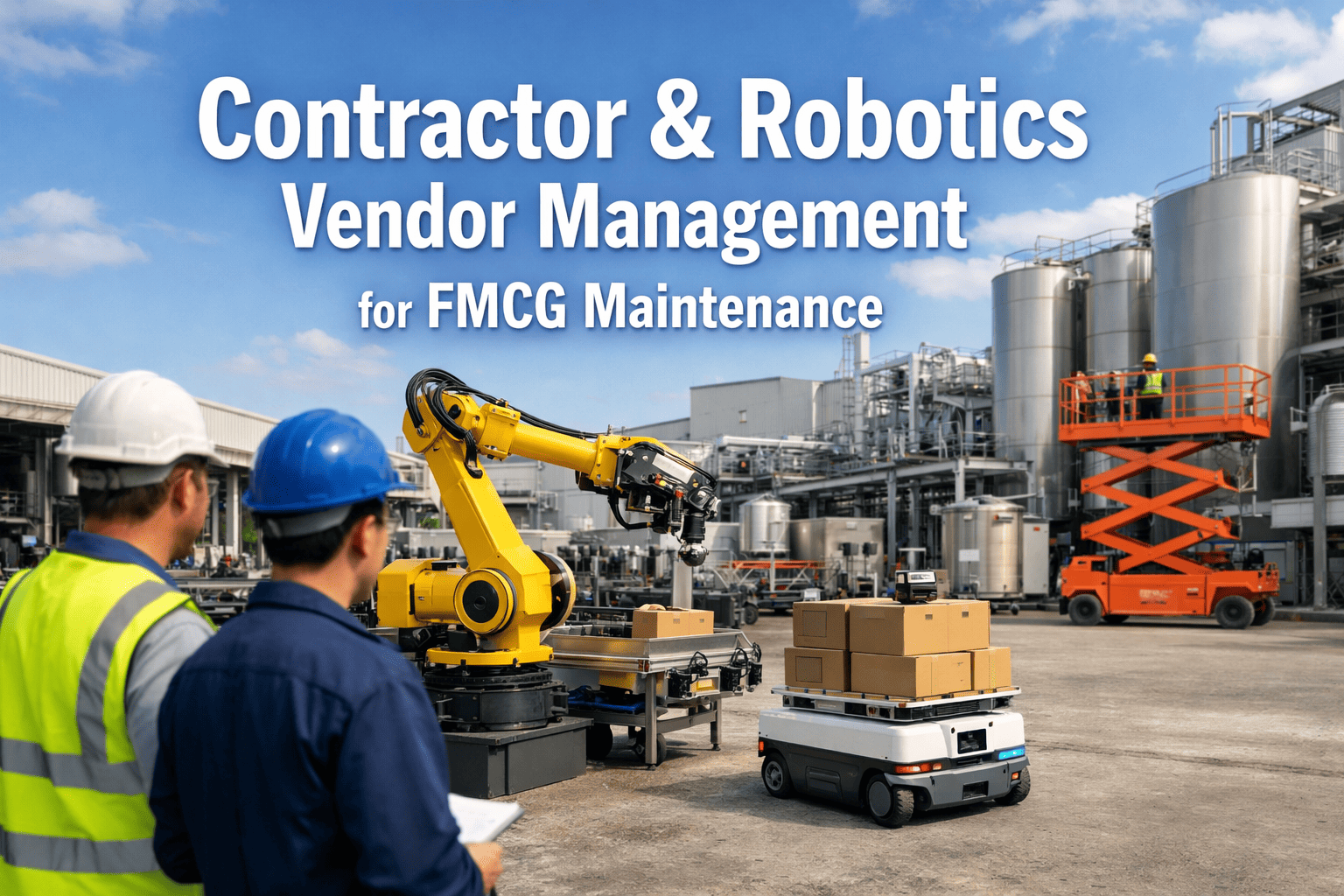
Contractor & Robotics Vendor Management for FMCG Maintenance
By Jacob on March 9, 2026
The average mid-size FMCG plant works with 30 to 50 maintenance contractors and vendors in a single operating year — robot OEM service engineers, conveyor belt specialists, refrigeration contractors, electrical compliance firms, CIP validation consultants, and packaging equipment service teams. Most plants manage this ecosystem through spreadsheets, email threads, and institutional memory. When a robot OEM sends an unqualified technician, when a contractor's insurance lapses mid-project, or when a vendor's service costs drift 40% above contract without anyone noticing, the failure mode is always the same: no system was in place to catch it. Oxmaint's vendor management module gives FMCG maintenance teams a single platform to qualify, track, score, and audit every contractor and robotics vendor they work with. Book a demo to see how it works for multi-vendor FMCG operations.
Oxmaint gives FMCG maintenance teams a single platform to qualify, track, score, and audit every contractor and robotics vendor — from robot OEMs to general site contractors.
Maintenance Contractors and Vendors Managed by a Typical Mid-Size FMCG Plant Per Year
23%
Of FMCG Maintenance Incidents Involve a Contractor or Third-Party Vendor
$340K
Average Annual Overspend on Unmanaged Contractor Costs in FMCG Facilities
61%
Of Plants Have No Formal Vendor Performance Scoring System in Place
Why Contractor Management Fails in FMCG Maintenance Environments
The vendor management problem in FMCG maintenance is structural, not accidental. Maintenance teams are built around the discipline of keeping equipment running — not around the administrative infrastructure of supplier qualification, contract management, and performance tracking. The result is a pattern that appears in plants across every FMCG category: a growing vendor roster managed through informal relationships, no documented qualification criteria, insurance and certification records scattered across inboxes, and no reliable way to tell which vendors are performing well and which are creating risk.
For robotics vendors specifically, the complexity compounds. A collaborative robot on a packaging line may involve the robot OEM for annual service, a systems integrator for software modifications, a vision system vendor for camera calibration, a gripper specialist for end-of-arm tooling, and an independent safety engineer for periodic risk assessment. Each of these parties has different qualification requirements, different documentation obligations, and different performance metrics — and their work is often interdependent in ways that make vendor isolation difficult. Book a demo to see how Oxmaint maps multi-vendor robotics service relationships into a single, trackable programme.
Six Root Causes of Contractor Management Failure in FMCG Plants
No Qualification Gateway
Root Cause
Contractors are onboarded on urgency rather than qualification. Insurance certificates, trade licences, safety inductions, and LOTO competency checks are never systematically verified before work begins.
Expired Documents Undetected
Root Cause
Insurance policies, electrical competency cards, food handler certificates, and robot safety certifications expire — and no system alerts the maintenance team. Vendors continue working on an expired compliance basis for months.
No Performance Visibility
Root Cause
Work orders are completed but never scored. First-time fix rates, rework frequency, on-time arrival, and post-service equipment reliability are never tracked — so high- and low-performing vendors look identical on paper.
Cost Drift Without Visibility
Root Cause
Vendor invoices are approved against individual work orders with no aggregation against annual budget or contract ceiling. Cost overruns accumulate across dozens of small purchase orders before anyone notices the total exposure.
Robot OEM Dependency
Root Cause
Robotics vendors hold the proprietary service knowledge for collaborative robots and automated systems — and exploit that dependency through premium emergency callout rates. Facilities with no OEM performance tracking have no leverage in rate negotiations.
No Audit Trail for Incidents
Root Cause
When a contractor-performed repair fails or triggers an equipment incident, there is no documented record of who was on site, what work was performed, and what qualifications they held at the time — critical information for insurance claims and regulatory investigations.
Oxmaint closes all six failure modes — qualification gateway, document expiry alerts, performance scoring, cost tracking, and full audit trail — in a single vendor management platform.
Vendor Qualification: Building a Compliant Contractor Gateway
A vendor qualification framework is the foundation of a managed contractor programme — and it is the step most FMCG plants skip. The consequence is not just compliance risk. An unqualified contractor who causes a line stoppage, a food safety incident, or a serious injury creates financial liability that almost always exceeds the cost of running a proper qualification process by an order of magnitude. The qualification framework must be tiered to vendor risk level — a robot OEM engineer working inside an automated cell has fundamentally different qualification requirements than a grounds maintenance contractor — and it must be enforced consistently, not selectively. Start your free trial to set up a qualification gateway for your full contractor register, or book a demo to see how Oxmaint automates document collection and expiry alerts.
Four-Tier Contractor Qualification Framework for FMCG Plants
Standard public liability — verified at contract award
Site visitor induction only — no production area access
Annual contract review — performance scored on cost and reliability
Review: At Contract Renewal
Robot OEM and Robotics Vendor Management: A Different Challenge
Managing robot OEM service relationships requires a different approach from general contractor management — because the power dynamic is different. When a packaging line cobot goes down at 2 AM, the OEM knows you have no alternative supplier for the proprietary software and spare parts that the robot requires. Emergency callout rates of $1,800–$3,500 per visit are standard across major robot OEM service agreements — and plants without documented service histories have no basis to challenge them.
The solution is not to reduce OEM dependency (which is largely unavoidable for complex robotic systems) but to build the documentation and performance data infrastructure that creates negotiating leverage and prevents the OEM from exploiting information asymmetry. A plant that can show an OEM 24 months of response time data, first-visit fix rates, and repeat-fault histories is in a fundamentally stronger position at annual service contract renewal than a plant that cannot. Book a demo to see how Oxmaint tracks robot OEM service performance against contract KPIs.
Robot OEM Service KPIs — Tracking Framework for FMCG Plants
Metrics to track for every robotics vendor service engagement — basis for annual contract renegotiation
Emergency Response Time
Contracted response time vs actual — tracked per callout across 12-month rolling period
Target: ≤4 hrs
First-Visit Fix Rate
Percentage of service visits that resolve the fault without a return visit within 30 days
Target: ≥85%
Parts Availability (Critical Spares)
Percentage of critical parts supplied within contracted lead time — stockouts tracked separately
Target: ≥95%
Planned PM Completion Rate
OEM-scheduled preventive maintenance completed on time vs scheduled date — deviation logged
Target: ≥98%
Repeat Fault Rate
Same fault recurring within 90 days of a service visit — indicates inadequate root cause resolution
Target: ≤5%
Invoice Accuracy
Invoiced amount vs contracted rate — unauthorised rate increases or billable hours discrepancies flagged
Target: 100%
Safety Compliance On-Site
LOTO adherence, PPE compliance, and permit-to-work completion rate — verified per visit
Target: 100%
Annual Cost vs Budget
Total annual OEM spend vs contracted annual budget — emergency callout frequency and cost tracked separately
Target: ≤105%
Plants that track robot OEM performance against contractual KPIs and present the data at annual renewal consistently achieve 18–32% cost reductions versus facilities that renegotiate without documented service history. The data eliminates the OEM's ability to justify premium rates for services that didn't meet contracted standards.
Track every robot OEM service visit, response time, fix rate, and invoice against contracted terms — then use the data at renewal to drive cost reductions of 18–32%.
Vendor Performance Scoring: Building a Supplier Scorecard
A vendor performance scorecard converts the qualitative judgment of "this contractor is reliable" into an objective, data-driven score that supports procurement decisions, contract renewals, and vendor rationalisation. In FMCG maintenance, where the same vendors are re-engaged repeatedly for specialist work, a scorecard system prevents the institutional knowledge problem — where the only person who knows which vendors perform well is the maintenance manager who has been in the role for eight years. Start your free trial to activate vendor scorecards for your contractor register, or book a demo to see how scoring integrates with work order completion in Oxmaint.
FMCG Maintenance Vendor Performance Scorecard — Five Categories
20%
Technical Quality
First-time fix rate on reactive work orders
Repeat fault rate within 90 days of service
Equipment uptime in 30 days post-service
Work quality score from maintenance supervisor
Weight: 20 points / 100
25%
Responsiveness
Emergency response time vs contracted SLA
Planned visit arrival time — on-time rate
Quote turnaround time for reactive work
Communication quality during active jobs
Weight: 25 points / 100
25%
Safety and Compliance
LOTO and permit-to-work compliance rate
PPE adherence on every site visit
Zero safety near-miss or incident record
All certifications current — no expiry gaps
Weight: 25 points / 100
30%
Cost and Value
Invoice accuracy vs contracted rates
Annual spend vs contracted budget ceiling
Value engineering suggestions implemented
Cost per completed work order vs benchmark
Weight: 30 points / 100
Contractor Compliance Tracking: What FMCG Plants Must Document
Contractor compliance documentation is not a nice-to-have in FMCG manufacturing — it is a direct requirement under health and safety legislation, GFSI food safety schemes, and the insurance policies that cover the facility. When an auditor from a retail customer's supplier assurance team visits, they will ask for evidence that every contractor on site is qualified, insured, and inducted. When an insurance claim follows a contractor-related incident, the underwriter will ask for the same. Book a demo to see how Oxmaint stores, tracks, and auto-alerts on every contractor compliance document in your register.
Contractor's own H&S policy — current revision, signed by director, relevant to scope of work performed on site
Alert: At renewal
Method Statement / Risk Assessment
Task-specific RAMS — required before any non-routine work commences, reviewed and accepted by maintenance manager
Per job type
Robot / Cobot Service Authorisation
OEM-issued authorisation for technician to service specific robot model — ISO 10218 compliance basis
Alert: 90 days prior
GDPR / Data Processing Agreement
Required where contractor has access to plant CMMS, process data, or quality systems containing personal data
At contract start
Plants managing a 30-vendor register without automated expiry tracking average 14 missed compliance document renewals per year — each one representing a period of uninsured or uncertified contractor activity on site that creates unquantified liability exposure.
Cost Management: Getting Control of Contractor Spend
Contractor and vendor costs represent 22–38% of total maintenance expenditure in FMCG facilities — and it is consistently the least-managed component of the maintenance budget. Direct labour costs are tracked meticulously; contractor spend is often aggregated as a single line in the accounts payable system with no breakdown by vendor, work type, equipment, or production line. The consequence is a maintenance budget that looks controlled at the summary level while individual vendor relationships quietly inflate year-on-year.
The three controllable cost drivers in FMCG contractor management are emergency callout frequency (which rises when planned maintenance is deferred), invoice verification (which fails when contracted rates are not documented in the work management system), and vendor proliferation (where too many vendors serving the same function prevents volume leverage at renewal). Start your free trial to bring contractor costs under management, or book a demo to see how Oxmaint links every vendor invoice back to a work order, contracted rate, and budget line.
Annual ROI of a Structured Vendor Management Programme
FMCG plant — 30–50 active contractors and vendors — packaging, filling, and robotic systems
Robot OEM Cost Reduction
18–32% reduction in annual OEM spend through performance-data-backed contract renegotiation — avg $420K annual OEM spend
$95,000
Emergency Callout Reduction
40% reduction in unplanned emergency callouts through better PM scheduling and vendor response SLA enforcement
$68,000
Invoice Overcharge Recovery
Average 4.8% invoice discrepancy rate across unmanaged contractor roster — recovered through systematic rate verification
$42,000
Compliance Incident Avoidance
Elimination of uninsured contractor events — average $85K exposure per incident before insurance recovery
$85,000
Vendor Rationalisation Savings
Consolidating 50-vendor roster to 30 preferred suppliers — volume leverage driving 8–12% rate improvement across remaining vendors
$52,000
Platform Investment
Vendor management module, implementation, and annual licence — all sites included
$28K–$55K/yr
Net Annual Value of Structured Vendor Management Programme
$342K+ 6–12x ROI
The financial case for structured vendor management is conservative — it does not include the unquantifiable value of avoided liability events, regulatory investigations, or the reputational cost of a contractor-caused food safety incident. For FMCG plants where contractor relationships directly affect line availability and food safety compliance, the programme cost is negligible against the risk exposure it eliminates.
Ready to bring your 30–50 contractor relationships under managed control? Oxmaint gives you qualification, compliance tracking, performance scoring, and cost management in one platform.
What documents must FMCG plants collect from maintenance contractors before allowing site access?
At minimum, plants should collect current public liability and employer's liability insurance certificates, a signed site induction record, a valid health and safety policy, and task-specific method statements and risk assessments before any non-routine work commences. For specialist and critical systems vendors — including robot OEMs and electrical contractors — trade competency certificates, OEM service authorisations, and ISO 10218 robot safety qualifications are additionally required. Book a demo to see how Oxmaint manages the full document register with expiry alerts and digital storage.
How should FMCG plants manage robot OEM service contracts to avoid cost overruns?
The most effective approach is to track OEM service performance against contractual KPIs — response time, first-visit fix rate, parts availability, and invoice accuracy — throughout the contract period and use the accumulated data at annual renewal. Plants that cannot demonstrate OEM underperformance against contracted standards have no basis to resist rate increases. Building a 12–24 month service history in a CMMS creates the negotiating foundation that consistently delivers 18–32% cost reductions at renewal. Start your free trial to begin tracking OEM performance from your next service visit.
What is vendor rationalisation and how does it reduce maintenance costs in FMCG plants?
Vendor rationalisation is the process of reducing a large, unmanaged contractor roster to a smaller preferred supplier list — typically by scoring all active vendors on performance and compliance and consolidating similar service categories under fewer, higher-performing relationships. The cost benefit comes from volume leverage: fewer vendors doing more work per relationship can negotiate better annual rates in exchange for volume commitment. FMCG plants that rationalise from 50 to 30 vendors typically achieve 8–12% rate improvements across the retained roster.
How does a CMMS improve contractor management in FMCG facilities?
A CMMS connects contractor activity directly to the work order system — so every vendor visit generates a record tied to the specific asset, with the contracted rate, the technician's qualifications, and the work outcome all documented in one place. This creates the performance data that vendor scorecards require, the compliance audit trail that food safety and insurance audits demand, and the cost visibility that prevents invoice overcharges from accumulating undetected. Book a demo to see how Oxmaint's vendor management module works alongside the full work order system.
What is the difference between T1 and T4 vendor qualification requirements?
Tier 1 vendors — robot OEMs, HV electrical contractors, CIP validation engineers — work on safety-critical or food-safety-critical systems and require the highest qualification standard: £5M+ public liability, specialist competency certifications, site-specific LOTO induction, and annual performance review. Tier 4 vendors — grounds maintenance, waste removal, non-contact facility services — pose minimal safety or food safety risk and require only standard public liability insurance and a site visitor induction. The tier system ensures qualification overhead is proportional to risk rather than applied uniformly across all 30–50 vendors on the register.
How often should FMCG plants conduct formal vendor performance reviews?
Tier 1 and Tier 2 vendors — those working on critical and specialist systems including robotics — should be formally reviewed annually, with a mid-year check-in if KPI data shows performance trending below target. Tier 3 and Tier 4 vendors are reviewed at contract renewal, which is typically biennial. Any vendor involved in a safety incident, a quality failure, or a significant service delay should be reviewed immediately regardless of tier — and the review outcome logged in the vendor's compliance record. Start your free trial to set up automated vendor review scheduling across your full contractor register.
Vendor Management for FMCG Maintenance Teams
30–50 Contractors. One Platform. Zero Compliance Gaps.
Oxmaint manages the complete contractor lifecycle — qualification gateway, document expiry alerts, performance scoring, work order linkage, cost tracking, and audit-ready compliance records. Built for FMCG plants managing robot OEMs, specialist maintenance vendors, and general contractors from a single maintenance platform.
Four-Tier Vendor Qualification Gateway with Document Storage
Automated Insurance and Certification Expiry Alerts
Robot OEM Performance Tracking Against Contract KPIs
Vendor Scorecard — Technical, Safety, Cost, and Responsiveness
Invoice Verification Against Contracted Rates Per Work Order
Full Audit Trail for Contractor Site Access and Work Performed