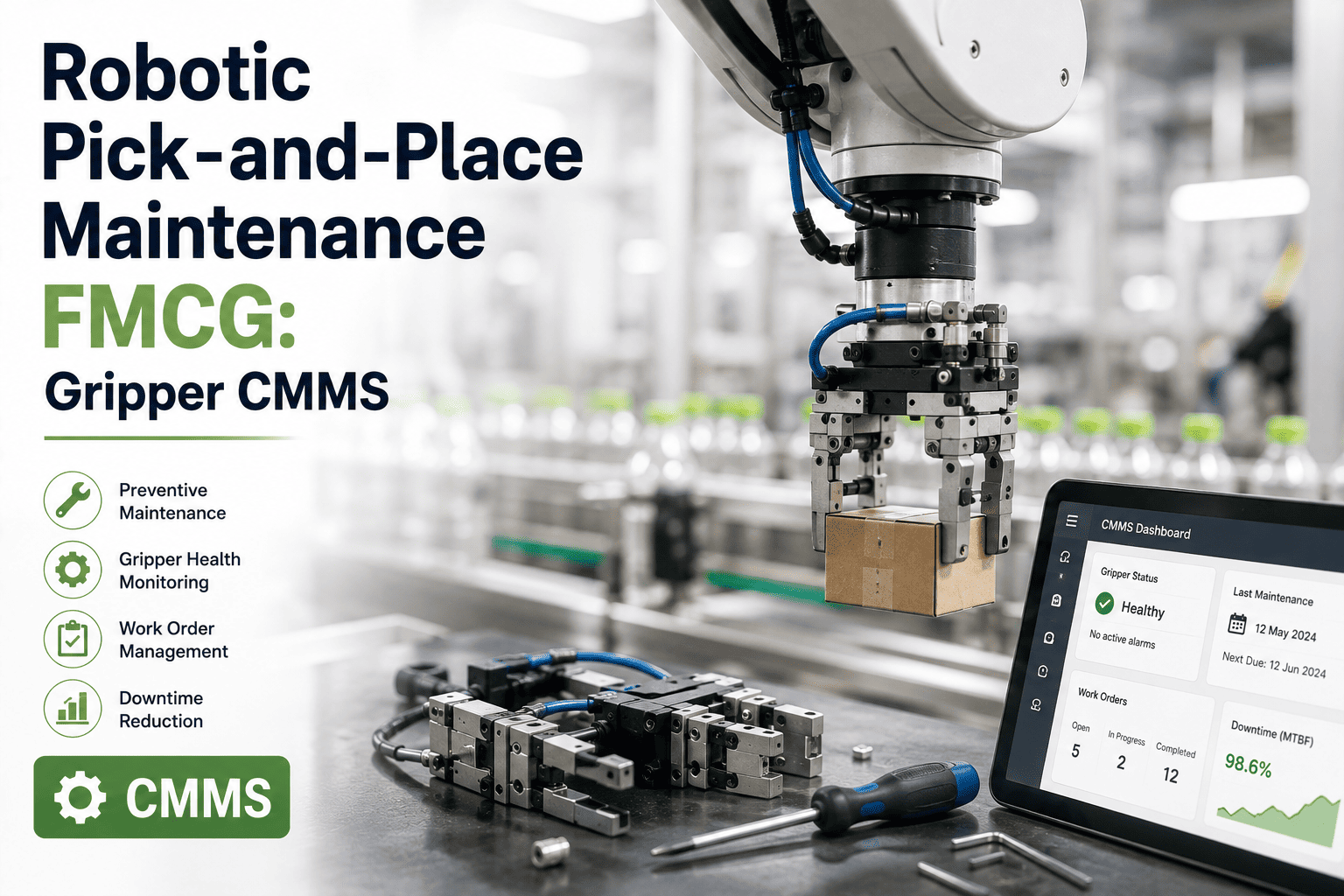
Robotic pick-and-place cells are the silent workhorses of FMCG packaging lines, cycling 60–120 times per minute under relentless shift pressure — and when a gripper drifts just 0.3 mm out of spec, the consequences rarely trigger an alarm. Misses, micro-drops, pouch creasing and cap-seat damage creep up as vacuum cups flatten, pneumatic fingers stiffen, and tool-center-point calibration quietly slips on axis 4 through 6. A properly configured CMMS closes that gap by scheduling gripper PM, vacuum system service, joint lubrication and axis recalibration against actual cycle counts rather than calendar guesses. This guide lays out the maintenance architecture that keeps high-speed FMCG robots above 98% OEE — and you can Start Free Trial to deploy it on your own line this week.
Is a worn gripper quietly costing you 2.4% of every shift's throughput?
On a 120-ppm FMCG line, a single drifted suction cup or fatigued parallel jaw can leak 180–260 dropped units per hour — invisible to the Andon board, painfully visible in the weekly waste report. CMMS-driven gripper PM closes that leak before finance notices it.
A 6-axis pick-and-place running 120 cycles/min × 16 hrs × 300 days, losing 1.8% to gripper drift, at $0.42 per dropped pouch — before counting rework, line stoppages and customer-claim exposure.
Gripper degradation hides inside your OEE numbers
Pick-and-place robots don't fail dramatically. They degrade on a curve — vacuum cup lips flatten, fingertip pads polish smooth, pneumatic jaw cylinders lose 5–15% of rated force, and TCP on axes 4–6 drifts 0.1–0.5 mm per 500,000 cycles. The line keeps running; the defect rate climbs.
A Midwest snack foods plant ran two delta robots at 110 ppm on a 16-hour shift. Gripper PM was calendar-based (quarterly). After 11 months, weekly waste reports showed a 2.1% pick-loss rate. Root cause: three of eight vacuum cups had crossed the 2M-cycle mark with no replacement, and TCP on cell A had drifted 0.42 mm. Moving to cycle-count triggers inside their CMMS cut drop rate to 0.6% within three weeks — recovering roughly $26K per month per line.
Gripper & vacuum PM checklist — by frequency tier
Maintenance intervals for FMCG robotic pick-and-place should be governed by cycle count, not calendar. Below is the tiered PM structure deployed through a CMMS, mapped to the four failure zones: gripper mechanism, vacuum system, motion axes and cabling.
Shift-Start Gripper Check
- Visually inspect suction cups for folds, cracks, product residue
- Confirm jaw gap setting matches product family spec sheet
- Run 10-cycle test pick at line speed; verify zero drops
- Check vacuum gauge reading within ±5 kPa of baseline
- Listen for hissing at fittings, filter regulator, ejector stack
Vacuum & Pneumatic Service
- Replace vacuum filter element; log pressure drop before/after
- Clean ejector nozzles; verify flow rate against nameplate
- Inspect gripper finger pads for polish, glazing, embedded debris
- Check pneumatic fitting torque on jaw cylinder supply lines
- Calibrate vacuum sensor against reference gauge; record drift
Axis Calibration & Vision
- Run TCP calibration routine on axes 4–6; tolerance ≤0.1 mm
- Re-master zero position on delta / SCARA base frame
- Clean and re-baseline vision camera lens and backlight panel
- Verify conveyor tracking encoder alignment ±0.5 mm
- Lubricate RV / harmonic reducer per OEM cycle spec
Cable Fatigue & Overhaul
- Inspect dress pack, energy chain, flex cable for jacket wear
- Measure motor encoder cable continuity and shield resistance
- Swap out high-cycle suction cups before failure threshold
- Recalibrate torque sensors on collaborative jaw grippers
- Full backup of robot controller, CMMS logs trend analysis
Where pick-and-place robots actually break down
Across 180+ FMCG robotic cell audits, four failure zones account for over 90% of unplanned downtime events. The table below ranks them by frequency, typical MTBF impact, and the CMMS trigger that catches each early.
| Failure Zone | Share of Downtime | Typical MTBF Impact | Early-Warn CMMS Trigger | PM Cost / Event |
|---|---|---|---|---|
| Vacuum cup wear | 31% | 4–8 hrs unplanned | Cycle-count swap at 1.8M | $28 |
| Gripper jaw fatigue | 22% | 3–6 hrs unplanned | Force sensor drift >8% | $95 |
| Axis 4–6 TCP drift | 19% | 2–5 hrs recalibration | Monthly re-master <0.1mm | $0 in-house |
| Flex cable fatigue | 14% | 6–12 hrs replacement | Dress-pack visual + ohm | $180 |
| Vision misalignment | 8% | 1–3 hrs re-baseline | Lens clean + re-grid weekly | $0 in-house |
The pattern is clear: four-fifths of FMCG robot downtime comes from components that cost under $200 to service proactively. The cost is never the part — it is the absence of a trigger.
Calculating the cost of gripper drift on your line
Most FMCG plants cannot quantify what a drifting gripper costs them because the loss is buried inside OEE availability and quality buckets. The formula below isolates it — and gives you the number to put on the CMMS business case.
Where PPM = picks per minute, Minutes = productive minutes per shift, Drift% = pick-loss rate attributable to gripper condition, UnitValue = full cost of one dropped or damaged unit including rework and claim exposure.
Turn cycle counts into maintenance triggers, not hindsight
Deploy Oxmaint's robotic PM templates — pre-built for delta, SCARA, 6-axis and cobot pick-and-place cells running on FMCG lines.
Configuring a pick-and-place CMMS in four layers
A CMMS that actually protects gripper health needs four configuration layers working together — asset hierarchy, trigger logic, work-order routing and analytics. Skip any one and you are back to calendar-based guessing.
Asset Hierarchy
Model each robot as parent asset with gripper assembly, vacuum generator, vision head and dress pack as child assets — each carrying its own cycle counter, PM spec and spare-part BOM.
Trigger Logic
Bind PM work orders to cycle-count milestones read from the robot controller via OPC-UA or MQTT — not calendar dates. Set escalation thresholds for drift, force loss and TCP deviation.
Work-Order Routing
Auto-route daily checks to operators, weekly vacuum service to mechanics, and quarterly calibration to robotics technicians — with checklists, photos and torque values enforced per line.
Analytics & Forecast
Trend force-sensor drift, vacuum decay and TCP deviation across weeks. Forecast cup replacement dates 14 days out so spares land before the cell crosses the failure threshold.
"We replaced calendar-based gripper PM with cycle-count triggers in our CMMS and cut unplanned robot downtime by 64% in one quarter. The cups were never the problem — the trigger was."
— Reliability Lead, Tier-1 FMCG confectionery plant, 14 robotic cellsFMCG robotic pick-and-place maintenance, answered
How often should vacuum suction cups be replaced on an FMCG pick-and-place robot?
For multi-bellows cups running at 100–120 ppm on a 16-hour shift, the practical replacement threshold is 1.8–2.2 million cycles — typically 4–6 weeks. Cup lip flattening and micro-cracking begin earlier but don't meaningfully affect pick rate until ~1.6M. Set the CMMS to flag cups at 1.5M for visual inspection and auto-generate a swap work order at 1.8M so spares arrive before failure.
What's the difference between calendar-based and cycle-count-based gripper PM?
Calendar PM assumes every shift wears the gripper equally — which is false on FMCG lines with seasonal volume swings and product changeovers. Cycle-count PM ties the work order to actual wear, read from the robot controller via OPC-UA. A cup that runs 90 ppm for two weeks is not in the same condition as one that ran 120 ppm for the same fortnight. You can see both configurations in action when you Book a Demo with our engineering team.
How do I calibrate TCP on axes 4–6 without taking the cell offline for hours?
Use the four-point TCP re-mastering routine built into the robot controller (ABB, FANUC, KUKA and Yaskawa all support it). With a calibrated pointer and reference cone, the routine takes 8–14 minutes per cell and brings TCP back within 0.05–0.08 mm. Schedule it monthly or every 1 million cycles — whichever comes first — and log the before/after deviation in the CMMS so drift trends become visible.
Can a CMMS integrate with our existing robot controllers and vision system?
Yes — modern CMMS platforms like Oxmaint connect to robot controllers via OPC-UA or MQTT for cycle counts, motor torque, encoder errors and TCP status. Vision system defect-rate data can be ingested via REST API so that a rising reject rate on a specific SKU automatically triggers a gripper inspection. Deployment typically takes 2–4 weeks for a 6–12 cell line; you can pilot it free for 14 days at app.oxmaint.ai.
What KPIs should we track for robotic pick-and-place reliability?
Track five: pick success rate (target ≥99.4%), gripper-related unplanned downtime hours per month (target <2 hrs/cell), mean cycles between cup replacement, TCP drift trend in mm per million cycles, and vacuum decay rate per shift. These five together give you a leading-indicator view of gripper health weeks before the defect rate climbs into the weekly waste report.
Stop budgeting for gripper drift you can prevent
Pre-built FMCG robotic PM templates · cycle-count triggers · OPC-UA integration · 14-day free trial · No credit card required.
Free 14-day trial · No credit card