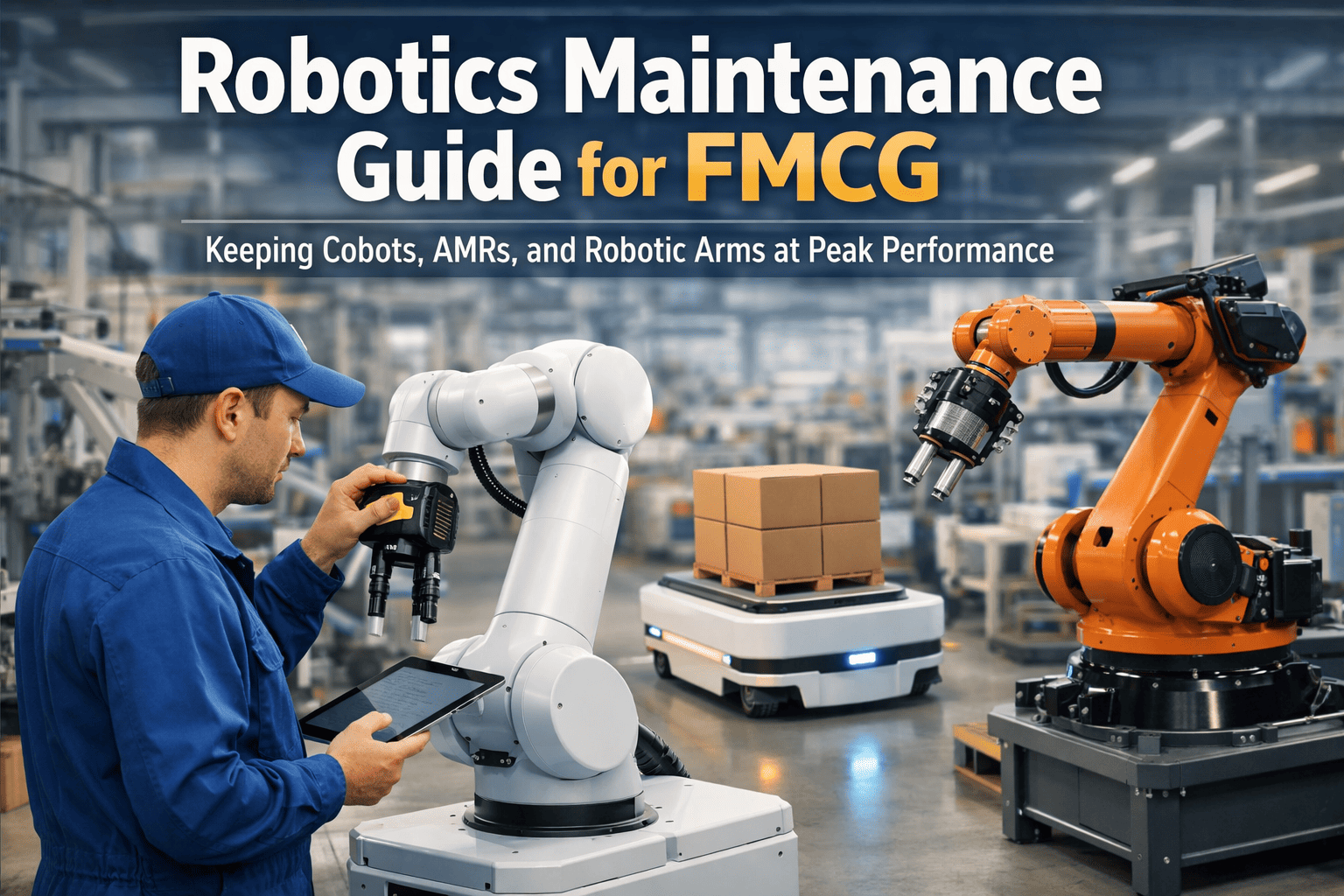
Robotics Maintenance Guide for FMCG: Keeping Cobots, AMRs, and Robotic Arms at Peak Performance
By Jean samson on March 17, 2026
A beverage plant in Bengaluru deployed six collaborative robots on its packaging line and an AMR fleet for pallet transport. Within 14 months, two cobots were offline simultaneously — one with a failed joint encoder that had been showing drift warnings in the controller log for six weeks, and one with a seized harmonic drive gearbox that a standard PM programme would have caught at the 4,000-hour service interval. The AMR fleet averaged 2.3 navigation errors per shift from LiDAR lenses clouded by condensation that nobody had scheduled to clean. Total production impact: 340 lost line-hours over the quarter. None of these failures were unpreventable. All of them were the result of a maintenance programme built for conventional equipment that was never updated to address the specific failure modes, service intervals, and calibration requirements of robotic systems. Start your free trial to track robotics maintenance in OxMaint. Book a demo to see OxMaint's Robotics & Cobot Maintenance Tracking module configured for FMCG robotic fleets.
Robotics & Cobot Maintenance Tracking
Robot Downtime Costs 3–8× More Than Conventional Equipment Downtime. Prevent It.
OxMaint tracks robot PM schedules, joint hour counters, calibration intervals, error log reviews, and fleet health dashboards — giving FMCG maintenance teams the visibility to prevent robotic system failures before they stop production lines that depend on 100% robot availability.
average cost of an unplanned robotic arm failure in FMCG including repair, parts, and production line stoppage
73%
of FMCG robot failures are preventable with a structured PM programme and controller log monitoring
4,000 hrs
standard first major service interval for most 6-axis collaborative robots — missed by 60% of FMCG plants
Why Robotic Systems Fail Differently — and Why Standard FMCG Maintenance Programmes Miss It
Conventional FMCG equipment fails in ways that a general maintenance technician can diagnose: a motor trips, a conveyor belt wears, a pump cavitates. Robotic systems fail through mechanisms that are invisible without specialist knowledge — harmonic drive gear wear that produces micron-level backlash changes before mechanical failure, encoder drift that accumulates over months until positioning accuracy falls below process tolerance, or battery management system degradation in AMRs that produces increasingly erratic performance before a full charge failure. A maintenance programme that treats a cobot like a conveyor will miss every one of these failure modes until they become production stoppages.
Top Failure Modes — FMCG Robotic Systems by Type and Frequency
The Three Robot Types in FMCG — and What Each Requires from Maintenance
FMCG plants typically deploy three distinct robotic system types, each with fundamentally different maintenance requirements, failure modes, and service interval structures. A unified robotics maintenance programme must address all three types — with type-specific PM tasks, calibration procedures, and health monitoring protocols — rather than applying a single generic robot maintenance checklist across the entire fleet.
Primary failure modes: Harmonic drive backlash accumulation in joints 1–3 (highest load), encoder calibration drift causing TCP (Tool Centre Point) accuracy loss, teach pendant battery failure, safety circuit degradation from repeated E-stop events, end-of-arm tooling wear from cycle count. Typical MTBF: 35,000–50,000 hours with proper maintenance; 8,000–15,000 hours without.
PM requirements: Joint grease replenishment per OEM interval (typically 6,000–12,000 hrs). TCP calibration check monthly or every 500 production hours. Controller log review weekly — error codes are the leading indicator of impending joint or encoder failure. Cable harness inspection every 6 months. Safety circuit functional test monthly.
Type 02
AMR
Autonomous Mobile Robots — MiR, Locus, 6 River Systems
Primary failure modes: LiDAR lens contamination causing navigation errors and false obstacle detection, battery capacity fade reducing shift range (typically 15–20% capacity loss per year without proper charge management), wheel encoder drift causing position errors in long corridors, bump sensor contamination causing spurious stops, map degradation as physical environment changes without map updates.
PM requirements: LiDAR and camera lens cleaning weekly (critical in dusty or high-humidity FMCG environments). Battery capacity test monthly — replace when capacity falls below 80% of rated. Wheel and drive system inspection monthly. Safety bump sensor function test weekly. Map accuracy verification monthly — update when facility layout changes. Charging station contact cleaning weekly.
Type 03
Fixed Arm
Fixed Industrial Robotic Arms — FANUC, KUKA, ABB IRB Series
Primary failure modes: Reducer (RV or harmonic) wear in high-load axes causing backlash and positioning error, servo motor brake degradation causing axis drift on power-off, cooling system blockage causing thermal derating, teach pendant and controller battery failure causing program loss, cable tray wear causing intermittent faults difficult to diagnose.
PM requirements: Reducer grease replacement per OEM schedule (typically 3,500–5,000 hrs). Axis brake test monthly — verify each axis holds position when servo disabled. Controller backup weekly — program and calibration data must be backed up before any maintenance event. Cooling filter cleaning monthly. TCP calibration check every 250 production hours on high-precision applications. Annual full calibration with mastering verification.
The Robotics PM Schedule — Interval-Based Tasks by System Component
Robot manufacturer service intervals are defined in operating hours — not calendar time — because robot component wear is driven by cycle count and load, not by how many weeks have passed. A CMMS tracking robot maintenance must capture operating hours from the robot controller and trigger PM tasks based on hour thresholds, not calendar dates. A cobot running two shifts per day accumulates service hours at twice the rate of a single-shift robot — calendar-based PM will either over-service or under-service depending on utilisation, creating unnecessary cost or missed service intervals respectively.
Component
Robot Type
PM Task
Interval
Failure If Missed
CMMS Trigger
Joint / Axis Grease
6-axis arm, cobot
Replenish per OEM spec — correct grease type and quantity critical
Function test all safety inputs — E-stop, safety scanner zones, interlocks
Monthly
Safety system degradation — regulatory and liability exposure
Monthly calendar trigger
EOAT Wear Check
All arm types
Inspect gripper fingers, suction cup condition, force sensor calibration
Weekly / 1,000 cycles
Product drop, damage, pick failure rate increase
Cycle counter + weekly visual
Hour-Based PM Triggers
Robot Service Intervals Are in Hours, Not Months. Your CMMS Must Track Both.
OxMaint captures operating hour data from robot controllers via API integration or manual entry, triggers PM work orders at OEM-specified hour thresholds, and tracks both calendar and hour-based maintenance intervals simultaneously — so joint grease replenishment happens at 6,000 hours whether the robot reaches that threshold in 8 months or 18.
Controller Log Monitoring — The Predictive Maintenance Tool Built Into Every Robot
Every industrial robot and cobot ships with a controller that logs every fault, warning, error, and operational anomaly with a timestamp and error code. This log is the most powerful predictive maintenance tool available for robotic systems — and the most consistently ignored. In the Bengaluru plant failure described at the opening, the encoder drift warning that preceded the joint failure by six weeks was sitting in the controller error log the entire time. No process existed to review it. In a properly structured robotics maintenance programme, controller log review is a weekly task that takes 10–15 minutes per robot and catches 60–70% of impending failures before they cause production stoppages.
Weekly Controller Log Review Checklist — Per Robot
Are there any new joint error codes or axis fault codes since the last review?
Retrieve error log from controller interface or pendant. Filter for new entries since previous week's review. Joint-specific error codes (J1–J6 on 6-axis arms) indicate which axis is affected. A single occurrence of a joint error may be noise — three or more occurrences of the same error code within 7 days on the same joint is a definitive leading indicator of mechanical or encoder degradation. Create a monitoring work order in the CMMS and increase review frequency to daily.
Has the robot's position accuracy degraded — are there increased pick-and-place miss events in the production log?
Compare production system miss/reject events to robot position error codes in the controller log. Increasing miss rate without any corresponding error code suggests TCP drift from tooling wear or vibration-induced calibration shift. Increasing miss rate with simultaneous position accuracy warnings in the controller log indicates encoder or joint mechanical degradation. Each scenario requires a different corrective response — TCP recalibration vs joint service — and the controller log is the diagnostic tool that distinguishes them.
Are there any thermal warnings or cooling system fault codes?
Controller thermal warnings (joint motor over-temperature, controller cabinet over-temperature) indicate cooling system degradation or operating environment changes. Joint motor thermal warnings on specific axes indicate increased friction — often the first sign of inadequate lubrication or early bearing failure before any mechanical symptom is audible or visible. Thermal warnings that are acknowledged and reset without investigation are a documented path to thermal derating and eventual motor failure.
For AMRs: are there navigation error codes, obstacle detection events, or battery management warnings?
AMR fleet management software logs navigation errors (failed path planning, obstacle detection, localisation loss) with timestamps and coordinates. A cluster of navigation errors at a specific location in the facility indicates either a sensor calibration issue on the robot or an environmental change (new rack, different lighting) that requires map update. Battery management system warnings (cell imbalance, reduced capacity detection) that appear more than twice in a 7-day period indicate a battery pack approaching replacement threshold — do not wait for a mid-shift failure.
Has the robot's cycle time increased — are there velocity reduction events in the log?
Robot controllers automatically reduce joint velocity when load monitoring detects anomalous current draw — a protective response to mechanical stress. This shows up as velocity reduction events in the controller log and as slightly increased cycle times in the production system. Velocity reductions on specific joints without any load change in the process indicate mechanical resistance increasing in that joint — almost always a lubrication deficiency or early harmonic drive wear. Catching this early makes the difference between a planned joint service and an emergency replacement.
TCP Calibration — The Most Critical Robot Accuracy Maintenance Task
Tool Centre Point calibration defines the exact position and orientation of the robot's working point relative to its base coordinate system. Every pick, place, weld, or inspection operation the robot performs is referenced to this calibration. TCP drift — caused by tooling impacts, thermal expansion, vibration, or joint wear — is invisible until it causes a process quality problem or a production miss event. Regular TCP verification and recalibration is the single maintenance task with the highest direct impact on production quality in robotic FMCG applications.
When to Check
Monthly Verification Schedule
TCP accuracy should be verified monthly on all production robots and after any event that could cause drift: tooling impact, robot collision, end-of-arm tooling replacement, significant temperature change in the installation area, or any maintenance event that requires robot repowering. In high-precision applications (vision-guided pick-and-place, assembly, dispensing), verify TCP weekly.
How to Check
4-Point Calibration Method
The standard 4-point TCP verification uses a fixed calibration point (pin, sphere, or dedicated fixture) mounted in the robot's reach. The robot approaches the point from four different orientations — if TCP is accurate, the tool tip converges on the same point from all four approaches. Maximum allowable deviation: ±0.5 mm for most FMCG pick-and-place applications, ±0.1 mm for precision dispensing. Document deviation measurement in CMMS work order.
Tolerance Limits
Pass / Fail Thresholds by Application
Pick-and-place (packaging): ±1.0 mm acceptable, ±2.0 mm recalibrate immediately. Precision dispensing (glue, sauce, filling): ±0.3 mm acceptable, ±0.5 mm recalibrate. Vision-guided applications: ±0.5 mm acceptable (camera can compensate for some drift). Welding or sealing: ±0.2 mm acceptable. Any deviation exceeding the recalibration threshold requires TCP reset before next production run — not at next scheduled maintenance.
Root Cause
What Drift Tells You
TCP drift within normal tolerance between monthly checks: normal tooling micro-wear — recalibrate and monitor. TCP drift exceeding recalibration threshold within 2 weeks of previous calibration: indicates either tooling damage, impact event, or progressive joint wear. TCP drift that recurs within days of recalibration: indicates a mechanical root cause (joint backlash, loose tooling mounting) that recalibration alone cannot address — requires joint inspection.
AMR Fleet Maintenance — The Unique Requirements of Mobile Robots
AMR maintenance differs from fixed robot maintenance in two critical ways: the robot moves through the entire production environment (exposing every sensor and mechanical component to every environmental condition in the facility), and the robot's performance is inseparable from the accuracy of its facility map and the cleanliness of its navigation sensors. AMR maintenance is half mechanical, half informational — and neglecting the informational half (map management, sensor calibration, fleet software updates) produces as many failures as neglecting the mechanical half.
AMR Fleet Maintenance — Four Systems That Require Dedicated Attention
Battery Management and Charging Infrastructure
Monthly capacity test — replace at <80% rated capacity
AMR batteries are lithium-ion and degrade with cycle count, depth of discharge, and charging temperature. FMCG plants running 2–3 shift operations accumulate 3–5 charge cycles per day — reaching 80% capacity in 18–24 months. A battery health dashboard in the fleet management software shows capacity trend per unit. Charging station contacts must be cleaned weekly — oxidised contacts reduce charging efficiency and accelerate battery degradation. Never allow AMR batteries to discharge below 10% — deep discharge irreversibly reduces capacity.
LiDAR and Vision Sensor Maintenance
Weekly cleaning — contamination causes 16% of all AMR failures
LiDAR sensors emit and receive laser pulses — any coating on the lens (dust, product splash, condensation film) attenuates the return signal and reduces effective range. In food and beverage facilities, fine airborne particulates, steam, and cleaning chemical mist are constant contamination sources. Clean with lint-free cloth and appropriate optical-grade solvent — never compressed air directly on lens. Vision cameras for navigation require the same cleaning protocol plus periodic focus verification (quarterly). Document cleaning in CMMS — lens contamination is the #1 cause of AMR navigation failures in FMCG environments.
AMR navigation maps must reflect the actual facility layout to within centimetres for reliable operation. Map degradation occurs when physical changes (new racking, relocated machinery, changed charging station positions, new safety barriers) are not reflected in the map. Assign a named responsible person to notify the AMR programme manager of any facility layout change. Run a map accuracy verification route monthly — an AMR that completes its standard routes without navigation errors and arrives at chargers within ±50 cm of expected position has adequate map accuracy. Any consistent position error at a specific location requires localised map update.
AMR wheels accumulate debris (shrink wrap, labels, tape) that causes uneven drive and position encoder errors. Inspect and clean all wheels and drive rollers weekly. Check wheel wear quarterly — a wheel worn beyond the OEM tolerance causes steering errors and accelerates wheel encoder degradation. Bump sensor surfaces must be clean and free of dents or damage — even a small dent changes the sensor's response characteristic and causes false obstacle detections. Drive motor current trending (from fleet software) identifies increasing mechanical resistance before motor failure.
The ROI of Structured Robotics Maintenance
Unplanned failure prevention (fleet of 6)
$168K/yr
Extended robot service life (30%)
$104K/yr
Reduced emergency repair costs
$74K/yr
OEE improvement from availability gain
$50K/yr
Warranty compliance (voids without PM records)
$30K/yr
Annual robotics maintenance programme cost$18K/yr
Annual value protected + risk prevented$426K+
24x ROI — Plus Warranty Protection That Most Plants Unknowingly Void
The warranty compliance figure deserves emphasis. Every major robot manufacturer — Universal Robots, FANUC, KUKA, ABB, MiR — includes a maintenance compliance requirement in their warranty terms. Specifically: joint lubrication at specified intervals must be documented, and controller software must be updated within defined release windows. A robot that experiences a harmonic drive failure outside of warranty because maintenance records cannot demonstrate the grease replenishment was performed at the required interval is a $15,000–$45,000 repair that would have been a warranty claim with proper documentation.
Catalogue every robot and AMR in the facility — manufacturer, model, serial number, installation date, current operating hours from controller, last service date, and next service due per OEM schedule. Pull controller error logs for each unit — document all active and recurring error codes. Assess current TCP accuracy for all arm-type robots. Check AMR battery capacity and map accuracy status. This census typically reveals 3–8 overdue service items per robot on a fleet with no structured programme.
Week 3
Catch Up Critical Overdue Services and Configure CMMS
Perform any overdue joint lubrication, TCP calibrations, and battery replacements identified in the census. Enter every robot and AMR as a CMMS asset with operating hour counter. Configure PM schedules with both calendar and hour-based triggers per OEM requirements. Set up weekly controller log review tasks per robot. Configure warranty compliance documentation — ensure grease type, quantity, and application date are captured on every joint service work order.
Week 4–5
First Full PM Cycle and Technician Training
Execute first complete PM cycle on all robots under the new programme. Train maintenance technicians on controller log interpretation — common error codes, what they indicate, and which require immediate action vs monitoring. Train on TCP calibration procedure for each robot type in the fleet. Establish spare parts inventory for critical consumables: joint grease (correct type per manufacturer), EOAT wear components, AMR wheel assemblies, controller batteries. Document first PM cycle baseline for each asset.
Week 6+
Ongoing Programme, KPI Tracking, and Predictive Expansion
Run weekly controller log reviews per CMMS schedule. Track robotic availability rate (target ≥97%), MTBF per robot unit, and TCP calibration pass rate as primary KPIs. Review at monthly maintenance meeting. At month 3, assess whether any robots warrant vibration monitoring on joint actuators as an additional predictive layer. At month 6, review OEM software update compliance and apply any outstanding firmware updates with documented change management records in CMMS.
Frequently Asked Questions
Most cobot PM tasks — joint lubrication, TCP calibration, controller log review, cable inspection, safety circuit testing — can be performed by maintenance technicians trained on the specific robot models in the facility. Robot manufacturer training courses (Universal Robots offers online UR Academy certification, FANUC has the FANUC Robotics University programme) typically take 1–3 days and equip technicians to perform all standard PM tasks and controller-level diagnostics. The tasks that require specialist engineers are: harmonic drive replacement (requires precise torque procedures and calibration), master calibration from scratch after a major collision or joint replacement, and firmware troubleshooting beyond documented error code resolution. For most FMCG plants, annual specialist engineer visits for mastering verification and deep diagnostics combined with trained internal technicians for all other PM covers the full maintenance requirement at a fraction of full-time specialist cost.
Critical spares to stock on-site: the correct joint grease per OEM specification for each robot model (using the wrong grease type voids warranty and can cause joint seizure), controller backup batteries (standard lithium battery — cheap and prevents program loss), end-of-arm tooling wear components (gripper fingers, suction cups, force sensor elements — consumables with predictable cycle-based life), teach pendant batteries, and AMR wheel assemblies and LiDAR lens covers. Important spares to keep at distributor with 24-hour availability commitment: servo drives for the most-used axes, safety relay modules, and cable harness assemblies. Do not stock harmonic drives on-site unless you have trained technicians — they require specialist installation and improper installation causes immediate failure. Instead, negotiate a 48-hour emergency supply agreement with the robot distributor for harmonic drive components.
Most modern cobots and industrial robots expose operating hour data through their controller API or via the robot's HMI interface. Universal Robots provides operating hours through the RTDE (Real-Time Data Exchange) interface. FANUC and KUKA expose operating hours via their respective OPC-UA or Ethernet/IP data interfaces. AMR fleet management software (MiR Fleet, Locus, etc.) provides per-unit operating hour data via REST API. OxMaint can ingest this data directly via API integration — auto-updating the operating hour counter on each robot asset and triggering PM work orders when hour thresholds are reached. For robots without API access, operating hours are entered manually from the controller display at each weekly controller log review — a 30-second task that maintains hour-based PM accuracy within the weekly review cycle.
In FMCG plants, robots operating in food contact or near-food zones must comply with the same maintenance documentation requirements as conventional food contact equipment — cleaning validation records after maintenance, food-grade lubricant documentation for any lubrication task near food contact surfaces, and foreign body risk control for maintenance activities (tools, fasteners, grease rags). Robot joint grease used in food contact zones must be NSF H1 rated — most standard robot joint greases are not food-grade and require substitution when robots operate in food contact areas. Some robot manufacturers (Universal Robots, FANUC) offer food-grade grease packages as OEM options. LOTO procedures must cover robot energy isolation — the robot must be powered down, brakes applied, and the teach pendant locked before any maintenance inside the robot's reach envelope, regardless of whether the robot is in collaborative or guarded mode.
With proper maintenance following OEM PM schedules, most cobots (Universal Robots UR series, FANUC CRX, ABB GoFa) have a published design life of 35,000–50,000 operating hours — approximately 8–12 years at single-shift utilisation, 4–6 years at two-shift utilisation. The primary life-limiting component is the harmonic drive gearbox in the highest-load joints (J1, J2, J3), which can achieve full design life with proper lubrication and within-tolerance operating loads. Without proper maintenance — specifically without joint grease replenishment at OEM-specified intervals — harmonic drive life reduces to 8,000–15,000 hours in the same applications, representing a 3–5× reduction in service life and a proportional increase in total cost of ownership. At a replacement cost of $25,000–$65,000 per cobot, the difference in service life represents $50,000–$200,000 in additional capital expenditure over a 10-year operational horizon for a 6-robot FMCG fleet — compared to a maintenance programme that costs under $18,000 per year in total.
Robotics & Cobot Maintenance Tracking
Track Every Joint Hour. Prevent Every Preventable Robot Failure.
OxMaint's Robotics & Cobot Maintenance Tracking module manages hour-based and calendar-based PM triggers, controller log review schedules, TCP calibration records, AMR fleet health dashboards, and warranty compliance documentation — giving FMCG maintenance teams a single system for every robot in the facility. Used by FMCG automation teams achieving 97%+ robotic availability and 24x ROI on their maintenance programme investment.
97%+
robotic availability target
24x
return on investment
73%
failures prevented
✓Hour-based PM triggers from controller data
✓Weekly controller log review scheduling
✓TCP calibration records with deviation trending
✓AMR battery capacity and fleet health tracking
✓Warranty compliance documentation per robot
✓Food-grade lubricant tracking for food zone robots