Conveyor systems are the circulatory system of every FMCG plant — and when they stop, everything stops. A single belt mistrack on a primary infeed conveyor halts the filler, backs up the depalletizer, idles the capper, labeler, and cartoner downstream, and puts 15–25 operators on unproductive standby within 90 seconds. Across FMCG facilities, conveyor failures account for 28–35% of all unplanned production line stoppages — more than fillers, cappers, and labelers combined. Yet conveyor maintenance in most plants consists of reacting to belt tears, replacing bearings after seizure, and cleaning up product spills caused by tracking failures that were visible for days before the stoppage occurred. The irony is that conveyors are among the simplest mechanical systems in the plant and among the most predictable in their failure modes. Belt wear follows a linear degradation curve. Bearing failure announces itself through vibration weeks in advance. Motor overload builds gradually as friction increases from misalignment and contamination. Every one of these failures is preventable with a structured PM programme that costs a fraction of the downtime it eliminates. Start your free trial to build conveyor-specific PM schedules in minutes. Book a demo to see OxMaint's Preventive Maintenance Scheduling module configured for conveyor systems.
Preventive Maintenance Scheduling
Conveyors Are Simple. Conveyor Failures Are Expensive. PM Prevents Both.
OxMaint builds conveyor-specific PM schedules with belt inspection intervals, bearing monitoring triggers, motor current trending, and automated work orders — so the simplest equipment in your plant stops being the biggest source of downtime.
28–35%
of all FMCG line stoppages caused by conveyor system failures
$4,200/hr
average cost per hour of conveyor-induced production line downtime
85%
of conveyor failures are preventable with structured PM programmes
The Six Conveyor Failure Modes That Stop FMCG Lines
Conveyor systems fail in predictable, well-documented patterns. Understanding these six failure modes — and the early warning signs that precede each one — is the foundation of a conveyor PM programme that prevents stoppages instead of reacting to them.
Belt mistrack / drift
Misaligned idlers, uneven loading, worn edge, crown roller wear
Belt edge fraying, product riding belt edge, intermittent sensor trips
45–90 min
Bearing seizure
Lubrication failure, contamination ingress, overload from misalignment
Elevated vibration, audible noise change, temperature rise on housing
2–4 hours
Motor overload trip
Accumulated friction from dirty rollers, product buildup, tight belt tension
Rising current draw, motor temperature trending up, intermittent trips
30–60 min
Belt tear / splice failure
Impact damage, foreign object, worn splice, belt age beyond service life
Visible splice wear, belt surface cracking, edge delamination
2–6 hours
Drive chain / gearbox failure
Chain stretch, lubrication starvation, gear tooth wear, coupling misalignment
Chain noise, vibration at mesh frequency, oil discoloration
4–8 hours
Sensor / control failure
Product buildup on photoeyes, proximity sensor drift, cable damage
Intermittent false stops, product jams at transfer points, erratic speed
20–45 min
The two most expensive failures — bearing seizure and belt tear — are also the two most predictable. A bearing gives 2–6 weeks of vibration warning before seizure. A belt splice shows visible wear 3–8 weeks before failure. These are not subtle signals requiring expensive technology to detect — they are visible, audible, and measurable with basic tools that every FMCG maintenance team already owns. The gap is not technology. The gap is a structured inspection programme that looks for these signs on a schedule.
The Conveyor PM Schedule: What to Check and When
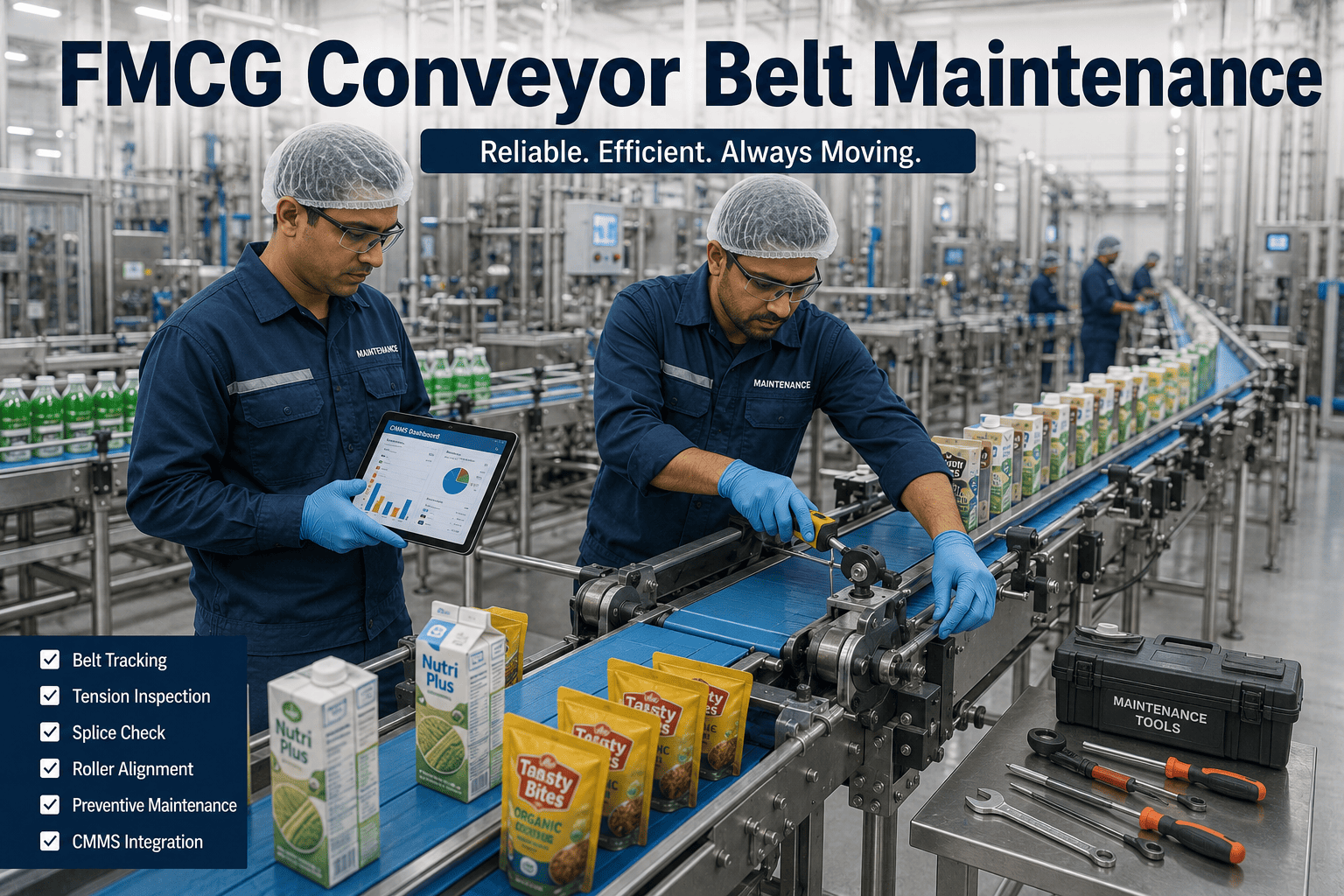
An effective conveyor PM programme has four inspection tiers — shift, daily, weekly, and monthly — each targeting different failure modes at different stages of development. The schedule below covers belt conveyors, roller conveyors, and chain conveyors used in FMCG packaging and material handling.
Belt tracking: verify belt centred on all rollers — no edge riding or fraying
Listen for bearing noise changes — grinding, squealing, or rhythmic clicking
Check transfer points for product buildup or accumulation jams
Verify all safety guards and E-stop cords are in place and functional
Clean photoeye sensors at critical detection points
Belt surface inspection: cuts, gouges, edge damage, splice condition
Touch-check bearing housings for temperature — above ambient = flag for monitoring
Motor current reading — compare to baseline; rising trend = friction increase
Check belt tension: 1–2% elongation between adjustments is normal; beyond = replace
Inspect drive chain tension and lubrication level (chain conveyors)
Vibration reading on all conveyor bearings — trend against baseline
Roller alignment check with straightedge — any misalignment causes tracking issues
Drive belt / V-belt tension and condition check (drive side)
Gearbox oil level and condition — milky = water ingress, dark = contamination
Speed verification: measured RPM vs set point — deviation = slip or drive wear
Full belt thickness measurement at 5 points — track wear rate, predict replacement date
Bearing lubrication: grease per OEM spec, clean fittings before applying
Motor insulation resistance test (megger) — declining = winding degradation
Chain wear measurement: 1% elongation = monitor; 2% = replace at next opportunity
Full sensor function test — every photoeye, proximity switch, and encoder verified
The total PM time investment per conveyor: approximately 3.5 hours per month across all four tiers. For a plant with 20 conveyors, that is 70 hours of PM monthly — preventing an average of 15–25 unplanned stoppages per month that would otherwise consume 80–160 hours of production downtime plus emergency repair labour. The PM-to-downtime ratio is consistently 1:2 or better — every hour of structured PM prevents at least 2 hours of unplanned downtime.
Automated PM Scheduling
Build Conveyor PM Schedules in Minutes — Track Compliance in Real Time
OxMaint generates shift, daily, weekly, and monthly PM work orders automatically for every conveyor in your plant — with mobile checklists, photo evidence, and compliance dashboards that show exactly which inspections are due, overdue, and completed.
Belt Tracking: The Single Most Impactful Conveyor PM Task
Belt mistrack is the most common conveyor failure in FMCG — and it is entirely preventable with a 5-minute inspection that most plants skip. A belt that drifts 5mm from centre today will drift 15mm by next week and 30mm the week after, at which point it contacts the frame, shreds the edge, and stops the line. The progression is linear and predictable. Here is how a mistrack develops, what it costs at each stage, and what intervention prevents it from progressing.
Week 1
2–5mm drift
Invisible to untrained eye. Detectable by straightedge or laser alignment tool.
Fix: Adjust idler alignment — 5 min, zero cost
Week 2–3
10–15mm drift
Belt edge approaching frame. Intermittent product tracking issues at transfers.
Fix: Realign idlers + check crown roller — 15 min, zero cost
Week 4–5
20–30mm drift
Belt contacting frame. Edge fraying visible. Product falling off at transfers.
Fix: Realign + possible edge trim — 30 min, minimal cost
Week 6+
30mm+ / belt failure
Belt edge destroyed. Possible belt tear at splice. Line stopped for emergency repair.
Repair: Belt replacement — 2–6 hours downtime, $800–$3,000 belt cost
Predictive Monitoring: The Three Signals That Predict Conveyor Failure
Beyond structured PM inspections, three data-driven monitoring techniques convert conveyor maintenance from calendar-based to condition-based — intervening based on actual equipment health rather than arbitrary time intervals.
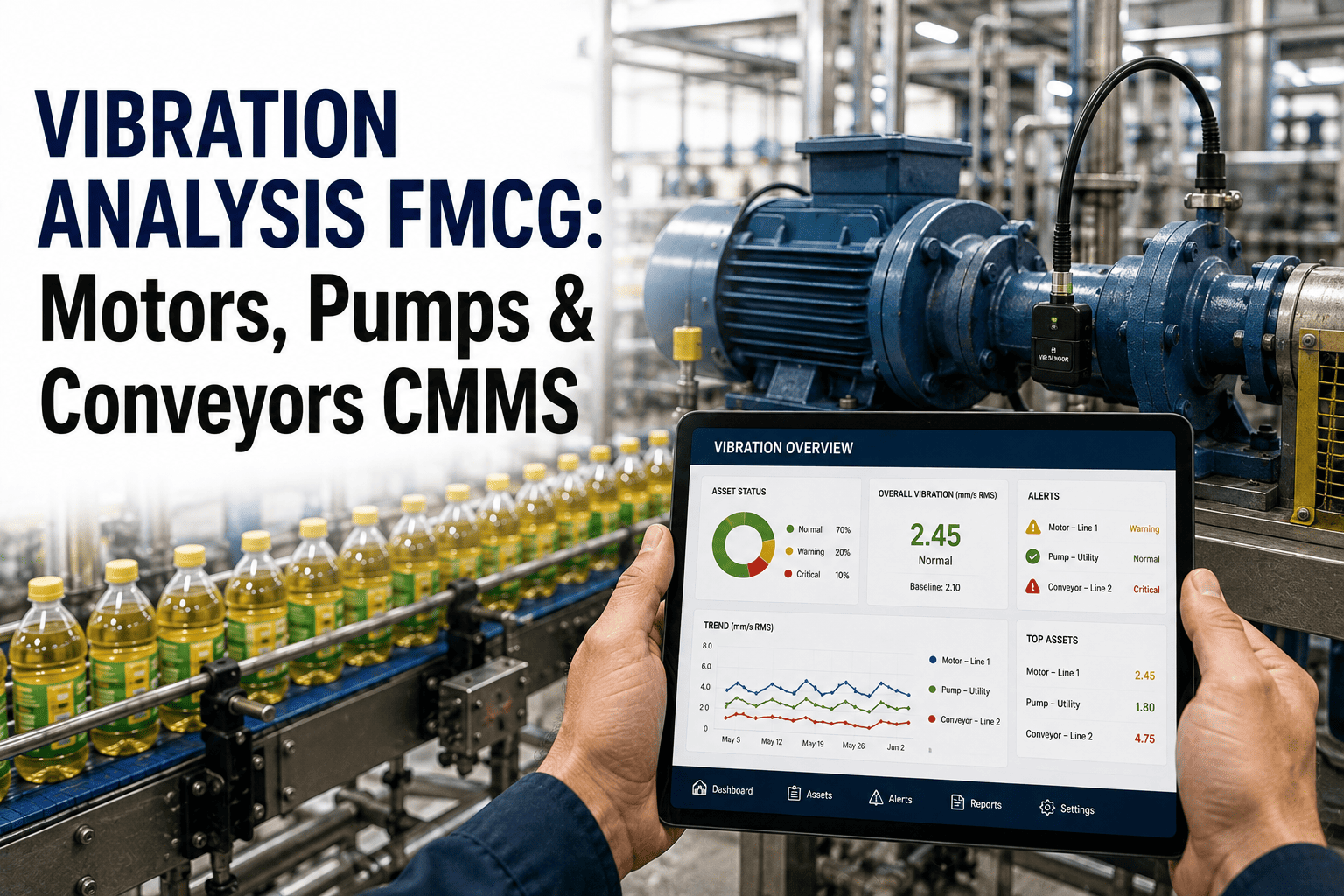
Tri-axial accelerometer mounted on bearing housing — measures velocity (mm/s) at bearing defect frequencies.
Normal<4.5 mm/s
Alert4.5–7.1 mm/s
Alarm7.1–11.2 mm/s
Danger>11.2 mm/s
Warning window: 2–6 weeks before seizure
CT clamp on motor supply — continuous current draw logging at 1-second intervals. Rising baseline = increasing mechanical load.
NormalNameplate FLA ±5%
Alert+10% above baseline
Alarm+20% above baseline
TripOverload relay activates
Warning window: 1–4 weeks before overload trip
Infrared temperature sensors or periodic IR camera inspections — hot spots indicate friction, misalignment, or electrical issues.
Normal<20°C above ambient
Alert20–35°C above ambient
Alarm35–50°C above ambient
Danger>50°C above ambient
Warning window: 1–3 weeks before failure
The three monitoring techniques are complementary, not redundant. Vibration catches bearing defects earliest. Current trending catches mechanical load increases that vibration may miss (belt tension, product accumulation, gearbox drag). Thermal monitoring catches electrical faults and lubrication failures that manifest as heat before they manifest as vibration or current change. A conveyor monitored on all three parameters has virtually zero probability of an undetected catastrophic failure.
The ROI: What Conveyor PM Actually Saves
Conveyor PM economics are straightforward because the cost of inaction is so high relative to the cost of prevention.
Eliminated downtime
$285K/yr
Emergency repair avoidance
$118K/yr
Belt life extension
$62K/yr
Product waste reduction
$45K/yr
Energy from friction reduction
$18K/yr
Annual PM programme cost (20 conveyors)$28,000
Annual value delivered$528K
19x ROI — Every $1 Spent on Conveyor PM Prevents $19 in Downtime and Repair Costs
Quick Start: 30-Day Conveyor PM Programme Launch
Week 1
Conveyor Census and Criticality Ranking
List every conveyor in the plant with location, type (belt/roller/chain), length, motor size, and line position. Rank by criticality: conveyors feeding bottleneck equipment get highest PM priority. Typical 5-line plant: 15–25 conveyors total.
Week 2
Baseline Condition Assessment
Inspect every conveyor against the 4-tier checklist. Record belt condition, bearing noise, motor current, and tracking status. Photograph any defects. Enter baseline data into CMMS. This assessment reveals the deferred maintenance backlog that is currently creating risk.
Week 3
Build PM Templates and Schedules in CMMS
Create shift, daily, weekly, and monthly PM templates for each conveyor type. Set auto-scheduling in OxMaint. Assign technicians to zones. Generate first month of work orders. Total setup time: 4–6 hours for a 20-conveyor plant.
Week 4
Fix the Top 5 and Go Live
Address the 5 most critical findings from the baseline assessment. Realign mistracked belts, replace worn splices, lubricate dry bearings, clean contaminated sensors. Go live with the full PM schedule. Track compliance from day one.
Frequently Asked Questions
Preventive Maintenance Scheduling
Every Conveyor Inspected. Every Failure Predicted. Every Stop Prevented.
19x
return on PM investment
30 Days
to full PM programme
Trusted by FMCG maintenance teams preventing conveyor downtime. No credit card required.