A pump on line 3 vibrates a little rougher every shift, and nobody notices until the bearing seizes at 2am. A conveyor drive hums slightly off-key for three weeks before the motor windings finally let go. Vibration doesn't fail quietly — it talks first. Sign up to turn that signal into a scheduled work order instead of an unplanned breakdown.
What This Guide Covers
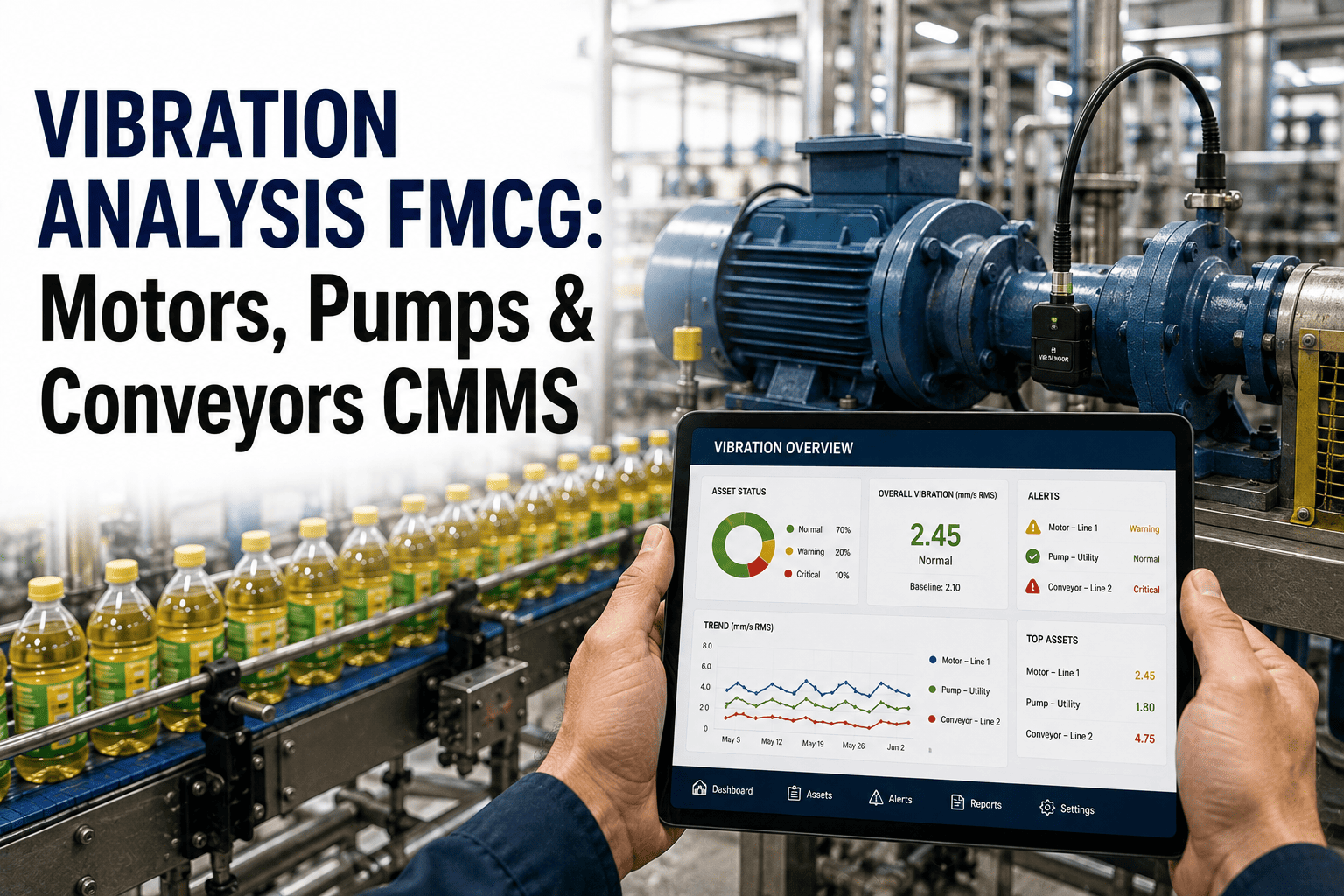
This guide covers vibration analysis for FMCG motors, pumps, and conveyors: motor bearing signatures, pump cavitation detection, conveyor drive imbalance, alarm threshold setting, and how a CMMS turns a vibration reading into a scheduled work order before the asset fails.
What Each Signal Is Actually Telling You
Motor
A repeating peak at the bearing's defect frequency, growing louder each week, is the earliest sign of race or ball wear
Pump
Random high-frequency noise riding on top of the normal signal usually points to cavitation from starved or throttled flow
Conveyor
A single strong peak at exactly one times running speed almost always traces back to drive-shaft or pulley imbalance
Where Vibration Monitoring Falls Apart Without A CMMS
| Stage |
How It Costs Reliability |
| Measurement |
Inconsistent measurement points between rounds make one month's reading impossible to compare with the next |
| Thresholds |
A single generic alarm level for every asset either misses slow-building faults or floods technicians with false alarms |
| Trend history |
Readings stuck in a spreadsheet or notebook make it hard to see the slow climb that separates normal wear from failure |
| Work order lag |
A threshold breach that sits in an inbox instead of triggering a work order gives the fault more time to spread |
Four Pillars Of A Vibration Monitoring Program
1
A Standardized Measurement Protocol
Fixed measurement points, orientation, and frequency for every asset so this month's reading actually compares to last month's
2
Alarm Thresholds Set From Baseline
Thresholds built from each asset's own healthy baseline instead of a single generic number applied plant-wide
3
Frequency-Domain Analysis Methodology
Reading the signal by frequency, not just overall amplitude, is what tells a bearing fault apart from a simple imbalance
4
CMMS Integration From Alert To Work Order
A threshold breach that opens a work order automatically instead of waiting for someone to notice and act on it
Catch The Fault Before It Becomes A Breakdown
OxMaint tracks vibration trends per asset, sets alarm thresholds from each machine's own baseline, and turns a breach straight into a work order. Sign up for a free trial to start tracking your motors, pumps, and conveyors, or book a demo to see it set up on your lines.
What A CMMS Adds To Vibration Analysis
Automatic Threshold Alerts
A reading crossing baseline fires an alert instantly, instead of waiting for the next scheduled review
Trend History Per Asset
Every past reading lives against the same asset, making a slow climb toward failure visible at a glance
Auto-Generated Work Orders
A threshold breach opens a work order on its own, so the fault gets scheduled instead of forgotten
One Dashboard For All Rotating Equipment
Motors, pumps, and conveyors sit on the same screen, so reliability teams see the whole plant at once
The Real Value Is In The Trend
A single vibration reading tells you very little on its own. It's the trend across weeks, compared against that asset's own baseline, that separates normal wear from a bearing that's about to let go on the next shift.
Frequently Asked Questions
Q
How often should motors, pumps, and conveyors be checked for vibration?
Critical rotating assets are usually checked weekly to monthly, while continuous monitoring on the most failure-prone lines catches changes between manual rounds.
Q
Why does a bearing fault show up as a specific frequency instead of just louder overall noise?
A worn race or ball strikes at a predictable rate tied to the bearing's geometry, which is why analysts look for that exact frequency rather than a general rise in noise.
Q
Why should alarm thresholds differ from one machine to another?
Two identical-looking pumps can have different healthy baselines depending on mounting and load, so a threshold based on each asset's own history catches real change instead of normal variation.
Turn Vibration Data Into Scheduled Work, Not Surprise Breakdowns
OxMaint connects measurement protocols, baseline-driven alarm thresholds, and trend history into one CMMS workflow for every motor, pump, and conveyor on your floor. Sign up for a free trial to get started, or book a demo to see it built around your equipment.