FMCG Conveyor Belt Maintenance: Tracking, Tension, and Splice Failure Prevention
By Jack Edwards on May 15, 2026
Conveyor belts are the circulatory system of every FMCG production plant — and the most expensive failure to let slide. When a belt mistracking event or splice failure stops an FMCG line, unplanned downtime costs food manufacturers up to $50,000 per hour in emergency stoppages, spoiled materials, and production loss. The food processing conveyor belt market reached USD 4.2 billion in 2024, reflecting how central this equipment category is to global food manufacturing. Despite the stakes, most facilities treat conveyor maintenance reactively — discovering belt tracking problems, worn splices, and seized rollers by the sound they make or the product they contaminate, not by a scheduled inspection. Foreign material contamination from belt failures was the number one cause of USDA food recalls in 2025, responsible for 13 out of 42 total recalls affecting over 71 million pounds of product. A structured conveyor maintenance program is not a best practice — it is a food safety obligation. Start a free trial to register your conveyor assets and build your first PM schedule in Oxmaint, or book a demo to see how FMCG plants structure conveyor maintenance in Oxmaint.
$50K/hr
Cost of unplanned downtime per hour in food manufacturing from conveyor failures and emergency stoppages
30%
Reduction in unplanned conveyor downtime achievable with predictive maintenance and IoT monitoring programs
$4.2B
Food processing conveyor belt market in 2024 — growing to $6.8B by 2033 as automation accelerates
66%+
Reduction in maintenance costs and uplift from 87% to 98% line availability with modular conveyor systems under PM
See Your Conveyor Asset ROI in 30 Minutes
See how much cost you can eliminate from reactive conveyor maintenance across your FMCG production lines.
✔ Conveyor belt wear and splice tracking✔ Automated PM work order generation✔ Food safety contamination risk elimination
No heavy implementation required | Works across multi-site portfolios | Live in days, not months
What Is FMCG Conveyor Belt Maintenance
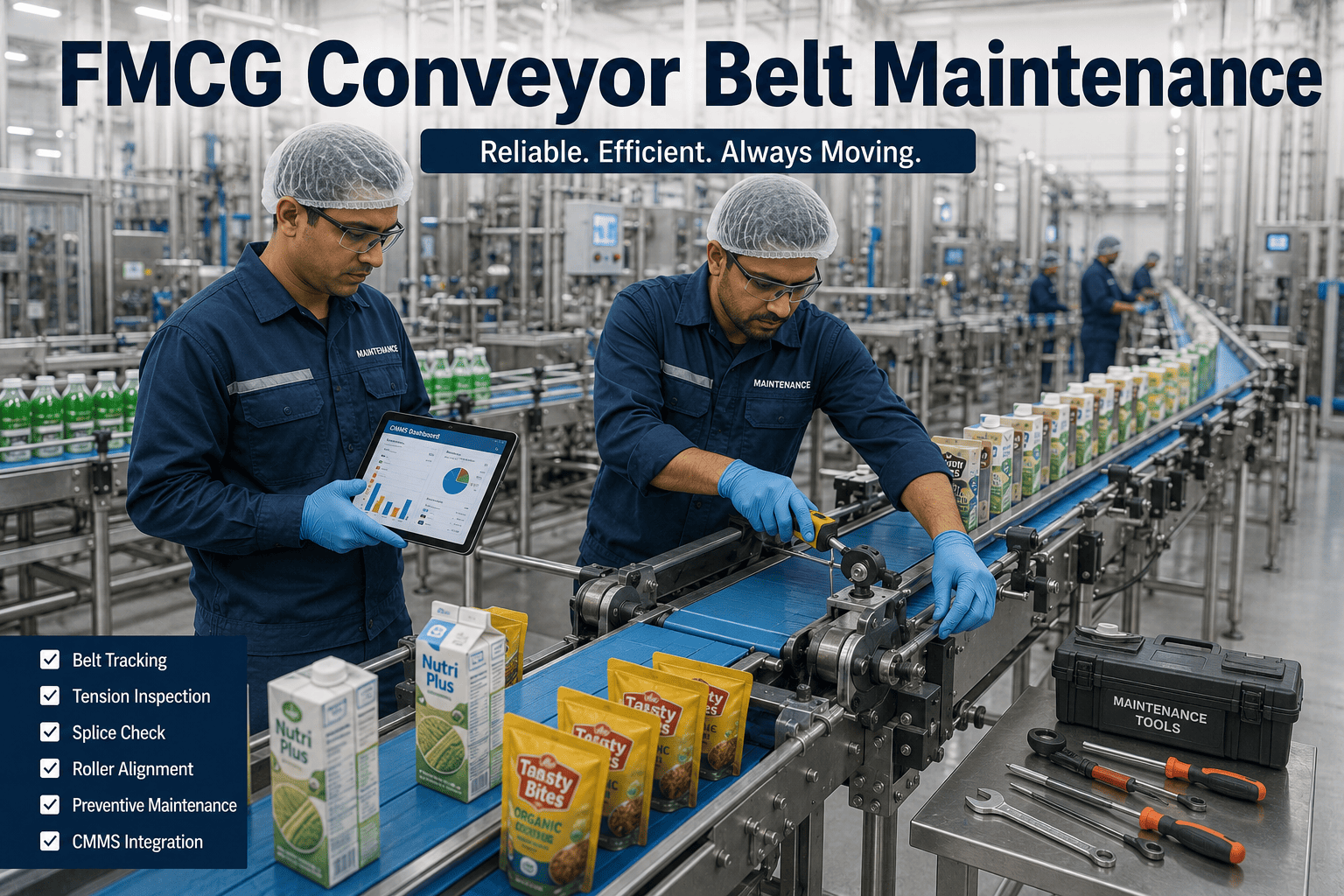
Conveyor belt maintenance in FMCG production environments is not simply the act of replacing worn belts. It is a systematic program covering belt tracking alignment, tension management, splice integrity inspection, roller and pulley condition, drive component servicing, and hygienic belt cleaning validation. Each of these variables has a distinct failure mode, a distinct inspection frequency, and a distinct consequence when neglected. Belt mistracking — the most common failure mode — causes accelerated edge wear, belt instability, product spillage, and in extreme cases, belt-off-track events that stop the entire line and damage structural components. Splice failures are the second-highest failure mode and the most dangerous from a food safety perspective: mechanical splice components that shed into product zones contaminate product and create recall-level contamination events.
The hygienic dimension of FMCG conveyor maintenance adds a layer of complexity absent in industrial applications. Food-grade belts operating in wet or high-humidity environments require cleaning validation to prevent biofilm formation, bacterial growth, and cross-contamination between product runs. Maintenance teams are responsible not just for mechanical reliability, but for the food-contact surface integrity that food safety programs depend on. A single crack in a belt surface or a failed CIP on a food-contact conveyor section creates a contamination pathway that product testing may not catch before product reaches retail. Start a free trial to begin registering your conveyor assets and building inspection schedules in Oxmaint.
Foreign material contamination from belt failures was the leading cause of USDA food recalls in 2025 — responsible for 13 of 42 recalls affecting over 71 million pounds of product.
Eight Key Concepts in FMCG Conveyor Belt Maintenance
Effective conveyor belt maintenance requires understanding eight distinct technical domains — each one a potential source of unplanned downtime, food safety risk, or regulatory non-conformance if not systematically managed.
01
Belt Tracking and Alignment
Belt mistracking is the number one cause of premature wear and conveyor stoppages. Proper tracking requires correct installation tension, clean pulleys, debris-free return rollers, and periodic alignment checks. Material buildup on return-side rollers is the primary mistracking trigger in food plants.
02
Belt Tension Management
Incorrect belt tension causes slippage (too loose) or accelerated wear on drive components and belt structure (too tight). Tension must be measured at defined intervals using tensioning tools and adjusted against belt type specifications. Both over-tensioning and under-tensioning compound over time.
03
Splice Inspection and Replacement
Belt splices — both mechanical and vulcanised — are the weakest point of any conveyor belt and require dedicated inspection. Mechanical splice fasteners thin and break; vulcanised splices crack or delaminate at lap joints. Splice measurement intervals must be defined by belt speed and load, not calendar time alone.
04
Roller and Idler Condition Monitoring
Seized or rough-running rollers cascade stress across the belt and accelerate wear patterns in specific zones. Rollers should be spun by hand during downtime windows to check for resistance, roughness, and bearing noise. One seized roller can increase motor load by 8–12% and create observable belt wear within weeks.
05
Pulley Lagging Wear Assessment
Drive pulley lagging provides traction for belt drive and reduces slippage. As lagging wears, traction reduces and belt slippage increases — causing increased motor load, heat buildup, and accelerated belt surface wear. Lagging condition is often inspected only at full belt replacement, missing progressive deterioration.
06
Hygienic Belt Cleaning Validation
Food-contact belts in wet environments require cleaning cycle validation: correct chemical concentration, temperature, contact time, and rinse effectiveness. Maintenance owns the cleaning equipment — spray bars, CIP nozzles, sanitiser dosing systems — that makes validated hygiene possible for food-grade conveyors.
07
Cover and Edge Wear Monitoring
Belt cover wear, cracks, cuts, and frayed edges are visual indicators that signal contamination risk and accelerating structural failure. Edge fraying specifically indicates tracking problems. Periodic belt surface inspection with documented condition ratings enables trend-based replacement planning before failure occurs.
08
Gearbox and Drive Motor Maintenance
Conveyor gearboxes exhibit noise anomalies 3–6 weeks before failure when trended correctly. Documenting abnormal sounds, oil leak findings, and bearing temperature across inspection events gives maintenance managers the lead time to plan gearbox service before an emergency stoppage occurs mid-shift.
The 6 Conveyor Maintenance Pain Points Costing FMCG Plants the Most
FMCG conveyor failures do not just stop a line — they contaminate product, trigger regulatory action, and cascade into brand damage that no downtime hour calculation captures fully. These six pain points are where FMCG conveyor maintenance programs fail — and where structured CMMS management makes the biggest difference. Start a free trial and get your first conveyor PM schedule built within 24 hours in Oxmaint.
Splice Failures Causing Product Contamination
Mechanical splice fasteners that fracture shed metal fragments into the product zone — triggering regulatory reporting, voluntary product recalls, and FDA investigation. A poultry plant in Georgia lost 22,000 lbs of finished product and incurred $1.8M in direct recall costs when a worn belt shed material into its packaging line. The belt had shown visible edge fraying for weeks.
No Belt Condition History or Wear Trending
Without documented inspection records, there is no visibility into how quickly a belt is degrading. Replacement decisions are made reactively — when the belt fails — not proactively when approaching its end-of-service condition. Facilities without belt condition histories make the same emergency procurement mistake repeatedly.
Mistracking Discovered by Sound Rather Than Inspection
Belt mistracking that is discovered when an operator hears an abnormal noise has already caused structural belt damage, pulley lagging wear, and potential spillage. By the time the sound is audible, the underlying cause — roller debris buildup, tension imbalance, or guide rail misalignment — has been compounding for days or weeks.
Hygienic Cleaning Gaps Creating Biofilm Risk
Food-grade belts with worn surfaces, cracked covers, or insufficiently cleaned joints become biofilm harborage points for Listeria, Salmonella, and other pathogens. Without documented cleaning validation records tied to each conveyor, hygiene non-conformances are invisible until a third-party audit or product testing event reveals them.
Spare Belt and Parts Stockouts Under Emergency
Custom food-grade belts — modular plastic, urethane flat belts, or stainless-infused mesh — carry 3–8 week lead times from specialist suppliers. Facilities without spare belt inventory and parts consumption tracking are one unexpected failure away from a week-long production gap waiting for belting that should have been on the shelf.
No Differentiation Between Production-Safe and Shutdown-Required Tasks
Many conveyor inspection tasks — belt surface visual, edge condition, tracking observation — can occur during production. Tasks requiring physical contact require planned downtime windows. Without this differentiation in the PM schedule, teams either defer all checks to infrequent shutdowns or stop the line unnecessarily for visual-only tasks.
How Oxmaint Structures FMCG Conveyor Belt Maintenance
Asset Management
Conveyor Asset Registry with Belt and Splice Records
Register each conveyor as an asset with sub-components — belt section, splices, rollers, drive, gearbox. Log belt condition ratings, splice measurement results, and tracking observations against each inspection work order to build a trend dataset that enables condition-based replacement scheduling.
PM Scheduling
Production-Safe vs Shutdown PM Task Separation
Oxmaint allows PM tasks to be tagged as production-safe or shutdown-required. Visual belt surface and edge checks run as production-safe tasks on daily and shift schedules. Splice measurement, tension adjustment, and roller spin checks schedule during planned sanitation or changeover windows — maximising uptime while maintaining inspection frequency.
Food Safety
Hygienic Cleaning Validation Documentation
Cleaning validation tasks for food-contact belt surfaces are logged with chemical concentration, temperature, contact time, and visual/ATP verification results. These records satisfy FSMA, SQF, and BRC hygiene monitoring requirements — and are retrievable per conveyor, per date, and per shift for audit purposes.
Corrective Action
Failed Inspection to Work Order in One Step
When a technician identifies a defect — a frayed belt edge, a rough roller, a splice showing fastener thinning — a failed checklist item in Oxmaint automatically generates a corrective work order, notifies the maintenance planner and shift supervisor, and requires photo evidence of the finding. Nothing falls through the shift handoff gap.
MRO Inventory
Belt and Spare Parts Inventory with Reorder Triggers
Link replacement belts, splicing kits, rollers, and gearbox components to each conveyor asset with minimum stock levels and lead-time-based reorder triggers. Oxmaint alerts purchasing before stock falls below safety levels — replacing emergency procurement with a planned replenishment cycle.
Compliance Reporting
Belt Maintenance History for Regulatory and Customer Audits
Every belt inspection, cleaning validation, splice replacement, and tracking adjustment is stored against the conveyor asset record. Single-click export of the complete belt maintenance history satisfies both internal food safety audits and customer or third-party audit requests without manual document compilation.
Plants implementing equipment-specific PM checklists tied to a CMMS platform reduce unplanned packaging downtime by 62% and extend equipment life by 2.3x.
Reactive vs Planned Conveyor Maintenance: The Real Comparison
The financial gap between reactive and planned conveyor maintenance is wide — and the food safety gap is wider still. This comparison shows what the shift delivers in practice.
Maintenance Scenario
Reactive / Unplanned
Planned / CMMS-Driven
Splice failure detection
Discovered by product contamination or stoppage
Measured at defined intervals — replaced at threshold
Belt mistracking detection
Operator hears sound — damage already done
Visual inspection on production-safe daily schedule
Belt condition history
None — no record until failure event
Trend data enabling condition-based replacement
Hygienic cleaning record
Paper log — gaps, missing parameters
Digital WO with parameters and ATP results logged
Roller condition awareness
Unknown until vibration or noise is audible
Spin check during every planned downtime window
Spare belt availability
Emergency order — 3–8 wk wait
On-hand stock managed by reorder triggers
Food safety recall risk
High — splice and belt degradation unmonitored
Low — condition trending catches degradation early
Audit readiness
No structured records — significant compilation effort
Instant filtered maintenance history per conveyor
ROI and Results: What Structured Conveyor PM Delivers
Plants implementing CMMS-driven PM programs for conveyor assets reduce unplanned stoppages by up to 62% in Year 1
$50K/hr
Cost of Every Avoidable Stoppage
Unplanned food manufacturing downtime costs up to $50,000 per hour — each prevented stoppage builds the ROI case for PM investment
98%
Line Availability Achievable
Facilities with systematic conveyor PM and modular belt management achieve line availability of up to 98% vs 87% industry baseline
2.3×
Equipment Life Extension
Condition-based belt and component replacement extends conveyor equipment life more than double vs reactive run-to-fail operations
Frequently Asked Questions
How does Oxmaint separate production-safe conveyor inspection tasks from shutdown-required maintenance tasks?
Oxmaint allows each PM task within a work order template to be tagged as production-safe or shutdown-required based on whether physical contact with the conveyor is needed. Visual belt surface inspections, edge condition checks, tracking observation, and safety guard checks are configured as production-safe tasks that run on daily or shift schedules. Tasks requiring physical access — bearing spin checks, splice measurement, tension adjustment, and lubrication — are scheduled during planned downtime, sanitation windows, or changeover periods. This prevents the common scenario where all inspection tasks default to infrequent planned stoppages, leaving production-safe checks undone for weeks. Start a free trial to build your first conveyor inspection template in Oxmaint.
How can we track belt splice condition and create a replacement schedule based on wear data?
Oxmaint allows splice measurements — fastener thickness for mechanical splices, lap opening measurements for vulcanised splices — to be logged as custom fields within recurring splice inspection work orders. By capturing these measurements at each inspection interval, Oxmaint builds a degradation trend for each splice. When measurements approach the replacement threshold defined in the asset record, a corrective work order for splice replacement is automatically generated with the required spare parts pre-populated from MRO inventory. This eliminates reactive splice replacement and gives planning teams 3–6 weeks of lead time to schedule the replacement during a planned downtime window.
How does Oxmaint document hygienic cleaning validation for food-grade conveyor belts?
Oxmaint supports custom work order templates for CIP and wet cleaning validation on food-grade conveyor systems. Each cleaning validation template includes required fields for chemical solution concentration, temperature at application, contact time, rinse confirmation, and visual or ATP swab result. Completed cleaning validation records are stored against the conveyor asset and are retrievable by date and shift for BRC/BRCGS, SQF, and FSMA food safety audit purposes. When an ATP result fails the specified threshold, a corrective action work order is automatically generated for re-cleaning and retesting. Book a demo to see hygienic cleaning validation templates configured for food-grade conveyor systems in Oxmaint.
Can Oxmaint manage spare belt and replacement parts inventory for conveyor systems with long lead times?
Yes. Oxmaint's MRO inventory module allows replacement belt sections, splicing kits, spare rollers, bearing assemblies, and drive components to be linked to each conveyor asset. Minimum stock levels are set based on lead time, consumption history, and criticality rating. Reorder alerts are triggered before stock falls below the safety threshold — giving procurement the lead time needed to source replacement parts without emergency premium pricing. For custom food-grade belt specifications with 4–8 week OEM lead times, this structured inventory management is the difference between a planned belt replacement and a week-long production gap.
Stop Treating Conveyor Failures as Inevitable
Turn Every Conveyor Into a Tracked, Predictable Production Asset
From belt condition trending to splice wear schedules, hygienic cleaning validation, and food safety contamination risk management — Oxmaint gives FMCG maintenance teams the infrastructure to prevent conveyor failures before they stop lines, contaminate product, or trigger recalls. Used by operations teams managing 10,000+ assets. See measurable results in the first 30 days.