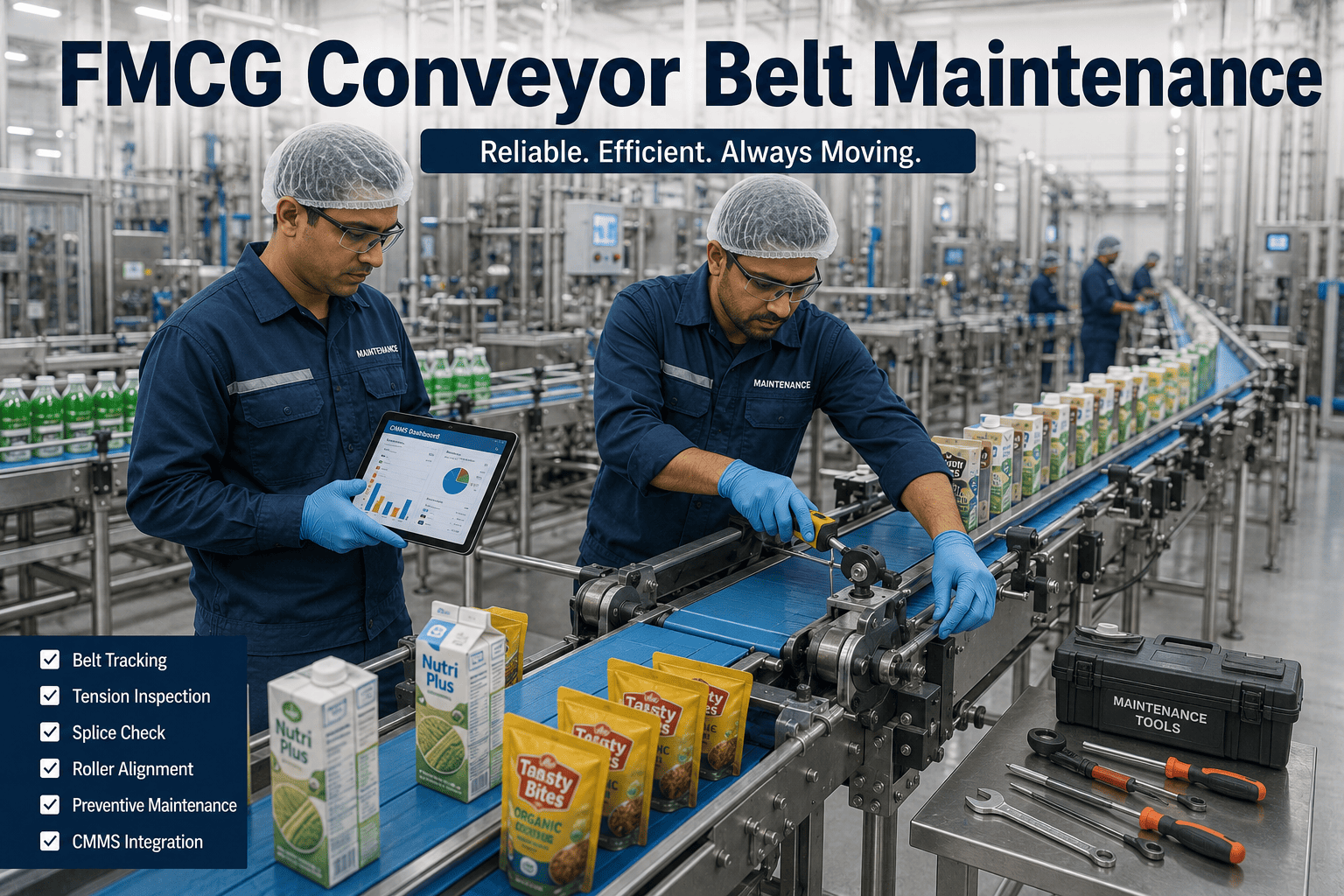
A single conveyor belt failure on a high-speed FMCG production line can halt 8,000–25,000 units per hour — and in a sector where margins are measured in fractions, that stoppage compounds fast. Yet most food and consumer goods facilities still manage conveyor maintenance reactively: waiting for a belt to slip, a roller to seize, or a drive motor to overheat before acting. The shift to structured, data-driven conveyor maintenance isn't complicated — but the gap between facilities that have made it and those that haven't shows up directly in OEE numbers. If you're ready to close that gap, start a free 30-day trial with Oxmaint or book a demo to see how leading FMCG facilities manage conveyor health at scale.
Conveyor Belt Maintenance for FMCG Production Lines
Preventive scheduling, roller inspection protocols, belt tracking correction, and AI-based failure prediction — the complete framework for high-uptime FMCG conveyor operations.
Where FMCG Conveyor Systems Actually Fail
Understanding failure distribution is the first step toward eliminating it. These six failure modes account for over 90% of unplanned conveyor stoppages in food and consumer goods manufacturing — and every one of them is detectable before it becomes a production event. Want to map your own conveyor failure history? Start a free trial and run a failure pattern analysis in your first week.
Belt drifts laterally due to off-center loading, worn return rollers, or misaligned tail pulley. Left uncorrected, causes edge fraying, product spillage, and structural frame contact damage.
Idler and return rollers fail due to bearing wear, product ingress, or inadequate lubrication intervals. A seized roller creates a friction hotspot that can damage belt underside in under 4 hours.
Motor draws excess current due to belt tension miscalibration, product overloading, or gearbox degradation. Often tripped by thermal protection — recovers briefly, then fails permanently without root cause repair.
Mechanical or vulcanised splice joints degrade under cyclic stress and thermal cycling in food processing environments. Failure is sudden and typically halts the entire line for 4–8 hours of emergency repair.
Worn skirting at load zones allows product spillage underneath the belt, accelerating belt wear and creating hygiene non-conformances that trigger food safety holds in addition to mechanical stoppages.
Gravity or screw tensioners drift out of range due to vibration or belt stretch. Under-tensioned belts slip on the drive pulley; over-tensioned belts accelerate bearing wear across all roller stations.
The Structured Conveyor Maintenance Schedule
Conveyor PM isn't a single frequency — it's a layered schedule tied to production cycles, environmental conditions, and belt hours. The table below reflects best-practice intervals for FMCG facilities running two or more shifts. Book a demo to see how Oxmaint auto-generates these tasks from your production runtime data.
| Frequency | Task | Component | Failure Mode Prevented | FMCG Priority |
|---|---|---|---|---|
| Daily | Belt tracking visual check | Belt, side guides | Mistracking, edge damage | Critical |
| Daily | Drive motor temperature check | Motor, gearbox | Thermal overload, motor burnout | Critical |
| Weekly | Roller spin check — all idlers | Carry and return rollers | Bearing seizure, belt underside damage | Critical |
| Weekly | Belt tension measurement | Tensioner, take-up pulley | Belt slip, accelerated bearing wear | High |
| Weekly | Skirt seal and load zone inspection | Skirting, loading chutes | Product spillage, hygiene non-conformance | High |
| Monthly | Bearing lubrication — all rollers | Idler, return, and drive bearings | Premature bearing failure | Critical |
| Monthly | Splice condition inspection | Belt splice joints | Sudden splice failure, line stoppage | Critical |
| Quarterly | Full belt thickness measurement | Belt surface | Unexpected belt failure at wear limit | High |
| Quarterly | Drive alignment check | Drive pulley, motor shaft | Vibration, premature belt edge wear | High |
| Annual | Full conveyor structural inspection | Frame, legs, cross-members | Structural fatigue, safety incident | Standard |
The Real Cost Comparison
The financial case for preventive conveyor maintenance in FMCG is overwhelming — not because the math is complicated, but because most facilities have never laid it out side by side. Here's what the comparison looks like across the metrics that matter to plant managers and operations directors.
Predictive Maintenance for FMCG Conveyors: What Sensors Actually Detect
Modern FMCG facilities are deploying low-cost IoT sensors on conveyor systems to catch failure signatures weeks before the line stops. When integrated with a CMMS like Oxmaint, these signals automatically trigger inspection work orders — removing the human lag between anomaly detection and corrective action. Book a demo to see Oxmaint's IoT integration configured for material handling equipment.
CMMS-Driven Conveyor Maintenance: What Changes
Each conveyor line is registered as an asset with full component tree — belt, rollers, drive unit, tensioner, guarding. Condition scores, last service dates, and failure history live on every asset. No spreadsheets, no site walkdowns to find records.
A conveyor running 3 shifts gets serviced at different intervals than one running 1 shift. Oxmaint ties PM triggers to actual belt hours and production cycles — not arbitrary weekly/monthly calendar dates — so maintenance tracks real wear, not elapsed time.
Every conveyor work order records who completed it, what parts were used, how long the job took, and what the outcome was. Recurring failures on specific sections surface immediately — eliminating the "we fixed that last month" guessing game.
When vibration, temperature, or current sensors breach thresholds, Oxmaint automatically creates a prioritised inspection work order, notifies the assigned technician, and links the alert to the relevant conveyor asset — closing the gap between detection and action.
Belts, idler bearings, splice kits, and drive components are linked directly to each conveyor asset. Minimum stock levels trigger auto-replenishment. When a work order is raised, the system confirms part availability before the technician leaves the maintenance room.
Daily belt tracking checks, weekly roller inspections, and monthly splice assessments are captured digitally with timestamps and electronic signatures. Failed items auto-generate corrective work orders. Every record is audit-ready for BRC, SQF, and FSMA inspections.
What FMCG Facilities Achieve After Structured Conveyor PM
Ready to model ROI for your own conveyor fleet? Start a free trial — your asset data and PM history migrate in days, not weeks.
FMCG Maintenance Managers Ask These
Stop Reacting to Conveyor Failures. Start Preventing Them.
Oxmaint gives FMCG maintenance teams production-triggered PM scheduling, live asset condition tracking, IoT-connected sensor alerts, and GMP-compliant digital inspection records — all in one platform built for multi-line, multi-site operations. No heavy implementation. No consultant fees. Running in days.