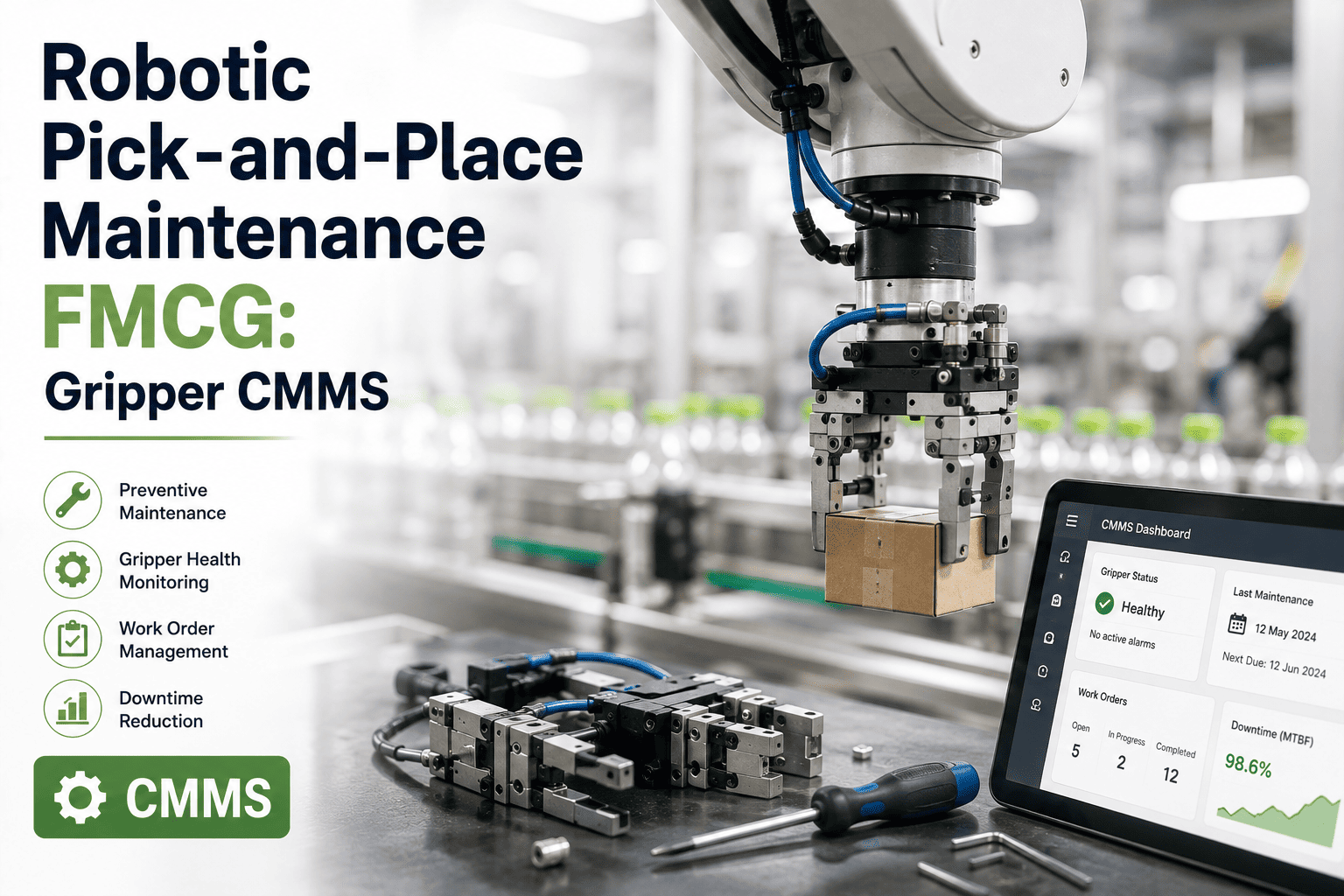
A snack manufacturer in Texas was running cloud-based defect classification on its robotic pick-and-place line — high-resolution images captured at the robot's end-effector, sent to a GPU cluster in a regional data center, classified, and returned with accept/reject instructions. Average round-trip latency: 220 milliseconds. At 160 picks per minute, that latency meant the robot was already placing the next item before the classification result arrived for the previous one. The workaround was throttling line speed to 95 picks per minute — a 41% throughput penalty to accommodate cloud inference. When the plant moved the classification model to an edge AI accelerator mounted directly on the robot controller, inference latency dropped to 11 milliseconds. Line speed returned to 160 picks per minute. Defect catch rate improved from 94.2% to 98.7% because the model was classifying current-frame images instead of frames that were already three picks old. But the real operational challenge was not the initial deployment — it was managing model versions, firmware updates, validation procedures, and performance monitoring across 14 robots running edge inference simultaneously. That management layer lives in Oxmaint. Schedule a demo to see how Oxmaint tracks edge AI model versions, firmware deployments, and inference performance across your robotic fleet.
Edge AI in FMCG Robotics
Cloud Latency Costs You Throughput. On-Device Inference Gives It Back.
FMCG production lines run at 100-600 units per minute. Cloud-based AI inference adds 150-400 ms of latency per decision — forcing line speed reductions, missed defects, and delayed robot actions. Edge AI moves inference to the robot, cutting latency to under 15 ms and enabling real-time decisions at full production speed. The challenge shifts from compute to management: tracking model versions, validating updates, and monitoring performance across dozens of edge devices.
11 msedge inference latency vs. 220 ms cloud round-trip
41%throughput recovered by eliminating cloud latency bottleneck
98.7%defect catch rate with current-frame edge classification
Why Cloud Inference Fails at FMCG Production Speed
The mathematics of cloud-based AI at FMCG line speeds are unforgiving. A packaging line running at 200 units per minute produces a new decision point every 300 milliseconds. Cloud inference — image capture, network transmission, GPU queuing, model execution, result return — consumes 150-400 ms depending on image size, network conditions, and server load. By the time the cloud returns a decision, the product has moved 1-3 positions downstream, making the classification result actionable only if the rejection mechanism can reach back in the line — which most cannot. The result is either reduced line speed or reduced detection accuracy. Edge AI eliminates this tradeoff entirely.
150-400 ms cloud inference round-trip at typical FMCG image sizes
300 ms decision window at 200 units/minute line speed
<15 ms edge inference on dedicated accelerators
Zero network dependency for real-time robot decisions
Edge AI does not eliminate cloud infrastructure — it relocates the time-critical inference step to the device while keeping model training, retraining, and performance analytics in the cloud. The operational challenge is managing the lifecycle of models deployed across dozens of edge devices in a production environment where incorrect model versions or failed firmware updates can halt entire lines.
Edge AI Hardware for FMCG Robotics
The edge AI accelerator landscape for FMCG robotics spans from compact modules that mount directly on robot controllers to dedicated edge servers that serve multiple robots from a line-side cabinet. Each option creates distinct maintenance and management requirements that your CMMS must track. Oxmaint registers every edge device as a maintained asset with firmware and model version tracking — Sign Up Free.
01
Robot-Mounted Accelerators — NVIDIA Jetson, Google Coral, Hailo
Compact modules (credit-card to book-sized) that mount directly on the robot arm, controller cabinet, or end-effector housing. NVIDIA Jetson Orin NX delivers 100 TOPS at 15-25W. Google Coral Edge TPU provides 4 TOPS at 2W for lightweight models. Hailo-8L offers 13 TOPS at 2.5W in an M.2 form factor. These devices run inference locally with zero network latency but require individual firmware management, thermal monitoring in production environments, and model version control per device.
02
Line-Side Edge Servers — Multi-Robot Inference
Rack-mounted or DIN-rail servers positioned at the production line serving 4-8 robots via wired Ethernet with sub-5ms local network latency. Intel and NVIDIA industrial edge platforms provide 200-500 TOPS with GPU acceleration. Centralized compute simplifies model management — one server update covers multiple robots — but introduces a single point of failure that requires redundancy planning and UPS protection tracked as maintenance assets.
03
Smart Cameras with Built-In Inference
Vision cameras from Cognex, Keyence, and Basler with onboard inference engines that capture, classify, and output results in a single device. Eliminates separate accelerator hardware but limits model flexibility — retraining requires vendor-specific tools and firmware updates that must be validated per camera. Track camera firmware versions and model deployment dates in your CMMS alongside lens cleaning and calibration schedules.
04
FPGA-Based Accelerators for Deterministic Latency
Field-programmable gate arrays from Xilinx (AMD) and Intel deliver deterministic inference timing — every frame processes in exactly the same number of clock cycles, unlike GPU-based accelerators where queuing creates variable latency. Critical for applications where consistent cycle time is required, such as synchronized multi-robot pick-and-place. FPGA bitstream management adds a unique firmware layer that CMMS must track alongside the AI model version.
Every edge device is a maintenance asset. Oxmaint tracks hardware health, firmware versions, model deployments, and inference performance for every accelerator, smart camera, and edge server in your robotic fleet.
Model Deployment Lifecycle: From Training to Production Edge
Deploying an AI model to a single edge device is straightforward. Managing model versions across 14, 40, or 100+ edge devices in a production FMCG plant — where a wrong model version on one robot can contaminate an entire product batch — is an operational discipline that requires CMMS-level tracking. Oxmaint manages edge model deployment as a tracked maintenance workflow — Book a Demo.
Train
Model Training in Cloud or On-Premise GPU
Models are trained on large labeled datasets using cloud GPU clusters or on-premise training servers. Training produces a full-precision model (FP32) that must be optimized for edge deployment. The training dataset version, hyperparameters, and validation accuracy are recorded as the model's birth certificate — linked in Oxmaint to every device that will eventually run it.
Optimize
Quantization and Compilation for Edge Hardware
Full-precision models are quantized (FP32 to INT8 or FP16) and compiled for the specific edge hardware target — TensorRT for NVIDIA Jetson, Edge TPU Compiler for Coral, Hailo Dataflow Compiler for Hailo devices. Quantization can reduce model accuracy by 0.5-2% — validation against a held-out test set must confirm that edge-optimized accuracy still meets production requirements before deployment.
Validate
Pre-Production Validation on Reference Device
The compiled edge model runs on a reference device against a validation dataset that represents real production conditions — varying lighting, product orientation, conveyor speed, and defect types. Accuracy, latency, and false positive rate must meet defined thresholds before the model is approved for fleet-wide deployment. Oxmaint records validation results as a quality gate in the deployment work order.
Deploy
Staged Rollout with Rollback Capability
Models deploy to production edge devices in stages — one robot first, then a line, then the full fleet — with performance monitoring at each stage. Every deployment is tracked in Oxmaint as a work order with device ID, previous model version, new model version, deployment timestamp, and post-deployment accuracy metrics. If performance degrades, rollback to the previous version is immediate and documented.
Firmware Update Workflows for Edge Devices
Edge AI accelerators require firmware updates independently of the AI models they run. Firmware governs hardware initialization, thermal management, power delivery, communication protocols, and security patches. A firmware mismatch between the accelerator and the deployed model can cause inference failures, incorrect results, or device lockups — all of which halt production.
Firmware-Model Compatibility Matrix
Every AI model compiled for edge hardware is validated against a specific firmware version. Updating firmware without revalidating the deployed model risks inference failures. Oxmaint maintains a compatibility matrix per device type — when a firmware update work order is created, it auto-generates a model revalidation task linked to the same device.
Staged Firmware Rollout with Production Verification
Firmware updates deploy to one device first, followed by a production verification period (typically 4-8 hours of full-speed operation) before expanding to additional devices. The work order includes pre-update backup, firmware flash, model revalidation, production run verification, and sign-off — each step tracked with timestamps and responsible technician.
Security Patch Management
Edge devices running Linux-based operating systems require security patches for OS vulnerabilities, network stack updates, and cryptographic library updates. In food manufacturing environments subject to FSMA cybersecurity considerations, patch compliance is auditable. Track patch status per device in your CMMS with automated alerts for overdue updates.
Thermal Management Firmware
Edge accelerators in FMCG environments face thermal challenges from production heat, washdown humidity, and enclosure restrictions. Thermal management firmware controls fan speeds, clock throttling thresholds, and thermal shutdown limits. Incorrect thermal firmware can cause inference slowdowns during peak production or device shutdowns during hot-weather periods.
Rollback Procedures and Version Archival
Every firmware update must include a tested rollback procedure. Oxmaint stores the previous firmware version image linked to the device record. If a firmware update causes production issues, the rollback work order restores the previous version and triggers a root cause investigation work order for the engineering team.
Inference Performance Monitoring
Once edge AI models are deployed to production robots, continuous performance monitoring ensures that accuracy does not degrade over time due to data drift, environmental changes, or hardware degradation. The metrics that matter are different from training-time metrics — production inference monitoring focuses on operational impact, not academic accuracy scores. Oxmaint monitors inference drift and triggers retraining workflows — Sign Up Free.
<15 ms
Target inference latency per frame — exceeding this signals thermal throttling, model bloat, or hardware degradation
98%+
True positive rate for defect detection — monitored weekly against manual QC audit samples
<1%
False positive rate — excessive false positives waste product and indicate model drift or lighting change
100%
Fleet model version consistency — every device running the approved production model version
<70 °C
Edge device junction temperature — above threshold triggers thermal investigation work order
Weekly
Accuracy audit frequency — compare edge decisions against manual QC samples to detect drift
Model drift is invisible until it causes quality escapes. Oxmaint monitors inference latency, accuracy trends, device temperature, and model version consistency across your entire edge fleet — and generates corrective work orders before drift becomes a production problem.
FMCG Applications Where Edge AI Transforms Robot Performance
Edge inference is not a universal requirement — it matters most where latency directly impacts throughput, accuracy, or safety. These are the FMCG applications where on-device inference delivers the highest operational return. Oxmaint tracks edge AI performance per application and per robot — Book a Demo.
A
Vision-Guided Pick-and-Place at Full Line Speed
Robots picking products from conveyors need object detection and grasp point calculation within the mechanical cycle time — typically 200-400 ms. Cloud inference cannot consistently meet this window. Edge AI delivers detection and grasp planning in under 30 ms, enabling pick rates of 120-200 cycles per minute without speed reduction. Track pick success rate per robot as an edge AI performance metric in your CMMS.
B
Real-Time Defect Classification and Rejection
Classifying product defects — burn spots, foreign material, underfill, label misprint, seal defects — at line speed requires inference before the product passes the rejection point. At 200 units per minute, the classification window is 300 ms. Edge AI at 10-15 ms inference provides a 285 ms margin for mechanical rejection actuation, versus cloud inference that may not return results before the rejection window closes.
C
Adaptive Robotic Palletizing
Mixed-SKU palletizing requires the robot to identify incoming case dimensions, orientation, and SKU in real time and calculate the optimal placement position. Edge inference classifies each case in under 20 ms, enabling the palletizer to handle mixed product streams without pre-staging or manual sorting. Track palletizing accuracy and cycle time per SKU as edge AI metrics.
D
Collaborative Robot Safety Monitoring
Edge AI on safety-rated vision systems detects human proximity, posture, and intent in real time — enabling speed-and-separation monitoring and hand-guiding modes without relying on network connectivity. Inference latency directly impacts the safety system's response time. A 200 ms cloud delay in detecting a worker entering the robot workspace is unacceptable; 10 ms edge detection is not.
The Eight-Step Path from Cloud to Edge
Migrating from cloud-based AI inference to edge deployment follows a structured validation path that ensures production accuracy is maintained or improved at every step.
Step 1
Baseline cloud model accuracy and latency metrics
Step 2
Select edge hardware matching compute and form factor requirements
Step 3
Quantize and compile model for target edge platform
Step 4
Validate edge accuracy against cloud baseline on test set
Step 5
Deploy to single pilot robot, monitor for 48-72 hours
Step 6
Compare pilot edge accuracy vs. manual QC audit
Step 7
Expand to full line with staged rollout per robot
Step 8
Fleet-wide deployment with CMMS version tracking
Moving inference to the edge was the easy part. Managing 14 edge devices running different model versions because someone updated three robots on Thursday night and forgot the rest — that was the hard part. Once we started treating every model deployment as a tracked work order in the CMMS with version verification on every device, we never had a version mismatch again. The CMMS does not care that the asset is a neural network instead of a motor — it tracks versions the same way it tracks serial numbers.
— Controls Engineering Lead, Top 20 North American Snack Foods Manufacturer
Your Robots Make Decisions at Line Speed. Your CMMS Should Manage the Models Behind Them.
Oxmaint treats every edge AI accelerator, model version, and firmware deployment as a tracked maintenance asset — with version control, deployment work orders, rollback procedures, performance monitoring, and audit documentation. One platform for the full edge AI lifecycle alongside your physical robot maintenance.
Frequently Asked Questions
Does edge AI eliminate the need for cloud infrastructure entirely?
No. Edge AI handles real-time inference — the time-critical classification and decision-making that must happen at line speed. Cloud infrastructure remains essential for model training (which requires large GPU clusters and extensive datasets), model retraining when production conditions change, performance analytics across the fleet, and long-term storage of inference logs and quality data. The architecture is complementary: cloud trains, edge infers, and your CMMS manages the lifecycle of both.
How often do edge AI models need retraining?
Retraining frequency depends on how quickly production conditions change. Lines running the same SKUs with stable lighting and consistent product quality may go 6-12 months between retraining cycles. Lines with frequent SKU changes, seasonal product variations, or evolving defect types may need quarterly retraining. The trigger for retraining is accuracy drift detected during weekly QC audits — when edge classification accuracy drops below the defined threshold, Oxmaint generates a model retraining work order with the relevant performance data attached.
What happens if an edge device fails during production?
Edge device failure handling depends on the application's criticality. For quality inspection, the line can continue with manual QC sampling while the device is replaced — Oxmaint auto-generates the replacement work order with the required model version and firmware specification so the spare device is configured correctly before installation. For vision-guided pick-and-place, the robot typically enters a safe-stop state until the edge device is restored. Pre-configured spare devices with the current model version and firmware — tracked as spare parts inventory in Oxmaint — reduce swap time to under 15 minutes.
How do we validate that the edge model matches cloud accuracy after quantization?
Quantization from FP32 to INT8 typically reduces model accuracy by 0.3-2.0 percentage points. Validation uses a held-out test dataset that represents real production conditions — not the training set. Run the quantized edge model and the full-precision cloud model on the same test images and compare classification agreement, false positive rate, and false negative rate. Oxmaint records the validation results as a quality gate — the model cannot be approved for fleet deployment until validation metrics meet defined thresholds.
Can Oxmaint track edge AI assets alongside traditional maintenance assets?
Yes — and that is the core advantage. Oxmaint registers edge AI accelerators, smart cameras, and edge servers as child assets under their parent robot, with their own PM schedules for firmware updates, thermal inspections, and model validation cycles. When a robot has a maintenance event, the CMMS shows the complete picture — mechanical components, electrical systems, and edge AI assets — in a single asset hierarchy. Model version, firmware version, last deployment date, and inference performance metrics sit alongside bearing hours, lubrication records, and calibration schedules.