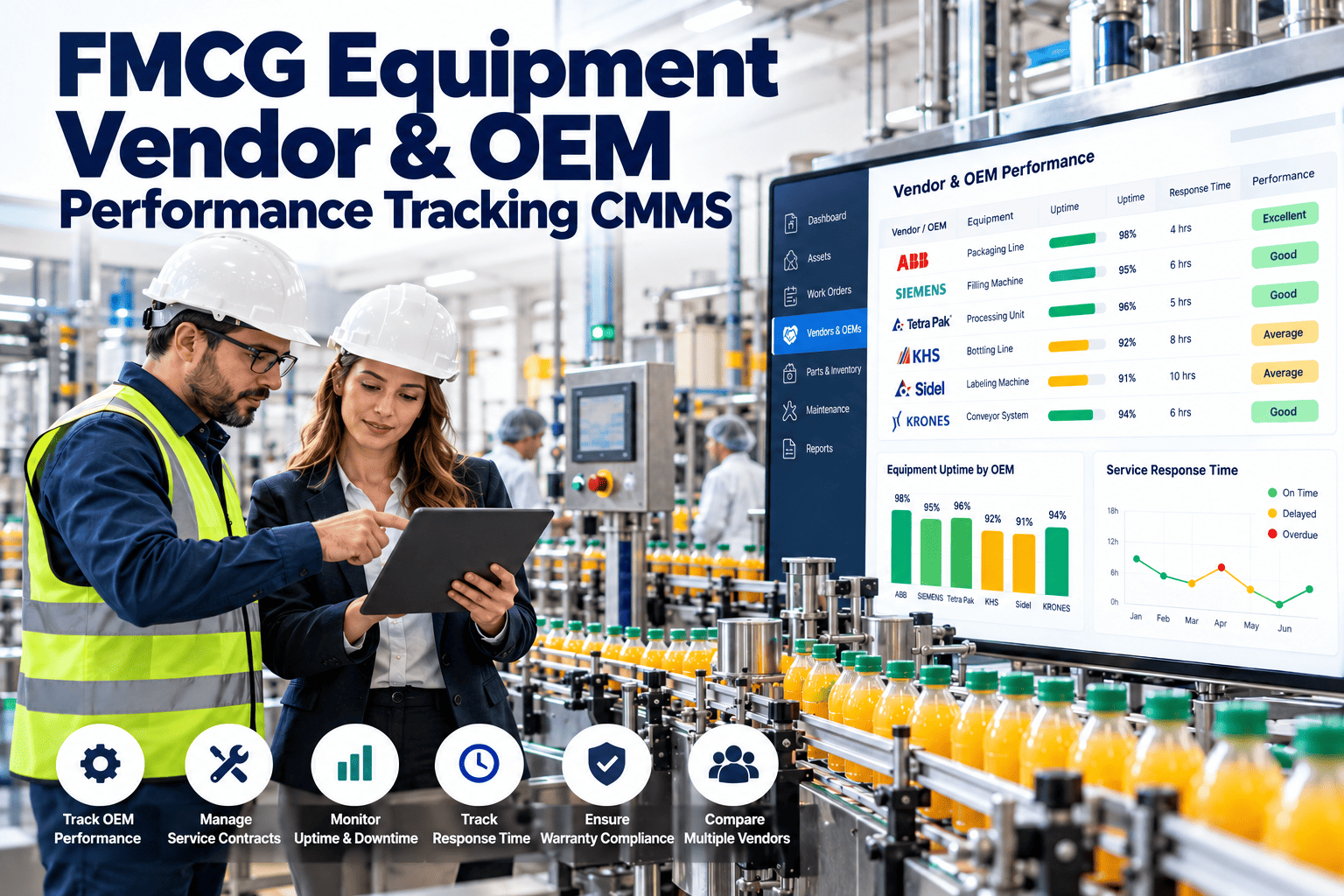
An FMCG plant depends on dozens of outside parties: OEMs who supply filling and packing lines, specialist contractors, spare parts distributors, and service providers who respond when a line stops. Yet performance is usually remembered rather than measured, so a vendor who is slow, a warranty that quietly expires, or a part that always arrives late goes unchallenged. Structured vendor and OEM tracking replaces opinion with evidence and gives procurement and maintenance a shared basis for decisions. This guide covers scorecards, warranty management, spare parts lead times, and service level agreements, with Oxmaint maintenance management software capturing the data from every job.
Hold every vendor to the service level you paid for
Track response, repair quality, parts lead time, and warranty claims for each OEM and contractor, so renewals and escalations are based on records.
Why vendor performance stays invisible
In most plants the information exists, but it is scattered. Nobody sees the full picture of a vendor in one place.
How it looks today
- Call-out times are remembered, not recorded
- Warranty terms sit in contract folders nobody opens
- Lead times come from supplier promises, not actual receipts
- Repeat visits for the same fault are not linked together
- Procurement and maintenance hold different views of the same vendor
- Renewal discussions rely on price alone
How it looks with tracking
- Every call-out is timed from request to arrival to fix
- Warranty status is visible on each asset record
- Actual lead time is calculated from order and receipt dates
- Repeat failures are linked to the vendor and the part
- One scorecard is shared by maintenance, procurement, and finance
- Renewals weigh quality, speed, and cost together
Building a vendor scorecard that people trust
A scorecard should be built from data you already record in work orders and purchase orders. Keep it small enough to review.
| Dimension | Measure | Data source | Review rhythm |
|---|---|---|---|
| Responsiveness | Time from request to arrival on site, by priority | Work order timestamps | Monthly |
| Restoration | Time from arrival to line running again | Work order and downtime records | Monthly |
| Fix quality | Repeat visits for the same fault within a set period | Asset history and failure codes | Quarterly |
| Parts delivery | Actual lead time against quoted lead time | Purchase order and receipt dates | Quarterly |
| Documentation | Complete service reports and accurate parts lists | Attached work order records | Quarterly |
| Commercial | Invoice accuracy and agreement to quoted rates | Invoices compared with work orders | Quarterly |
| Safety and compliance | Permit adherence and incident reports | Contractor induction and permit records | Quarterly |
Scorecard rules that prevent arguments
- Share the measures and weights with the vendor at the start of the contract
- Separate vendor-caused delays from plant-caused delays, such as access or permits
- Use the same period and definitions for every vendor in a category
- Review the scorecard with the vendor, not only internally
Warranty management: from commissioning to recovery
Warranties are worth money only when they are tracked, claimed, and evidenced. Treat each stage as part of the asset lifecycle.
Capture at commissioning
Record start date, duration, covered components, exclusions, and any usage conditions on the asset record as soon as the equipment is accepted.Flag approaching expiry
Schedule inspections before the warranty ends, so defects are found and claimed while the vendor is still obliged to fix them.Document each failure
Capture photos, operating conditions, fault codes, timestamps, and maintenance history. Weak evidence is the main reason claims are rejected.Submit within the claim window
Check the notice period in the contract and send complete claims promptly, with the vendor contact and reference recorded.Track recovery
Record the outcome, credit, or replacement part, and compare recovered value with the cost of the failure.Protect your own warranty position
- Follow the OEM's required maintenance schedule and keep records that prove it
- Use approved parts and technicians where the warranty requires them
- Avoid modifications that could void coverage without written agreement
Never lose a warranty claim to missing records again
Keep warranty terms, service history, and vendor work on the same asset record, so evidence is ready when a claim is needed.
Spare parts lead time tracking
A line is only as available as its slowest spare. Measure actual lead times, not the number on the quotation.
Classify spares by consequence
Class A: line-stopping and long lead
Hold stock on site or agree vendor-managed stock. Track these parts most closely and review levels often.Class B: important with moderate lead
Hold minimum levels based on actual lead time and usage, with reorder points that adjust to supplier performance.Class C: common and quickly available
Buy as needed or through simple replenishment agreements, and avoid tying up money in stock.Designing service level agreements that can be measured
An SLA is only useful if both sides can verify it from records. Write each commitment in a form your system can track.
| SLA element | Weak wording | Measurable wording |
|---|---|---|
| Response | Prompt attendance when called | On-site arrival within an agreed number of hours by priority, measured from the logged request |
| Restoration | Fix as quickly as possible | Target time to restore the line for critical assets, with defined exclusions |
| Parts | Parts supplied in good time | Critical parts delivered within a stated lead time or held on consignment |
| Remote support | Telephone help available | Remote expert contact within a stated time, including out-of-hours coverage |
| Remedies | Parties will discuss issues | Service credits or corrective actions when targets are missed in a review period |
| Reporting | Reports on request | Service report attached to every job within an agreed time |
OEM service or independent provider: a fair comparison
Neither is always better. Decide per asset and per task using tracked performance rather than assumption.
Factors favoring the OEM
- Warranty or software licence requires OEM involvement
- Proprietary controls and diagnostics are not available elsewhere
- Complex overhauls need original specifications and tools
- Safety-critical modifications need manufacturer approval
Factors favoring an independent provider
- Faster local response and more flexible scheduling
- Lower labor rates for routine mechanical and electrical work
- Willingness to work across multiple equipment brands
- Documented success on comparable repairs in your plant
Running a vendor review meeting that leads to action
A review is worthwhile only if it ends with named actions. Keep the agenda consistent so trends become visible.
Share the scorecard first
Send the data before the meeting so discussion focuses on causes, not on disputing numbers.Review the worst three jobs
Walk through the slowest or most repeated cases and agree what actually went wrong.Agree corrective actions
Assign owners and dates on both sides, including plant actions such as faster access or clearer fault reports.Check last review actions
Confirm previous commitments were completed. Unfinished actions should escalate.Red flags that deserve attention early
| Red flag | What it may indicate | First response |
|---|---|---|
| Response times drifting upward | Stretched vendor resources or lower priority for your plant | Review SLA terms and request a recovery plan |
| Same fault repaired repeatedly | Symptom fixing rather than root cause correction | Require a failure analysis and link all visits |
| Quoted lead times regularly missed | Unreliable supply chain or optimistic quoting | Increase safety stock and qualify an alternative source |
| Incomplete service reports | Weak documentation and warranty evidence risk | Make reports a condition of invoice approval |
| Invoices differing from work orders | Billing errors or scope creep | Reconcile every invoice to the logged job |
How Oxmaint supports vendor and OEM tracking
Performance data comes from ordinary work. Oxmaint records each job, part, and asset so the scorecard builds itself.
| Tracking need | Oxmaint capability | Benefit |
|---|---|---|
| Response and restoration times | Work orders with timestamps and status | Measured performance by vendor and priority |
| Warranty status | Asset management with documents and dates | Coverage visible when a failure occurs |
| Repeat failures | Asset history and failure records | Repeat visits linked to the same fault |
| Parts lead times | Inventory and purchasing records | Actual lead times and reorder points tuned to them |
| Scheduled vendor service | Preventive maintenance scheduling | OEM service intervals met and evidenced |
| Review preparation | Dashboards and reports | Scorecard data ready for each meeting |
Data to capture on every vendor job
Scorecards fail when the underlying records are thin. A few mandatory fields on each work order make the analysis possible.
At request and arrival
- Vendor name and contract reference
- Time the request was logged and its priority
- Time the technician arrived on site
- Asset, fault description, and symptoms observed
- Whether the delay was caused by access, permits, or vendor availability
At completion
- Time the line was released back to production
- Root cause and action taken
- Parts fitted, with serial or batch information
- Service report and photos attached
- Warranty coverage confirmed or declined
Onboarding a contractor or OEM engineer properly
Good performance starts with a clean start. Give every external party the same information and expectations.
Hygiene and food safety expectations
- Control of tools, fasteners, and consumables entering production areas
- Rules for lubricants, with food-grade products where contact is possible
- Clean-up and sign-off steps before a line is released after repair
- Records that allow quality to trace work done on food-contact equipment
Renewal decisions based on evidence
Before each renewal, combine performance with commercial and risk factors. A simple matrix keeps the discussion fair.
| Performance | Dependency on the vendor | Likely decision |
|---|---|---|
| Strong | High | Renew, consider a longer term, and agree shared improvement goals |
| Strong | Low | Renew and use the vendor as a benchmark for others |
| Weak | High | Renew with a formal improvement plan, remedies, and a backup option in development |
| Weak | Low | Replace or retender after a documented review period |
Questions to settle before renewing
- Did the vendor meet agreed targets in most review periods, and if not, why?
- Were failures linked to poor service or to plant conditions such as operating errors?
- Are there qualified alternatives for this equipment, and what would switching cost?
- Should any scope move in-house through training, or move out to a specialist?
Formulas worth standardizing
Agree the definitions once so every review compares like with like.
Service measures
- Mean response time: average of arrival time minus request time, by priority
- Mean restoration time: average of release time minus arrival time
- Repeat visit rate: jobs with a second visit for the same fault divided by total jobs
- SLA attainment: jobs meeting the target divided by total jobs in the period
Parts and commercial measures
- Lead time variance: actual lead time minus quoted lead time
- On-time delivery rate: parts received by the confirmed date divided by parts ordered
- Warranty recovery rate: value recovered divided by value claimed
- Invoice accuracy: invoices matching work orders divided by invoices received
Consolidating or diversifying your vendor base
Fewer vendors can mean better terms, while several can mean resilience. Use performance data to find the right balance per category.
When to consolidate
- Several vendors provide similar services with uneven quality
- Volume could secure better response times and rates
- Administration and induction effort is high for small suppliers
- One provider already performs consistently well across assets
When to keep options open
- A single vendor controls a line-critical service or part
- Performance has declined and no alternative is qualified
- Geographic spread requires local support at each site
- Specialist knowledge sits with a small number of firms
Reduce single-vendor risk
- Qualify a second source for the highest-risk parts and services
- Keep drawings, manuals, and software backups under your own control
- Document emergency contacts and escalation steps for every critical vendor
- Test the backup option occasionally on a low-risk job
Keep the program light enough to survive
- Start with the five vendors that cause the most downtime or spend
- Automate the scorecard from work order and purchase data wherever possible
- Hold reviews quarterly for most vendors and monthly only for critical ones
- Publish results internally so maintenance and procurement see the same facts
Frequently asked questions
What should an OEM scorecard include?
Response time, restoration time, repeat visits, parts lead time, documentation quality, and invoice accuracy.
How do I avoid missing warranty claims?
Record terms on the asset, flag approaching expiry, and attach evidence to every failure from the first day.
How should lead time be measured?
Use actual receipt dates compared with order dates for every part, then adjust stock to the real figure.
Where do the vendor records come from?
From ordinary work orders. You can log them in Oxmaint as jobs happen.
Can I see a vendor tracking setup?
Yes. Book a demo to review warranty, parts, and service history on asset records.
Replace vendor opinions with performance records
Track response, repairs, parts, and warranties for every OEM and contractor, and walk into each review with the evidence.