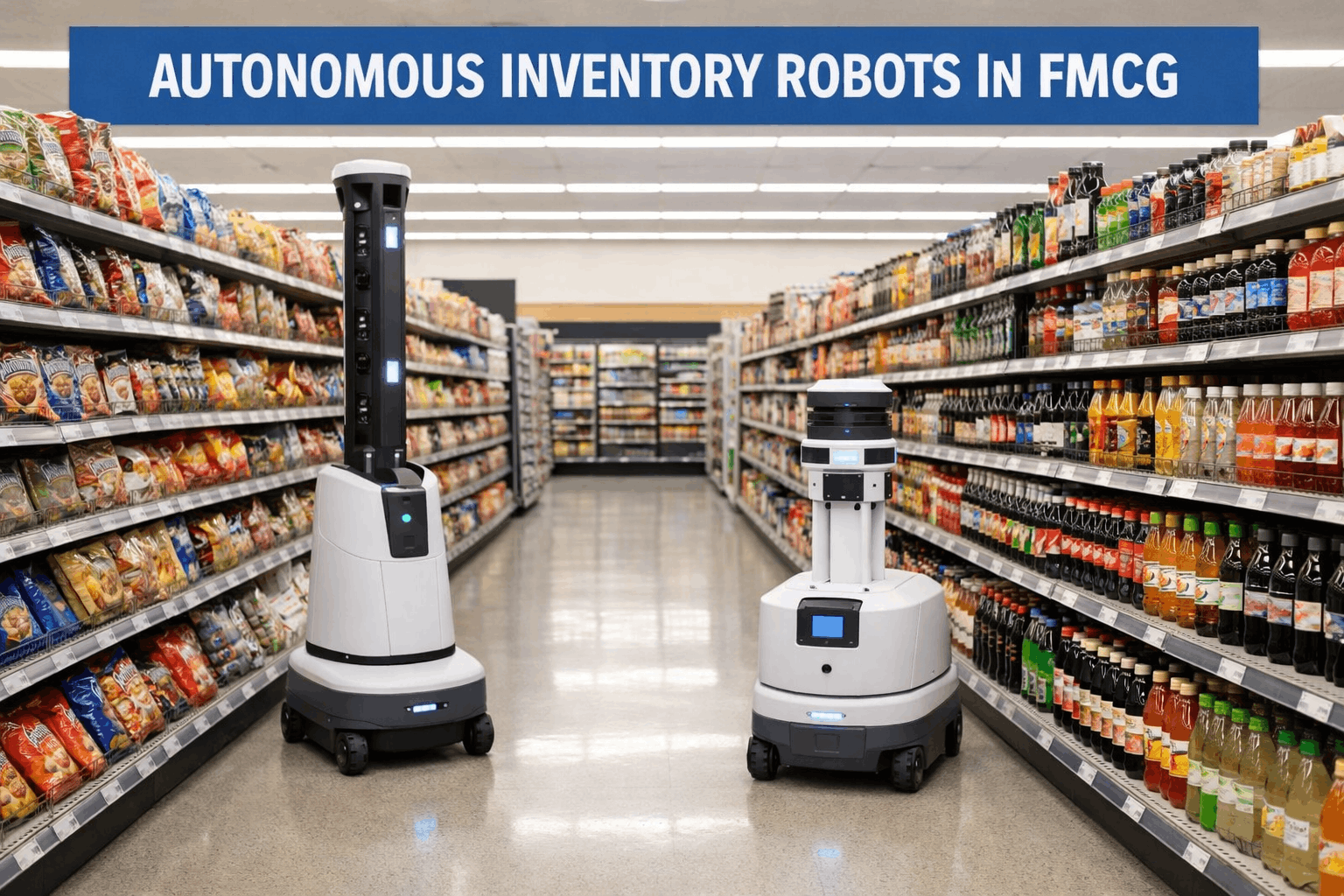
FMCG inventory shrinkage costs the industry $1.77 trillion annually — driven by stockouts, phantom inventory, expired products, and manual counting errors that go undetected for weeks. AI-powered inventory management combined with AMR stock-counting robots replaces periodic cycle counts with continuous, autonomous visibility across every warehouse bay, cold storage rack, and distribution center floor. The result: 99.5% inventory accuracy, automated restocking, and demand predictions that prevent both stockouts and costly overstock positions. Start your free trial to gain real-time stock control. Book a 30-minute demo with our supply chain team.
$1.77T
Global Annual Cost of Retail and FMCG Inventory Distortion
72%
Consumers Who Switch Brands After a Single Stockout Event
3.5%
Perishable Inventory Written Off Annually Due to FIFO Failures
99.5%
Inventory Accuracy Achievable with AI + AMR Scanning Systems
What Is AI-Powered FMCG Inventory Management?
AI-powered inventory management is the integration of autonomous counting robots, machine learning demand models, and automated replenishment logic into a single platform that maintains continuous visibility over every SKU across every location — without manual intervention.
AMR stock-counting robots navigate warehouse aisles autonomously, scanning barcodes, RFID tags, and shelf positions using computer vision. This data feeds into an AI engine that compares physical counts against system records in real time, predicts demand 14–21 days ahead, and triggers purchase orders before stock gaps appear. For FMCG operations where a single stockout event costs $4,500 per SKU in lost revenue, this continuous intelligence replaces the guesswork that legacy systems depend on.
Why Manual Inventory Processes Are Failing FMCG Brands
Legacy counting methods were designed for slower supply chains. In modern FMCG distribution — where SKU counts exceed 15,000 and product velocity changes weekly — manual processes create six compounding failure points.
!
Stale Count Data
Monthly cycle counts are obsolete within 48 hours. By the time discrepancies surface, stockouts have already cost an average of $38K in lost orders per distribution center.
!
Phantom Inventory
62% of FMCG warehouses carry phantom stock above 5% — products the system says exist but physically do not. Every phantom unit generates a failed pick, expedited reorder, and disappointed customer.
!
Expiration Waste
Poor FIFO visibility destroys 3.5% of perishable inventory annually. A $200M brand writes off $7M in expired product each year — product that was in stock but buried behind newer batches.
!
Labor-Intensive Counting
Manual counting consumes 4,200+ labor hours annually in a mid-size DC. At $28/hr fully loaded, that is $117K per year spent on an activity that delivers 63–78% accuracy at best.
!
Overstock Capital Lock
Without demand intelligence, safety stock runs 40–60% above actual need. Mid-size FMCG operations trap $2.8M in excess working capital that generates zero return while occupying premium warehouse space.
!
Multi-Location Blind Spots
Visibility degrades 23% per additional site. Without real-time cross-facility data, one warehouse sits on 8 weeks of stock while another stockouts — and nobody knows until the order fails.
Manual Counting vs. AI-Driven Stock Visibility
The difference between manual and AI-powered inventory management is not a marginal improvement — it is a structural transformation across every performance metric.
Manual / Spreadsheet-Based
Counting Frequency
Monthly or quarterly — 48-hour data staleness window
Accuracy Level
63–78% — human errors compound across 15K+ SKUs
Stockout Response
Discovered at pick failure — 2.4 day average delay
Reorder Intelligence
Static min/max levels — missed during demand spikes
Expiration Control
FIFO enforced on paper — not validated physically
Annual Counting Cost
$117K in labor for 4,200 hours of non-productive work
AI + AMR Autonomous System
Counting Frequency
Continuous — full facility scanned every 4–8 hours
Accuracy Level
99.5%+ — computer vision eliminates counting errors
Stockout Response
Predicted 3–7 days before occurrence via demand models
Reorder Intelligence
Dynamic AI thresholds adjust to velocity and seasonality
Expiration Control
AI flags at-risk products 30–60 days out for action
Annual Counting Cost
78% labor reduction — AMRs scan without disruption
Six AI Capabilities That Transform FMCG Inventory
Each capability builds on real-time stock data to create a self-correcting supply chain where human intervention is the exception, not the rule.
01
Autonomous AMR Counting
Robots scan 100K sq ft every 4–8 hours using RFID, barcode, and vision sensors. 3.2x faster than manual teams. Zero warehouse disruption — scans run during off-peak hours automatically.
02
Demand Forecasting Engine
ML models analyze 18+ months of sales data, promotional calendars, weather, and seasonal patterns. Predicts demand per SKU per location 14–21 days ahead with 91% accuracy.
03
Automated Replenishment
When stock approaches AI-calculated reorder points, POs generate automatically with optimal quantities. Vendor routing, negotiated pricing, and approval workflows fire without manual input.
04
Expiration Intelligence
AI monitors batch dates across all locations. Products approaching expiry trigger markdown recommendations or cross-site transfers 30–60 days out — reducing spoilage waste by 34%.
05
Cross-Site Stock Balancing
Real-time multi-location visibility enables AI to recommend inter-facility transfers. One DC has 8 weeks of stock, another is 3 days from stockout — the system balances before impact.
06
Shrinkage Pattern Detection
Continuous counting detects discrepancies within hours. AI identifies shrinkage hotspots by zone, shift, product category, and day of week — enabling targeted loss prevention actions.
Your Competitors Count Inventory Every 4 Hours. You Count Every 30 Days.
Oxmaint connects AMR scanning, demand intelligence, and automated restocking into a single platform — giving you the stock visibility that modern FMCG distribution demands.
How Oxmaint Delivers Real-Time Inventory Intelligence
Oxmaint unifies asset management, parts tracking, and inventory analytics into a platform built for multi-site FMCG operations. Every restocking decision is data-driven.
01
Unified Asset + Inventory Registry
Every SKU, spare part, and consumable tracked alongside the equipment it supports. When a pump needs a seal kit, Oxmaint shows location, quantity, cost, lead time, and last reorder date.
02
Dynamic Min/Max Intelligence
AI adjusts reorder points based on consumption velocity, seasonal demand curves, and supplier lead times. Static safety stock is replaced with living thresholds that evolve with your operation.
03
Portfolio-Level Visibility
Single dashboard shows stock levels, consumption trends, and reorder status across all warehouses, DCs, and production sites. Benchmark locations, identify imbalances, and trigger transfers instantly.
04
Automated Procurement Workflow
AI-triggered POs route through approval chains, preferred vendor lists, and negotiated pricing tiers automatically. Average procurement cycle reduced from 4.2 days to 6 hours.
$2.6M
Average Annual Savings per Mid-Size FMCG Distribution Center
71%
Reduction in Stockout Events After AI Implementation
34%
Decrease in Expired Product Write-Offs Year Over Year
6 Hrs
Average Procurement Cycle Time with Automated PO Workflows
Implementation: From Manual Counts to Autonomous Intelligence
Most FMCG operations achieve full AI-managed inventory within 16–24 weeks using a four-phase approach that delivers measurable ROI from Phase 2 onward.
Phase 1
Digitize and Baseline (Weeks 1–4)
Migrate all inventory records into Oxmaint. Conduct full physical count for accuracy baseline. Map SKU locations, velocity classifications, and current reorder parameters across all sites.
Phase 2
Continuous AMR Scanning (Weeks 5–10)
Deploy AMR counting robots. Integrate scan data with platform records. Resolve phantom inventory discrepancies. Accuracy typically jumps from 68% to 94% within first 3 scan cycles.
Phase 3
AI Forecasting Activation (Weeks 11–18)
Activate demand prediction models on top 50% of SKUs by velocity. Switch from static to AI-dynamic reorder points. Begin automated restocking with approval workflows for procurement teams.
Phase 4
Full Autonomous Operations (Weeks 19–24)
Extend AI restocking to all SKUs. Activate cross-location balancing, expiration management, and shrinkage detection. Validate ROI against Phase 1 baselines — typical result: $2.6M annual savings.
From 68% Accuracy to 99.5% — in Under 10 Weeks
Most Oxmaint customers eliminate phantom inventory and hit 94%+ accuracy within their first three AMR scan cycles. Start your implementation today and see the difference data-driven stock control makes.
Frequently Asked Questions
How do AMR stock-counting robots operate in busy FMCG warehouses?
AMR robots use LiDAR navigation and pre-mapped routes to traverse warehouse aisles autonomously. They scan barcodes, RFID tags, and shelf positions using mounted computer vision cameras. A single unit covers 100,000 sq ft in 4–8 hours — compared to 3–5 days for a manual counting team. Scanning typically runs during off-peak hours or shift changes, requiring zero disruption to normal picking and shipping operations.
What accuracy improvement should FMCG brands expect from AI inventory systems?
Operations typically move from 63–78% accuracy with manual counting to 99.5%+ with AI and AMR systems. This improvement eliminates phantom inventory, reduces stockout events by 71%, and cuts expired product waste by 34%. The accuracy gain alone delivers $800K–$1.2M in annual savings for a mid-size FMCG distribution center before factoring in labor reduction and overstock release.
Can AI forecast seasonal demand spikes for FMCG categories?
Yes. AI models ingest 18+ months of historical sales data alongside promotional calendars, regional events, weather data, and economic indicators. The engine predicts demand per SKU per location 14–21 days ahead with 91% accuracy. For seasonal FMCG categories like beverages, confectionery, and suncare — where demand can swing 200–400% — this predictive window prevents both costly stockouts and margin-destroying overstock positions.
Book a demo to see seasonal forecasting.
How does Oxmaint integrate with existing ERP and WMS platforms?
Oxmaint connects with SAP, Oracle, Microsoft Dynamics, and major WMS platforms through standard API integrations. Inventory data syncs bi-directionally — stock levels, PO status, consumption rates, and reorder triggers stay consistent across all systems. Integration is configured during Phase 1 with no custom development required. Most connections are live within 5–7 business days.
Every Hour Without Real-Time Visibility Costs You Revenue
Oxmaint delivers continuous stock intelligence, AI-driven restocking, and portfolio-wide visibility — so every SKU is in the right place, at the right quantity, at the right time.
.png)