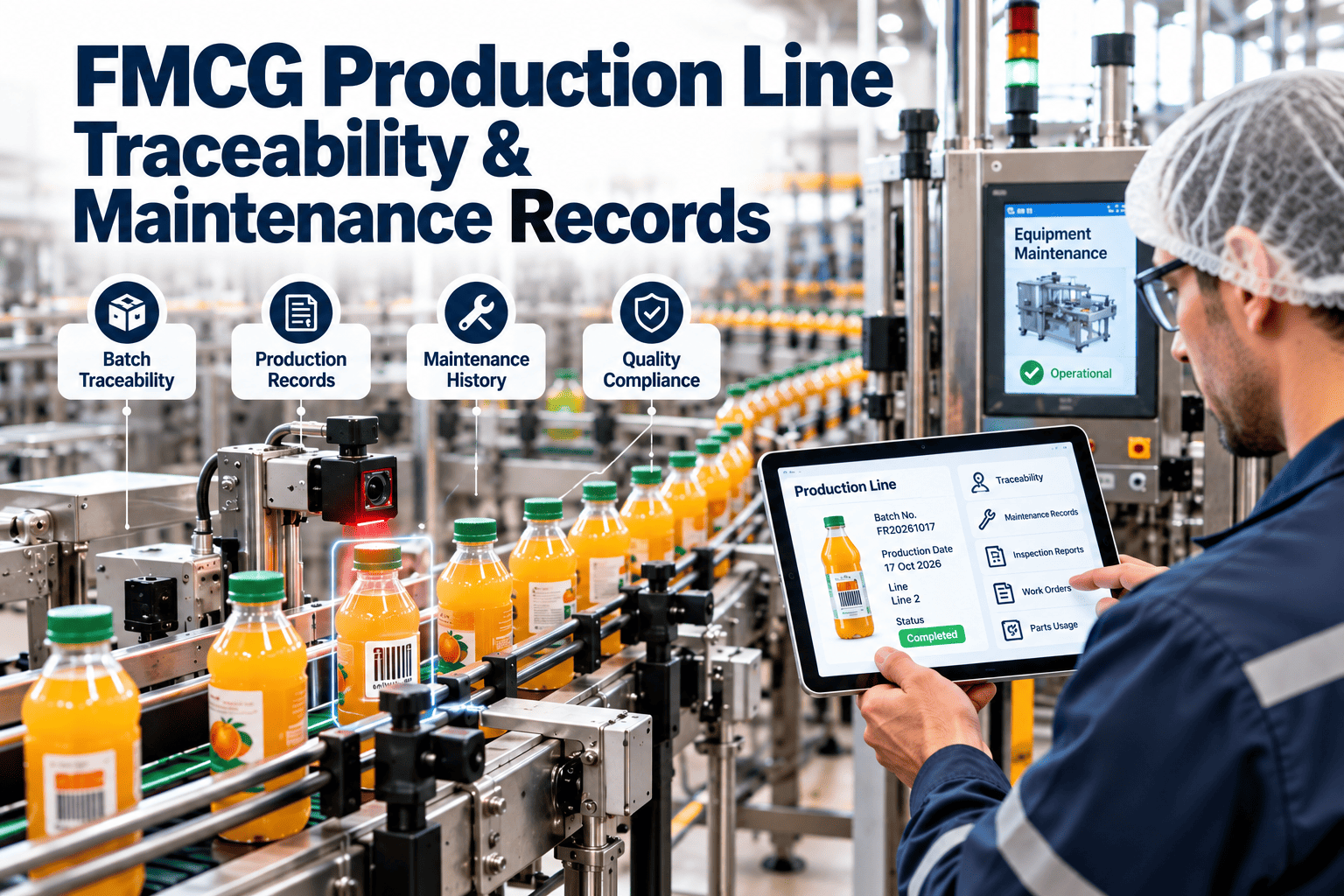
When a quality hold lands on a Friday afternoon, the first question is rarely about the product. It is about the line: what ran, what stopped, what was repaired and what was changed. Lot codes tell you what was made, but maintenance records tell you under what equipment condition it was made. FMCG plants that join the two can scope a hold in hours instead of days. This guide shows how to link production lots to maintenance events, with workflows built in Oxmaint maintenance management software.
Link Every Lot to the Equipment Condition It Was Made Under
Correlate downtime, repairs and changeovers with lot codes so a quality hold can be scoped precisely, defended to auditors and closed faster.
The Gap Between Lot Records and Maintenance Records
Most plants keep two sets of truth. Production systems know the lot, the time and the line. The maintenance system, or a paper log, knows the repair. Nothing connects them.
- Lot and batch codes
- Start and finish times
- Line and shift
- Ingredients and packaging used
- Quality check results
- Which asset stopped and why
- What was repaired or adjusted
- Which parts were fitted
- Who cleared the line
- Calibration and inspection status
What the gap costs when a hold occurs
- Wider holds than necessary because nobody can confirm which lots were unaffected
- Hours spent reconciling shift logs, emails and handwritten notes
- Weak root cause analysis because the equipment history is incomplete
- Difficulty showing customers or auditors that a hold was scoped on evidence
What Traceability Means for Maintenance Teams
Traceability is often treated as a supply chain and quality topic. For maintenance, it means two practical obligations.
The Data Chain: Lot to Line to Asset to Event
A usable trace needs a clear chain of identifiers. Each link should be a recorded field, not a memory.
Minimum fields worth capturing on every work order
- Asset ID and line, so the event attaches to a production path
- Start and end time to the minute, matched to the production clock
- Event type: planned, breakdown, adjustment, cleaning-related, calibration
- Food contact status of the affected component
- Parts fitted, including batch or lot numbers for critical spares where relevant
- Person who cleared the line and the time of release
Correlating Downtime With Quality Holds
Downtime patterns often explain quality events. A rise in micro-stops before a coding fault, or a repair before a seal complaint, becomes visible when both are stored against the same line and time window.
| Maintenance signal | Possible quality link | What to check |
|---|---|---|
| Repeated micro-stops on the filler | Fill volume variation or leakers | Valve wear, sensor drift, product temperature |
| Unplanned stop on the packer | Incorrect case count or damaged packs | Jam clearance method, guide settings, restart checks |
| Seal bar or heater replacement | Seal integrity issues in following lots | Temperature verification, dwell time, first-off checks |
| Metal detector or checkweigher fault | Reduced detection confidence | Fault duration, verification tests, product since last good check |
| Coder or printer repair | Missing or illegible lot codes | Code verification, packs produced before fix |
| Conveyor belt or guide repair | Foreign material risk, product damage | Fragments accounted for, area inspected before restart |
Walkthrough: Scoping a Hold in Four Steps
Consider a seal complaint traced to lots produced on one line. With linked records, the scoping exercise follows a short, evidenced sequence.
Regulatory Context: Traceability Is Tightening
US food traceability rules under FSMA Section 204 require records for foods on the FDA Food Traceability List, built around Critical Tracking Events and Key Data Elements. FDA has extended the compliance date to July 20, 2028, and records must be available within 24 hours of a request.
Certification schemes such as BRCGS, SQF and FSSC 22000 also expect traceability and, in practice, the ability to scope an incident quickly. Confirm requirements for your markets with your certification body or regulatory adviser.
Building Traceable Maintenance Records With Oxmaint
Oxmaint helps teams record work orders against assets, lines and time, attach clearance sign-offs and keep parts and inspection history together. Set up your asset and line structure so maintenance events can be matched to production records.
Cleaning, Changeover and Sanitation as Traceability Events
Not every event that matters is a repair. Changeovers, allergen cleans and sanitation windows define where one lot ends and another begins on a line.
| Event | Why it matters for traceability | What to record |
|---|---|---|
| Product changeover | Marks the boundary between lots and formulations | Time, line, person, clearance check and first-off result |
| Allergen or deep clean | Supports claims about cross-contact control | Method, verification result and sign-off before restart |
| Planned maintenance stop | Defines when equipment condition changed | Tasks done, parts fitted and release time |
| Equipment trial or setting change | May alter process conditions for later lots | Old and new settings, approver and verification |
Rework, Reprocessing and Line Clearance
Rework flows break simple lot-to-line logic. Maintenance events on rework equipment need the same attention as on the main line.
- Give rework and reprocessing equipment its own asset records and inspection routes
- Record maintenance on shared or intermediate equipment against every line it serves
- Require line clearance after maintenance before rework is reintroduced
- Keep the link between the rework lot, the equipment used and the work orders raised
Who Does What in a Traceability Exercise
A mock or real trace works best when every role knows its part. Agree these in advance, not during the incident.
Running a Mock Trace Exercise
A mock trace shows how your records behave under pressure, without the pressure of a real hold. Run one each quarter and record the findings.
- Select a finished lot at random and name a plausible defect
- Time how long it takes to list every maintenance event on the line in the production window
- Note every question that needed a phone call, a paper search or a guess
- Turn each gap into an action with an owner, such as a missing field or inconsistent asset name
- Repeat the exercise on a different line after fixes are in place
Typical findings from a first mock trace
- Work orders without end times, so the production overlap cannot be judged
- Repairs recorded against a generic line name instead of the specific machine
- Operator adjustments that appear in shift notes but not in the maintenance record
- Calibration status held by quality, with no link from the line asset
Equipment Data That Strengthens a Trace
Beyond work orders, other equipment records help explain what a line was doing during a lot. Decide which are worth keeping against the asset.
| Data source | What it adds to a trace | How maintenance can use it |
|---|---|---|
| Alarm and fault logs | Shows brief faults that never became work orders | Review before and after a defect to spot patterns |
| Temperature and pressure records | Confirms process conditions during the run | Check sensor calibration status for the same period |
| Metal detector and checkweigher logs | Records rejects and verification tests | Link to repairs and calibrations on the device |
| Cleaning and CIP records | Shows hygiene status at start of the run | Link failed cycles to follow-up maintenance |
| Shift handover notes | Captures informal interventions and adjustments | Convert recurring notes into structured work orders |
Keep it proportionate
- Start with the stations most likely to affect product safety or legality
- Add data sources only when someone will use them in a trace or a review
- Check that each source uses the same line and asset names as your maintenance system
- Retire fields nobody reads, so technicians are not burdened with empty data entry
Preparing for Customer and Auditor Trace Requests
External requests arrive at inconvenient times. A short, prepared routine keeps responses accurate and calm.
- Name a trace coordinator for each shift pattern, so requests are never stranded
- Keep a template report that lists lots, line, equipment events, clearances and calibration status
- Agree who reviews and approves the report before it leaves the site
- Log each request, the time to respond and any gaps found
Starting Small: A First Month Plan
You do not need a plant-wide programme to see value. Begin with one line and one defect type, and expand as the team gains confidence.
- Week one: confirm asset names, line names and time sources on the chosen line
- Week two: require start time, end time and sign-off on every work order
- Week three: link calibration and clearance records to the same assets
- Week four: run a mock trace, record the gaps and fix the top three
Scope the Next Quality Hold on Evidence, Not Guesswork
Record maintenance events against assets and lines so they can be matched to lots when it matters.
Integrating Maintenance and Production Data
You do not need a single system to link lots and maintenance. You need consistent identifiers and a reliable way to reconcile time.
| Approach | How it works | Strength | Limitation |
|---|---|---|---|
| Manual reconciliation | Compare shift logs and work orders by line and time | No integration work | Slow, error-prone, dependent on one person |
| Shared identifiers | Use the same asset and line IDs in both systems | Simple and repeatable | Requires discipline and naming standards |
| Exported reports | Regular exports from production joined with maintenance history | Good for trend review | Not real time |
| Integrated systems | Systems exchange line status, downtime and lot data | Fastest scoping | Needs IT involvement and testing |
Clock discipline matters more than technology
If production time and maintenance time differ by several minutes, correlation fails exactly when you need it. Agree one time source, and record start and end times consistently on every work order.
Traceability Checklist for Maintenance Records
Use this list as a monthly review. Each item should be answerable from the system without a search.
Common Traceability Weak Points in Maintenance
These patterns appear again and again in plants that struggle to scope holds.
Measuring Traceability Performance
A few indicators show whether your records will hold up under pressure.
Frequently Asked Questions
Make Every Lot Traceable to the Equipment Behind It
Connect maintenance events, clearances and inspections to your production lines, and shorten the time to answer when quality calls.