
A major FMCG manufacturer recalled 240,000 units of packaged sauce after consumers reported inconsistent viscosity and off-taste across three production batches. Investigation revealed two simultaneous root causes: a reformulated thickening agent that had not been evaluated for thermal stability — a design gap — and a mixing speed parameter that drifted 18% above specification during shift changeovers — a process gap. The recall cost $110,000 in direct losses plus retailer penalties. Had the company applied DFMEA during reformulation and PFMEA during process validation, both failure modes would have been identified and mitigated weeks before production began. Understanding which FMEA type your FMCG operation needs — and when to apply each — is the difference between preventing failures at $600 in analysis cost and discovering them at $110,000 in recall cost. FMCG manufacturers deploying structured FMEA programs through Oxmaint's integrated FMEA module reduce product recalls by 74% within the first program year. Book a demo with our FMCG quality specialists to see DFMEA and PFMEA workflows in action.
DFMEA + PFMEA — Oxmaint Quality Platform
Stop Reacting to Failures. Start Preventing Them with Structured FMEA.
Oxmaint digitises your DFMEA and PFMEA workflows — auto-calculating RPNs, tracking corrective actions to verified closure, and generating audit-ready risk documentation from a single platform used by R&D, quality, production, and maintenance together.
74%
Recall Reduction for Companies Running Both DFMEA and PFMEA Together
68%
Of FMCG Process Steps Exceed RPN Action Threshold of 200 When First Analysed
12–28×
ROI on Structured FMEA Program Investment in First Year of Operation
$110K
Average Direct Cost of a Single FMCG Recall — Preventable With $600 in Analysis
THREE TYPES AT A GLANCE
FMEA vs DFMEA vs PFMEA — Scope, Timing, and Application
Three analysis types, three different scopes — all essential for comprehensive FMCG risk management across design, process, and system levels
FMEA — General
Primary Focus
System-level failure modes across design, process, and operational dimensions
When Applied
Any stage — design, process, or system — as the umbrella risk methodology
Key Output
Risk Priority Numbers (RPNs) and unified risk register for the operation
FMCG Use Case
End-to-end supply chain risk · regulatory audit preparation · HACCP integration
DFMEA — Design
Primary Focus
Product design and formulation — what can fail in the product itself before manufacturing begins
When Applied
Before production — during R&D phase, formulation changes, and packaging redesigns
Key Output
Design validation requirements, specification limits, accelerated stability test protocols
FMCG Use Case
New formulations · packaging redesigns · supplier changes · shelf life extensions
PFMEA — Process
Primary Focus
Manufacturing process steps — what can fail in how the product is made, handled, and packed
When Applied
During and after process setup — line commissioning, changeover development, and rejection investigation
Key Output
Process control plans, corrective action register, PM schedule adjustments, SPC parameters
FMCG Use Case
Production line optimisation · recurring batch rejections · changeover failures · CIP validation
Best Practice: Run DFMEA First — Then Feed Its Outputs Directly Into PFMEA
Sequential Integration
WHEN TO USE WHICH
Six Critical Decision Points for FMEA Type Selection
The most common mistake FMCG quality teams make is applying the wrong FMEA type at the wrong stage — these six decision points clarify which analysis belongs where
DFMEA
New Product Launch
Evaluate formulation stability, packaging compatibility, and shelf life risks before scaling to production — catches design failures no process control can fix
PFMEA
Line Changeover Issues
Analyse setup errors, parameter drift, and contamination risks during SKU transitions — process failures that occur even with a perfect product design
DFMEA + PFMEA
Supplier Change
New raw material requires both design re-validation and process parameter adjustment — a supplier change touches both design intent and production execution
PFMEA
Recurring Defects
Systematic process failures causing repeat batch rejections, consumer complaints, or rework — the root cause is in how the product is made, not in its design
DFMEA
Packaging Redesign
Seal integrity, material compatibility, barrier properties, and consumer safety must be evaluated at design stage — before tooling investment and line setup
FMEA
Regulatory Audit Prep
System-level risk register covering FSSAI, ISO 22000, HACCP, and BRC compliance requirements — the unified view that satisfies all audit documentation needs
DFMEA WORKFLOW
How DFMEA Protects FMCG Products Before They Reach Production
Design FMEA evaluates potential failure modes in the product itself — formulation, packaging, labeling, and material selection — before a single unit is manufactured
01
Define Functions
Map every product function and consumer requirement
Document regulatory and food safety requirements
Establish performance specifications and limits
Scope: Product Intent
02
Identify Failures
List how each product function could fail
Map failure effects on consumer, brand, and compliance
Trace root causes in design decisions and material choices
Output: Failure Mode List
03
Score and Prioritise
Rate Severity, Occurrence, and Detection (1–10 each)
Calculate Risk Priority Numbers — RPN = S × O × D
Rank risks by RPN to sequence corrective actions
Output: RPN Rankings
04
Mitigate and Validate
Design changes to eliminate high-RPN failure modes
Accelerated stability and stress testing per risk findings
Update design specifications with validated controls
Output: Safe Design
PFMEA RISK MAP
PFMEA Risk Analysis by FMCG Process Step
Common failure modes, typical RPN ranges, and recommended process controls across the six most critical FMCG process families
Raw Material Receiving
Wrong grade accepted, contaminated lot passed, temperature abuse in transit, allergen mislabeling on incoming material
RPN: 280–420
Batching and Mixing
Incorrect ingredient weight, addition sequence error, mixing time deviation, temperature overshoot during emulsification
RPN: 320–480
Thermal Processing
Pasteurisation time shortfall, oven zone temperature imbalance, cooling rate deviation, hot-fill temperature drift beyond specification
RPN: 360–540
Filling and Packaging
Underfill or overfill beyond tolerance, seal contamination, label misregistration, cap torque out-of-spec, headspace oxygen drift
RPN: 240–400
Changeover and CIP
Allergen cross-contact from incomplete rinse, wrong recipe parameters loaded, gasket not replaced after wear cycle, chemical residue in lines
RPN: 400–600
Warehousing and Dispatch
FIFO violation, temperature excursion in storage, pallet damage, incorrect batch code shipped to trade
RPN: 180–320
Average FMCG Processes with RPN Above Action Threshold (200+)
68%
RPN = Severity × Occurrence × Detection. Scores above 200 require documented corrective action. Scores above 400 indicate critical risk requiring process redesign or additional automated detection controls before production continues.
Auto-Calculated RPNs — Integrated Corrective Actions
DFMEA and PFMEA — Both in One Platform, Both Connected to Your CMMS
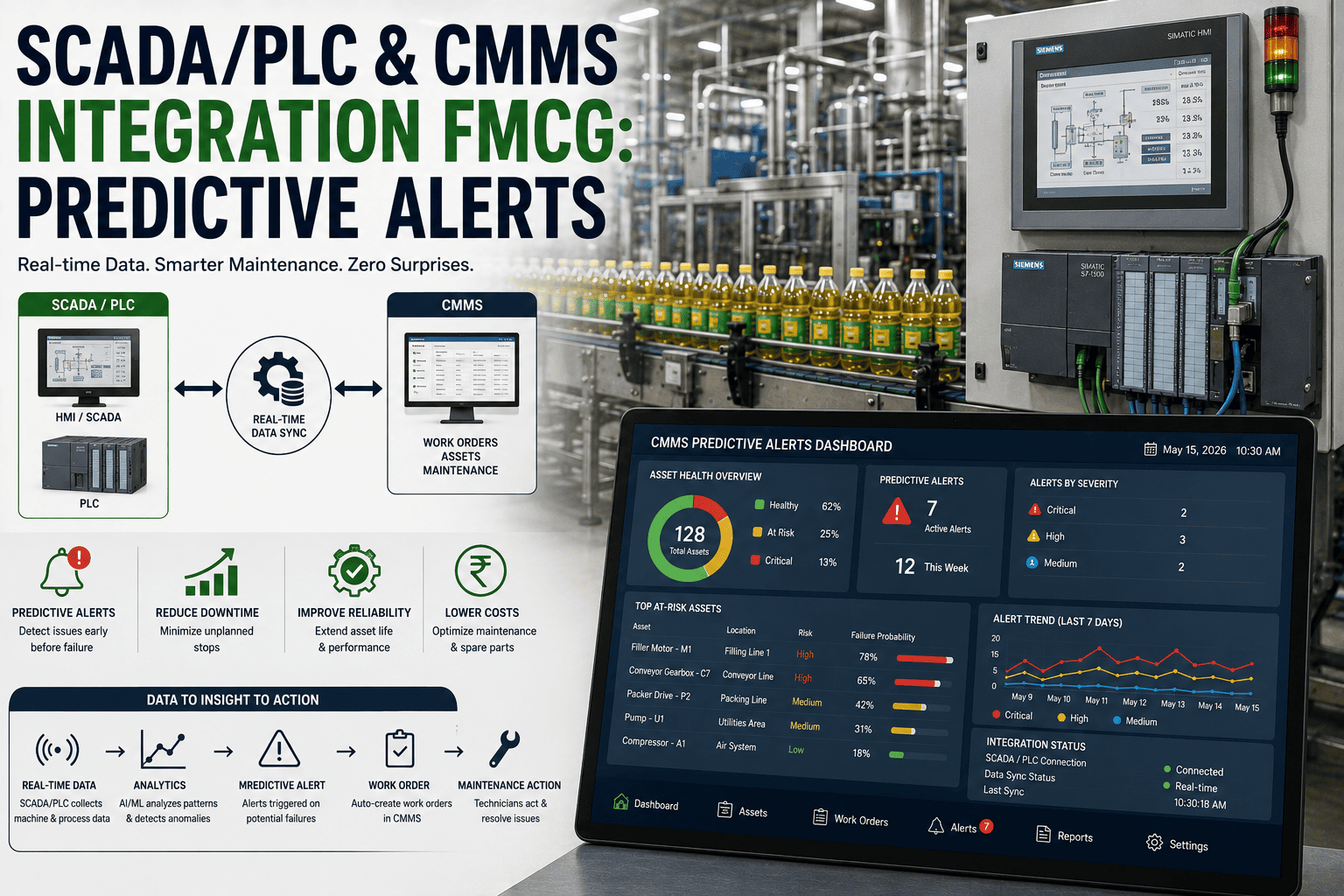
When PFMEA identifies an equipment-related failure mode, Oxmaint generates the corrective work order, PM schedule update, and verification task automatically — so every finding becomes a closed loop, not a filed document.
DFMEA vs PFMEA
Side-by-Side Comparison for FMCG Quality Teams
Understanding where DFMEA ends and PFMEA begins prevents the gaps where most FMCG failures slip through — between product development and manufacturing
DFMEA — Design FMEA
Core Question
What can go wrong with the product itself — even if manufactured perfectly?
Team Ownership
R&D, product development, and packaging engineers — led by design function
Typical Failures Found
Formulation instability, material incompatibility, packaging barrier gaps, shelf life failures
Cost of Catching Late
$24,000–$120,000+ including recalls, reformulation costs, and retailer penalties
Prevention Investment
$600–$1,800 per analysis — R&D team time and accelerated test protocols
PFMEA — Process FMEA
Core Question
What can go wrong in how we make it — even with a perfect product design?
Team Ownership
Production, quality, and maintenance engineers — led by process function
Typical Failures Found
Parameter drift, changeover errors, equipment wear, CIP failure, operator error patterns
Cost of Catching Late
$3,600–$48,000 per event including batch rejection, rework, and consumer complaint handling
Prevention Investment
$240–$960 per analysis — cross-functional team sessions using CMMS failure history
ROI FRAMEWORK
Annual ROI of a Structured FMEA Program in FMCG
Mid-size FMCG plant — 4 production lines — 200 SKUs — 15 new product launches per year
Recall Prevention
3 prevented recalls × $33,600 average recall cost including product retrieval, penalties, and brand damage
$100,800
Batch Rejection Reduction
PFMEA-driven process controls reduce batch rejections by 58% — 12 fewer rejects per year at $4,800 average cost each
$57,600
Faster Time-to-Market
DFMEA eliminates design rework cycles — 3 weeks faster launch per new product × $5,040 revenue per week per SKU
$75,600
Consumer Complaint Reduction
62% fewer quality complaints — reduced retailer penalties, return processing costs, and brand erosion value
$26,400
Audit and Compliance Efficiency
Pre-built FMEA documentation cuts FSSAI, ISO 22000, HACCP, and BRC audit preparation time by 50%
$14,400
Total Annual Value Delivered
$274,800
Program investment: $9,600–$21,600/year including software, training, and cross-functional team time. Net ROI: $253,200–$265,200. Return: 12–28× in first year. ROI accelerates as FMEA databases mature with historical failure data from the CMMS.
IMPLEMENTATION ROADMAP
Building a Sustainable FMEA Program — Phased Deployment
A phased approach that builds cross-functional capability while delivering early wins — FMEA embedded in daily operations, not filed after an audit
01
Week 1–3: Foundation
Train cross-functional FMEA team across functions
Select 2–3 highest-risk products and processes
Establish FMCG-calibrated RPN scoring criteria
Output: Team Capability
02
Week 4–8: First Analysis
Complete DFMEA on next scheduled product launch
Complete PFMEA on highest-rejection production line
Implement top 5 corrective actions per FMEA analysis
Output: $18K–$36K Saved
03
Month 3–6: Scale
Expand PFMEA coverage to all production lines
DFMEA mandatory for every new product launch
Link FMEA outputs to SPC control plans and CMMS
Output: $72K–$144K Saved
04
Month 6+: Mature
Living FMEA databases updated continuously from CMMS
Predictive risk scoring from historical failure data
FMEA-driven capital and maintenance planning decisions
Output: 12–28× ROI
REAL-WORLD CATCHES
Documented FMEA Catches in FMCG Manufacturing
Real failures prevented through structured risk analysis before they reached consumers — demonstrating the distinct value of DFMEA and PFMEA working together
DFMEA Catch — Beverage Formulation
What DFMEA Identified
New natural colorant degraded under UV exposure in clear PET bottles — 40% color fade by shelf life midpoint
Mitigation Applied
UV-barrier additive in PET formulation and modified colorant stabiliser system — validated in accelerated test
Prevention Cost
$2,160 — reformulation and accelerated stability testing
Avoided Loss
$54,000 — trade rejection, consumer complaints, and brand repair
PFMEA Catch — Snack Packaging Line
What PFMEA Identified
Nitrogen flush timing created 12% leak rate after changeover from smaller pouch format to larger SKU
Mitigation Applied
Format-specific flush parameters added to changeover checklist with automated verification at line start
Prevention Cost
$480 — checklist update and sensor calibration
Avoided Loss
$21,600 — leaked packs, shelf life failures, and retailer returns
Combined cost of both analyses
→
Combined loss avoided
29× return on analysis investment
COMMON MISTAKES
Six FMEA Implementation Mistakes in FMCG — and How to Fix Them
FMEA programs fail not because the methodology is flawed but because implementation shortcuts undermine analysis quality — all six have proven solutions
One-Time Audit Exercise
FMEA must be a living document — updated after every failure, process change, or new data point, not filed after the certification audit
Single-Person Authoring
Effective FMEA requires cross-functional teams — R&D, production, quality, and maintenance perspectives together in the same session
Generic RPN Scales
Customise Severity, Occurrence, and Detection scales to your specific FMCG products — automotive scales produce misleading RPNs in food manufacturing
No Action Follow-Through
Assign owners, deadlines, and verification criteria for every corrective action — track to closure with evidence, not just status update
DFMEA–PFMEA Disconnect
DFMEA outputs must feed directly into PFMEA inputs — design assumptions become the process verification points that PFMEA evaluates
Ignoring Detection Rating
Detection is the most actionable RPN factor — improving detection controls often reduces RPN faster and cheaper than product or process redesign
Frequently Asked Questions
FMEA (Failure Mode and Effects Analysis) is the umbrella methodology for systematically identifying potential failure modes and their consequences. DFMEA (Design FMEA) applies this methodology specifically to product design — evaluating how formulations, materials, packaging, and product specifications could fail before production begins. PFMEA (Process FMEA) applies it to manufacturing processes — evaluating how equipment settings, operator actions, material handling, and environmental conditions could cause defective output. In FMCG, DFMEA answers "can this product fail even if manufactured perfectly?" while PFMEA answers "can this process fail even with a perfect product design?" Both are necessary because design and process failures are independent risk categories that require different teams, different timing, and different corrective actions.
Use DFMEA during product development — before a new product, reformulation, packaging change, or supplier substitution reaches the production floor. This is when design failures can be caught at minimal cost — analysis, testing, and design revision are all cheaper than post-launch corrections. Use PFMEA when setting up or modifying production processes — during new line commissioning, process optimisation, changeover procedure development, or after any batch rejection that indicates a process-related root cause. The best practice is sequential integration: complete DFMEA first, then use its outputs — design assumptions, critical parameters, specification limits — as inputs for PFMEA. This ensures process controls are specifically designed to protect the design intent rather than generic process targets.
RPN is calculated by multiplying three factors: Severity (1–10, impact of failure on consumer and business), Occurrence (1–10, likelihood the failure will happen), and Detection (1–10, likelihood the failure will escape to the consumer without being caught). Higher RPNs indicate higher risk — scores above 200 in FMCG typically require documented corrective action, and scores above 400 indicate critical risks requiring process redesign before the next production run. However, RPN alone can be misleading — a failure with Severity 10 but low Occurrence and high Detection (RPN=20) may still require action because the consequence is severe regardless of probability. Modern FMEA practice uses RPN alongside Severity-first prioritisation, ensuring any failure mode with a Severity score of 8 or above receives mandatory action regardless of the overall RPN value.
FMEA serves as the analytical foundation that informs which parameters SPC should monitor and which process steps HACCP should designate as Critical Control Points. PFMEA identifies high-RPN process parameters — these become the variables tracked on SPC control charts during production. DFMEA identifies critical product characteristics — these become the specifications that SPC verifies at the output stage. HACCP hazard analysis directly parallels FMEA methodology but focuses specifically on food safety hazards biological, chemical, and physical. Many FMCG manufacturers combine FMEA and HACCP into integrated risk assessments that satisfy both quality and food safety requirements simultaneously, reducing total documentation burden while providing more comprehensive coverage than either tool alone.
A single DFMEA or PFMEA analysis typically requires 2–4 cross-functional team sessions of 2–3 hours each, involving 4–6 team members from R&D, production, quality, and maintenance. For a mid-size FMCG plant running 200 SKUs across 4 lines, expect 8–12 PFMEA analyses per year (one per process family) and 12–15 DFMEA analyses per year (one per new product launch or major reformulation). Total annual investment: $9,600–$21,600 including software tools, team time, and training. Against prevented recalls ($33,600 average direct cost), prevented batch rejections ($4,800 average each), and faster product launches (3 weeks of revenue per SKU per launch cycle), the ROI consistently exceeds 12× in the first year of a structured program.
FMEA Module — Oxmaint Quality Platform
Every Product Failure Has a Root Cause. FMEA Finds It Before Your Customers Do.
Oxmaint digitises your DFMEA and PFMEA workflows into a single platform — auto-calculating RPNs, assigning corrective actions to owners, linking findings to CMMS work orders, and generating audit-ready risk documentation for FSSAI, ISO 22000, FSSC, and BRC requirements.
DFMEA and PFMEA — Both in One Platform, Both Linked to CMMS
Auto-Calculated RPNs — Severity × Occurrence × Detection, Ranked Live
Corrective Actions Auto-Assign to Owners With Due Dates and Verification
PFMEA Findings Auto-Generate CMMS Work Orders and PM Schedule Updates
Living Document Updates — Every Change, Failure, and Audit Trail Logged
Audit-Ready Export — FSSAI, ISO 22000, FSSC 22000, BRC Documentation
FMEA module included on all plans · Cross-functional team onboarding included · No minimum contract


-in-fmcg-a-step-by-step-guide-to-eliminating-recurring-failures.png)
-in-fmcg-monitoring-production-quality-in-real-time.png)