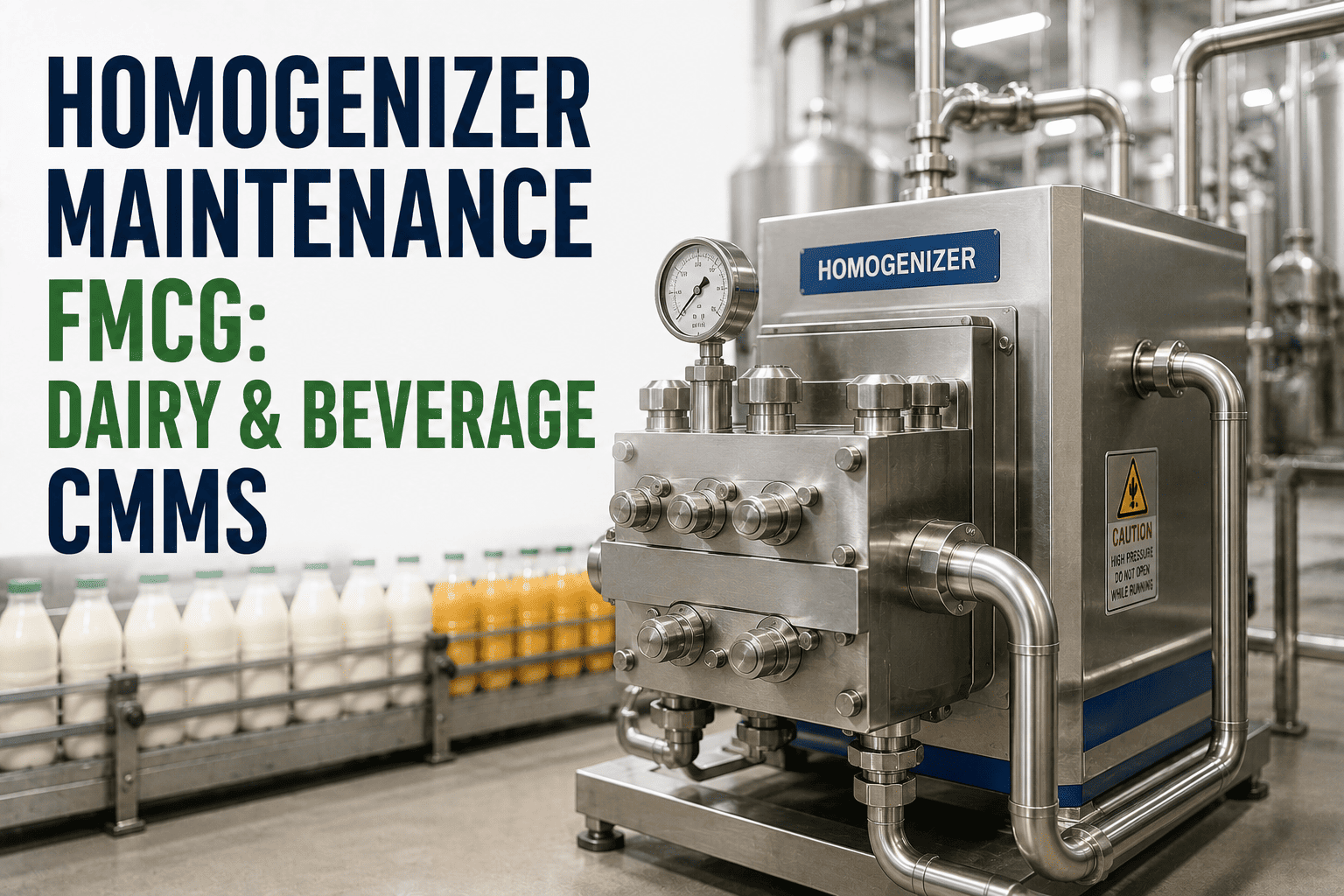
High-pressure homogenizers run at 200 bar and 15,000 RPM in dairy and beverage plants, which means a single worn valve seat can scrap a full batch, trigger a recall, and idle a 12,000-liter-per-hour processing line for hours. This CMMS-driven guide covers homogenizer maintenance in FMCG for dairy and beverage operations — plunger seal replacement, valve seat inspection, pressure gauge calibration, and the preventive maintenance workflow that keeps availability above 98%. If your team is still tracking PM on spreadsheets, the 30-minute setup in Start Free Trial will replace the clipboard on every critical processing asset.
What stops the whole line when your homogenizer drops off pressure at 180 bar?
A single failed plunger seal or lapped valve seat can idle a 12,000 L/hr dairy line for 6–14 hours and scrap the batch upstream. A CMMS-driven PM program cuts unplanned homogenizer downtime by 40–60% in FMCG plants.
High-pressure, high-consequence: the asset that owns your line
A two-stage homogenizer forces milk, cream or juice through a 15-micron gap at 150–250 bar. Every hour it runs, the valve seats erode, plungers wear, and seals lose elasticity. Treat it like a generic pump and you will lose the line — and the batch.
ISO 14224 reliability data from food and beverage processors places the homogenizer in the top 5% of critical rotating assets by downtime impact. In a typical 180-asset dairy plant running two UHT lines, a single homogenizer failure can cascade into $42,000 of lost production per day once raw milk silo capacity backs up. A CMMS-driven PM program targeting this asset specifically — not generic pump maintenance — is what separates 98% availability from 91%.
The homogenizer PM checklist dairy and beverage teams actually use
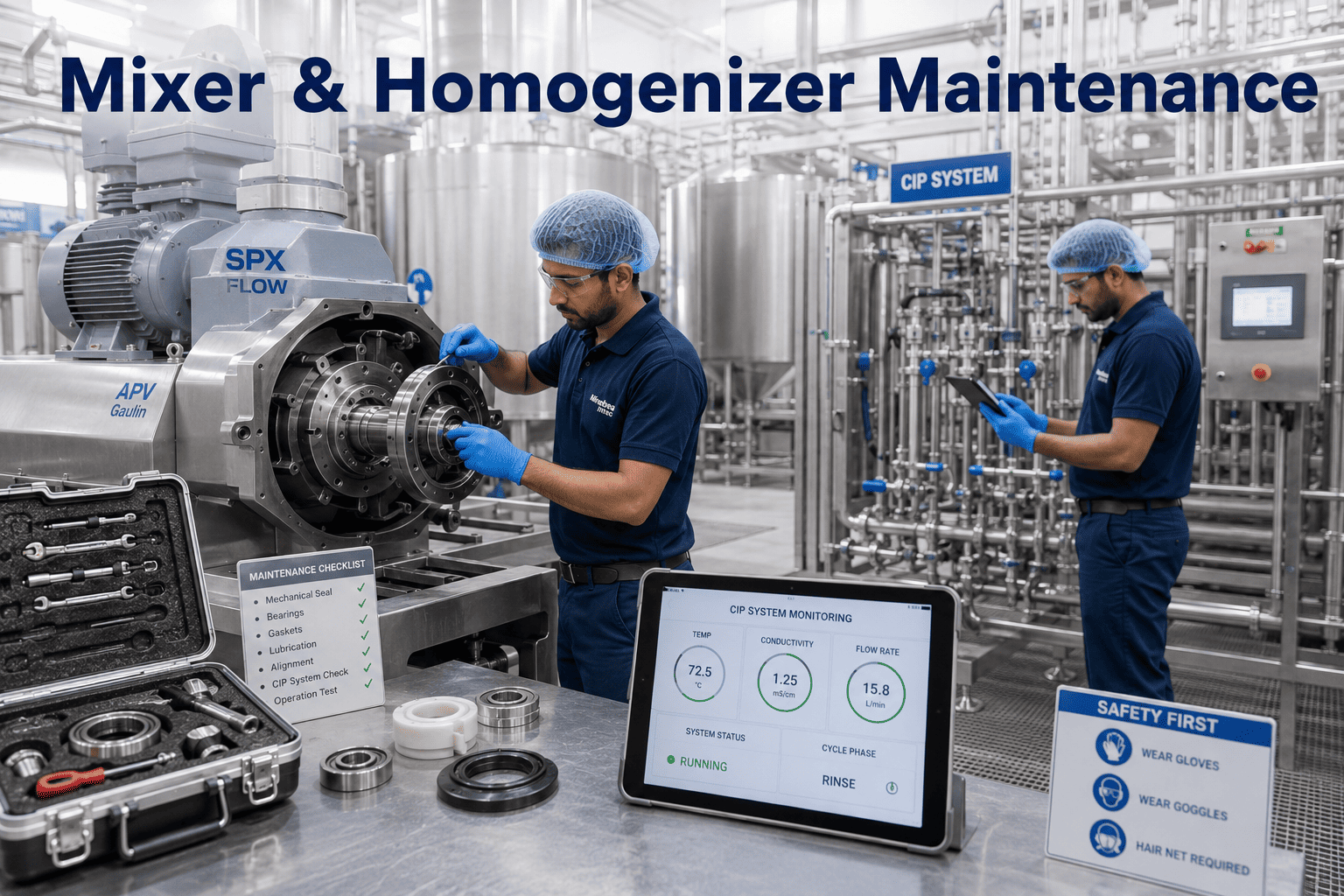
Three service tiers — daily walkaround, weekly inspection, and a 500-hour valve and seal service — keep the asset between 96% and 99% availability. Every task below should be a scheduled work order in your CMMS, not a clipboard note.
Pre-shift walkaround
- Verify inlet pressure stable within ±0.5 bar of setpoint
- Inspect plunger area for leaks past the seal — no visible drip
- Check oil level and temperature on the crankcase sight glass
- Confirm vibration dampener readings within baseline band
- Log homogenizing pressure in the CMMS round sheet
Pressure and seal inspection
- Calibrate both stage-1 and stage-2 pressure gauges against a reference
- Inspect second-stage valve seat for pitting and erosion track
- Measure plunger seal weepage — flag if a drip forms within 60 seconds
- Torque-check homogenizing valve cover bolts to OEM spec
- Pull vibration trend from CMMS — compare to previous week
Valve and seal service
- Remove and lap both first-stage and second-stage valve seats
- Replace plunger seals, V-packings, and O-rings on all plungers
- Inspect impact rings and replace if wear exceeds 0.3 mm
- Change crankcase oil and replace the oil filter element
- Reverify pressure after restart and log in CMMS history
Homogenizer preventive maintenance schedule at a glance
A consolidated PM matrix for a typical 2-stage dairy or beverage homogenizer running 16 hours per day. Every interval, duration, and trigger condition should be configured as an auto-generated work order in the CMMS.
| PM Task | Interval | Trigger | Duration | Typical Parts Cost |
|---|---|---|---|---|
| Pressure gauge calibration | Weekly | Scheduled + drift >2 bar | 20 min | $0 (in-house) |
| Valve seat inspection | 200 hrs | Run-hours | 45 min | $80 |
| Plunger seal replacement | 500 hrs | Run-hours + weepage flag | 2.5 hrs | $340 |
| Valve seat lapping / replace | 500 hrs | Run-hours + erosion >0.3 mm | 3 hrs | $420 |
| Crankcase oil + filter change | 2,000 hrs | Run-hours | 1 hr | $180 |
| Plunger overhaul + bearing inspect | 8,000 hrs | Run-hours + vibration trend | 8 hrs | $2,400 |
Three signals that predict 80% of homogenizer failures
Vibration, pressure stability, and seal weepage are the three leading indicators of valve, bearing, and seal failure on a homogenizer. Wire them into the CMMS as condition-based triggers and you shift from calendar PM to predictive PM.
Vibration trend shift
A 25% rise in RMS vibration on the crankcase housing over a 7-day window typically precedes a bearing or plunger failure by 10–18 days. CMMS threshold alerts let maintenance pull the asset during a planned CIP window, not mid-batch.
Pressure drift on stage 2
A 5-bar drift downward on the second-stage gauge while the first stage holds steady almost always means a lapped valve seat is eroding. Catch it at 5 bar and you re-lap the seat; catch it at 15 bar and you replace it — and the impact ring.
Seal weepage rate
A V-packing that develops a visible drip within 60 seconds of startup is at 70–80% of its useful life. Logging weepage as a CMMS condition field lets the system auto-advance the next seal replacement work order by 100–200 hours.
A 180-asset dairy plant: from spreadsheet PM to CMMS-driven homogenizer reliability
A Midwest fluid milk plant running two UHT lines and one HTST line tracked homogenizer PM on a shared spreadsheet. Three failures in 14 months drove an average of 11.5 hours of unplanned downtime each. Here is what changed when homogenizer PM moved into a CMMS.
Three homogenizer failures in 14 months. Seal replacement intervals missed on two of three machines. Pressure calibration logged manually, often a week late.
Auto-generated work orders on run-hours. Vibration thresholds trigger condition-based service. Pressure calibration locked to weekly with a 48-hour escalation if not closed. Payback on the CMMS investment: under 4 months.
Stop tracking homogenizer PM on a spreadsheet
Deploy a CMMS-built homogenizer reliability program in under 30 minutes. Configure PM triggers, condition alerts, and parts kits for every critical processing asset.
Homogenizer maintenance in FMCG: questions maintenance leaders ask
How often should plunger seals be replaced on a dairy homogenizer?
Under typical 16-hour-per-day dairy operation, V-packing plunger seals last 400–600 run-hours. The 500-hour mark is the standard service interval, but a CMMS should auto-advance that by up to 200 hours earlier if seal weepage crosses a logged threshold. Running seals past 700 hours risks coolant ingress into the product side and a much costlier plunger overhaul.
What is the correct way to calibrate a homogenizer pressure gauge?
Use a certified deadweight tester or a calibrated reference gauge on the gauge port, isolate the process, and compare readings at 25%, 50%, 75%, and 100% of operating pressure. Any drift greater than 2 bar at full scale requires gauge replacement. Log the calibration result, the technician, and the reference device serial in the CMMS — auditors and HACCP reviewers expect a traceable record.
Can a CMMS integrate run-hour data from the homogenizer PLC?
Yes. A modern CMMS like OXMaint accepts run-hour and vibration signals via OPC-UA or Modbus from the homogenizer controller, then auto-triggers PM work orders against actual usage rather than calendar dates. You can see this in action — Book a Demo and we will walk through a live homogenizer asset with condition triggers configured.
What does a typical homogenizer failure cost a beverage plant?
For a mid-size beverage line running 12,000 liters per hour, a single homogenizer stoppage typically costs $8,000–$22,000 in lost batch value, labor, and restart time. If the failure cascades into a missed shipping window or a raw-ingredient silo backup, the figure can exceed $40,000 per day. This is why homogenizer availability is the single biggest lever on overall line OEE.
How long does it take to deploy a CMMS for homogenizer reliability?
A focused homogenizer PM program — asset records, three service tiers, parts kits, and condition triggers — can be configured in a single afternoon. Most dairy and beverage teams are running live work orders within 24–48 hours. You can start with the 14-day trial at Start Free Trial and import your existing PM schedule directly.
Build your homogenizer reliability program today
Join dairy and beverage plants running 98%+ availability on critical processing assets with OXMaint CMMS. Configure your homogenizer PM, condition triggers, and parts kits in under 30 minutes.
Free 14-day trial · No credit card