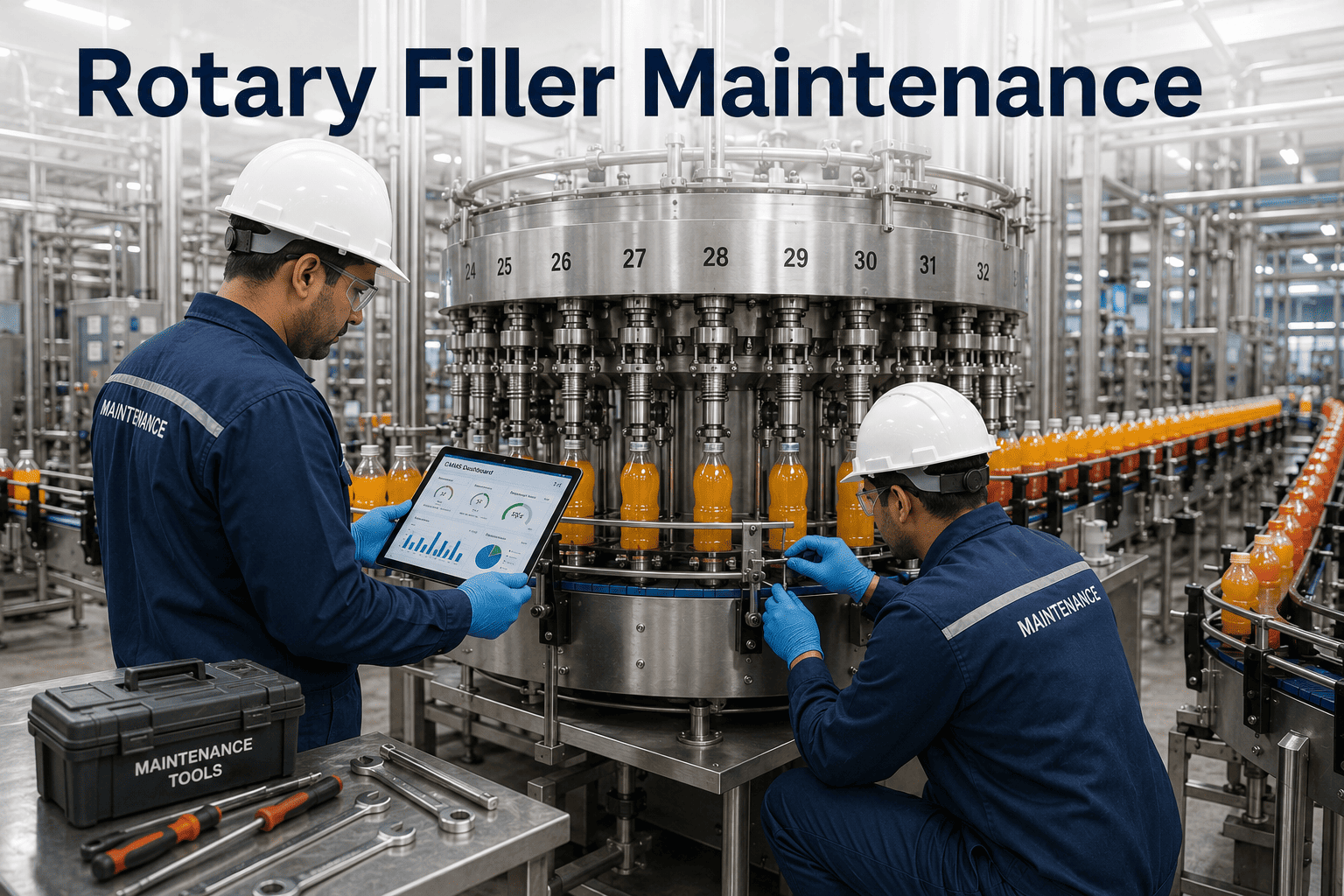
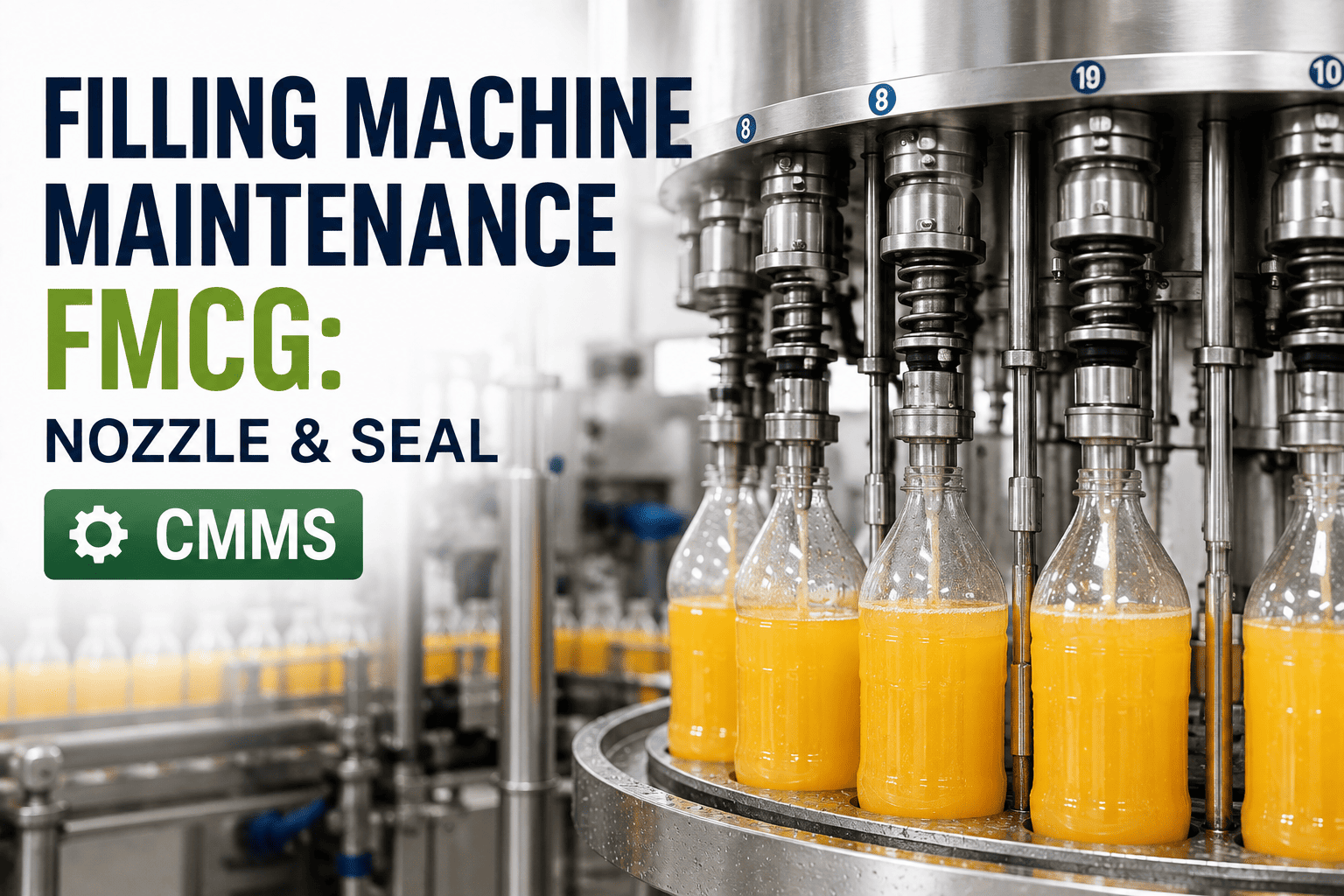
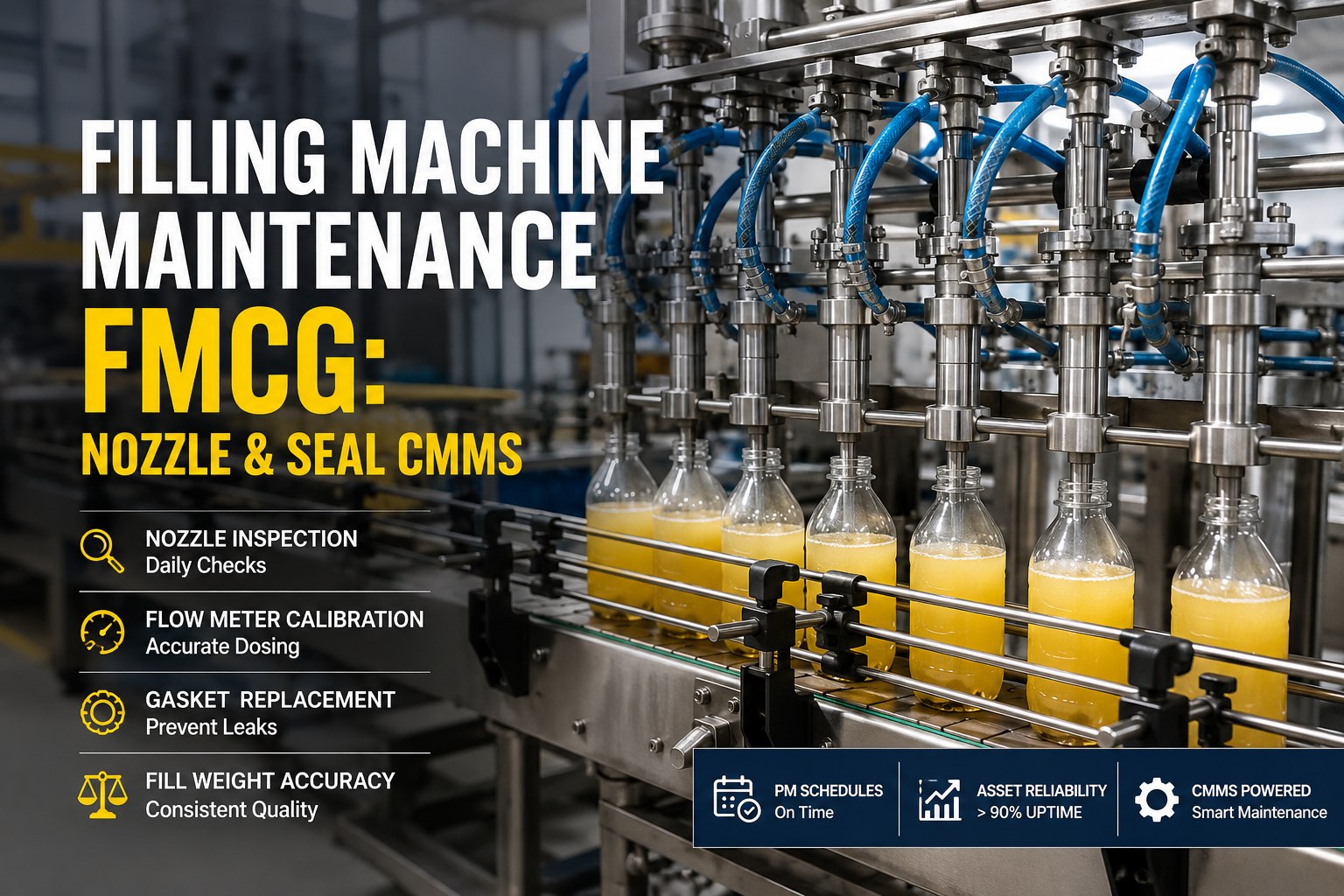
Rotary Filler Maintenance for FMCG Bottling Lines: Valve, Seal, and Fill Accuracy
By Jack Edwards on May 15, 2026
The rotary filler is the highest-value and highest-risk asset on any FMCG bottling line. When it fails, the financial impact is immediate and concentrated: unplanned filler downtime costs high-speed beverage plants an average of $180,000 or more per hour in lost production, wasted materials, and emergency response costs. Yet the failure modes that drive these events — fill valve seal wear, carousel bearing degradation, and flow meter drift — all produce detectable sensor signatures 14 to 30 days before a production-impacting event occurs. The gap between a reactive plant and a proactive one is not technical capability. It is whether a structured preventive maintenance program is in place to capture those signals and convert them into planned interventions during scheduled downtime windows — rather than unplanned stoppages during a production run. Start a free trial to register your rotary filler assets and build your first PM schedule in Oxmaint, or book a demo to see how beverage and bottling operations manage filler maintenance in Oxmaint.
$180K+
Average hourly cost of unplanned rotary filler downtime in high-speed beverage bottling plants
14–30 days
Sensor lead time before a production-impacting filler failure — catchable with structured PM and monitoring
29%
Average OEE improvement in the first year of AI-driven bottling line analytics deployment
60%
Reduction in emergency changeover costs with predictive seal and bearing replacement scheduling
See Your Filler Asset ROI in 30 Minutes
See how much cost you can eliminate from reactive filler maintenance across your FMCG bottling operations.
✔ Valve seal and bearing wear tracking✔ Fill accuracy calibration scheduling✔ CIP system maintenance documentation
No heavy implementation required | Works across multi-site portfolios | Live in days, not months
What Is Rotary Filler Maintenance
A rotary filler is the operational heart of any FMCG bottling or canning line. Whether the configuration is a gravity filler for still beverages, an isobaric counter-pressure filler for carbonated products, or a hot-fill system for juices and teas, the core maintenance challenge is the same: the filler is a high-cycle precision machine running at speeds of 30,000 to 120,000 containers per hour, where every wear event degrades fill accuracy and every unplanned stoppage triggers a cascade of production losses. Filling machines account for a disproportionate share of total line downtime because they are the highest-speed, most mechanically complex assets on the line — and because their failure modes accumulate gradually and invisibly until a threshold is crossed that stops production entirely.
The three dominant failure modes — fill valve seal wear, carousel bearing degradation, and flow meter drift — share a common characteristic: they are each detectable through structured inspection and sensor monitoring weeks before they become production-impacting events. Fill valve seals degrade from chemical exposure during CIP cycles and mechanical cycling during filling. Carousel bearings wear from continuous rotational load. Flow meters drift from product contact and calibration decay. All three require different inspection methods, different PM intervals, and different spare parts management strategies. Without a CMMS to structure, schedule, and document these programmes, most plants manage their fillers reactively — replacing seals after valve leaks are visible and bearings after vibration is audible. By then, the cost multiplier against a planned repair is already 4.8 times. Start a free trial to begin structuring your rotary filler PM programme in Oxmaint.
Fill valve seal wear, carousel bearing degradation, and flow meter drift are the three failure modes driving most filler downtime — all produce sensor signals 14 to 30 days before production impact.
Eight Key Concepts in Rotary Filler Maintenance
Effective rotary filler maintenance requires mastery of eight distinct technical domains — each one a potential source of product quality non-conformance, consumer safety risk, or production stoppage if not systematically managed.
01
Fill Valve Seal Replacement Programmes
Fill valve seals degrade from CIP chemical exposure and mechanical cycling. Replacement intervals should be defined by cycle count — typically every 3 million cycles — not calendar time, which does not correlate with actual wear rate in variable-throughput lines.
02
Carousel Bearing Monitoring
Carousel bearings carry the full rotational load of the filler under wet, thermally variable conditions. Vibration monitoring, lubrication interval management, and bearing temperature trending provide 2–4 weeks of lead time for planned bearing replacement.
03
Fill Accuracy and Flow Meter Calibration
Flow meters drift from product contact and calibration decay. Regular calibration verification against certified reference equipment — at minimum monthly for high-speed lines — prevents the fill volume errors that drive product recalls and consumer complaints.
04
CIP System Maintenance
CIP effectiveness depends on the condition of the CIP equipment, not just the programme parameters. Chemical dosing pumps, spray devices, conductivity sensors, heat exchangers, and return piping all require scheduled maintenance separate from the filler itself.
05
Isobaric Counter-Pressure Valve Maintenance
For carbonated beverage fillers, CO2 loss per fill cycle, snift valve timing drift, and pre-evacuation pressure stability are the key failure indicators. These parameters require dedicated monitoring separate from the liquid fill circuit.
06
Filler Bowl Level Control Verification
Filler bowl level sensors govern fill volume consistency across all valve positions simultaneously. Sensor fouling, calibration drift, and float mechanism wear all produce systematic fill weight variance across carousel positions — a precision problem that compounds with every cycle.
07
Nozzle and Filling Head Condition Management
Filling nozzle wear and fouling produce both product contamination risk and fill accuracy degradation. Nozzle inspection, cleaning validation, and wear assessment should be structured as individual work order tasks — not bundled into general line cleaning checks.
08
Lubrication Programmes for Drive Components
Rotary filler drive components — main drive gear, cam followers, starwheels — require food-grade lubrication on defined interval schedules. Over-lubrication in food-contact zones is as problematic as under-lubrication from a product safety perspective.
The 6 Rotary Filler Pain Points Costing Bottling Plants the Most
Filler downtime in FMCG bottling operations does not just stop one asset — it stops the entire line. At $180,000+ per hour, even a 90-minute reactive repair event costs more than a full year of structured preventive maintenance. These six pain points define where rotary filler maintenance programmes break down — and where the financial losses compound fastest. Start a free trial to close these gaps before the next unplanned stoppage costs you production hours.
Valve Seal Failure Discovered Mid-Run
Fill valve seal failures that are discovered during a production run — through leaking valves, fill weight alarms, or product contamination — require emergency line stoppage, CIP, valve disassembly, seal replacement, and revalidation before restart. Total elapsed time: 4–12 hours. Total cost: $720K+ at high-speed line rates.
No Fill Weight Variance Trending by Carousel Position
Fill weight variance that is averaged across all positions masks position-specific valve wear. A single valve showing 0.8% variance against a 0.3% specification tolerance affects every container passing through that position — potentially thousands of units before the pattern is detected and traced to its source.
CIP Validation Gaps Creating Microbiological Risk
CIP cycles that are run on schedule but with degraded equipment — fouled spray devices, drifted conductivity sensors, worn pump performance — fail to achieve the validated log-reduction even when all programme parameters appear to be met. Without CIP equipment PM, compliance with the CIP schedule does not guarantee compliance with food safety standards.
Carousel Bearing Failure With No Warning
Carousel bearing failures that are discovered by audible noise or vibration detectable to operators have already progressed to a stage where bearing replacement during a planned window is no longer possible. Emergency bearing replacement on a rotary filler typically requires partial disassembly — 8 to 18 hours — compared to 2 to 4 hours for a planned intervention.
Fill Volume Errors Leading to Product Recalls
Flow meter drift that is not caught through regular calibration verification produces systematic underfill or overfill across production runs. Facilities following fill volume calibration protocols report 15% fewer product recalls from fill volume errors — meaning those without structured calibration programmes absorb those recall events instead.
No Maintenance Record History for Compliance Audits
FSMA, BRC/BRCGS, and customer quality audits require documented evidence of preventive maintenance completion for food-contact filling equipment. Plants maintaining paper-based or spreadsheet records face hours of document compilation before every audit — and risk non-conformance findings from maintenance record gaps that a digital CMMS would have prevented.
How Oxmaint Powers Rotary Filler Maintenance Excellence
Asset Management
Filler Asset Registry with Component-Level Tracking
Register each rotary filler with its carousel positions, valve assemblies, drive components, and CIP system as individual tracked sub-assets. Log seal condition, bearing readings, and flow meter calibration results against each component — building a wear trend dataset for condition-based replacement decisions.
PM Scheduling
Cycle-Count Triggered Seal and Bearing PM
Configure fill valve seal replacement triggers based on cycle counts — not calendar days — matching actual wear rates to replacement intervals. Carousel bearing PM triggers combine run-time hours with vibration threshold alerts, auto-generating work orders when replacement windows arrive before failures occur.
Fill Accuracy
Flow Meter Calibration Scheduling and Documentation
Monthly flow meter calibration work orders auto-generate with fields for actual vs reference measurement, calibration equipment ID, and technician sign-off. Results are stored against the asset record and flagged when variance exceeds specification — creating a documented fill accuracy compliance record for every auditable period.
CIP Management
CIP Equipment PM Separate from Filler PM
CIP system assets — dosing pumps, spray devices, heat exchangers, conductivity sensors — are managed as separate asset records with their own PM schedules. This ensures CIP equipment condition is maintained independently from filler mechanical PM, eliminating the gap where CIP programme compliance masks equipment degradation.
MRO Inventory
Seal and Bearing Spares Inventory with Reorder Triggers
Link valve seal sets, bearing assemblies, and CIP spray device replacements to filler asset records with minimum stock levels and lead-time reorder triggers. Eliminate the scenario where a planned seal replacement is delayed 3 weeks because spares were not on the shelf when the PM was due.
Compliance Reporting
Audit-Ready Filler Maintenance Records
Every PM completion, calibration result, seal replacement, and CIP equipment service is timestamped and stored against the filler asset record. Single-click export of the complete maintenance history for any audit period — satisfying FSMA, BRC/BRCGS, and customer quality audit requirements without manual document compilation.
A Midwest bottler reduced annual valve-related downtime by 58 hours through systematic trend analysis of maintenance data — the equivalent of recovering an entire production shift every month.
Reactive vs Planned Rotary Filler Maintenance: The Full Cost Picture
The financial case for shifting from reactive to planned filler maintenance is straightforward when the true cost of a reactive event is properly accounted. The per-hour downtime cost makes every prevented stoppage a recoverable investment in PM.
Maintenance Scenario
Reactive / Unplanned
Planned / CMMS-Driven
Valve seal replacement trigger
Leak detected mid-run — line stopped immediately
Cycle-count threshold reached — planned window
Carousel bearing replacement
Audible vibration — 8–18hr emergency repair
Vibration trend alert — 2–4hr planned replacement
Flow meter calibration
Discovered via product recall or audit finding
Monthly calibration WO — documented and on schedule
Emergency repair cost multiplier
4.8× planned maintenance cost
Baseline cost — no emergency premium incurred
Fill weight variance detection
Averaged data masks position-specific valve wear
Per-position variance tracked — single valve identified
CIP effectiveness assurance
Schedule compliance only — equipment condition unknown
CIP equipment PM confirms actual cleaning effectiveness
Product recall risk
High — fill volume and hygiene failures unmonitored
Low — 15% fewer recall events with calibration protocols
BRC and FSMA audit readiness
Manual record compilation — days of effort, gap risk
Single-click maintenance history export per filler
ROI and Results: What Structured Filler PM Delivers
Every hour of unplanned filler downtime avoided through planned PM represents $180,000+ in preserved production value at high-speed beverage plant rates
29%
OEE Improvement in Year 1
Bottling plants implementing structured analytics and PM programmes report an average 29% improvement in filling line OEE within the first twelve months
60%
Emergency Changeover Cost Reduction
Predictive replacement of seals and bearings before failure reduces emergency changeover costs by up to 60% — converting emergency events into planned work orders
15%
Fewer Product Recalls
Facilities following structured fill volume calibration protocols report 15% fewer product recalls from fill volume errors — each recall prevented saves millions in direct and brand costs
Frequently Asked Questions
How does Oxmaint structure preventive maintenance for rotary filler valve seals based on cycle counts rather than calendar time?
Oxmaint supports both calendar-based and meter-based PM triggers. For rotary filler valve seals, you configure the PM work order to trigger based on production cycle counter readings — typically every 3 million fill cycles per valve position — rather than a fixed calendar interval. The cycle counter integrates with the filler's production counter via manual logging or IoT connection. When the cycle count threshold is reached for a valve bank, Oxmaint auto-generates the seal replacement work order with the correct seal set pre-populated from MRO inventory, giving your maintenance planner 5–7 days of advance notice to schedule the work during the next planned downtime window. Start a free trial to configure your first cycle-count PM trigger in Oxmaint.
How can Oxmaint help us track fill weight variance by carousel position to detect individual valve wear?
Oxmaint supports custom inspection forms within recurring PM work orders. For rotary fillers, you can configure a fill weight verification form that captures fill weight readings per carousel position against the specified target weight and tolerance. When a position-specific reading exceeds the acceptable variance, a corrective action work order is automatically generated — flagging the specific valve position for inspection and seal replacement, rather than requiring a full carousel service to locate the failing valve. Over time, the position-specific trend data shows which valve positions are wearing fastest, informing maintenance interval adjustments for each position independently.
Can Oxmaint manage CIP system maintenance separately from rotary filler mechanical PM?
Yes, and this separation is critical. Oxmaint allows CIP system components — chemical dosing pumps, spray devices, heat exchangers, conductivity sensors, and return piping — to be registered as separate asset records with their own PM schedules independent of the filler's mechanical PM. This means a monthly CIP spray device inspection and a weekly conductivity sensor verification both appear as separate work orders, are assigned to the appropriate technician, and generate their own completion records. The result is that CIP compliance documentation is maintained separately from filler PM compliance — which is exactly what FSMA and BRC/BRCGS auditors look for when evaluating the independence of hygiene validation from mechanical maintenance. Book a demo to see CIP system asset management configured in Oxmaint.
How does Oxmaint support fill volume calibration record-keeping for product recall prevention?
Oxmaint generates recurring flow meter calibration work orders at the interval you specify — monthly for high-speed lines is the recommended baseline. Each work order template includes fields for the actual measured fill volume, the reference measurement tool used, the calibration certificate number of the reference instrument, the technician performing the calibration, and the result classification. All calibration records are stored against the filler asset and are retrievable by date range for audit submissions. When a calibration result falls outside specification, Oxmaint triggers a corrective action work order for immediate flow meter service or replacement — closing the loop before the out-of-specification condition produces a production run of mis-filled product.
Stop Absorbing $180K/hr Filler Downtime Events
Turn Your Rotary Filler Into a Predictable, High-OEE Asset
From valve seal cycle-count scheduling to carousel bearing trend monitoring, fill accuracy calibration records, and CIP system PM — Oxmaint gives FMCG bottling operations the maintenance infrastructure to prevent filler failures before they stop lines and cost production. Used by operations teams managing 10,000+ assets. See measurable results in the first 30 days.