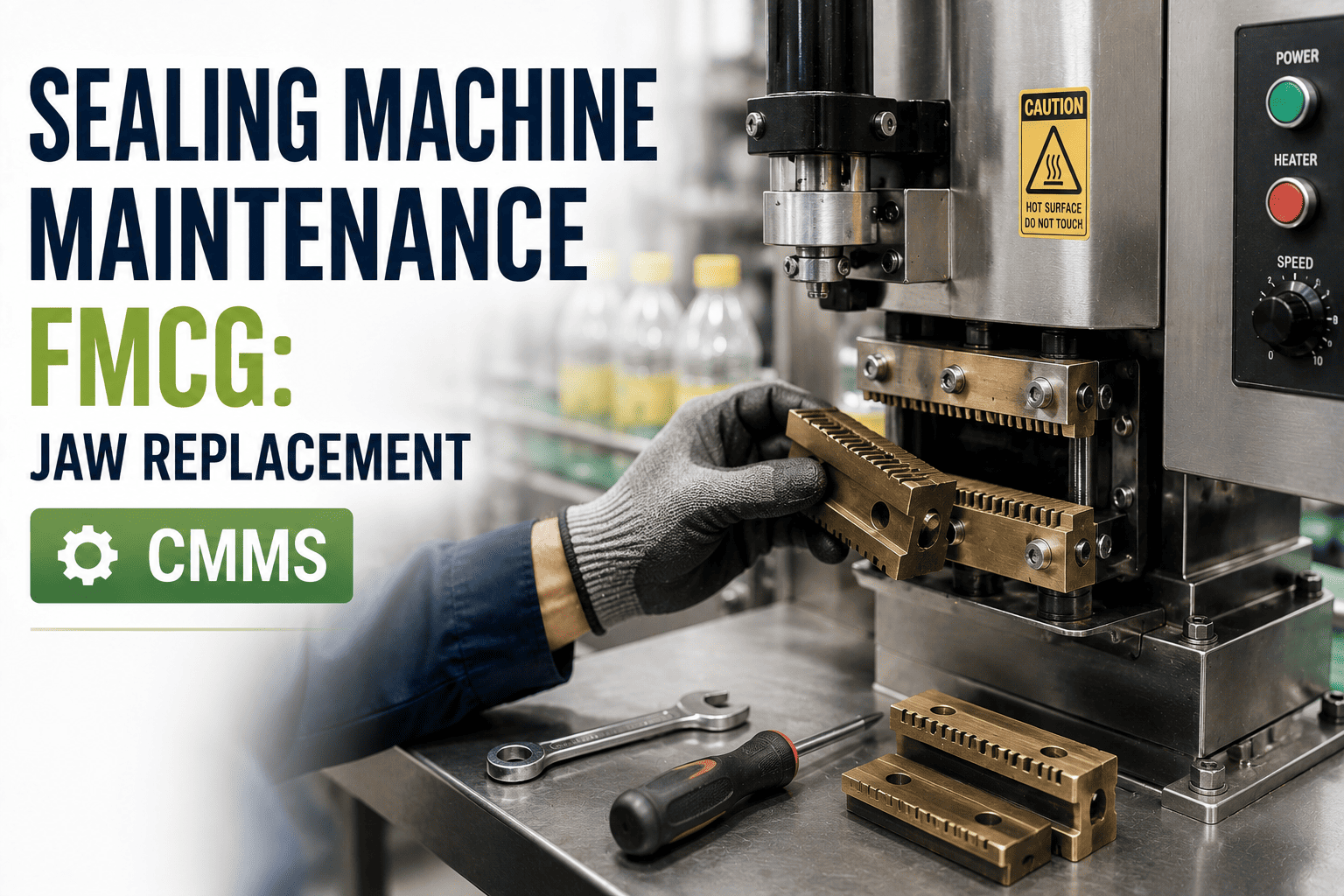
On a high-speed pouch or flow-wrap line, sealing jaws are the single point where product, film and reputation converge — and where a 0.3 mm drift in seal width quietly becomes a 4–6% leak-rate spike at the retort or distribution center. Jaw wear and temperature drift sit firmly in the top three defect sources for FMCG sealers, yet most plants still trigger replacement on calendar intervals or, worse, after a customer complaint. This guide lays out a CMMS-driven preventive maintenance structure for sealing machines: cycle-count tracking, seal-width drift detection, temperature uniformity testing, and the jaw-replacement trigger logic that keeps OEE defensible and audit-ready. If you want to skip straight to building the workflow, you can Start Free Trial and configure the jaw-replacement template in under 20 minutes.
Are your sealing jaws failing the line before the line fails the customer?
Seal-jaw wear and temperature drift drive up to 30% of reject waste on FMCG pouch and flow-wrap lines. Cycle-count tracking, seal-width drift detection and uniform-temperature audits — all inside one CMMS — cut that loss before a single leaker ships.
Why jaw wear and temperature drift are the top-3 defect source
On a typical 120-SPM flow-wrap line running two shifts, a single sealing jaw set accumulates roughly 1.4 million cycles per week. Teflon-coated serrated jaws begin showing measurable land-width loss after 8–12 million cycles, and resistance-bar temperature can drift ±8°C from setpoint long before an operator notices. Here is what that looks like in scrap and rework.
The four trigger variables inside a sealing-jaw CMMS workflow
A defensible sealing machine PM program never relies on one signal. The CMMS watches four independent variables and escalates a jaw-replacement work order the moment any one crosses its threshold — or when two drift into the warning band simultaneously.
Jaw cycle count tracking
The PLC pulses the CMMS after every sealing cycle. At 8M cycles the asset moves to a "watch" state; at 12M an automatic jaw-replacement work order generates with parts kit, torque spec and calibration check-list attached.
Seal-width drift detection
Every shift, QC pulls a sample pouch and measures seal width to ±0.1 mm. A drift greater than 0.3 mm from the validated 10 mm nominal triggers a jaw-inspection task in the CMMS — long before a leaker reaches the case packer.
Temperature uniformity testing
A weekly thermal-paper or IR-mapping test across five points of the seal bar flags any zone deviating more than ±5°C. The CMMS stores the heat map, tracks the trend curve and schedules a resistance-bar or thermocouple swap when the band tightens.
Sealing bar visual inspection
Every 500K cycles a technician inspects the bar for Teflon wear, serration rounding, spring tension loss and parallelism. Findings feed back into the CMMS as condition data that accelerates — or extends — the replacement date.
What changes when jaw replacement is condition-triggered, not calendar-triggered
A 180-asset FMCG plant running calendar-based 90-day jaw swaps typically over-maintains 40% of its sealers and still gets blindsided by emergency swaps on the other 60%. Switching to CMMS-driven condition triggers flips both numbers.
| PM Dimension | Reactive / Calendar-Based | CMMS Condition-Triggered |
|---|---|---|
| Jaw replacement trigger | Fixed 90-day interval or leaker complaint | Cycle count + drift + temp uniformity thresholds |
| Average jaw service life | 9.2M cycles (premature swaps common) | 13.4M cycles (full usable life extracted) |
| Unplanned sealer downtime | 6.0 hrs per emergency event | 0.75 hrs per scheduled PM event |
| Seal-defect escape rate | 4.1% at QC, 0.8% at customer | 0.6% at QC, <0.05% at customer |
| Audit traceability | Paper log, partial data, no trend | Full digital history per asset, ISO 55000-ready |
| Annual parts spend (1 line) | $11,400 (over-stock + emergency freight) | $6,900 (kit issued against trigger) |
The jaw-replacement ROI calculation every plant manager should run
Before deploying the CMMS workflow, baseline three numbers: current defect-escape rate, average cycle life per jaw set, and unplanned sealer downtime hours per quarter. The formula below converts them into annual savings.
(4.1% × 42M units × $0.18) + (24 hrs × $4,200) + (6 over-replaced sets × $580) = $50,148 recovered per year, per line
Stop replacing jaws on a hunch — let cycle data decide
Deploy the sealing-jaw PM template in OxMaint and watch every sealer's cycle count, drift and temperature uniformity from one dashboard.
A mid-scale snack plant that killed 70% of its leaker escapes in one quarter
A regional snack operation running four flow-wrap lines logged a 3.8% in-line leaker rate and 14 emergency jaw swaps in a single quarter. Teflon-coated jaws were swapped every 90 days regardless of condition, yet temperature drift on Line 3 had pushed a cold zone to 132°C against a 145°C setpoint — undetected for five weeks.
After deploying OxMaint with cycle-count triggers, weekly thermal mapping and a 0.3 mm seal-width drift alert, the same plant dropped its leaker escape to 1.1%, eliminated all emergency swaps, and extended average jaw life from 9.1M to 13.0M cycles. The parts inventory tied up in emergency buffer stock fell by $7,200.
We finally replaced jaws because the data said to — not because the calendar or a customer complaint said to. That single shift gave us back 11 hours of unplanned downtime per line, per quarter.
— Reliability Lead, regional snack manufacturerSealing machine maintenance FMCG — your questions answered
How many cycles should a sealing jaw last before replacement in an FMCG environment?
Most Teflon-coated serrated jaws on continuous-motion flow-wrap sealers deliver a usable life of 10–14 million cycles when temperature is held within ±5°C and parallelism is maintained. The CMMS should set a watch threshold at 8M cycles and a mandatory replacement trigger at 12M — adjusted up or down based on actual drift and visual-inspection data from your specific film and speed profile.
What seal-width drift tolerance should trigger a CMMS alert?
A drift of 0.3 mm from the validated nominal seal width (commonly 10 mm for pouch applications) is the standard alert threshold. At 0.5 mm drift the CMMS should auto-generate an inspection work order, and at 0.8 mm the jaw set should be quarantined for measurement. These thresholds align with ISO 11607 validation expectations for sterile and shelf-stable packaging.
How often should I test sealing-bar temperature uniformity?
Weekly thermal mapping across five reference points on the seal bar is the defensible cadence for two-shift FMCG operations. The CMMS stores each map, plots the trend per zone, and flags any single point deviating more than ±5°C from setpoint. Monthly is acceptable for single-shift lines, but only if cycle-count and seal-width data are also being tracked in the same system. To stand this up quickly, start your free trial and clone the seal-bar thermal-map template.
Can the CMMS integrate cycle counts directly from the sealer PLC?
Yes. OxMaint accepts cycle pulses via OPC-UA, MQTT or a simple REST webhook from the sealer PLC. Once configured, every cycle increments the asset's counter in real time, and the CMMS auto-generates the jaw-replacement work order at the threshold you define — no manual data entry, no spreadsheet drift.
What does a jaw-replacement PM work order include in the CMMS?
Each triggered work order carries the parts kit number, torque sequence, parallelism gauge spec, Teflon-coating verification step, post-install thermal-map test, and a sign-off log for QA. The full digital trail — cycle count at replacement, drift measurements, temperature trend, technician, and parts batch — is archived against the asset for audit defense under ISO 55000 and customer packaging validation reviews. You can see the full template by booking a 30-minute demo with our team.
Make every seal defensible — from cycle one to cycle twelve million
Deploy OxMaint's sealing-jaw PM workflow and turn jaw wear, drift and temperature into tracked, trended, audit-ready data.
Free 14-day trial · No credit card