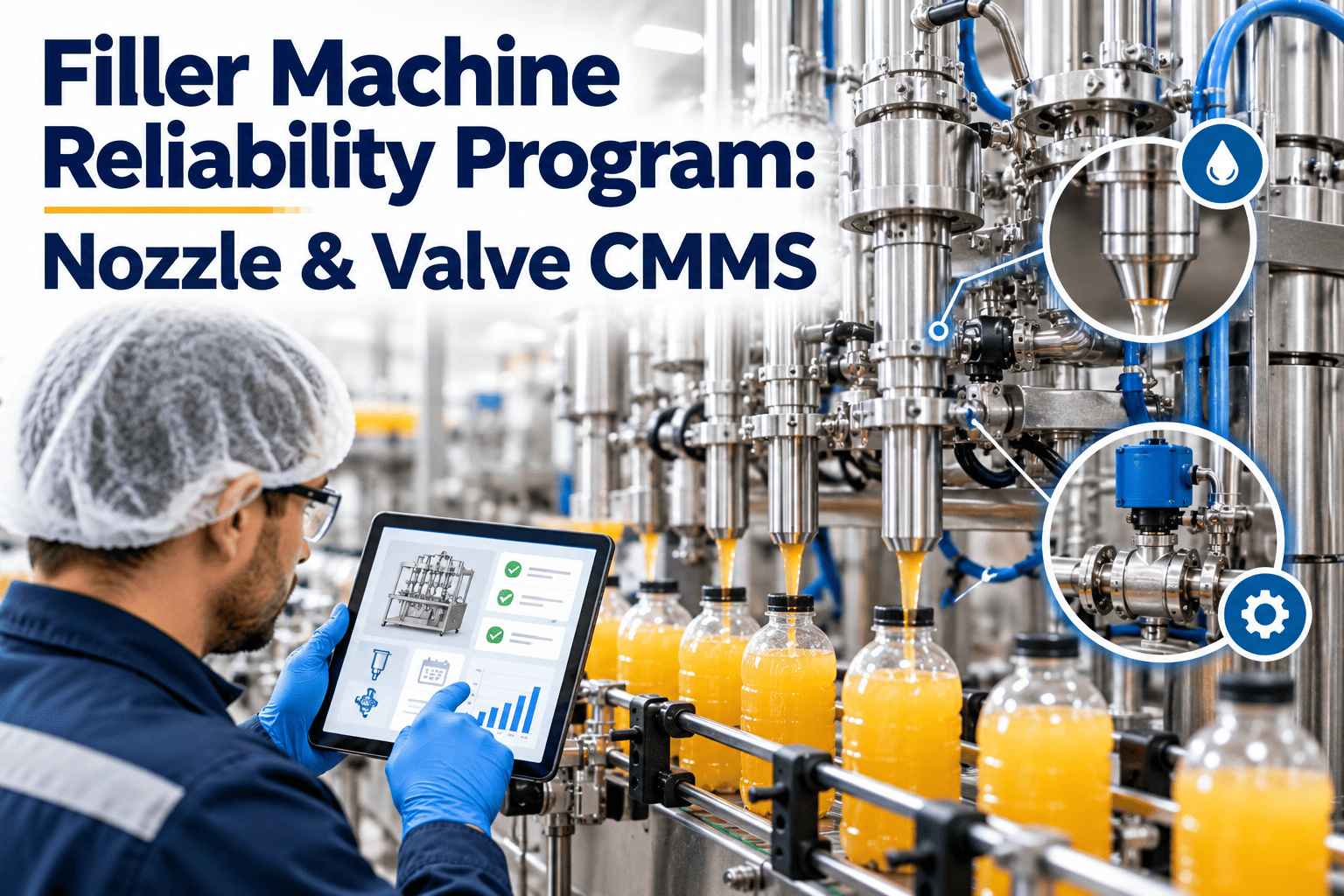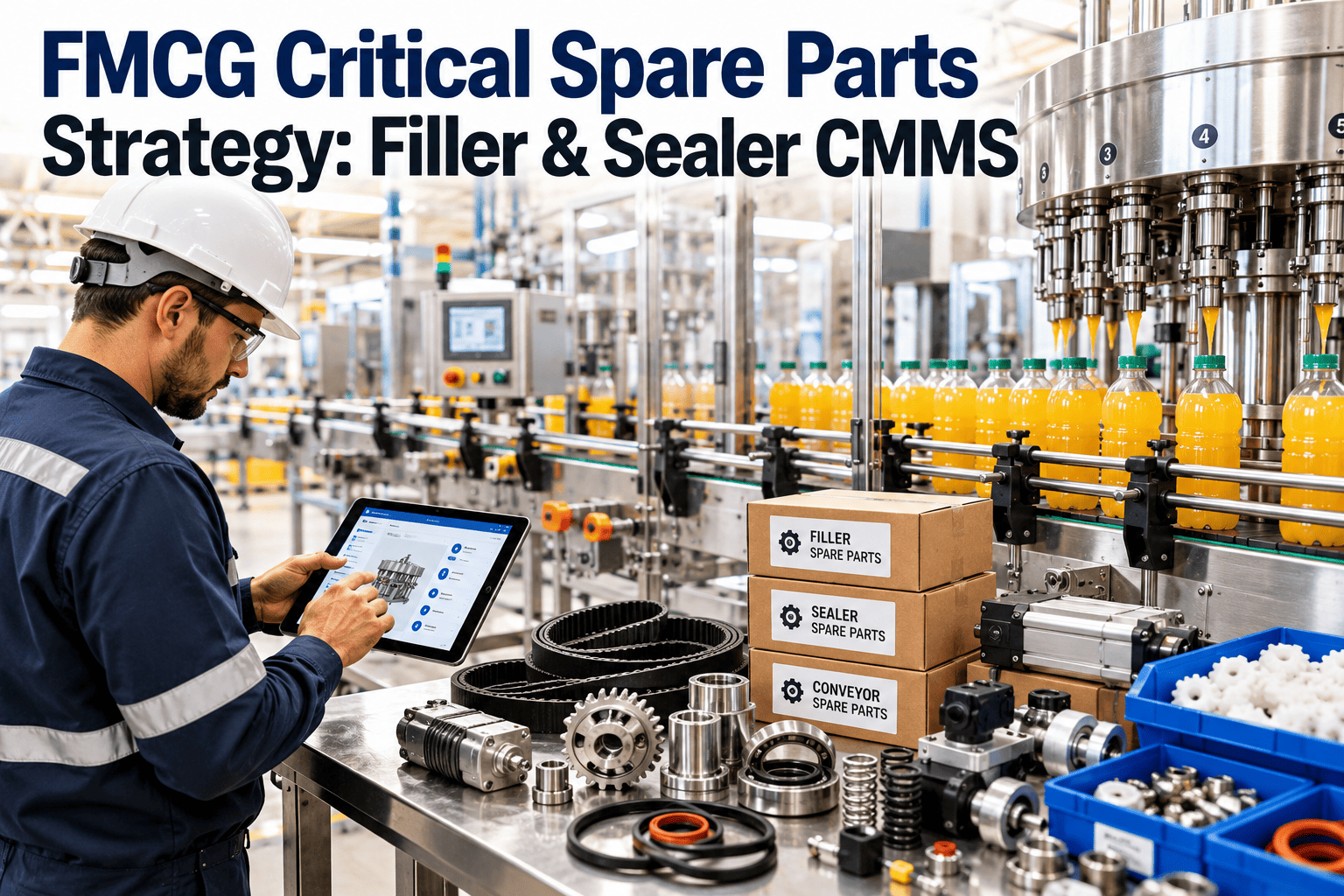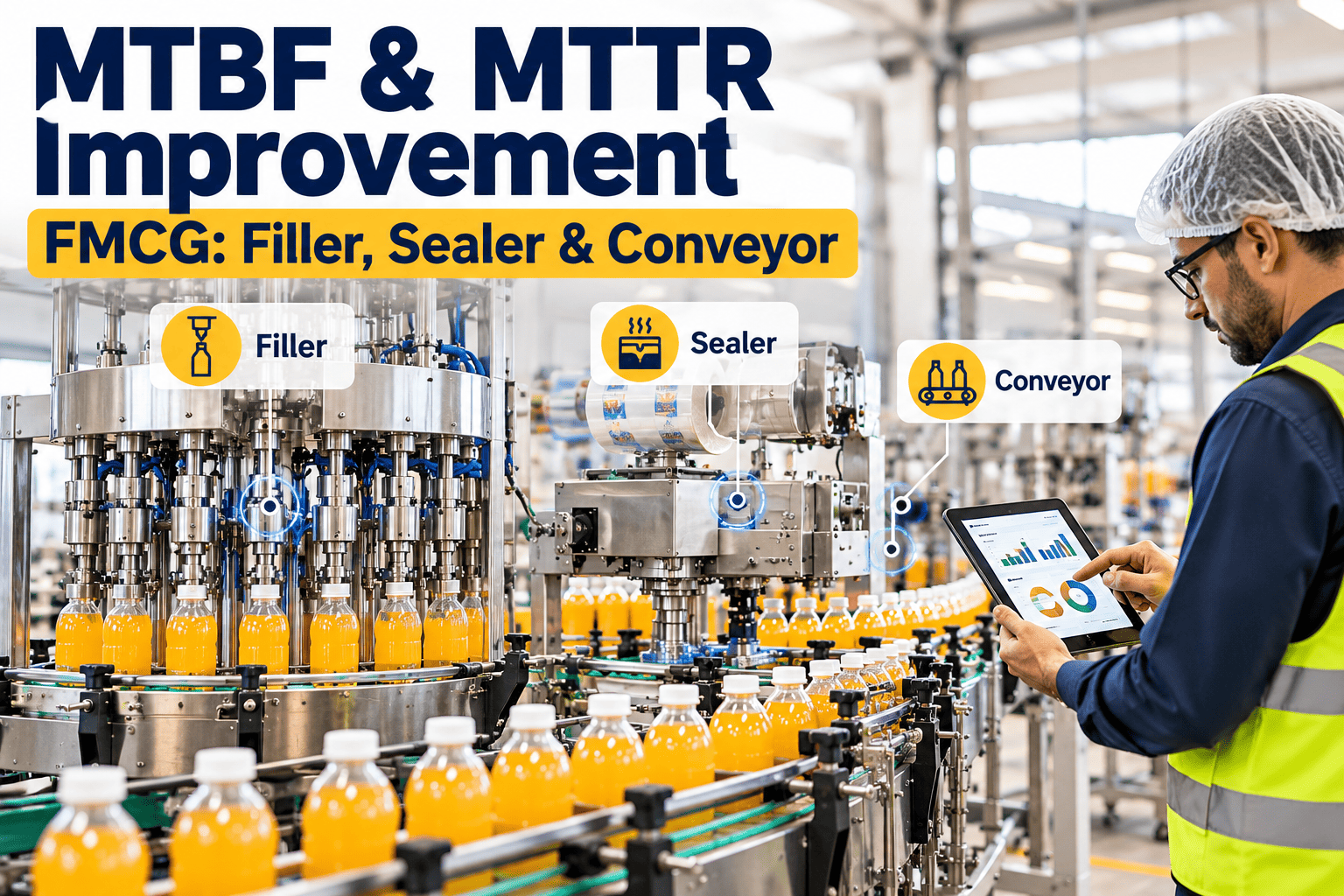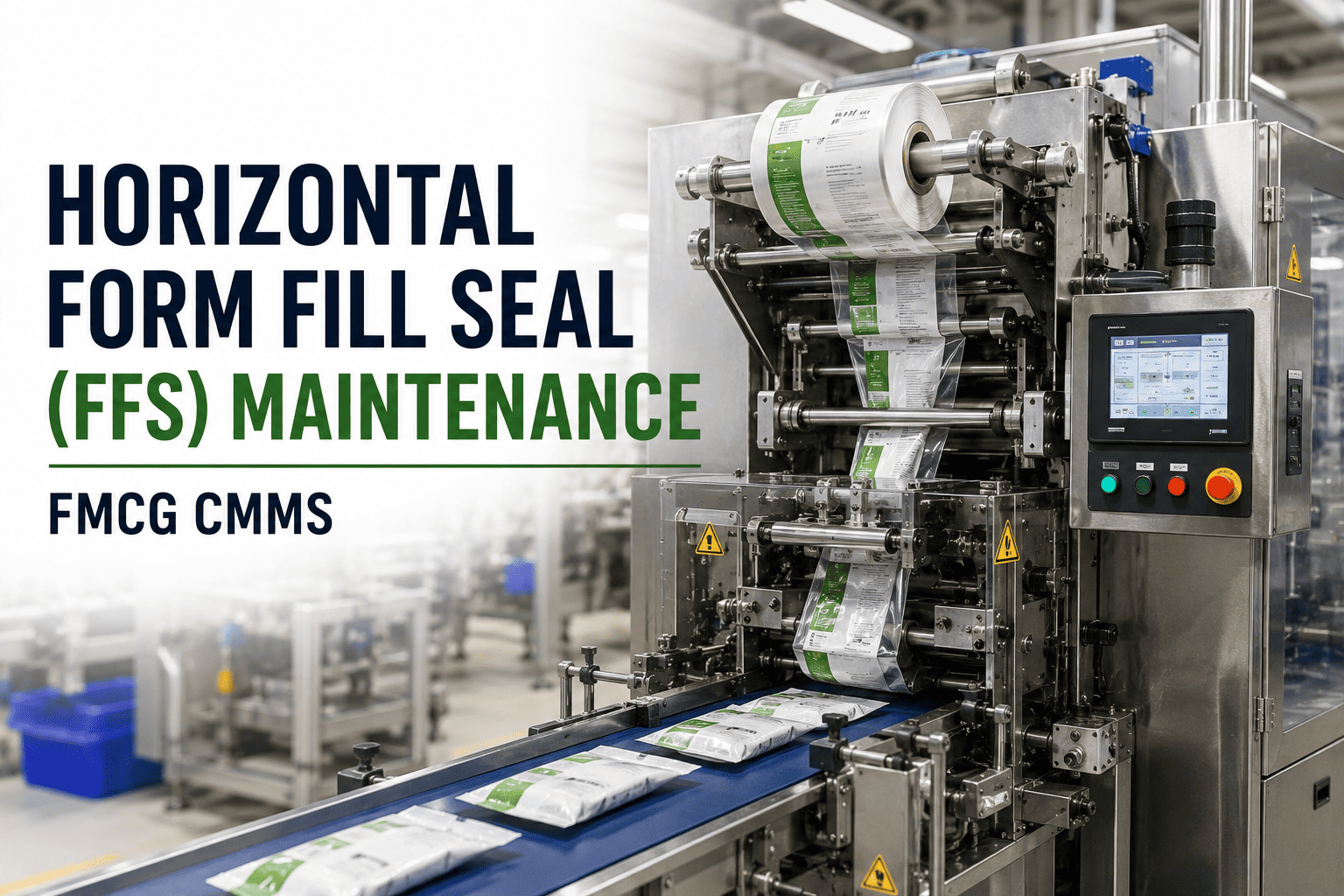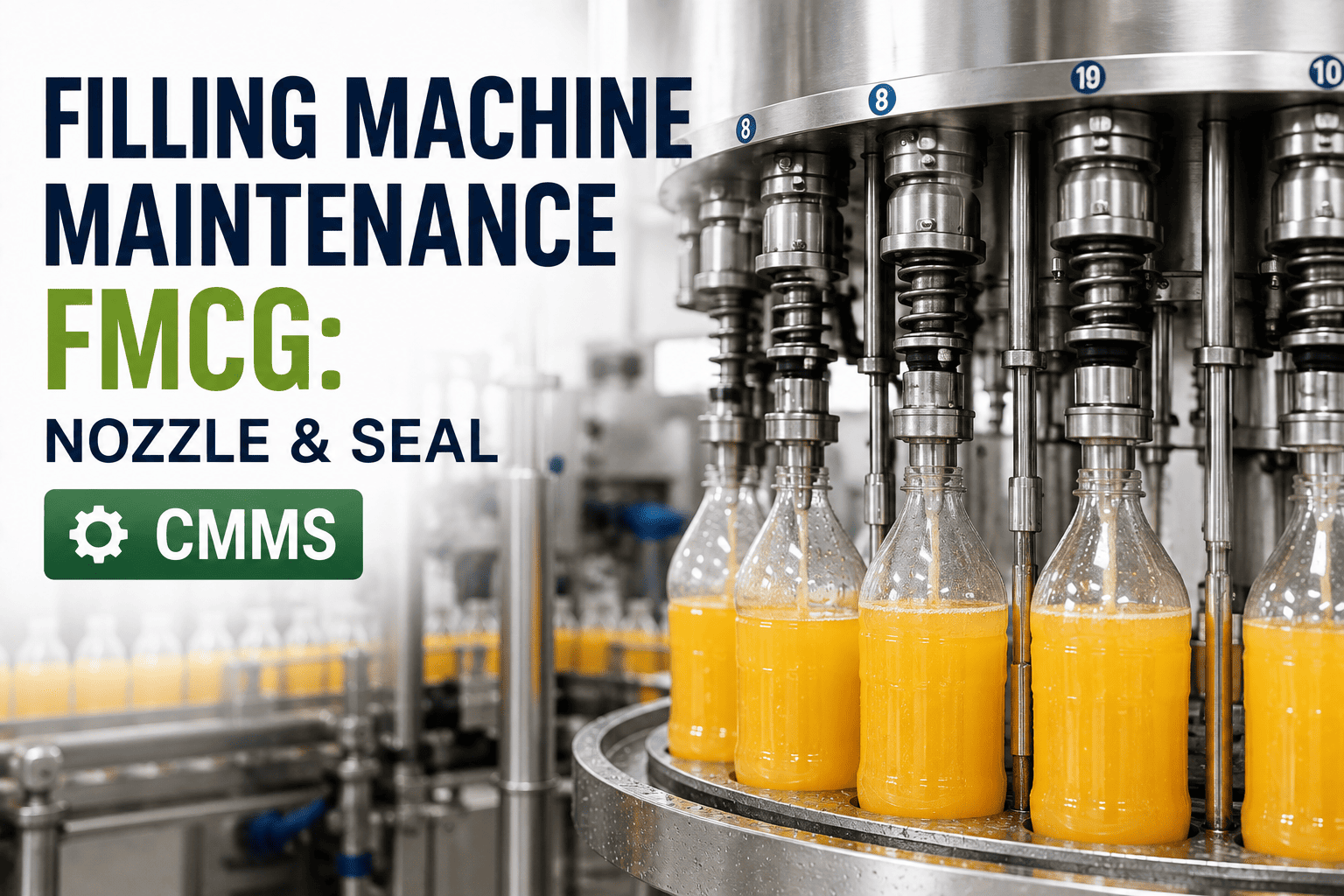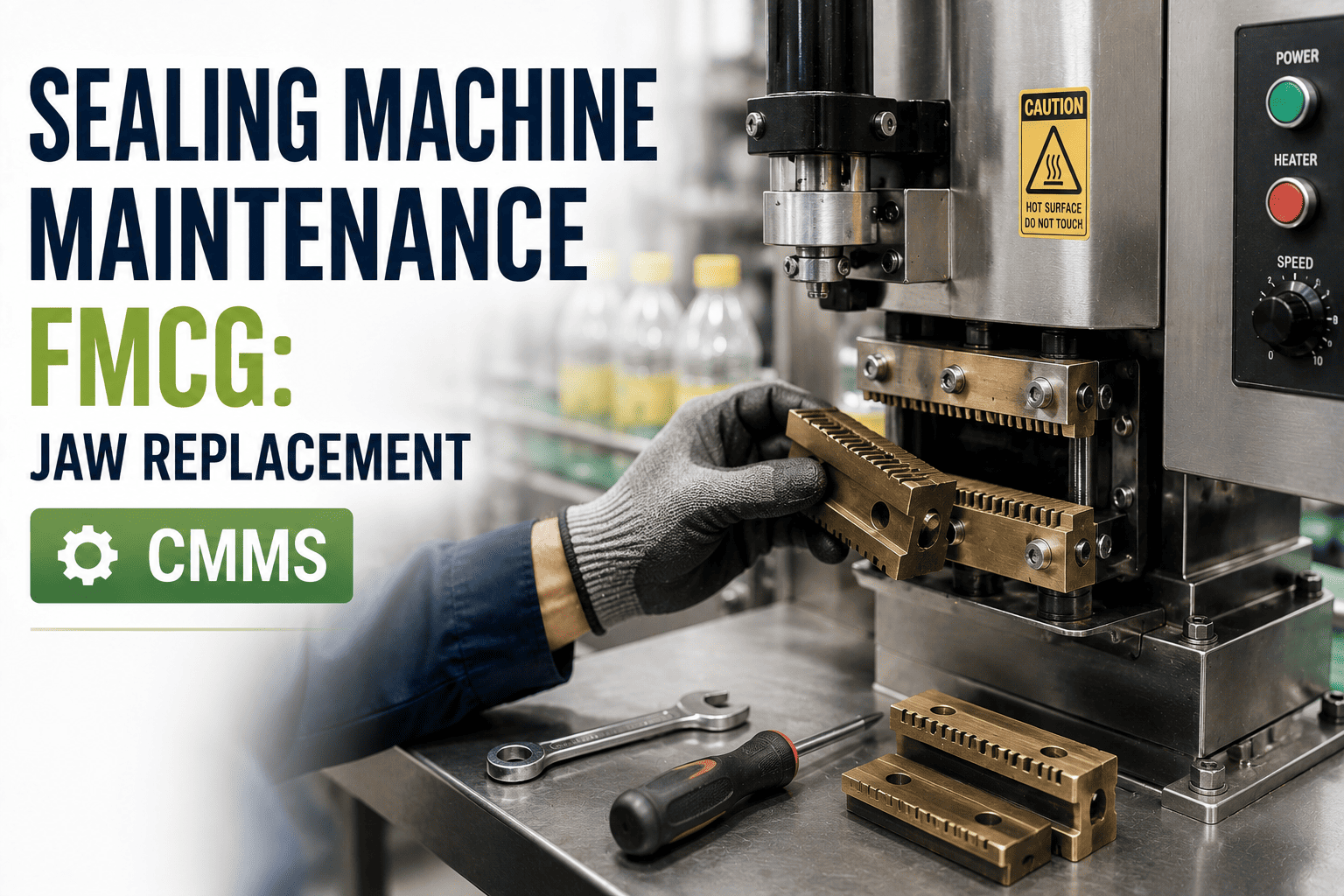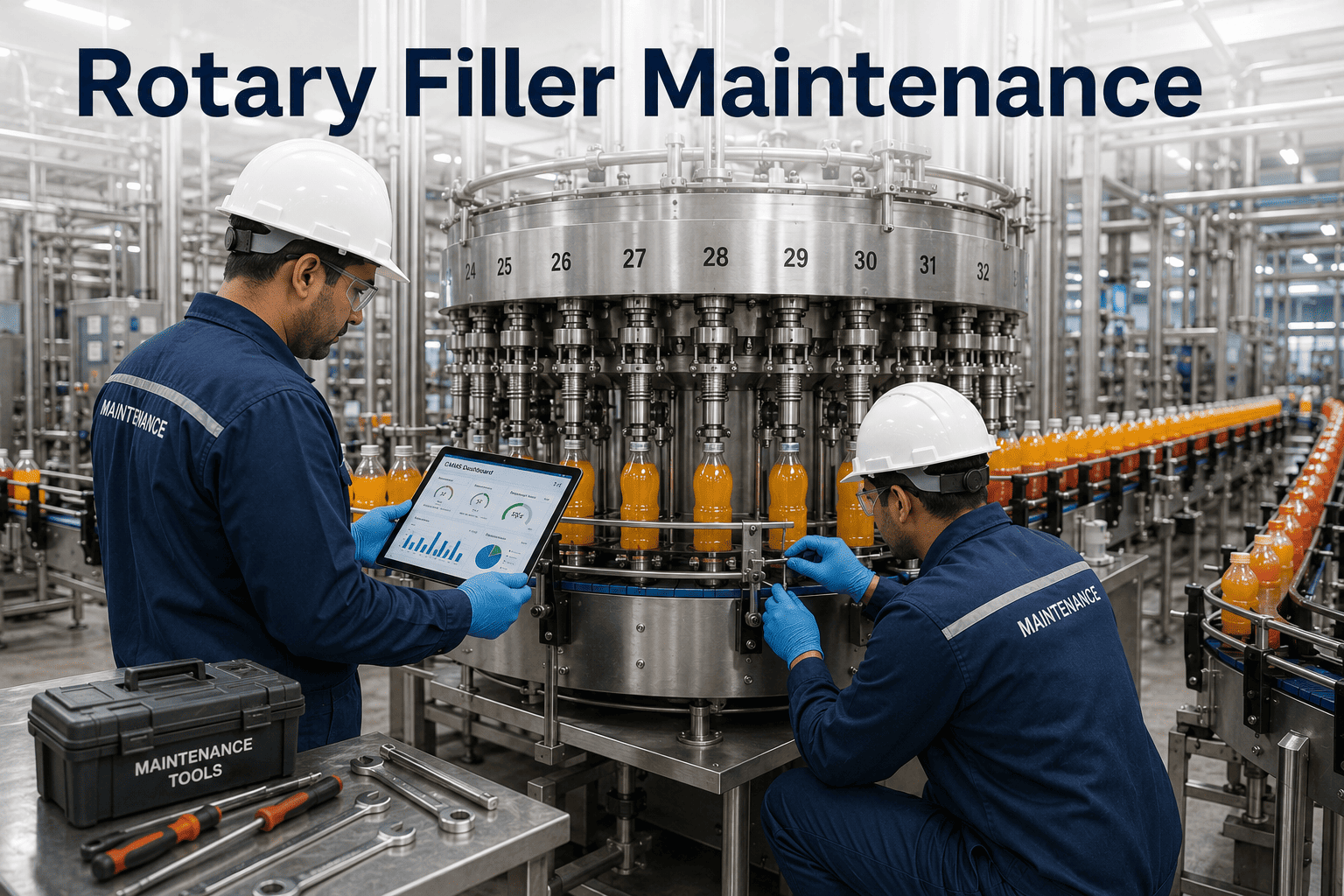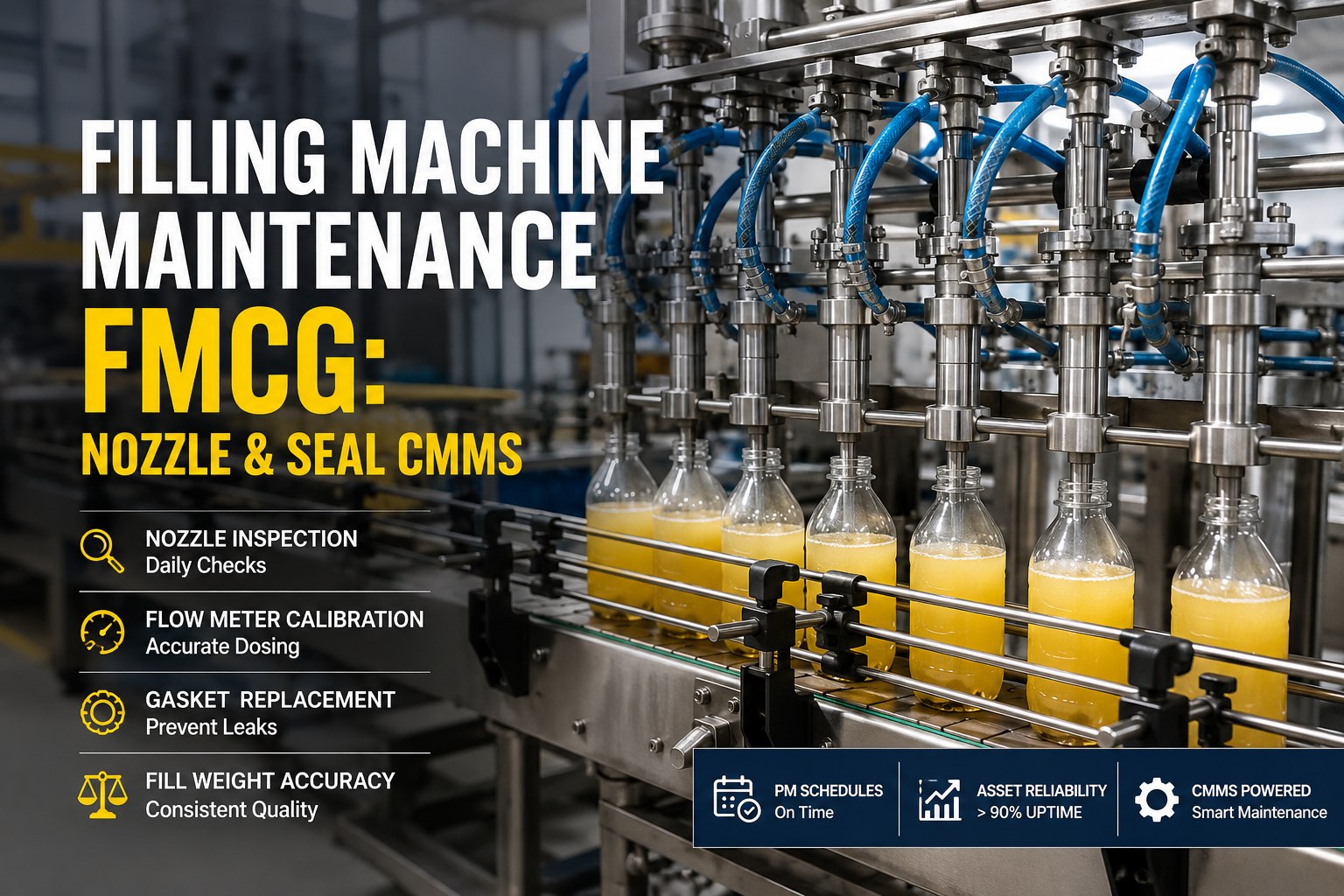
On a typical FMCG packaging line, the filling machine is the asset where downtime costs compound fastest — a single stuck nozzle or weeping seal can idle an entire shift within minutes. This guide translates field-proven PM practice into a CMMS-driven program built specifically around nozzle inspection, seal replacement thresholds, flow-meter calibration, and fill-weight accuracy. Plants that formalize these routines typically lift filler availability above 90% and cut giveaway by 1.5–3%. Ready to operationalize it? Start Free Trial and deploy the workflow in under a week.
One stuck nozzle takes the whole line down. Is your filler PM program built to stop it?
Nozzle-by-nozzle inspection cadence, seal replacement thresholds, dosing calibration and a CMMS-driven reliability program that keeps high-speed FMCG filler availability above 90% — without firefighting weekend changeovers.
The Filling Machine Is the Highest-Consequence Asset on the Line
Every other station — capper, labeler, case packer — can buffer around a 5-minute hiccup. The filler cannot. When a dosing nozzle fouls or a product seal weeps, the entire upstream and downstream chain stops within one cycle.
For a mid-tier plant running 180 SKUs across two shifts, even a single percentage point of filler availability translates into roughly 1,400 additional production hours per year. That is the gap a disciplined nozzle-and-seal program closes — and it is why CMMS-driven filler maintenance is no longer optional in competitive FMCG operations.
Tiered Filler Maintenance Checklist by Cadence
Nozzle and seal integrity cannot be inspected "when convenient." The cadence below is the baseline used by plants sustaining >90% filler availability on high-speed lines.
- Visual nozzle wipe — check each tip for product build-up, stringing, or O-ring extrusion
- Fill-weight audit — 5 consecutive containers per lane against nominal ±0.5%
- Seal surface wipe — inspect static and dynamic seals for moisture track or drips
- Drip tray check — confirm no residual product pooling under nozzles after purge cycle
- Nozzle disassembly — remove tips, clean orifice, inspect for scoring or polymer buildup
- Flow-meter verification — run calibration check against certified reference weight
- Gasket inspection — replace any seal showing compression set beyond 25%
- Pneumatic actuator stroke time — confirm within ±10 ms of baseline
- Full seal kit replacement on high-viscosity product lanes
- Flow-meter deep calibration — traceable to ISO 17025 reference, log in CMMS
- Nozzle orifice gauge check — replace tips showing >0.05 mm wear from nominal
- Fill-weight SPC review — investigate any lane drifting beyond ±2σ
| Component | Inspection Cadence | Replacement Threshold | CMMS Trigger |
|---|---|---|---|
| Filling nozzle tip | Daily visual / Weekly gauge | Orifice wear > 0.05 mm | Condition-based work order |
| Product seal (dynamic) | Weekly inspect | Compression set > 25% or visible crack | Auto-generated PM at 8 weeks |
| O-ring (nozzle body) | Daily drip check | Any extrusion or leak path | Inspection failure flag |
| Flow meter | Weekly verify / Monthly calibrate | Drift > ±0.5% from reference | Calibration schedule + tolerance check |
| Pneumatic actuator | Weekly stroke test | Stroke time deviation > ±10 ms | Predictive alert from trend data |
| Fill-weight system | Daily SPC sample | Cpk < 1.33 on any lane | SQC integration flag |
Numbered Nozzle Service Stream
Nozzle failures rarely happen without warning — they happen because the warning signs (stringing, drift, slow close) were not logged. This five-step stream is the spine of the weekly nozzle PM.
Purge & Isolate
Run product recovery cycle, isolate the lane, lockout-tagout. Log purge duration in the CMMS — a purge taking >15% longer than baseline signals a partially blocked nozzle orifice that will become a stoppage within 48 hours.
Tip Removal & Visual Inspection
Remove each nozzle tip, inspect under direct light for scoring, polymer buildup, or mechanical deformation. Photograph and attach to the work order — image history is the single most valuable diagnostic for trending slow-developing wear.
Orifice Gauge Check
Use a calibrated pin gauge to measure orifice diameter. Anything exceeding nominal by 0.05 mm goes to the replacement queue. At 0.08 mm the nozzle is actively contributing to fill-weight drift and must be retired.
O-Ring & Seal Replacement
Replace the nozzle body O-ring on every weekly PM for high-viscosity or abrasive products; every other week for water-thin products. Inspect the dynamic seal surface for axial scoring that will chew through a new seal within days.
Reinstall, Prime & Verify Fill Weight
Reinstall, prime three cycles, then run a 10-container fill-weight verification per lane. Log mean, range, and Cpk directly into the CMMS. Lane Cpk below 1.33 triggers an automatic re-calibration work order.
The Economics of Dosing Accuracy
Fill-weight drift is the silent margin leak on every FMCG line. The formula below quantifies what a 1% drift actually costs — and why flow-meter calibration belongs in the CMMS, not in a technician's notebook.
"We moved nozzle inspection and flow-meter calibration into a CMMS-managed PM cycle and cut filler unplanned downtime by 38% in the first quarter. The single biggest lever was making the daily fill-weight audit non-negotiable — logged, trended, and auto-escalated."
— Reliability Lead, mid-size beverage plant running 4 rotary fillers at 600 bpm
From $42K Annual Loss to 94% Filler Availability
A 180-asset FMCG plant was spending $42,000 annually on emergency filler repairs and giveaway attributed to unmanaged nozzle wear and seal degradation. Here is what changed when the program moved into a CMMS structure.
- Nozzle inspection ad-hoc, logged on paper
- Seal replacement reactive — after leak detected
- Flow-meter calibration "when drift suspected"
- Filler availability: 82%
- Annual emergency repair spend: $42K
- Giveaway variance: 2.1%
- Daily nozzle PM with photo log per work order
- Seal kits on 8-week auto-schedule, condition-extended
- Flow-meter cal every 14 days, ISO-traceable
- Filler availability: 94%
- Annual emergency repair spend: $11K
- Giveaway variance: 0.7%
Net result: $31,000 in emergency repair savings, plus an estimated $58,000 in recovered giveaway — a $89,000 annual swing from a program that took six weeks to deploy and paid for the CMMS subscription within the first quarter of go-live.
Deploy a CMMS-Driven Filler Reliability Program in Under a Week
Pre-built nozzle, seal, and flow-meter PM templates. Auto-escalating fill-weight alerts. ISO-traceable calibration logs. Start today.
Filling Machine Maintenance in FMCG
How often should filling nozzles be inspected on a high-speed FMCG line?
Daily visual inspection of every nozzle tip is the baseline for lines running above 300 bpm. Weekly disassembly with orifice gauge measurement catches slow-developing wear before it shows up as fill-weight drift. Plants that skip the daily wipe typically see nozzle-related stoppages within 5–7 days of buildup onset.
What seal replacement threshold should trigger automatic replacement?
Replace any dynamic seal showing compression set beyond 25%, visible cracking, or any leak path detected during the daily drip check. For high-viscosity or abrasive products, set an 8-week auto-replacement PM in the CMMS regardless of visual condition — the cost of a premature seal change is trivial compared to a product-contamination event or line stoppage.
How does a CMMS improve fill-weight accuracy?
A CMMS enforces the calibration cadence, captures every fill-weight reading against tolerance, and auto-triggers a recalibration work order when a lane's Cpk drops below 1.33. This removes the human judgment gap — the technician cannot "skip this week" because the system escalates the missed PM. You can see it in action when you Book a Demo.
Can I manage multiple filler types and product lanes in one CMMS?
Yes. Each filler, lane, and nozzle position is a distinct asset with its own PM schedule, calibration history, and condition log. This lets you track per-lane Cpk trends, identify which nozzles are wearing fastest, and route the right technician with the right parts — all from a single dashboard.
What is the typical payback period for formalizing filler PM in a CMMS?
Most FMCG plants recover the CMMS cost within the first quarter through reduced emergency repair spend and recovered giveaway alone. The worked example above — $89,000 annual swing on a four-lane filler — is representative for mid-tier operations. Start Free Trial to model your own line.
Stop the Line-Down Nozzle Failure Before It Starts
Pre-built filler PM templates, seal replacement schedules, and flow-meter calibration workflows — live in days, not months.
Free 14-day trial · No credit card