Household Products FMCG: Maintenance Guide for Chemical Processing & Packaging Lines
By Jason on March 11, 2026
A mid-size household products manufacturer producing liquid detergents, surface cleaners, and bathroom disinfectants lost $278,000 in a single quarter — not from a market shift or supply chain disruption, but from three simultaneous equipment failures all traceable to deferred maintenance. A chemical blending vessel developed a pinhole corrosion leak after its sacrificial anode had been overdue for replacement by 14 months, contaminating 8,400 litres of in-process bleach-based cleaner. A caustic dosing pump on the detergent filling line failed mid-run because its PTFE diaphragm had never been scheduled for replacement — the manufacturer's default PM schedule was copied from a water pump, not a caustic-duty pump. And a packaging conveyor's chain lubricator had been dispensing incompatible petroleum-based lubricant onto a line running pH 13 alkaline product containers, degrading conveyor chain at 4x the normal wear rate. In household products manufacturing, chemical compatibility is not a chemistry problem — it is a maintenance problem. Every seal, gasket, pump diaphragm, sensor, and lubrication point must be specified, tracked, and replaced for the chemical environment it operates in. Start your free trial today to deploy Chemical Safety Checklists and PM Schedules for your production lines. Schedule a 30-minute demo with our household products manufacturing specialists.
Chemical incompatibility failures don't announce themselves. Oxmaint Chemical Safety Checklists and PM Schedules ensure every seal, gasket, and wetted component is tracked against the chemical environment it operates in.
Average Quarterly Loss from Deferred Maintenance in a Mid-Size Household Products Facility
73%
Of Chemical Processing Equipment Failures Involve Incorrect or Overdue Wetted-Part Maintenance
4x
Faster Wear Rate When Lubricants or Seals Are Chemically Incompatible with the Product Being Processed
9x
ROI Delivered by Structured Chemical-Aware Preventive Maintenance in Household Products Plants
Reactive Chemical Plant Maintenance
Seal & Gasket ManagementReplaced After Leak — Product Loss and Contamination
Corrosion ControlDetected After Visible Damage — Vessel Replacement Required
Chemical CompatibilityGeneric PM Schedules — Not Matched to Product Chemistry
Safety ComplianceReactive — Incidents and Near-Misses Drive Corrective Action
Line Uptime68–76% — Frequent Chemical-Driven Stoppages
Chemical-Aware Preventive Maintenance
Seal & Gasket ManagementReplaced on Schedule — Zero Unplanned Chemical Leaks
Corrosion ControlProactive Inspection and Anode Replacement — Vessels Protected
Chemical CompatibilityProduct-Specific PM Schedules — All Wetted Parts in Spec
Safety ComplianceContinuous — Digital Checklists, Zero Recordable Incidents
Line Uptime93–97% — Planned Maintenance Windows Only
Six Critical Equipment Categories in Household Products Manufacturing
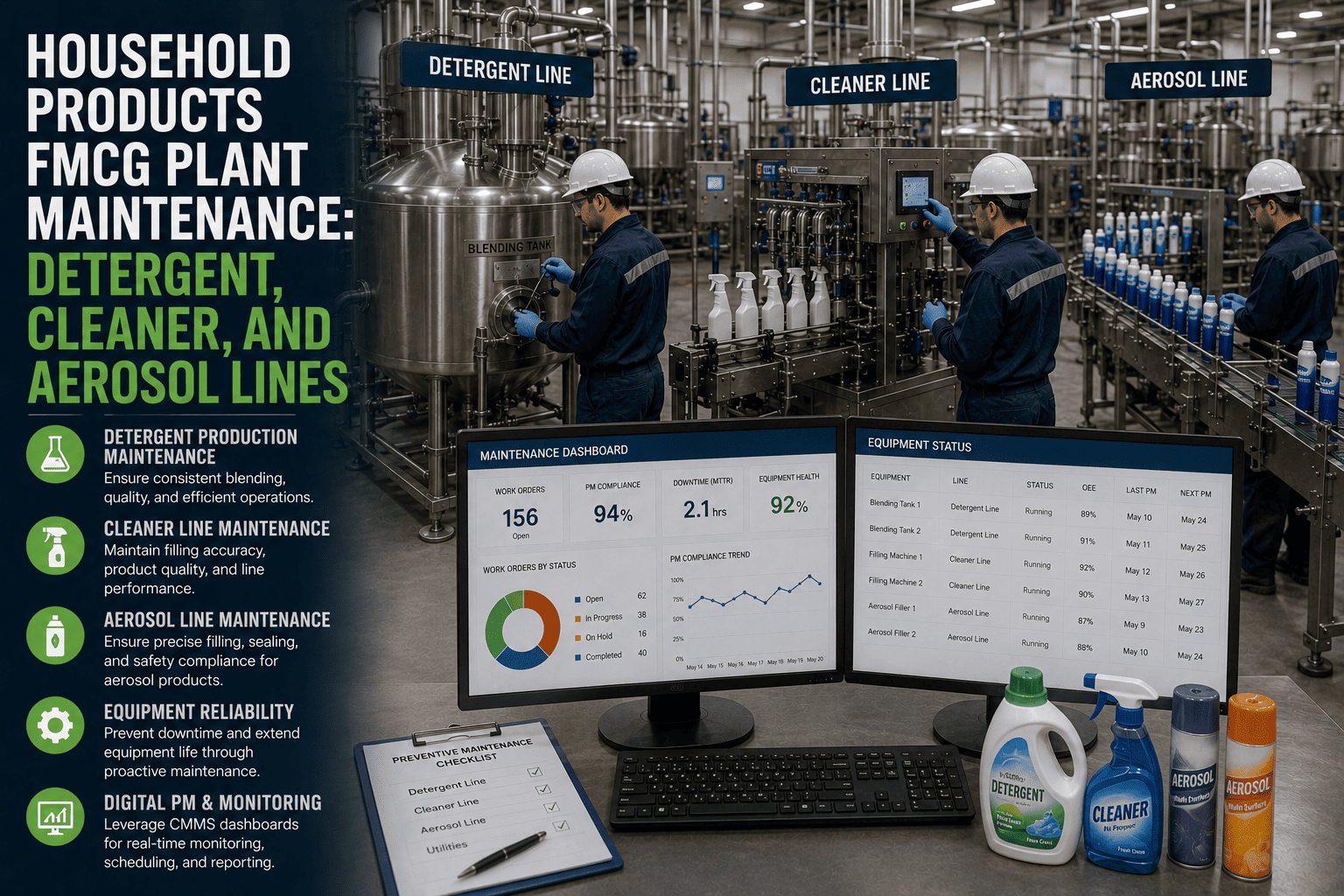
Household products manufacturing relies on six equipment categories — each operating in chemically aggressive environments that demand product-specific maintenance protocols. A generic industrial PM schedule applied to caustic detergent, bleach, or solvent-based product lines will always fail prematurely. Effective maintenance through Oxmaint means matching every maintenance task to the chemical environment of the specific product being produced.
01
Chemical Mixing & Blending Vessels
Corrosion & Contamination Risk
Sacrificial anode inspection and replacement cycles
Vessel lining integrity checks for chemical attack
Agitator shaft seal compatibility with product pH
Temperature and pH sensor calibration and replacement
02
Chemical Dosing & Filling Pumps
Chemical Compatibility Risk
Diaphragm material verification — PTFE, EPDM, Viton by product
Pump head and valve seat wear inspection schedules
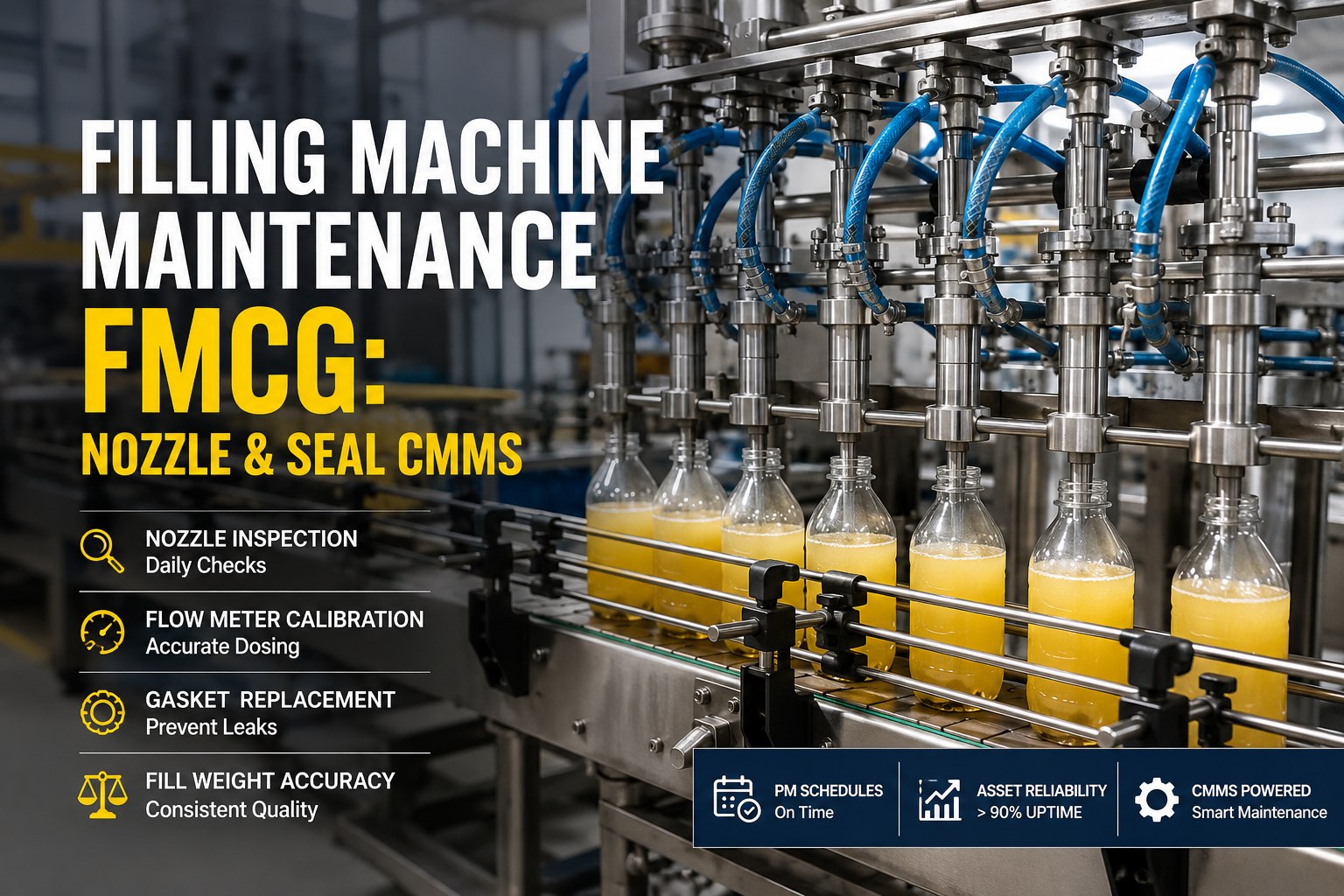
Flow meter calibration for accurate chemical dosing
Seal-less pump cavity flushing and inspection
03
Filling & Capping Machines
Accuracy & Safety Risk
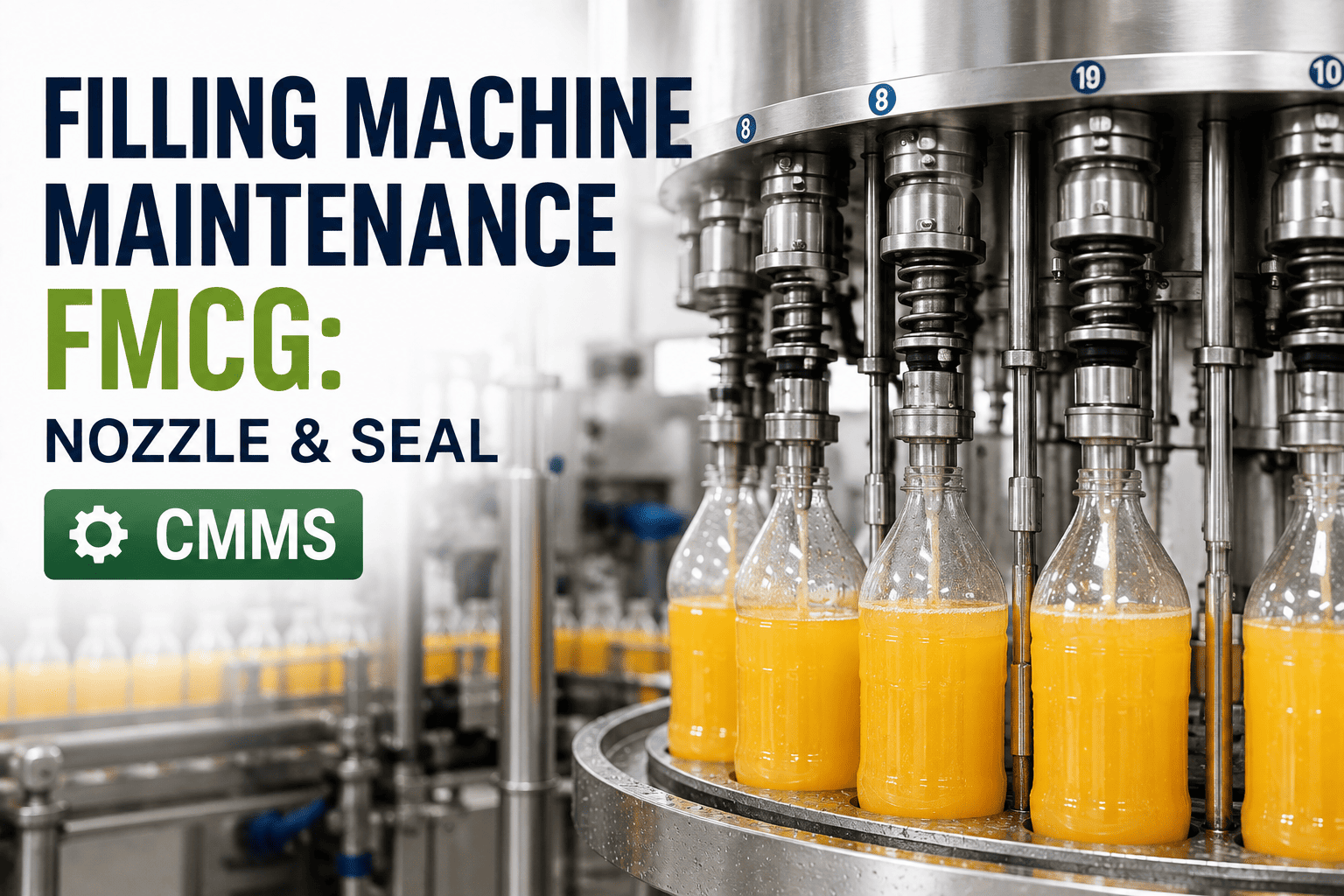
Fill nozzle and valve seat chemical resistance verification
Fill weight load cell calibration — chemical product density variation
Cap torque verification and chuck wear inspection
Drip tray and catch basin inspection for chemical accumulation
04
Conveyor & Material Handling Systems
Chemical Wear & Contamination Risk
Chemical-compatible lubricant specification by product zone
Chain and belt wear rate monitoring in chemical exposure areas
Roller and guide rail corrosion inspection schedules
Spill containment drain and channel maintenance
05
Chemical Storage & Transfer Systems
Safety & Regulatory Risk
Tank and IBC inspection for liner integrity and valve condition
Bund and secondary containment inspection schedules
Transfer pipe and hose condition — chemical compatibility rated
Level sensor calibration and overflow prevention system checks
06
Labeling, Coding & Packaging Lines
Compliance & Throughput Risk
Label applicator roller and adhesive system maintenance
CIJ/TTO coder printhead cleaning and ink system checks
Shrink tunnel temperature calibration and element inspection
Case erector and sealer adhesive system condition
Chemical compatibility isn't a one-time specification — it's an ongoing maintenance discipline. Oxmaint PM Schedules let you assign product-specific maintenance tasks to every wetted component on your lines, with automated alerts before failures occur.
Eight Maintenance Strategies for Household Chemical Product Lines
Maintaining household product manufacturing equipment requires a maintenance framework built around chemical aggressiveness, not just mechanical wear. Each strategy below addresses a specific failure mode that is uniquely elevated in chemical processing environments — from caustic detergent lines to bleach-based cleaner production and solvent-based air freshener filling.
Eight Proven Maintenance Strategies for Household Products Manufacturing
01
Corrosion Prevention
Sacrificial anode replacement on fixed time-based schedule
Annual vessel lining inspection with ultrasonic wall thickness testing
Cathodic protection system verification for buried tanks
Impact: Zero Corrosion-Driven Vessel Failures
02
Seal & Gasket Programs
Product-specific seal material register — PTFE, EPDM, Viton, Buna-N
Replacement on time-based cycles, not failure-triggered
Post-replacement leak test before product introduction
Impact: Zero Unplanned Chemical Leaks
03
Pump Diaphragm Care
Diaphragm replacement intervals matched to chemical exposure severity
Visual inspection at every PM for micro-cracks and delamination
Pump performance trending to detect early degradation
Impact: 85% Fewer Pump Failures
04
Chemical Safety Checklists
Pre-shift safety inspection — chemical containment and PPE stations
Bund integrity and spill kit readiness verified before production
Emergency shower and eyewash station function test — weekly
Impact: Zero Recordable Safety Incidents
05
Lubrication Management
Chemical-compatible lubricant specification by line and product zone
Lubrication points mapped and tagged — correct product verified at PM
Centralized lubrication system filter and reservoir maintenance
Impact: 4x Longer Chain & Bearing Life
06
Sensor Calibration
pH, conductivity, and temperature sensors — monthly calibration
Level sensors in chemical tanks — quarterly function verification
Flow meters on dosing lines — calibration with traceable standards
Impact: ±0.2% Dosing Accuracy
07
CIP System Maintenance
Spray nozzle and manifold inspection after every CIP cycle
CIP chemical concentration sensor calibration — weekly
CIP pump seal compatibility verified for cleaning chemical used
Incompatible chemical combinations flagged in changeover procedure
First-fill pH and concentration verification before full run release
Impact: 100% Changeover Safety Compliance
Chemical Compatibility & Corrosion Risk by Product Category
Understanding the chemical aggressiveness of each household product category is the foundation for building correct maintenance intervals, selecting the right seal and gasket materials, and specifying chemical-compatible lubricants. The table below maps the primary corrosion and compatibility risks for common household product lines — and the maintenance actions that address them through Oxmaint Chemical Safety Checklists.
Product Category
Primary Maintenance Risk
Key Maintenance Action
Liquid Detergents (pH 8–11)
Alkaline attack on standard seals — EPDM preferred; carbon steel corrosion on unlined vessels
EPDM seal program + vessel lining inspection every 6 months
Viton seals on solvent lines; pressure vessel inspection every 6 months
Fabric Conditioners & Softeners
Cationic surfactants build up in pump cavities and sensor pockets — affecting dosing accuracy
Pump cavity flush at every PM; sensor pocket cleaning weekly
Seal and gasket material compatibility must be verified against the specific formulation, not just product category. Consult your chemical supplier's compatibility data for each wetted component material. Oxmaint Chemical Safety Checklists include material compatibility fields for every maintenance task.
A Generic PM Schedule Is Not a Chemical Plant Maintenance Program.
Oxmaint Chemical Safety Checklists and PM Schedules let you build product-specific maintenance protocols for every line — matching seal materials, lubricants, calibration intervals, and corrosion checks to the actual chemistry your equipment operates in.
ROI of Chemical-Aware Preventive Maintenance in Household Products
The financial case for structured maintenance in household chemical product manufacturing is built on five value streams: unplanned downtime elimination, chemical waste reduction, equipment life extension, safety incident avoidance, and regulatory compliance protection. Because chemical-driven failures tend to be sudden and complete — a diaphragm rupture, a vessel leak, a seal failure — the cost of a single reactive event typically exceeds the entire annual preventive maintenance program cost.
Value Category
Calculation Basis
Annual Value
Unplanned Downtime Elimination
Line uptime from 72% to 95% — 23% throughput recovery across 4 chemical product lines
$118,000
Chemical Waste & Product Loss
Zero in-process batch contamination — eliminates $38K–$95K/event product disposal costs
$86,000
Equipment Life Extension
Correct seal and lubricant programs extend vessel, pump, and conveyor life by 40–60%
$64,000
Safety Incident Avoidance
Zero chemical exposure incidents — workers compensation, investigation, and remediation costs avoided
$52,000
Regulatory Penalty Avoidance
Zero EPA / HSE / CPCB violations — no consent orders, fines, or mandatory shutdowns
$44,000
CIP Chemical Efficiency
40% reduction in CIP chemical consumption through calibrated concentration control
$28,000
Total Annual Value Delivered
$392,000
Program investment: $32,000–$46,000/year including Chemical Safety Checklist setup, PM schedule configuration, seal register, and training. Net ROI: $346,000–$360,000. Return: 8–12x in first year. Facilities running bleach or acid product lines see faster payback due to higher baseline failure frequency.
Implementation Roadmap: Chemical-Safe Maintenance in 90 Days
Building a chemical-aware maintenance program for household products manufacturing follows a structured path that eliminates the most dangerous failure modes first — starting with seal and corrosion risks — and systematically extends coverage to all equipment categories. Schedule a demo to build a deployment plan matched to your specific product lines and chemical processing environment.
01
Week 1–2: Chemical Audit
Map all equipment against product chemistry by line
Identify seal, gasket, and lubricant incompatibilities
Flag overdue corrosion inspections and anode replacements
Output: Chemical Risk Register
02
Week 3–6: Quick Wins
Replace all incompatible seals and gaskets immediately
Correct lubricant specifications on all chemical-exposed lines
Deploy Chemical Safety Checklists for highest-risk equipment
Output: Immediate Risk Elimination
03
Month 2–3: Systematize
Product-specific PM schedules deployed across all 6 equipment categories
Sensor calibration program live with traceable records
Corrosion inspection and anode replacement scheduled for all vessels
Output: Full Chemical PM Coverage
04
Month 3+: Optimize
Predictive maintenance using pump performance and sensor trend data
Failure mode analysis linked to product formulation changes
Continuous improvement driven by uptime and safety KPIs
Output: 8–12x ROI Sustained
Real-World Maintenance Wins in Household Products Manufacturing
The most compelling proof for chemical-aware preventive maintenance comes from documented cases where household products facilities eliminated costly failures by addressing the specific maintenance requirements of their chemical processing environment.
Win 1: Detergent Plant — South Asia
Challenge3 pump diaphragm failures per quarter on caustic dosing lines — $74,000/year in downtime and product loss
Maintenance ActionsPTFE diaphragm program with chemical-matched replacement intervals, pump performance trending deployed
Result After 6 MonthsZero diaphragm failures — pump MTBF extended from 90 days to 14+ months
Annual Savings$68,000 (Downtime + Product Loss + Emergency Repair)
Win 2: Household Cleaner Plant — Eastern Europe
ChallengeBleach line conveyor chain failing every 8 weeks — petroleum lubricant incompatible with pH 12 product
Why do standard industrial PM schedules fail in chemical product manufacturing?
Standard industrial PM schedules are designed around mechanical wear rates in neutral or mildly aggressive environments. Household chemical product lines operate in environments that are fundamentally different — pH values ranging from 1 to 13, oxidising bleach formulations, solvent-based aerosols, and cationic surfactant systems each attack seals, gaskets, diaphragms, and metal surfaces at rates that are 2–10x faster than standard industrial assumptions. A diaphragm pump on a water transfer application may need replacement every 18–24 months. The same pump on a caustic soda dosing line may need replacement every 60–90 days. Without product-specific PM schedules built into your CMMS, failures are guaranteed. Sign up free to build chemical-specific PM schedules for your product lines.
What seal and gasket materials should be used for different household chemical products?
The primary seal material recommendations for common household chemical product environments are: PTFE (polytetrafluoroethylene) for bleach-based products, strong acids, and oxidising formulations — PTFE has near-universal chemical resistance; Viton (FKM) for solvent-based products, aerosols, and high-temperature alkaline applications; EPDM for general alkaline detergents, surfactant systems, and steam applications — EPDM is not suitable for solvent contact; Buna-N (nitrile) for mild alkaline and neutral products only — degrades rapidly in acid, bleach, or solvent environments. Every wetted component in your facility should have its seal material recorded in a maintenance register matched to the product it handles. Never assume that the seal specified for one product is compatible with a product changeover unless verified.
How often should corrosion inspections be performed on chemical processing vessels?
Corrosion inspection frequency depends on the chemical aggressiveness of the product and the vessel material of construction. For 316L stainless steel vessels handling bleach or acid products, ultrasonic wall thickness testing should be performed every 6 months and sacrificial anodes replaced annually. For carbon steel vessels with chemical-resistant linings, lining integrity inspection should occur every 12 months with immediate attention to any visible delamination, blistering, or pinhole formation. For HDPE and FRP vessels, UV degradation and impact damage inspection quarterly. Vessels that handle multiple products through changeover should be inspected after any product change involving a significant pH shift. Deferred corrosion inspections are the single largest cause of sudden catastrophic vessel failures in chemical processing.
What are the key chemical safety maintenance requirements for household products lines?
Chemical safety maintenance in household products manufacturing covers three critical areas. First, containment integrity: bund walls, drip trays, and secondary containment systems must be inspected before every shift and formally tested quarterly — a failed bund during a vessel leak is a regulatory violation, not just a housekeeping problem. Second, emergency response equipment: emergency showers, eyewash stations, spill kits, and neutralisation agents must be inspected weekly with documented records — regulators and insurers require evidence of regular function testing. Third, chemical transfer integrity: hoses, couplings, and transfer connections on chemical-duty service must be inspected before every use and formally pressure-tested at defined intervals. Oxmaint Chemical Safety Checklists cover all three areas with pre-built templates that generate digital records for every inspection. Book a demo to see the checklists in action.
What is the payback period for a chemical-aware PM program in household products manufacturing?
Most household products facilities achieve full payback within 3–5 months of implementing a chemical-aware preventive maintenance program. The program investment of $32,000–$46,000 per year is typically recovered within the first quarter because the two highest-value quick wins — eliminating incompatible seal and lubricant materials, and correcting diaphragm pump replacement intervals — deliver immediate, measurable results. Facilities that have experienced a recent vessel leak, pump failure, or safety incident typically achieve payback within 6–8 weeks because the avoided recurrence value alone exceeds the annual program cost. The compounding value builds through equipment life extension (40–60% longer service life with correct chemical PM programs) and the permanent elimination of chemical waste from batch contamination events.
Chemical Processing Maintenance for Household Products
Your Lines Are Running on the Wrong PM Schedule. Every Day Increases the Risk.
Oxmaint Chemical Safety Checklists and PM Schedules give household products manufacturers the product-specific maintenance infrastructure to eliminate chemical-driven failures — with automated work orders, seal material registers, corrosion tracking, and safety inspection records built in.
Chemical Safety Checklists — Pre-Built for Household Product Lines
Product-Specific PM Schedules by Chemical Environment
Seal Material Register with Compatibility Tracking
Corrosion Inspection Scheduling with Vessel History
Automated Work Orders on Seal and Anode Replacement Alerts

.png)


