How to Implement Just-in-Time (JIT) Maintenance in FMCG Manufacturing
By Jonas on March 5, 2026
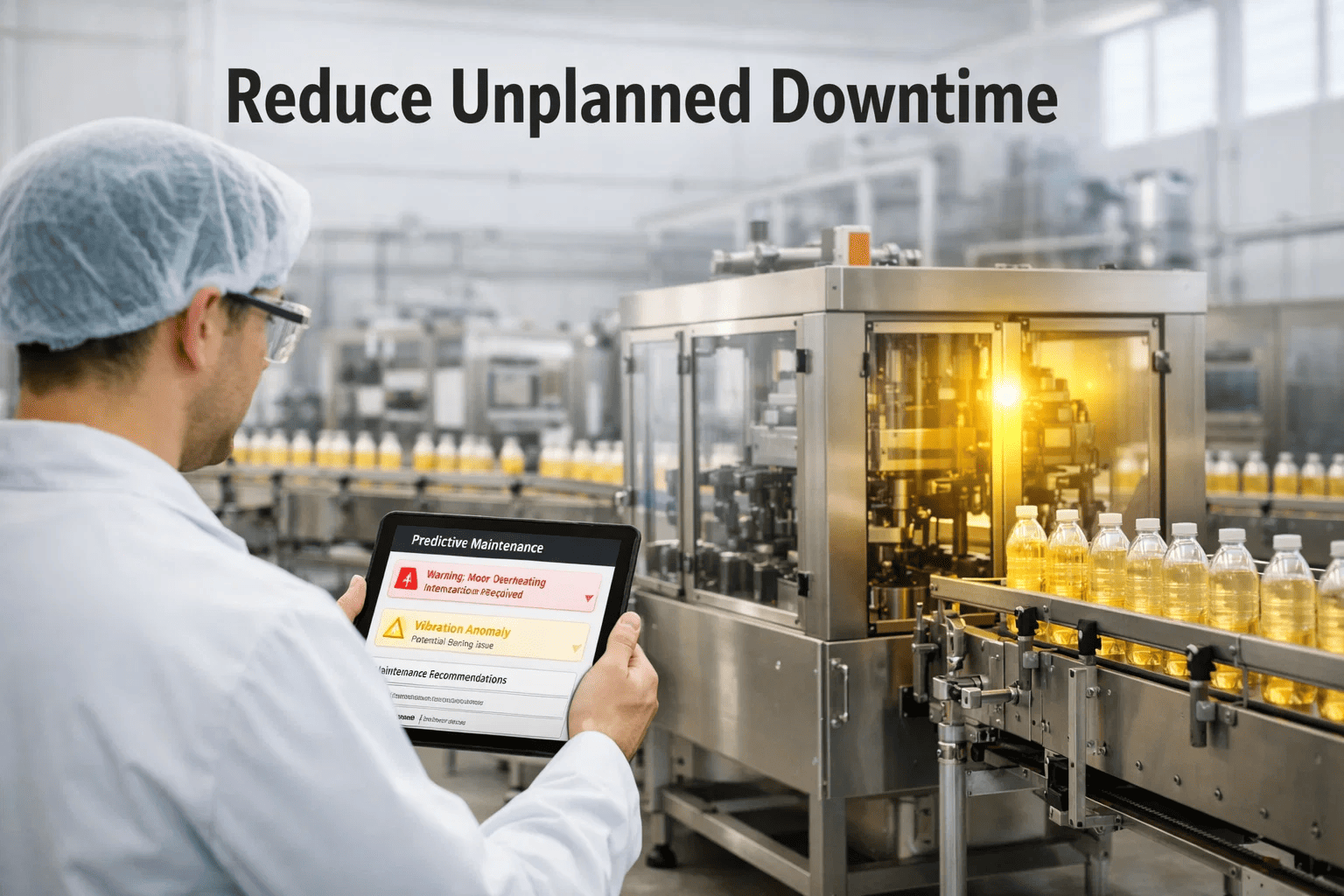
Unplanned downtime costs FMCG manufacturers an average of $260,000 per hour. Just-in-Time (JIT) maintenance eliminates this by synchronizing every repair, inspection, and replacement with live production schedules — so work happens at exactly the right moment, never too early, never too late. For plants running lean manufacturing, JIT maintenance is the missing link between operational efficiency and equipment reliability. Oxmaint's production-aligned scheduling engine gives FMCG maintenance teams the tools to execute every PM task, condition-based repair, and parts replacement within natural production windows — without a single manual coordination call. Book a demo to see how JIT scheduling works across your production lines.
Oxmaint synchronizes maintenance schedules with live production data — so every PM task, condition-triggered repair, and parts replacement lands in the right window, automatically.
Maintenance Tasks That Disrupt Active Production Runs
4.8x
Cost Multiplier for Emergency Repairs vs. Planned Work
92%
FMCG Plants Still Using Calendar-Based PM Scheduling
What Is Just-in-Time Maintenance?
JIT maintenance is the practice of performing maintenance activities at the precise moment they deliver maximum value — aligned with production windows, equipment condition data, and supply chain schedules. Unlike calendar-based preventive maintenance (which services equipment whether it needs it or not) or reactive maintenance (which waits for failure), JIT maintenance uses real-time condition monitoring and production planning data to schedule work during natural production gaps — changeovers, sanitation cycles, shift handovers, and planned idle periods. In FMCG manufacturing, where production lines run 20+ hours per day and changeover windows are measured in minutes, this precision scheduling is the difference between 85% and 98% OEE — not by reducing maintenance frequency, but by eliminating the conflict between when maintenance is needed and when production can afford to stop. Book a demo to see how Oxmaint maps your production schedule to your maintenance backlog in real time.
Why Calendar-Based PM Fails in FMCG
Traditional preventive maintenance schedules repairs every 30, 60, or 90 days regardless of actual equipment condition or production demand. In FMCG environments — where a single packaging line runs 20+ SKUs per shift, changeovers happen multiple times per day, and food safety requirements make unplanned stoppages particularly costly — calendar-based PM creates predictable failures at the worst possible times. The equipment that needs servicing most urgently is often the equipment the production schedule cannot spare, and the maintenance window that exists is often used for work that didn't need doing yet — resulting in a programme that simultaneously over-services healthy assets and under-serves assets that need attention, creating parts waste, overtime cost, and unplanned failures all at once. Start your free trial to replace calendar-based scheduling with production-aligned JIT maintenance, or book a demo to see how Oxmaint handles the transition from fixed-interval PM.
Calendar-Based PM vs. JIT Maintenance — Head-to-Head
Calendar-Based PM
Scheduling Logic
Fixed intervals — every 30/60/90 days regardless of equipment condition
Production Impact
37% of PM tasks interrupt active production runs — costing $260K/hr each time
Parts Waste
28% of replaced components still have 40%+ remaining useful life
Overtime Labour
$180K+/year in unplanned overtime to resolve PM-production conflicts
Failure Prediction
None — failures between PM cycles are fully reactive and unplanned
JIT Maintenance
Scheduling Logic
Condition-driven + production-window-aligned — work triggers on data, not dates
Production Impact
96% of maintenance fits within changeover or planned downtime windows
Parts Waste
Components replaced at 85–95% wear — near-zero premature replacement
Overtime Labour
Eliminated — all work pre-scheduled within standard shift allocations
Failure Prediction
Condition monitoring detects 78% of failures 1–4 weeks before occurrence
Six Root Causes of Maintenance-Production Conflict in FMCG Plants
JIT maintenance fails to take root in most FMCG plants not because the concept is wrong, but because the underlying conditions that make calendar-based PM the default are never addressed. Understanding the root causes is the prerequisite to fixing them permanently — and each one has a specific platform capability that closes it.
Why JIT Maintenance Is Hard to Implement Without the Right Platform
No Real-Time Production Visibility
Root Cause
Maintenance teams have no live view of production schedules. They cannot see when the next changeover is, how long sanitation will run, or which lines are idle — so they cannot exploit natural production gaps.
Disconnected CMMS and MES Systems
Root Cause
CMMS and MES run as separate platforms with no data exchange. A PM work order created in the maintenance system has no awareness of the production run active on the same line at the same time.
No Condition Monitoring on Critical Assets
Root Cause
Without vibration, temperature, or oil analysis data, maintenance teams cannot predict when a component will fail. Calendar-based intervals become the only available logic — even when the equipment doesn't need attention yet.
Parts Not Pre-Staged for Windows
Root Cause
A 20-minute changeover window is wasted when the technician spends 15 minutes locating parts. JIT maintenance requires parts to be at the work location before the window opens — not retrieved during it.
Technician Assignment Is Manual and Slow
Root Cause
65% of maintenance delays are caused by resource scheduling conflicts — the right technician is not assigned, not available, or not informed until after the window has opened. Manual assignment cannot operate at JIT speed.
No Window Utilisation Feedback Loop
Root Cause
Plants cannot improve what they cannot measure. Without tracking how many PM tasks complete within production windows vs. during active runs, there is no baseline, no accountability, and no data to improve from.
Oxmaint closes all six root causes — real-time production visibility, MES integration, condition-based triggers, automated parts staging, smart technician assignment, and window utilisation reporting.
Implementing JIT maintenance requires four interconnected capabilities. Missing any one creates gaps that force teams back into reactive mode — condition data without production integration produces well-timed work orders that still conflict with active runs; production integration without parts staging produces perfect scheduling windows that are wasted waiting for components. The four pillars must be built together.
The Four-Pillar JIT Maintenance Framework for FMCG Plants
01
Condition Monitoring
Vibration sensors on rotating equipment — motors, gearboxes, fans
Thermal imaging on electrical panels and high-friction components
Oil analysis and particle counting for hydraulic systems
78% of failures show symptoms 1–4 weeks before occurrence
Outcome: Predictive Window Targeting
02
Production Integration
CMMS pulls live production schedules from MES and ERP systems
Changeover, sanitation, and idle windows identified automatically
PM tasks matched to available windows by duration and asset location
Conflicts flagged before scheduling — never discovered at execution
Outcome: Zero Production Conflicts
03
Parts Availability
Digital inventory with min/max levels and automatic reorder triggers
Parts reserved against work orders at scheduling — not at execution
Lead time tracking prevents stockouts before critical windows
Kits pre-staged at work location before window opens
Outcome: 100% Parts Readiness
04
Workforce Orchestration
Skill-based routing assigns certified technicians to matched work types
Shift availability and proximity factored into assignment logic
Work orders include step-by-step procedures and duration estimates
65% of delays eliminated when assignment is automated, not manual
Oxmaint connects condition data, production schedules, parts inventory, and workforce availability into a single scheduling engine — so every maintenance task lands in the optimal window without manual coordination. The platform is built for FMCG operational complexity: multi-line plants, multi-shift operations, multi-category production runs, and the regulatory requirements of food manufacturing environments. Book a demo to see how the scheduling engine works against a live production environment like yours.
Core platform capabilities that enable production-aligned maintenance scheduling across FMCG operations
Production-Aligned PM Scheduling
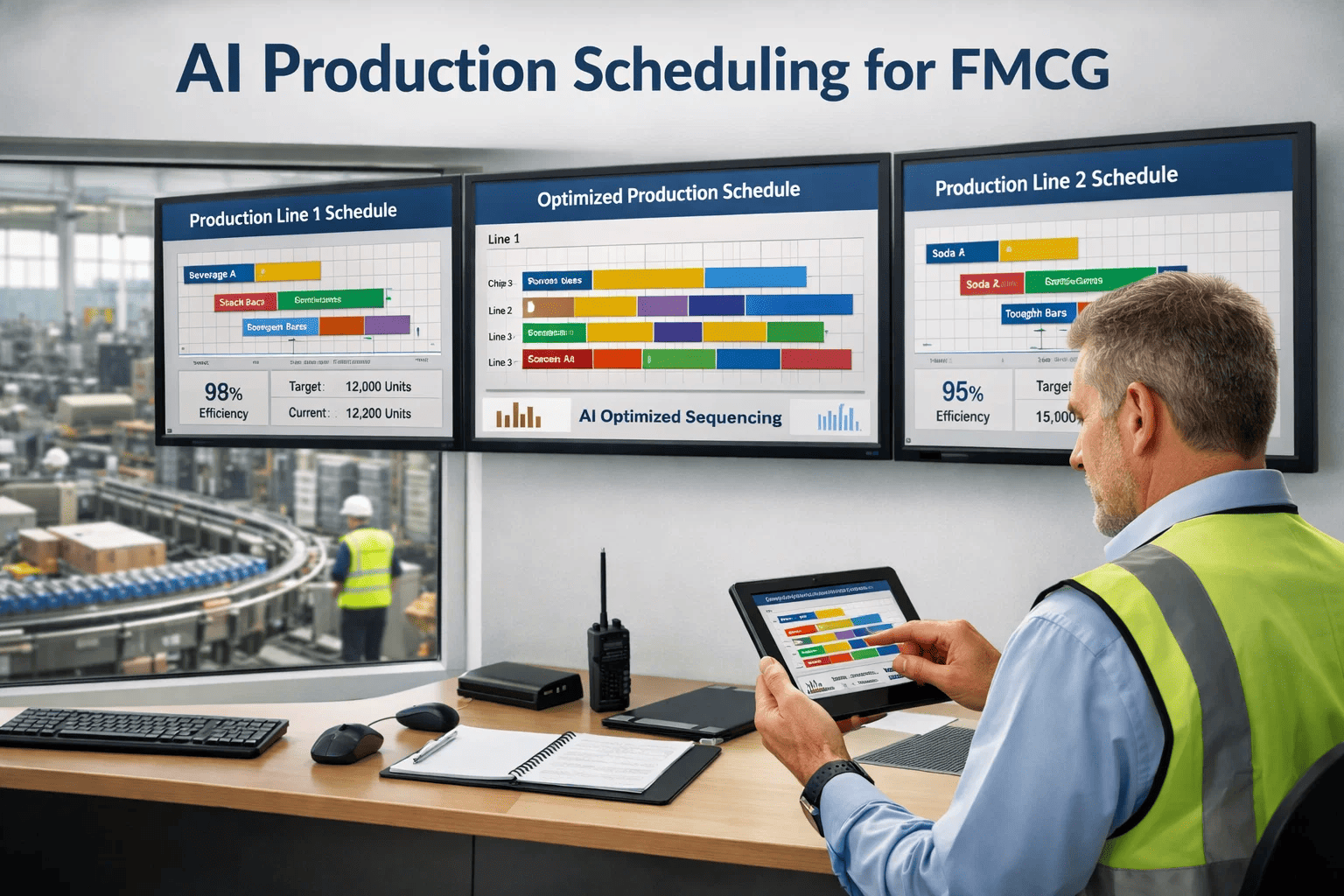
Live MES/ERP integration identifies changeover gaps, sanitation windows, and planned idle periods — PM tasks slotted automatically with zero manual coordination required
96% Within-Window Rate
Condition-Based Work Triggers
IoT sensor thresholds trigger work orders automatically — vibration, temperature, pressure, and oil analysis data connected directly to the scheduling engine
78% Failure Prediction
Automated Parts Staging
Work order creation automatically checks availability, reserves components, and alerts procurement — parts staged before the window opens, never sourced during it
Zero Stockout Delays
Smart Technician Assignment
Skill-based routing assigns certified technicians by trade, proximity, and shift schedule — work orders include procedures, tools required, and duration estimates
65% Wrench-Time Gain
Asset Criticality Scoring
Automatic ranking by downtime cost per hour, failure frequency, and production-line dependency — JIT prioritisation applied to top 20% first for fastest ROI
72% of Events Covered
Window Utilisation Reporting
Tracks the ratio of maintenance completed within production windows vs. during active runs — dashboards per line, per shift, per asset class, and per team
Real-Time Dashboard
ERP / MES Integration
Bidirectional data exchange with SAP, Oracle, Dynamics, and leading MES platforms — production schedules, asset master data, and work orders synchronised automatically
SAP / Oracle / Dynamics
Emergency Escalation Routing
When condition data signals imminent failure before a window is available, Oxmaint automatically escalates, reassigns resource, and coordinates production stoppage authorisation
<8 Min Response Time
FMCG plants that implement production-aligned JIT maintenance through Oxmaint achieve an average 13-point OEE improvement within 9 months — driven by eliminating production-interrupting PM tasks, reducing emergency reactive work, and increasing technician wrench time from 28% to 65%+.
Every Oxmaint JIT capability is built for FMCG operational complexity — multi-line, multi-shift, multi-SKU environments where changeover windows are measured in minutes and production conflicts cost $260K per hour.
JIT Maintenance by Equipment Type: FMCG Priority Assets
Not all FMCG assets benefit equally from JIT scheduling. The 80/20 rule applies with unusual precision in FMCG maintenance: 20% of assets generate 72% of production-impacting maintenance events. JIT implementation should start with these assets — where window scheduling precision delivers the largest reduction in unplanned downtime. Oxmaint's asset criticality scoring identifies the priority list automatically from your work order history and downtime records — no manual analysis required.
Downtime cost per hour, optimal maintenance window, and JIT scheduling approach per asset type
Filling & Dosing Machines
Highest per-hour downtime cost of any FMCG asset — seal and valve inspection scheduled during product changeovers (15–30 min windows), CIP sanitation cycles used for deeper PM tasks
$180K–$300K/hr
Packaging & Labelling Lines
High jam and misfeed frequency — belt tension, sensor alignment, and format part inspection scheduled at SKU changeovers; tooling replacement timed against wear counters
$90K–$180K/hr
Conveyor Systems
Belt wear, drive motor vibration, and roller bearing condition monitored continuously — lubrication and tension adjustment scheduled in shift handover windows (10–20 min)
$60K–$120K/hr
Palletisers & Robotic Cells
End-of-arm tooling wear and robot joint temperature tracked via OEM sensors — PM triggered at wear thresholds and scheduled in end-of-shift or weekend windows
$80K–$140K/hr
CIP & Sanitation Systems
Pump seal and heat exchanger inspection scheduled inside planned CIP cycles — maintenance executed during the sanitation window itself, creating zero additional downtime
Regulatory Critical
Compressed Air & Utilities
Compressor oil, filter, and belt service timed against runtime hours tracked in CMMS — scheduled in low-demand periods identified from MES production load data
$40K–$80K/hr
FMCG plants that apply JIT scheduling to their top 20% critical assets first — filling machines, packaging lines, and palletisers — achieve up to 68% reduction in production-impacting maintenance events within 6 months. These assets represent the highest ROI entry point for JIT adoption.
JIT Maintenance Implementation Roadmap
Moving from calendar-based PM to production-aligned JIT maintenance is a phased process. Most FMCG plants achieve full JIT capability within 6–9 months. The sequencing matters: attempting to deploy condition monitoring before the CMMS-MES integration is live creates data that cannot be acted on; attempting to automate technician assignment before the parts staging process is established creates well-assigned technicians who arrive at empty kitting stations. The roadmap below sequences phases to build on each other correctly.
Migrate all PM schedules, asset records, and parts inventory into Oxmaint
Establish OEE, downtime hours, and maintenance cost baselines
Map production schedules and identify recurring maintenance windows
Classify assets by criticality — identify top 20% priority list
Milestone: Baseline Established
Ph2
Window Alignment (Weeks 5–12)
Realign existing PM tasks to changeover and sanitation windows
Install condition monitoring on top 20% critical assets
Begin tracking PM completion rate within windows vs. active runs
Implement parts staging process for high-frequency PM tasks
Milestone: First ROI Visible
Ph3
Condition-Based Triggers (Weeks 13–24)
Replace calendar triggers with condition thresholds on critical assets
Integrate IoT sensor data with CMMS work order generation
Automate technician assignment by skill, shift, and proximity
Measure reduction in premature part replacements and overtime cost
Milestone: Predictive Capability Live
Ph4
Full JIT Operations (Weeks 25–36)
Extend condition-based scheduling to all asset classes plant-wide
Automate parts staging and technician assignment at scale
Achieve 96%+ maintenance completion within production windows
Benchmark against Phase 1 baselines — report full ROI
Milestone: 96%+ Window Rate Achieved
Annual ROI of JIT Maintenance Adoption
The financial case for JIT maintenance is driven by five independent cost reduction levers — each measurable from the first month of implementation. The combined annual return for a mid-size FMCG plant consistently exceeds $1.4M, with the first ROI visible within 8–12 weeks of Phase 2 window alignment. The table below shows the typical breakdown across a plant running 4–6 production lines with 30–50 assets under management. Start your free trial to begin capturing these savings, or book a demo to model the ROI against your specific plant profile.
Annual ROI of JIT Maintenance — FMCG Plant Profile
Mid-size FMCG operation — 4–6 production lines — filling, packaging, and palletising equipment
Unplanned Downtime Elimination
Reducing production-interrupting PM tasks from 37% to <4% — 8 hrs unplanned downtime avoided per month at $260K/hr average cost across primary lines
$520,000
Premature Parts Replacement
Eliminating replacement of components with 40%+ remaining life — 28% of replaced parts currently wasted at avg $320K/yr spend on premature replacements
$320,000
Emergency Repair Cost Reduction
4.8x cost multiplier on reactive emergency work — 60% reduction in emergency callouts through condition-based prediction and scheduled intervention
$240,000
Overtime Labour Savings
Eliminating $180K+/yr unplanned overtime from PM-production conflicts — all maintenance pre-scheduled within standard shift allocations with no emergency callbacks
$180,000
Technician Productivity Gain
Wrench time from 28% to 65% — same headcount completing 2.3x maintenance volume, removing the need for 1–2 additional technician FTEs planned for next year
$140,000
Platform Investment
Oxmaint CMMS licence, IoT integration, implementation support, and annual maintenance — all sites included, no per-user charges
$45K–$85K/yr
Net Annual Value of JIT Maintenance Programme
$1.4M+ 14–22x ROI
The ROI model above is conservative — it excludes the value of avoided food safety incidents caused by reactive maintenance failures, regulatory non-compliance costs, and the reputational impact of customer-facing service disruptions. For FMCG plants operating near capacity, the margin protection value of eliminating unplanned production stoppages is often the largest single ROI driver of all.
The average FMCG plant captures $1.4M+ per year from JIT maintenance adoption — with first ROI visible within 8–12 weeks. The implementation timeline is 6–9 months, not years.
Predictive maintenance tells you when equipment will fail. JIT maintenance tells you when to act on that prediction without disrupting production. They are complementary — predictive provides the condition data, JIT provides the scheduling intelligence that converts a failure prediction into a correctly-timed, fully-resourced work order. Oxmaint combines both into a single workflow: sensors detect wear, the system identifies the next available production gap, and a work order with staged parts and an assigned technician is automatically scheduled for that window.
Yes. Even 24/7 operations have micro-windows: product changeovers (15–45 minutes), CIP sanitation cycles (60–120 minutes), shift handovers (10–20 minutes), and planned rate reductions. JIT maintenance identifies and fully utilises these windows. For tasks requiring longer windows, Oxmaint coordinates with production planners to create scheduled maintenance slots at periods of lowest throughput impact — typically weekend shifts or low-demand SKU runs — with the full maintenance brief prepared in advance so execution time is maximised, not consumed by logistics.
Start with assets that have the highest downtime cost per hour and the most production-schedule conflicts. In FMCG, this typically means filling machines, labelling systems, end-of-line packaging, and palletisers. These assets usually represent 20% of the equipment register but account for 72% of all production-impacting maintenance events. Oxmaint's asset criticality scoring identifies the priority list automatically from your existing work order history and downtime records — no manual analysis required.
Most FMCG plants see measurable ROI within 8–12 weeks of Phase 2 window alignment — the first savings come from eliminating production interruptions caused by misaligned PM schedules, typically worth $80K–$150K per quarter. Full ROI including parts waste reduction, labour optimisation, and emergency cost reduction is typically achieved within 6 months. The average annual return for a mid-size FMCG operation is $1.4M against a platform investment of $45K–$85K — a 14–22x return on investment.
No. JIT implementation is a phased migration, not a rip-and-replace. Phase 2 realigns existing PM tasks to production windows without changing their frequency — this alone eliminates most production-maintenance conflicts and delivers first ROI. Condition-based triggers replace calendar intervals progressively, starting with the top 20% of critical assets in Phase 3. By Phase 4, 80%+ of PM tasks are condition-triggered, but the transition is gradual and evidence-based rather than imposed across the plant simultaneously.
Oxmaint integrates with SAP PM, SAP S/4HANA, Oracle EAM, and Microsoft Dynamics 365 through standard API connections and pre-built data connectors. The integration enables bidirectional exchange of production schedules, asset master data, parts inventory, and work order status — giving the JIT scheduling engine the real-time production visibility it needs to place maintenance work in the right windows. Integration is typically configured and live within 4–6 weeks as part of the Phase 1 digitisation process. Book a demo to walk through the specific integration path for your ERP platform.
JIT Maintenance for FMCG Operations
Stop Choosing Between Maintenance and Production
Oxmaint synchronizes your maintenance programme with live production schedules — so every PM task, condition-based repair, and parts replacement happens at exactly the right moment. Zero production conflicts. Zero missed windows. Zero premature replacements. Average $1.4M annual savings from day one of full deployment.
Live MES/ERP Integration — Production Schedules in Real Time
IoT Condition Monitoring — Sensor-Triggered Work Orders
Automated Parts Staging Before Every Maintenance Window
Skill-Based Technician Assignment and Shift Scheduling
Window Utilisation Dashboard — Per Line, Per Shift, Per Team
Used by FMCG maintenance teams across food, beverage, personal care, and household products manufacturing. Deployment support included. No minimum contract term.
-maintenance-in-fmcg-manufacturing.png)