The average FMCG plant runs 4-7 disconnected software systems — ERP for procurement and finance, MES for production execution, SCADA for process control, a legacy CMMS for work orders, and spreadsheets filling the gaps between all of them. This fragmentation costs mid-size food manufacturers an estimated $380,000 annually in duplicated data entry, delayed maintenance responses, and inventory discrepancies that trigger emergency parts orders at 3x premium pricing. When your SCADA system detects a motor vibration anomaly at 2 AM but cannot automatically generate a CMMS work order, the alert sits in an operator log until the morning shift — by which time the bearing has failed, the line is down, and production is scrambling. Plants that integrate CMMS with ERP, MES, and SCADA report 42% faster maintenance response times, 28% reduction in spare parts carrying costs, and 35% improvement in overall equipment effectiveness. See how OxMaint connects to your existing plant systems — book a demo to walk through integration architecture, or start a free trial and connect your first data source today.
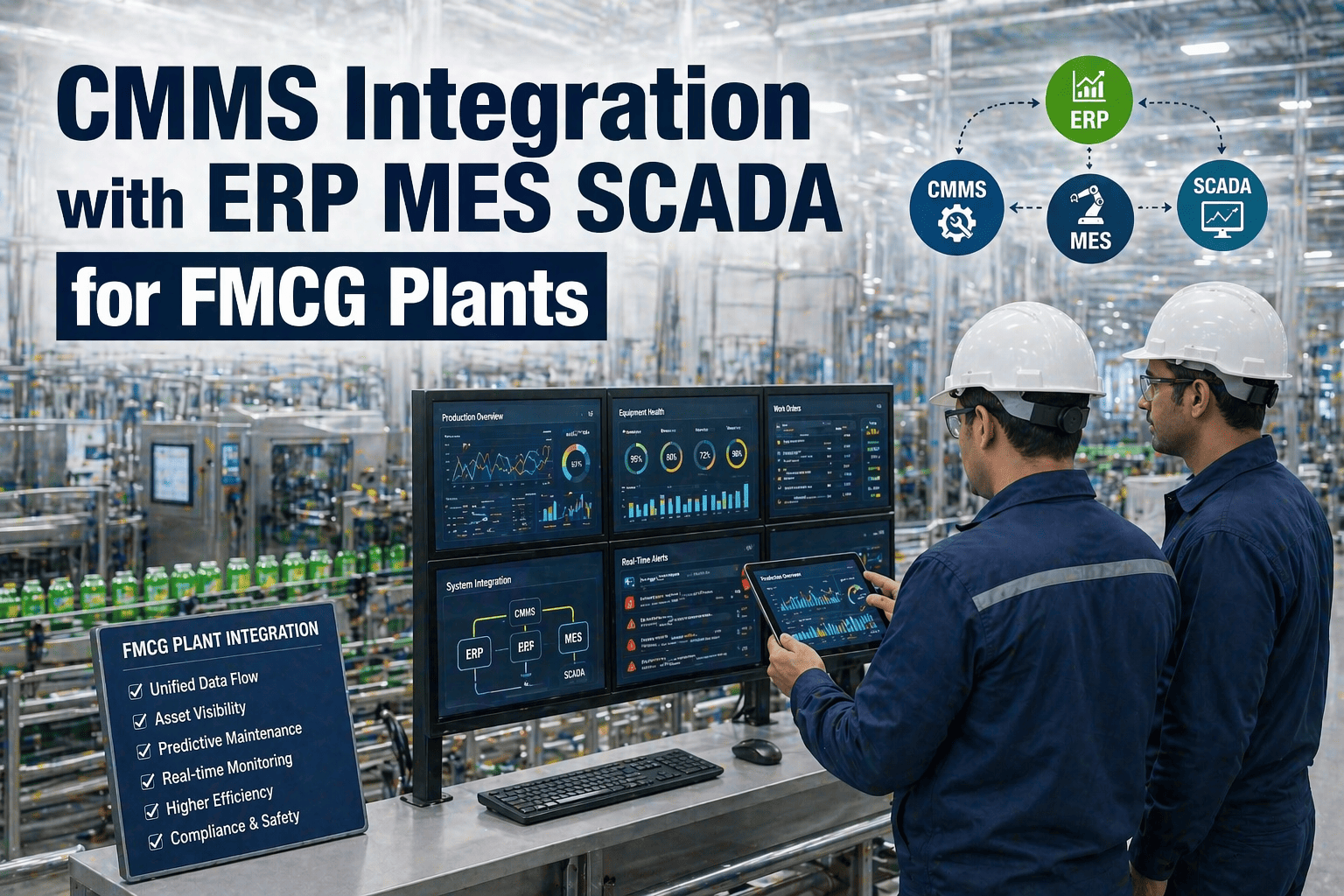
CMMS Integration with ERP, MES & SCADA in FMCG Plants
Connect maintenance operations with production execution, process control, and enterprise resource planning. Eliminate data silos, automate work order triggers, and synchronise spare parts inventory across all plant systems.
Why FMCG Plants Need Integrated Systems
In food and beverage manufacturing, maintenance is not an isolated function — it is embedded in production scheduling, quality control, regulatory compliance, and supply chain operations. When these systems operate in silos, the plant pays the price in downtime, waste, and audit risk. A CMMS that integrates with ERP, MES, and SCADA transforms maintenance from a reactive cost centre into a data-driven production enabler that directly impacts OEE, food safety, and profitability. See how this works in practice — start a free trial and book a demo to discuss your specific integration requirements.
The Four Integration Layers
Each system serves a distinct role in the plant — and each creates unique value when connected to maintenance operations through OxMaint.
Stop Copying Data Between 4-7 Disconnected Systems. Connect Them to One Maintenance Platform.
OxMaint integrates with SAP, Oracle, Wonderware, Rockwell, Siemens, and hundreds of IoT protocols — so maintenance data flows automatically between every system in your plant.
What Breaks When Systems Are Not Integrated
Siloed vs. Integrated FMCG Plant Operations
Integration ROI for FMCG Plants
Frequently Asked Questions
Does OxMaint integrate with SAP ERP?
Yes. OxMaint integrates with SAP ERP via standard APIs — syncing spare parts inventory, purchase requisitions, cost centre allocations, and employee records. When a work order consumes a spare part, OxMaint decrements CMMS inventory and triggers a goods movement in SAP. When inventory hits the reorder point, a purchase requisition generates automatically in SAP MM. Maintenance labour hours flow to SAP HR/payroll. This bi-directional integration eliminates the duplicate data entry that costs maintenance planners 6-8 hours per week at most FMCG plants. Start a free trial to explore SAP integration capabilities.
How does SCADA integration create automatic work orders?
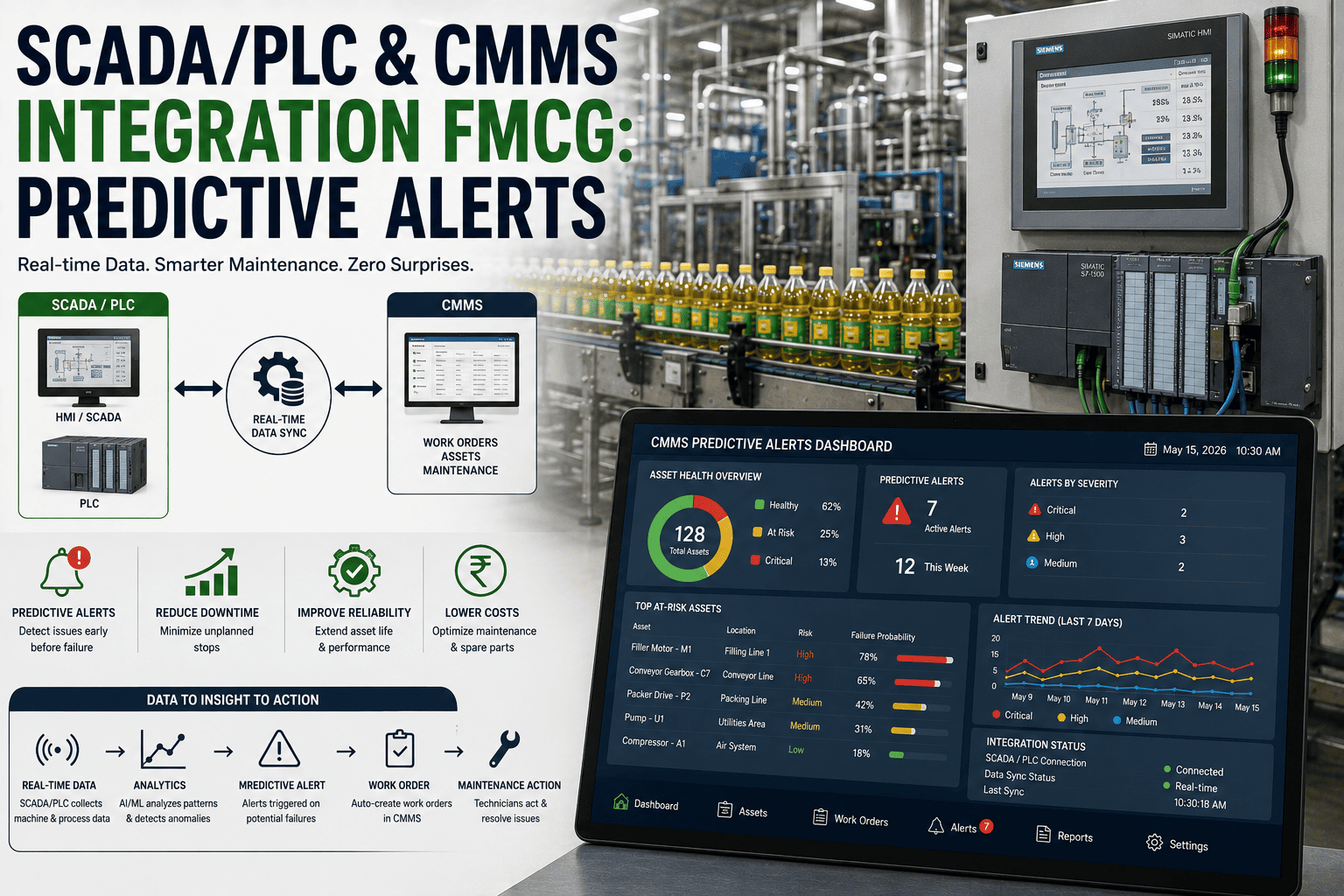
OxMaint connects to SCADA systems via OPC-UA or REST API. When a SCADA alarm exceeds a configured threshold — motor vibration above 4.5 mm/s, bearing temperature above 85 degrees C, differential pressure beyond 22% of baseline — the integration creates a CMMS work order automatically with the asset identified, alarm details attached, priority set based on severity, and the correct technician assigned. The entire process completes in under 30 seconds from alarm to dispatched work order. Book a demo to see SCADA-to-work-order automation in action.
Can OxMaint coordinate PM scheduling with MES production plans?
OxMaint reads production schedule data from MES systems to identify available maintenance windows. When PM is due on a filling line, the system checks MES for the next planned changeover, CIP cycle, or production gap — and schedules the PM to coincide with that window. If no suitable window exists within the PM tolerance period, the system escalates to the maintenance planner with options rather than silently deferring the PM. This eliminates the chronic conflict between production and maintenance scheduling that costs FMCG plants 12-18% of potential PM completion. Start a free trial to configure production-aware PM scheduling.
What protocols does OxMaint support for IoT sensor integration?
OxMaint supports MQTT, OPC-UA, Modbus TCP, and REST API for IoT sensor connectivity. This covers the vast majority of industrial wireless sensors, edge gateways, and PLC data sources used in FMCG manufacturing. For plants with legacy equipment that lacks SCADA connectivity, retrofit IoT sensors (vibration, temperature, current, pressure) can connect directly to OxMaint via MQTT — providing predictive maintenance capability without requiring PLC modification or SCADA expansion. Book a demo to discuss your integration architecture.
Your ERP Knows What You Bought. Your MES Knows What You Made. Your SCADA Knows What Is Failing. OxMaint Connects All Three to Your Maintenance Team.
SAP, Oracle, Wonderware, Rockwell, Siemens, MQTT, OPC-UA — OxMaint integrates with them all. One platform connecting financial data, production schedules, and real-time equipment health to maintenance operations.