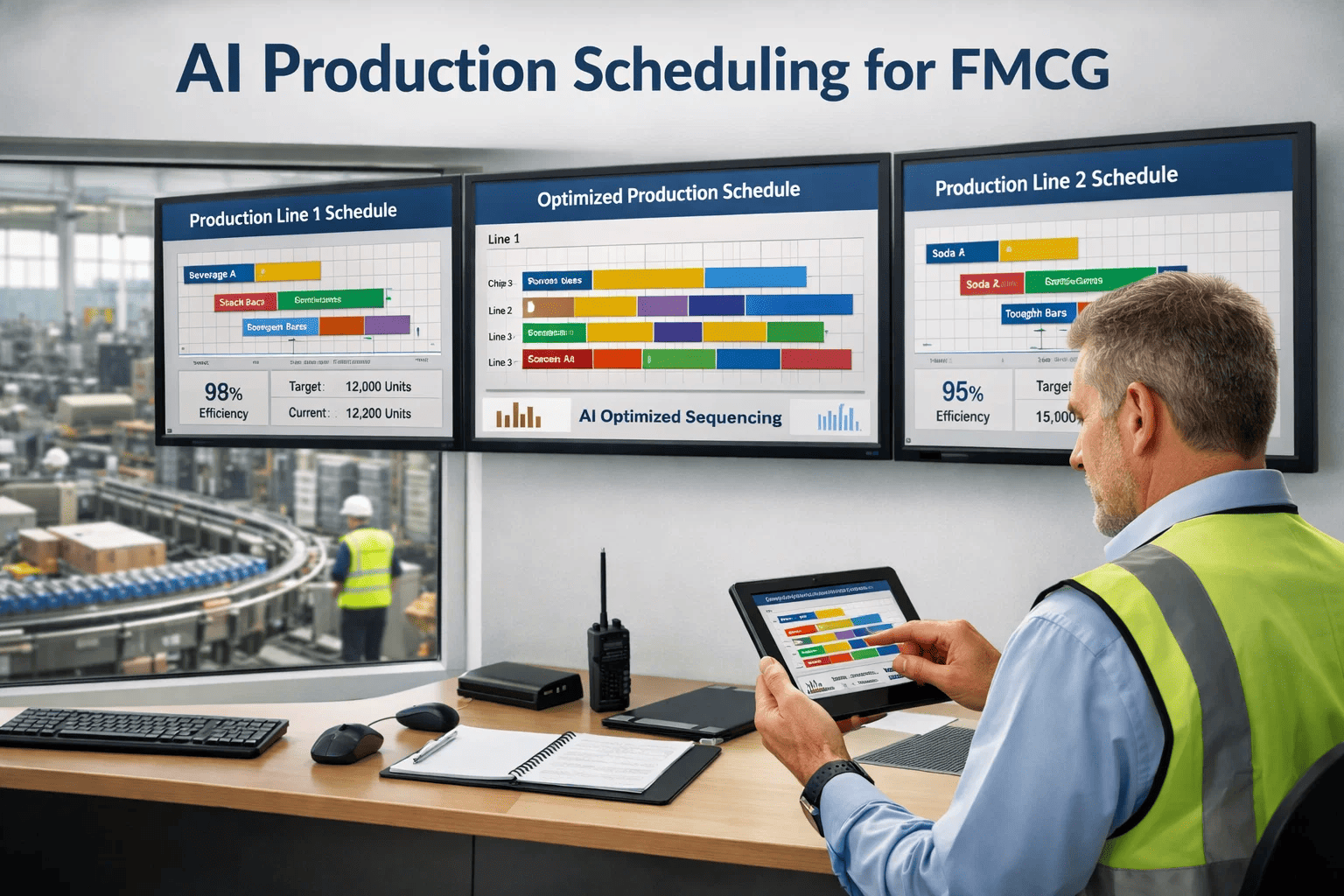
FMCG production scheduling is the operational decision that determines whether the next 16 hours of line time create maximum revenue — or bleed margin through avoidable changeovers, starved lines, and expedited changeovers that undo every efficiency gain the maintenance team worked for. Traditional production scheduling in food and consumer goods manufacturing is a manual exercise performed by a planner who knows the line capability approximately, knows the demand forecast imprecisely, and makes the best decision possible without being able to model the cost of every sequencing option simultaneously. AI-driven scheduling changes this equation entirely — evaluating thousands of sequencing combinations in seconds, factoring in real equipment capability, changeover matrices, and live demand signals to generate a schedule that a human planner could not produce in a day of manual work. Start a free trial and connect Oxmaint's production analytics to your scheduling decisions today, or book a demo to see demand-driven FMCG scheduling optimization in a 30-minute walkthrough.
35%
Schedule Adherence Gap
typical gap between planned and actual production in manual FMCG scheduling environments
18+
Daily SKU Switches
on high-variety FMCG lines — each sequence decision affects 17+ others downstream
20–30%
Changeover Time Reduction
from AI-optimized SKU sequencing alone — without any equipment modification
15%
Capacity Increase
additional utilizable production capacity recovered from smarter scheduling optimization
Every sub-optimal schedule costs you production capacity you can never recover
Oxmaint connects real equipment capability data, maintenance schedules, and OEE baselines to production planning — ensuring your schedule reflects what the line can actually do today, not a static capacity assumption set at system implementation.
Why FMCG Production Scheduling Is Uniquely Complex
FMCG production scheduling faces a combination of complexity factors that make manual optimization structurally inadequate. The number of scheduling variables that must be simultaneously optimized exceeds human cognitive capacity — and the cost of a sub-optimal sequence compounds across every run, every shift, and every line.
SKU Proliferation
100+ Active SKUs per Line
Modern FMCG portfolios have grown dramatically — a single packaging line may run 80 to 150 different SKU configurations with unique changeover times, speeds, and quality requirements per transition. Manually optimizing the sequence of 18 daily SKU runs involves 18 factorial combinations — more options than a human can evaluate in any reasonable timeframe.
Changeover Dependency
Asymmetric Changeover Matrices
Changeover time between any two SKUs depends on the direction of the switch — from flavor A to flavor B may take 45 minutes, while B to A may take 15 minutes. Sequencing rules based on changeover matrices (color runs, allergen runs, size runs) can reduce total changeover time by 20 to 30 percent compared to demand-only sequencing.
Asset Constraints
Real Equipment vs. Theoretical Capacity
Standard ERP-based scheduling assumes static line capacity. Real lines have variable actual performance based on asset condition, maintenance status, and recent micro-stop history. Scheduling against theoretical capacity consistently creates unachievable schedules — the root cause of the 35% schedule adherence gap in most FMCG plants.
Demand Volatility
Promotions and Retailer Demands
Promotional volume spikes, retailer order amendments, and short-shelf-life product sequencing create constant schedule disruption. Traditional planning systems cannot rapidly re-optimize a 3-day schedule around a last-minute +40% volume change — AI re-optimization does this in seconds with full downstream visibility.
How AI Scheduling Optimization Works in FMCG
AI production scheduling applies constraint-based optimization and machine learning to generate sequences that minimize total changeover time, maximize line utilization, and meet demand deadlines simultaneously. The difference from manual scheduling is not incremental — it is structural: AI evaluates combinations that humans cannot, learns from actual line performance data, and updates recommendations in real time as conditions change. Start a free trial to see how live OEE data improves scheduling accuracy, or book a demo to walk through the scheduling optimization workflow with your own line data.
01
Demand Signal Ingestion
AI scheduling ingests live demand signals — confirmed orders, forecast demand, promotional volumes, and stock levels — and converts them into a prioritized production requirement list updated in real time, not at the next planning cycle.
02
Real Capacity Modeling
Line capacity is calculated from actual OEE performance data — not theoretical maximum. If Line 3 has consistently run at 78% OEE over the past 14 days, the schedule is built on 78% — not 100% — eliminating the structural overcommitment that causes chronic schedule non-adherence.
03
Changeover Matrix Optimization
AI applies the full asymmetric changeover time matrix to sequence SKUs in the order that minimizes total changeover time while meeting demand deadlines. On a line with 18 daily changeovers averaging 55 minutes each, a 25% sequence improvement recovers 4+ hours of production capacity daily — without any SMED investment.
04
Maintenance Window Integration
Planned maintenance windows are embedded in the schedule — not bolted on as disruptions. PM tasks are scheduled at natural changeover points or low-demand periods, minimizing their impact on production while ensuring completion. Oxmaint's CMMS feeds maintenance schedule data directly into the production planning layer.
Manual Scheduling vs. AI-Optimized Scheduling
AI Scheduling Optimization — Results
20–30%
Changeover Reduction
From sequence optimization alone — without any SMED investment or equipment modification
92%
Schedule Adherence
Achievable when schedules are built on real OEE data — vs. 65% typical when using theoretical capacity
4+ hrs
Production Recovered Daily
Net production time recovered per line from changeover sequence optimization on 18-changeover-per-day runs
15%
Capacity Increase
Additional effective capacity from smarter scheduling — equivalent to building 15% more line capacity without CapEx
Frequently Asked Questions
How does AI production scheduling reduce changeover time in FMCG?
AI scheduling reduces changeover time by optimizing the sequence of SKU runs based on the full asymmetric changeover time matrix — grouping compatible SKUs together to minimize the total setup time between runs. On a line with 18 daily changeovers averaging 55 minutes each, optimized sequencing commonly reduces average changeover time by 20 to 30 percent — recovering 4 or more hours of production capacity per day without any equipment modification or SMED project investment. The AI evaluates all possible run sequences simultaneously, which a human planner cannot do in real time.
Why do most FMCG plants have poor schedule adherence?
The primary cause of poor schedule adherence in FMCG is scheduling against theoretical line capacity rather than actual OEE performance. If a scheduler builds a 24-hour schedule assuming 100% line efficiency but the line actually runs at 74% OEE, 26% of the planned output will not be produced — resulting in constant shortfalls, expedited runs, and reactive schedule changes. AI scheduling tools that use rolling actual OEE data as the capacity baseline consistently achieve 85 to 92% schedule adherence versus 60 to 70% in systems built on static theoretical assumptions.
How does CMMS data improve FMCG production scheduling accuracy?
CMMS data improves scheduling accuracy in three ways: first, by providing actual OEE and throughput data that replaces theoretical capacity assumptions in the schedule model. Second, by communicating planned maintenance windows so PM activities are embedded in the schedule rather than disrupting it reactively. Third, by providing asset condition scores that affect line performance — if a critical filler is running with a degraded condition score, the scheduler can factor in a realistic throughput rate rather than assuming design speed. Oxmaint's CMMS feeds all three data types into the production planning layer automatically.
Can AI scheduling handle FMCG demand volatility and promotional spikes?
AI scheduling platforms handle demand volatility far more effectively than manual systems because they can re-optimize a complete multi-line, multi-day schedule in seconds when demand signals change. When a retailer increases a promotional order by 40% with 48 hours notice, an AI system evaluates all possible resequencing options, identifies the sequence that meets the new requirement with minimum changeover impact and maximum capacity utilization, and presents the revised schedule within seconds. A human planner presented with the same change requires hours to manually rebuild the schedule — often making conservative sub-optimal decisions due to time pressure.
Schedule every line at its actual capability — and recover hours of production daily
Oxmaint connects live OEE performance data, maintenance windows, and asset condition scores to the production planning decision — giving FMCG schedulers the real capacity intelligence they need to build schedules that hold, sequences that minimize changeover, and plans that account for maintenance without reactive disruption.