SCADA, PLC & Robotic Controller Integration with CMMS for FMCG
By Jason on March 9, 2026
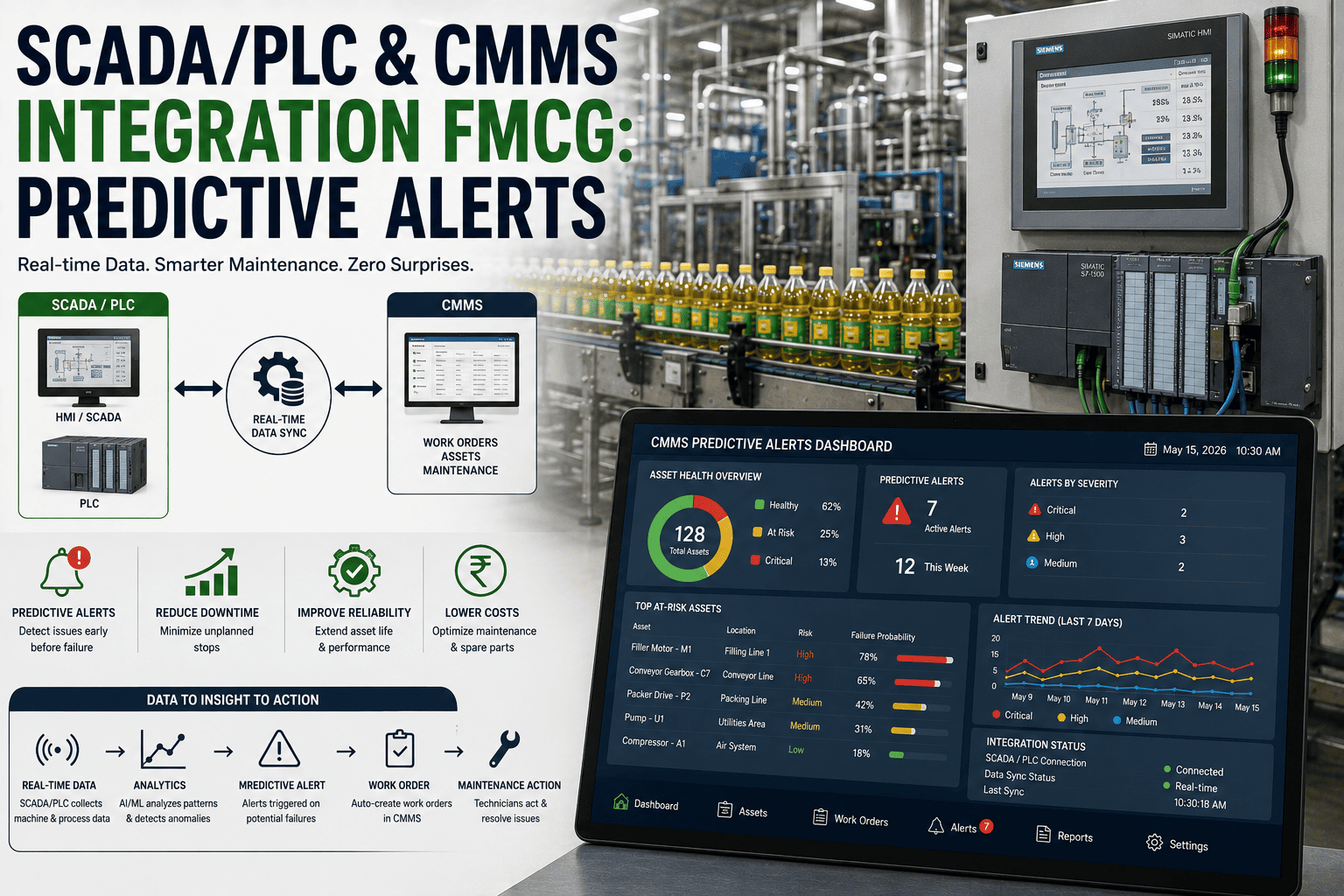
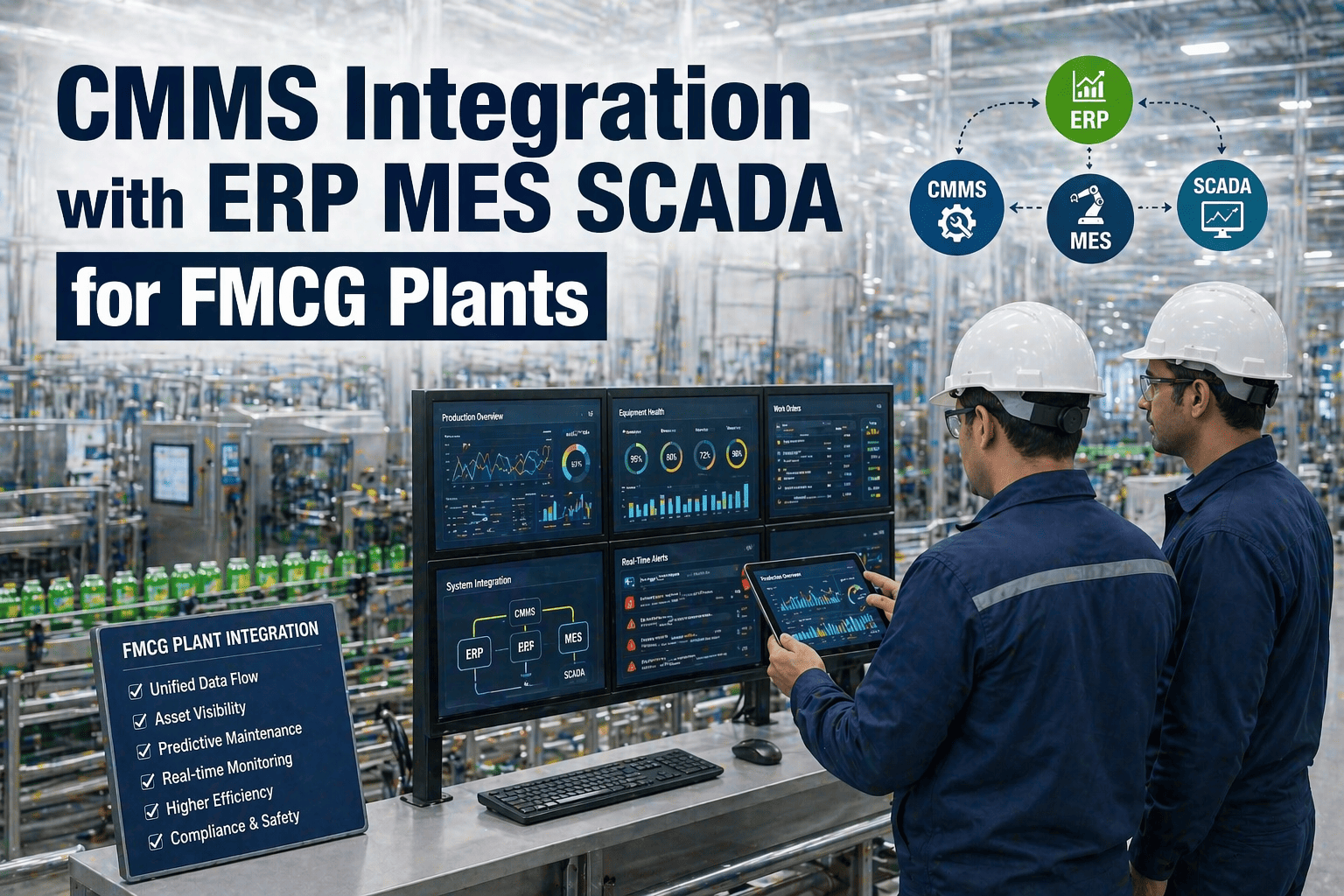
FMCG production lines generate thousands of data points every minute — PLC fault codes, SCADA alarms, robot controller anomalies, and sensor threshold breaches — but in most plants this data never reaches the maintenance team until a technician physically investigates a stoppage. The gap between machine intelligence and maintenance response is where unplanned downtime lives. Integrating SCADA systems, PLCs, and robotic controllers directly with a CMMS eliminates this gap: fault conditions automatically trigger work orders, route them to the right technician with full machine context, and begin capturing resolution data before the technician reaches the machine. Plants using Oxmaint's SCADA and automated work order integration reduce alarm-to-response time by 67% and cut unplanned downtime events by 41% within the first six months. Start your free trial to connect your production systems to your maintenance workflow, or book a demo to see live SCADA-to-WO triggering in action.
67%
Reduction in Alarm-to-Maintenance-Response Time With SCADA-CMMS Integration
41%
Fewer Unplanned Downtime Events Within 6 Months of Automated WO Triggering
78%
of FMCG Plants Have No Automated Link Between Production Alarms and Maintenance WOs
23 min
Average Manual Alarm-to-WO Delay Eliminated by Direct SCADA Integration
Your SCADA knows a pump is failing before your maintenance team does. Oxmaint's integration layer closes the gap — automatically triggering, prioritising, and routing work orders from production system alarms in real time.
Why SCADA and PLC Data Doesn't Reach Maintenance Teams
The disconnect between production automation systems and maintenance management is one of the most costly integration gaps in FMCG manufacturing. SCADA systems and PLCs generate highly actionable maintenance data — fault codes, runtime counters, threshold breaches, and alarm histories — but this data typically lives inside the OT network, visible only to operators and process engineers. Maintenance teams work in a separate system, responding to verbal reports and paper tickets rather than the machine data that should be driving their work queue. Book a demo to see how Oxmaint bridges the OT-to-maintenance gap across your production systems.
Disconnected Systems vs Integrated SCADA-CMMS
The operational difference when production data drives maintenance response
Disconnected Systems
Alarm Response
Operator sees alarm → tells supervisor → supervisor calls technician — 20–40 min delay
WO Context
Technician arrives with no machine history, no fault code, no job plan
Priority
All alarms feel equally urgent — critical faults compete with nuisance alarms
Data Capture
Fault history lost — no linkage between PLC fault code and maintenance resolution
Integrated SCADA-CMMS
Alarm Response
PLC fault triggers WO automatically — technician notified in under 90 seconds
WO Context
WO pre-populated with fault code, asset history, job plan, and parts list
Priority
AI classifies alarm severity against asset criticality — P1 to P4 assigned automatically
Data Capture
PLC fault code linked to WO resolution — pattern recognition builds over time
Integration Architecture: How SCADA, PLCs, and Robotic Controllers Connect to CMMS
A production-to-maintenance integration operates across three layers — the data acquisition layer (SCADA, PLCs, robot controllers), the integration middleware layer (OPC-UA, REST APIs, MQTT brokers), and the CMMS application layer where work orders are created, routed, and tracked. Understanding each layer is essential for planning an integration that is both technically reliable and operationally useful. Start your free trial to begin mapping your integration architecture, or book a demo to see Oxmaint's integration connector library.
SCADA platforms (Wonderware, Ignition, FactoryTalk, WinCC), PLCs (Siemens S7, Allen-Bradley, Mitsubishi), robotic controllers (FANUC, KUKA, ABB, Universal Robots), and process instrumentation via DCS. Each source exposes fault codes, alarm states, runtime counters, and condition data — the raw signal layer for automated WO triggering.
Layer 2 — Integration Middleware
Protocol Bridge
OPC-UA server acts as the universal OT data broker — translating proprietary PLC protocols into a standardised data model. MQTT brokers handle high-frequency sensor streams. REST API connectors bridge OT data to cloud CMMS. Edge computing nodes filter alarm noise and apply trigger logic before data crosses the IT-OT boundary.
Layer 3 — CMMS Application
Work Order Engine
Oxmaint receives structured alarm events, maps them to asset records, applies priority classification rules, generates work orders with pre-populated context, and routes to the assigned technician — all within a configurable trigger-to-WO pipeline. Bidirectional — WO completion data can write back to SCADA historian for asset health reporting.
Alarm Filtering and Deduplication
Signal Intelligence
Raw SCADA alarm feeds contain nuisance alarms, transient spikes, and repeat triggers that would flood the maintenance queue without filtering. Oxmaint's integration layer applies configurable suppression rules — minimum alarm duration, alarm frequency thresholds, and maintenance window exclusions — before a WO is generated.
Data Mapping: What Each System Contributes to the Work Order
The quality of an automatically triggered work order depends entirely on how well the source system data is mapped to the CMMS fields. A WO that contains only an alarm code is barely better than a verbal report — it still requires a technician to investigate before diagnosis can begin. A well-mapped WO should give the technician everything they need to start the job. Book a demo to see how Oxmaint maps your specific SCADA and PLC data to pre-populated work orders.
Data Mapping — Source System Fields to CMMS Work Order Fields
SCADA → Asset ID and Location
Automatic Mapping
SCADA tag names mapped to Oxmaint asset register — alarm source tag resolves to specific asset ID, functional location, and production zone. Technician dispatched to the exact sub-assembly, not just "Line 3."
PLC Fault Code → WO Description
Automatic Mapping
PLC fault codes translated to human-readable fault descriptions using a configurable fault code library. WO description pre-populated with symptom, fault code, and last-known process state at time of alarm — eliminating the "machine stopped" generic description.
Alarm Severity → WO Priority
Automatic Mapping
SCADA alarm priority levels (critical, major, minor) combined with asset criticality rating in Oxmaint to calculate WO priority — P1 through P4. A critical alarm on a non-critical asset may generate a P3; a minor alarm on a critical path asset may generate a P2.
Robot Fault Code → Job Plan
Automatic Mapping
Robot controller fault codes mapped to asset-specific job plans in Oxmaint — WO generated with the relevant troubleshooting guide and step-by-step procedure attached. Technician arrives with the correct job plan already loaded on their mobile device.
Runtime Counter → PM Trigger
Automatic Mapping
PLC runtime counters, cycle counts, and operating hour registers mapped to PM trigger thresholds in Oxmaint. When a runtime counter crosses the defined PM interval, a preventive maintenance WO is generated automatically — replacing fixed-calendar scheduling with actual-usage-based triggers.
Process Parameters → Condition Context
Automatic Mapping
Temperature, pressure, vibration, and flow values at time of alarm captured and attached to the WO as process snapshot data. Technician can see exactly what the machine was doing when the fault occurred — removing the need for a separate SCADA investigation before starting the repair.
A WO that arrives with asset ID, fault code, job plan, parts list, and process snapshot gives your technician a 15-minute head start on every repair. Oxmaint builds that WO automatically from your SCADA and PLC data.
Robotic Controller Integration: Specific Requirements for FMCG Lines
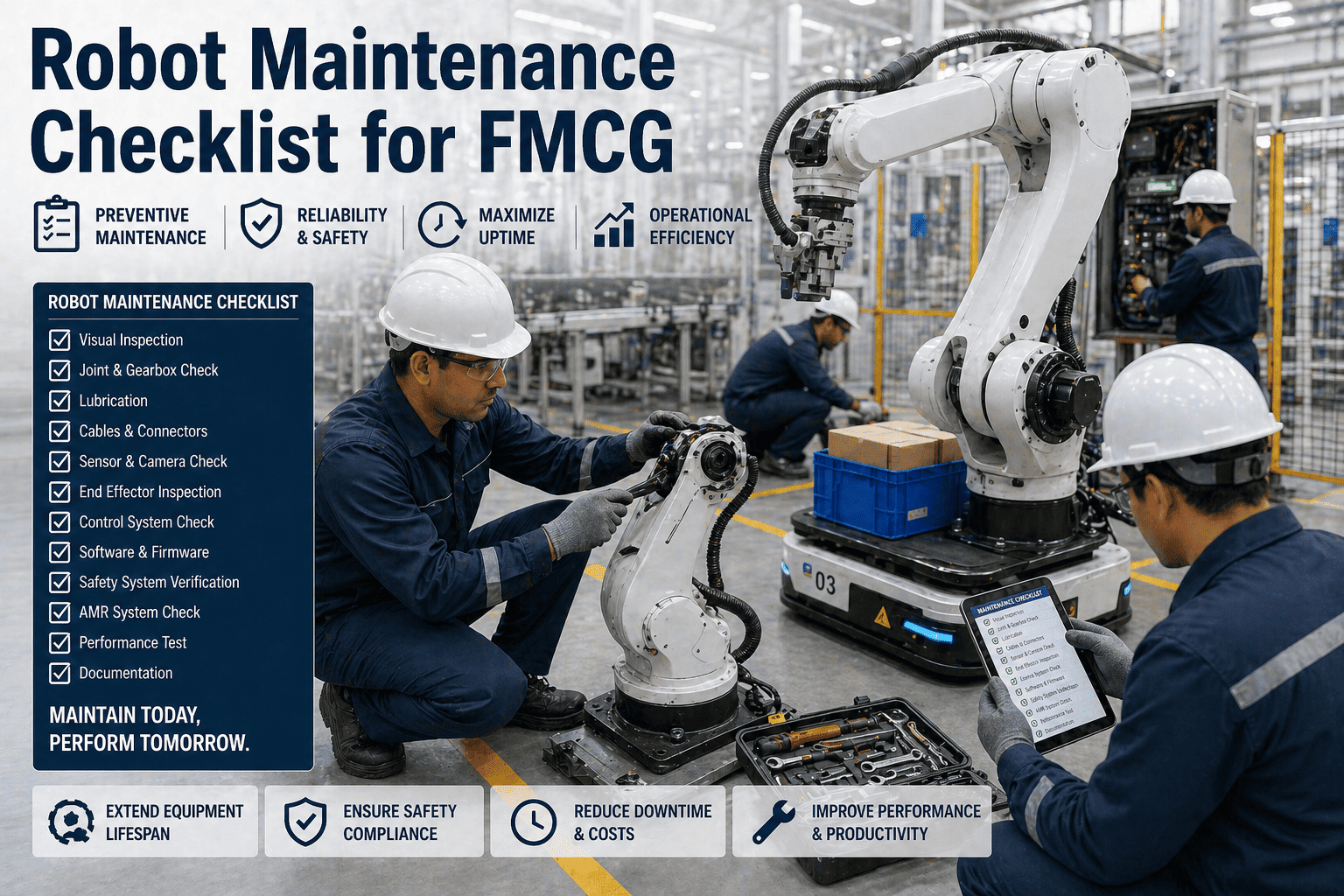
Robotic controllers present distinct integration challenges compared to standard PLCs — they expose richer fault data (joint torque anomalies, path deviations, servo errors, payload limit breaches) but communicate via proprietary protocols that require controller-specific connectors. Each major robot brand has a different integration pathway, and FMCG lines often have mixed fleets requiring multiple connectors simultaneously. Book a demo to see how Oxmaint integrates with your specific robot brands and controller versions.
Connection method, data available, and CMMS trigger capability by robot manufacturer
FANUC (R-30iB / R-30iB Plus)
FOCAS2 library or OPC-UA via FANUC FIELD system. Exposes alarm history, servo load data, cycle counts, and joint wear indicators. PM trigger on cycle count and servo load accumulation.
OPC-UA / FOCAS2
KUKA (KRC4 / KRC5)
KUKA.OPC-UA server native on KRC4/5. Exposes robot status, error codes, axis positions, and motor current. Direct OPC-UA subscription in Oxmaint — alarm states trigger WO on threshold breach.
Native OPC-UA
ABB (IRC5 / OmniCore)
ABB Ability Connected Services API or OPC-UA via ABB OPC Server. Exposes fault logs, motor temperatures, and predictive maintenance indicators. REST API integration available for cloud-connected IRC5 controllers.
OPC-UA / REST API
Universal Robots (UR3/5/10/16)
UR RTDE (Real-Time Data Exchange) interface exposes joint temperatures, payload data, and safety status. REST API via UR Dashboard Server. Low-latency fault detection — ideal for collaborative robot LOTO trigger integration.
RTDE / REST API
Yaskawa Motoman (YRC1000)
MotoPlus API or OPC-UA via third-party gateway. Exposes servo alarm codes, position error data, and maintenance interval counters. Cycle-count-based PM triggers available via register monitoring.
OPC-UA / MotoPlus
Stäubli (CS9)
Stäubli uniVAL drive OPC-UA interface on CS9 controllers. Exposes joint load data, cycle counters, and calibration status. WO trigger on joint load accumulation threshold — predictive bearing replacement.
OPC-UA / uniVAL
FMCG packaging and palletising lines frequently run mixed robot fleets — FANUC on the palletiser, UR cobots on the packaging line, and KUKA on the case packing cell. Oxmaint's multi-connector architecture aggregates fault data from all brands into a unified WO queue with consistent priority classification.
Six Automated WO Trigger Types for FMCG Production Systems
Not all automation data should trigger a work order — and not all work orders require the same response. The six trigger types below cover the full range of maintenance-relevant events that SCADA, PLC, and robotic controller data can generate, from immediate emergency dispatch to usage-based PM scheduling. Start your free trial to configure your trigger rules in Oxmaint, or book a demo to see each trigger type in action on a live integration demo.
Six Automated Work Order Trigger Types — SCADA, PLC, and Robot Controllers
Critical Alarm Trigger
P1 — Immediate
SCADA critical alarm or PLC emergency fault code triggers a P1 WO instantly — technician notified via mobile push, supervisor escalation sent simultaneously. No operator intervention required. Alarm-to-notification time under 90 seconds. Used for safety alarms, drive faults, and production-stopping equipment failures.
Threshold Breach Trigger
P2 / P3 — Condition Based
Sensor value exceeds a defined maintenance threshold — motor temperature above 85°C, vibration above 8mm/s RMS, bearing temperature trending upward over 3 consecutive readings. WO priority set by distance from critical threshold. Early warning triggers allow planned response before failure occurs.
Runtime / Cycle Count Trigger
P3 / P4 — Usage Based
PLC runtime register or robot cycle counter crosses a defined PM interval — 2,000 operating hours, 500,000 cycles, or 10,000 seal activations. Replaces fixed-calendar PM scheduling with actual-usage triggers. Equipment that runs less generates fewer PMs; equipment running at high utilisation triggers maintenance at the right interval automatically.
Robot Anomaly Trigger
P2 / P3 — Robot Specific
Robot controller detects joint torque deviation, path accuracy degradation, or servo load accumulation outside normal operating band. WO triggered with robot-specific fault code, axis number, and payload data attached. Catches mechanical wear before it causes a robot fault stop on the production line.
Repeated Alarm Pattern Trigger
P3 — Pattern Based
The same alarm code appears 3 or more times within a configurable window (e.g. 8 hours) — indicating a recurring fault that resets without resolution. Oxmaint's pattern engine identifies repeat alarm clusters and generates a root cause investigation WO with full alarm history attached, preventing the fault from becoming a line-stopping event.
OEE Degradation Trigger
P3 / P4 — Performance Based
SCADA performance data shows OEE dropping below threshold on a specific asset — output rate declining, micro-stoppage frequency increasing, or quality reject rate rising. Oxmaint generates a performance investigation WO before the degradation becomes a major stoppage, linking production KPI data to the maintenance response record.
Six trigger types — one unified work order queue. Oxmaint handles critical alarms, condition thresholds, usage-based PMs, robot anomalies, repeat patterns, and OEE degradation in a single integration layer your maintenance team actually uses.
ROI of SCADA-CMMS Integration in FMCG Manufacturing
The financial return on SCADA-CMMS integration is driven by three factors: faster response to production alarms reducing downtime duration, usage-based PM triggering reducing both over-maintenance and under-maintenance, and the elimination of the alarm-investigation step that currently consumes 15–25% of maintenance technician time in unintegrated plants. Start your free trial to begin building your integration business case, or book a demo to see how Oxmaint quantifies integration ROI for your specific production environment.
Annual ROI of SCADA-CMMS Integration
FMCG plant — high-speed packaging and filling with robotic palletising
Alarm Response Time Reduction
23-minute manual delay eliminated × 4.2 alarms/day × $420/hr production loss rate × 250 production days
$151,200
Usage-Based PM Optimisation
Eliminating 28% over-PM and 15% under-PM vs calendar scheduling — parts and labour cost reduction plus 2 fewer unplanned failures per month
$87,400
Robot Fault Prevention
Early anomaly detection prevents 3 robot fault stops per quarter × 4.5hr average recovery time × $420/hr line rate
$22,680
Technician Productivity Recovery
Eliminating 15% alarm investigation time × 8 technicians × 250 days × $38/hr fully-loaded rate
$45,600
Integration Investment
Oxmaint SCADA integration layer, OPC-UA configuration, robot connector licences, and ongoing support
$55K–$80K/yr
Net Annual Value of SCADA-CMMS Integration
$250K+ 4–5x ROI
Results based on Oxmaint customer integrations across FMCG facilities. Plants with high-frequency alarm environments and mixed robot fleets consistently achieve upper-range outcomes. Integration payback period typically 14–20 weeks from go-live.
Frequently Asked Questions
Do we need to replace our existing SCADA system to integrate with Oxmaint?
No — Oxmaint integrates with your existing SCADA system as it is, without requiring any replacement or upgrade. The integration works via OPC-UA, REST API, or MQTT broker connections that sit alongside your current SCADA infrastructure. Oxmaint acts as a consumer of your SCADA data, not a replacement for it. The most common integration pattern is an OPC-UA server already present in most modern SCADA platforms (Ignition, WinCC, FactoryTalk) that Oxmaint subscribes to — requiring only tag mapping configuration rather than any SCADA modification. Book a demo to walk through the integration approach for your specific SCADA platform.
How do we prevent SCADA alarm floods from generating too many work orders?
Alarm management is the most important configuration step in any SCADA-CMMS integration, and Oxmaint's integration layer includes several filtering mechanisms specifically for this purpose. Minimum alarm duration filters suppress transient alarms that clear within a configurable window (typically 30–120 seconds) without generating a WO. Frequency suppression prevents the same alarm code from generating more than one WO within a defined period. Maintenance window exclusions prevent WOs from being generated for alarms that occur during a scheduled maintenance activity. And alarm priority thresholds allow you to define which alarm severity levels generate WOs versus which are logged only. The result is a signal-to-noise ratio that keeps your maintenance queue clean and actionable.
Can PLC runtime counters replace calendar-based preventive maintenance schedules?
For most FMCG equipment, yes — and the results are measurably better. Calendar-based PM scheduling assumes every asset runs at the same utilisation rate, which is rarely true in FMCG plants where lines run at different speeds, products change, and seasonal demand varies significantly. Runtime-counter-based PM triggers generate maintenance at actual usage intervals — meaning assets that run less get serviced less, and assets running at high utilisation get serviced more frequently. Customers who switch from calendar to runtime-based PM typically see a 20–30% reduction in total PM labour hours and a 15–25% reduction in PM-induced parts consumption, while simultaneously reducing the incidence of failures caused by under-maintained equipment that hit its failure point between calendar PM dates.
What is the typical implementation timeline for SCADA-CMMS integration?
For a single production line with one SCADA system and a standardised PLC platform, a basic integration producing automated WO triggers can be operational in 4–6 weeks. This includes OPC-UA configuration, tag mapping, alarm filter setup, and WO trigger rule configuration. Multi-line integrations with mixed PLC brands and robotic controller connections typically take 10–16 weeks. The longest phase is usually tag mapping and alarm triage — deciding which of the thousands of available SCADA tags are maintenance-relevant and configuring appropriate trigger logic. Oxmaint provides integration engineering support and a library of pre-built connector configurations for the most common SCADA, PLC, and robot platforms used in FMCG manufacturing. Book a demo to discuss your specific integration scope and timeline.
How does SCADA-CMMS integration affect cybersecurity and the IT-OT boundary?
IT-OT security is a legitimate concern in any integration that involves the OT network, and Oxmaint's architecture is designed to respect the IT-OT boundary without requiring direct OT network exposure. The recommended architecture uses a one-way data diode or DMZ-based OPC-UA proxy that allows data to flow from OT to IT without creating a return path into the control network. Oxmaint communicates only with the IT-side interface — never directly with PLCs or robot controllers. All data in transit is encrypted, and no commands or control signals flow from Oxmaint back into the OT network. For facilities with strict IEC 62443 or NIST CSF compliance requirements, Oxmaint can provide architecture documentation for review by your cybersecurity and OT teams before integration begins.
SCADA and Automation Integration for FMCG Maintenance
Connect Your Production Systems to Your Maintenance Workflow — Automatically
Oxmaint's SCADA integration layer connects PLCs, SCADA platforms, and robotic controllers to your maintenance work order queue — turning production alarms into structured, prioritised, pre-populated work orders routed to the right technician in under 90 seconds.
OPC-UA, MQTT, and REST API Connectors — All Major SCADA and PLC Platforms
Used by FMCG maintenance and OT teams across packaging, filling, and processing operations on 3 continents. Integration engineering support included. No minimum contract term.