Mixer & Blender Maintenance for Batch Quality in FMCG
By Jack Edwards on April 8, 2026
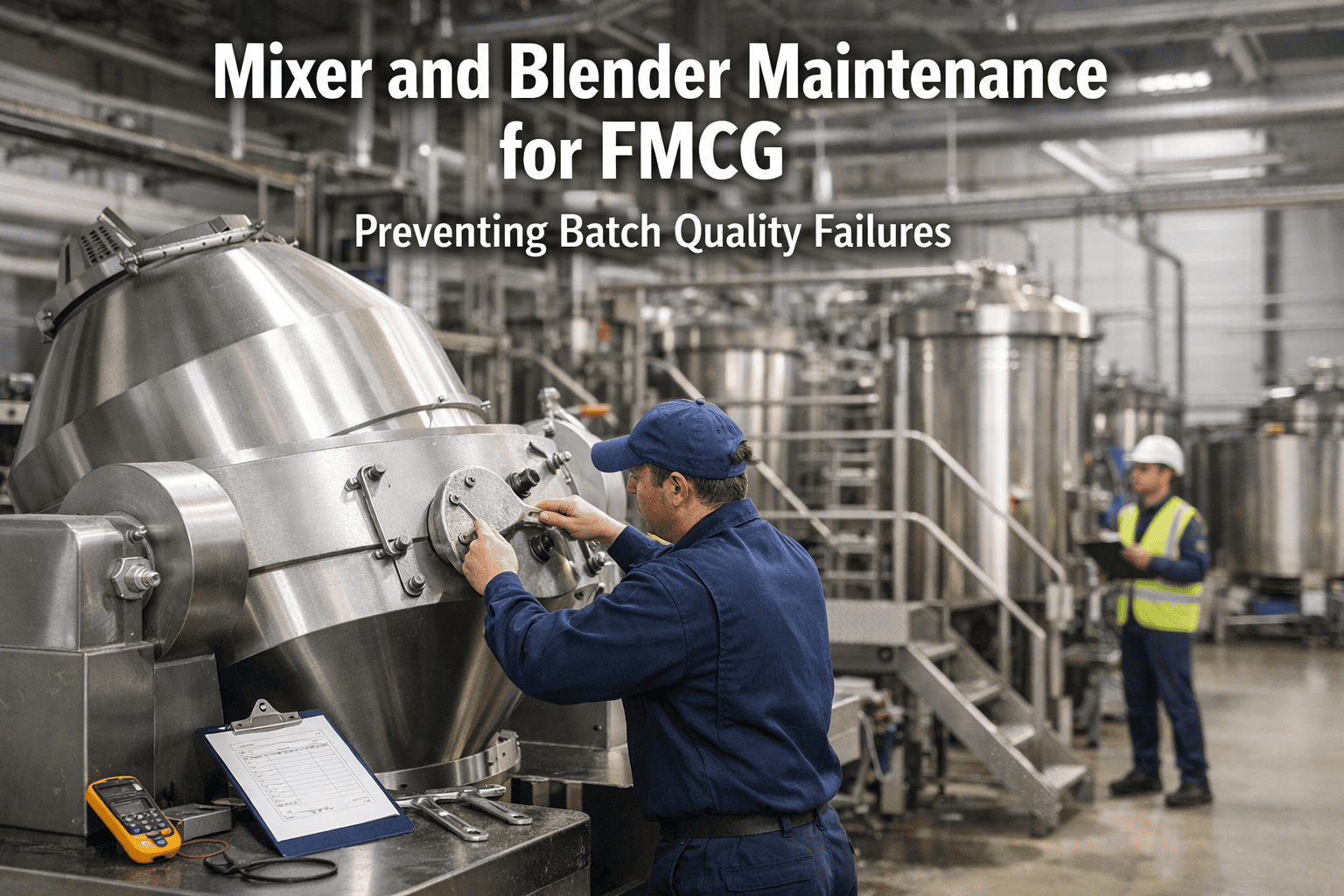
In FMCG production, a mixer running with a worn blade, a weeping shaft seal, or an uncorrected vibration anomaly does not immediately stop the line — it quietly degrades batch quality, accelerates bearing failure, and creates contamination risk that only surfaces at audit or recall. Mixer and blender maintenance is not a reactive task. It is the primary control point for batch consistency, product safety, and production uptime. See how Oxmaint automates mixer PM for FMCG lines — start free.
PdM & AI for FMCGBatch QualityMixer Maintenance
Mixer & Blender Maintenance for Batch Quality in FMCG — The Complete Guide
Blade wear, shaft seal failure, and unmonitored vibration are the three most common causes of batch variation and unplanned downtime in FMCG mixing operations. This guide covers every maintenance layer — from daily inspection to predictive motor monitoring — and how Oxmaint automates it across your production lines.
In FMCG manufacturing, mixers and blenders are the point at which raw ingredient variation is either corrected or amplified. A properly maintained mixer produces homogenous, repeatable batches within specification. A degraded mixer — running with worn blades, a leaking seal, or a misaligned shaft — delivers batch variation that no downstream adjustment can fully correct.
Blade Wear = Inconsistent Mix
Worn blades and agitators directly degrade mix uniformity, extend batch cycle times, and — in severe cases — introduce metal particle contamination. Blade wear is rarely visible during normal operation. It is only caught through scheduled dimensional inspection and metal detection verification.
Seal Failure = Contamination Risk
Sanitation failures on mixing equipment are the primary root cause of allergen cross-contact events and microbiological non-conformances in food manufacturing audits. A weeping shaft seal does not announce itself — it seeps until the batch is compromised.
Vibration = Cascade Failure Chain
A 50-gram imbalance at operating speed generates significant bearing load. Misalignment generates excess vibration that cascades into accelerated bearing wear, shaft fatigue, and eventual agitator seizure mid-batch — condemning product and triggering an unplanned shutdown.
Documentation = Compliance & Audit
Under FSMA Preventive Controls, sanitation and maintenance records must document procedures, dates, operators, and verification results — retained for two years and available for FDA inspection. A CMMS that auto-generates these records removes the documentation burden from your QA team entirely.
A seized agitator mid-batch means contaminated product, regulatory scrutiny, and unplanned downtime cascading through your entire production schedule. Every step in the chain from vibration anomaly to catastrophic gearbox failure is preventable with a CMMS-enforced inspection program. Start a free trial and load your first mixer PM schedule in minutes, or book a demo with an FMCG maintenance specialist.
Critical Components
The Six Components That Determine Mixer Reliability
Industrial mixers in FMCG environments carry some of the highest failure-consequence of any rotating equipment on the line. Each component below has a defined failure mode and a defined inspection method. Missing any one of them creates a gap where undetected wear becomes a batch quality event.
01
Blades & Impellers
Edge Wear, Chips & Metal Fragment Risk
Chipped blades, weld cracks, and worn edges reduce mixing efficiency and introduce metal fragment risk into the batch. Inspect visually at every PM cycle. Measure blade-to-wall clearance with calipers. Follow every blade inspection with a metal detection test run in high-risk applications.
Inspection: Weekly visual + Monthly dimensional
02
Shaft Seals
Leakage, Cross-Contamination & Allergen Risk
Mechanical shaft seals and lid gaskets should be visually inspected weekly. Relying on visible leakage as the replacement trigger is a late failure indicator — by that point, product integrity is already compromised. Replace on OEM-specified interval regardless of apparent condition.
Inspection: Weekly visual + Monthly functional test
03
Bearings
Friction, Heat Build-Up & Cascade Failure
Seal and bearing components typically last 6–12 months depending on operating conditions. Apply food-grade grease (NSF H1 rated) to all greased bearing points per manufacturer intervals. Early wear signs — unusual noise, rough rotation, elevated temperature — should trigger scheduled replacement, not emergency repair.
Lubrication: Per OEM schedule · Inspection: Monthly
04
Gearbox
Oil Level, Contamination & Thermal Drift
Verify gearbox oil level at every PM cycle. Oil contamination from seal seepage begins undetected — discoloration visible but not logged means no thermal baseline exists. A gearbox running 18°C above baseline is a late-stage warning. Oil change intervals must be schedule-driven, not condition-visible.
Oil check: Weekly · Full oil change: Quarterly
05
Motor & Drive
Amperage Draw, VFD Faults & Cooling Vents
Clogged cooling vents, incorrect amperage draw, and VFD faults cause motor failures during peak production cycles. Trend motor current against historical baseline. A rising amperage trend over consecutive weeks signals increased load — worn bearings, product buildup on impeller, or mechanical restriction — before motor failure occurs.
Current trending: Weekly · VFD log review: Monthly
06
Shaft & Alignment
Bending, Misalignment & Vibration Cascade
Misalignment generates excessive vibration, accelerates bearing wear, and bends shafts under sustained load. Inspect for unusual vibration or deflection during operation. Use a straight-edge for shaft alignment verification at monthly intervals. Even minor misalignment generates excessive bearing load that shortens component life significantly.
A structured PM schedule maps every mixer maintenance task to a defined frequency and responsible party. Without this structure, maintenance relies on individual technician memory — which means tasks are missed, intervals drift, and the first sign of failure is a batch quality event rather than an inspection finding.
Daily
Pre-Operation Inspection
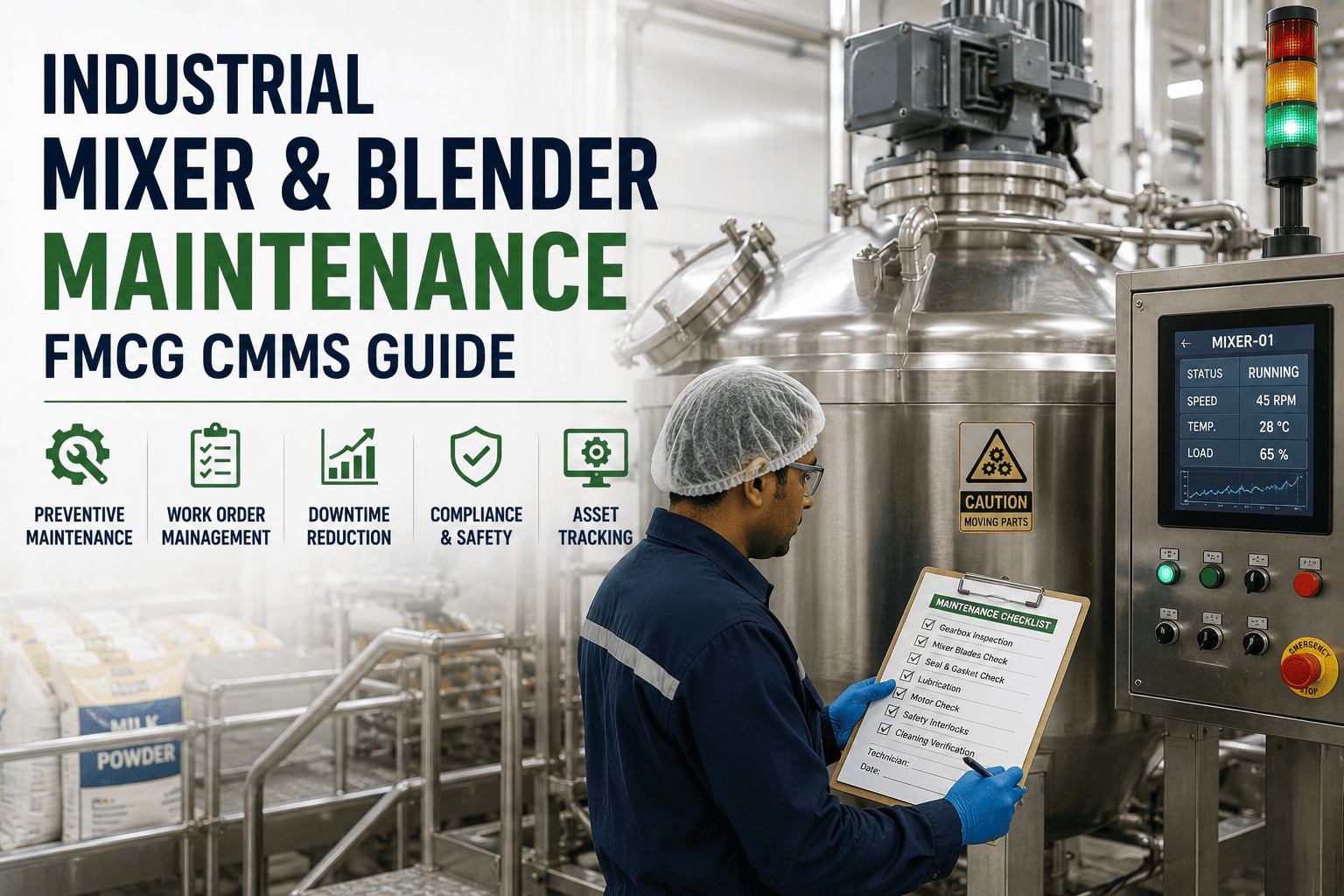
Visual check of blades and impeller for chips or cracks. Shaft seal inspection for visible leakage or product residue around seal housing. No-load startup at low speed — listen for grinding, knocking, or squealing before loading product. Hand vibration baseline check on motor housing and gearbox housing. Any abnormal signal stops production before the batch starts.
Weekly
Seal, Bearing & Vibration Check
Formal shaft seal functional test. Bearing lubrication verification — apply NSF H1 food-grade grease to all greased points per OEM schedule. Vibration measurement at motor housing, gearbox, and bearing housings — record values and plot against historical trend. Gearbox oil level verification. Motor amperage reading against baseline. Rising trends on any parameter initiate corrective action before failure.
Monthly
Dimensional Inspection & Alignment
Blade-to-wall clearance measurement with calipers at defined wear points. Shaft alignment verification with straight-edge. Impeller balance assessment — check for product buildup creating rotational imbalance. Drive belt and gearbox visual inspection for cracks or fraying. Metal detection test run following blade inspection. Full CIP (clean-in-place) verification and ATP swab documentation for FSMA compliance records.
Quarterly
Gearbox & Drive Overhaul
Full gearbox oil change — regardless of visual condition. Bearing replacement per OEM interval or condition data, whichever triggers first. Complete seal replacement at OEM-specified interval — visible leakage is already a failed replacement indicator. Motor thermal imaging and VFD diagnostic review. Safety interlock testing including emergency shut-offs, safety locks, and guardrail condition check. Spare parts inventory reconciliation.
Vibration Monitoring
Vibration Monitoring on Mixers — What to Measure and When to Act
Vibration sensors on mixers and blenders detect misalignment, looseness, and bearing defects before they become equipment failures. A rising vibration trend over consecutive measurement periods is an early warning that requires corrective action — not a note to revisit next quarter.
High-Frequency
20,000 – 60,000 Hz
Detects
Early-stage lubrication deficiency and initial bearing surface degradation — weeks before audible noise or low-frequency signal change
Action: Lubricate and re-measure within 48 hours
Mid-Range
1,000 – 20,000 Hz
Detects
Developing bearing defects, gear mesh irregularities, and coupling misalignment — the window for planned replacement before failure
Action: Schedule bearing replacement within next planned shutdown
Low-Frequency
10 – 1,000 Hz
Detects
Imbalance from blade wear or product buildup, shaft misalignment, structural looseness, and rotor faults — the operational vibration signature
Action: Stop, inspect impeller, verify shaft alignment before restarting
Thermal Imaging
+18°C above baseline
Detects
Gearbox thermal drift from oil contamination, bearing friction escalation, or motor overload — a late-stage but still recoverable warning before failure
Action: Immediate oil change and bearing inspection
The 75:1 Cost Multiplier
A $200 bearing failure during active mixing that condemns a 2,200kg batch represents a 75:1 cost multiplier. Bearing wear produces a new harmonic signature weeks before failure. Without trending data, operators attribute unusual noise to normal operation — until the gearbox fails mid-batch, product is contaminated, and 38 hours of downtime begins. Industry benchmarks show 91% of companies using predictive maintenance report improved asset reliability.
Automate every lubrication, seal, and vibration task on your mixer PM schedule.Oxmaint maps each maintenance task to your specific mixer assets, generates work orders on the correct frequency, and tracks every completion in a timestamped audit log — no spreadsheets required.
Reactive vs Structured Mixer Maintenance — The Real Gap
Reactive Maintenance Approach
Blade wear discovered at batch quality failure or metal detection rejection
Seal replaced only when visible leakage is reported — product already at risk
Vibration anomalies attributed to normal noise until gearbox fails mid-batch
No bearing lubrication log — maintenance relies on individual technician memory
FSMA audit requires manual record assembly — sanitation logs incomplete or missing
Batch variation investigated per event — no trend data to identify root cause
Emergency repair costs 4.8× more than planned maintenance intervention
Equipment lifespan shortened by 5–7 years vs. structured PM baseline
Structured PM with Oxmaint
Blade wear caught via monthly dimensional inspection before batch impact
Seals replaced on OEM-specified interval regardless of visible condition
Vibration trends flagged weeks before failure — planned replacement scheduled
Every lubrication event logged with NSF H1 lubricant spec and technician ID
FSMA-compliant sanitation records auto-generated and retained for 2 years
Batch variation linked to asset condition data — root cause identified fast
40% fewer mechanical failures — planned repairs at planned cost
Equipment lifespan extended 5–7 years beyond reactive maintenance baseline
All mixer PM templates, lubrication specs, and sanitation checklists pre-loaded in Oxmaint. Access free.
Results
What Structured Mixer PM Delivers — Measured
40%
Reduction in mechanical mixer failures with documented PM program vs. reactive maintenance
78%
Reduction in contamination incidents in FMCG facilities using digital maintenance platforms in year one
5–7 yr
Equipment lifespan extension achieved through structured mixer and blender maintenance programs
95%
Of companies using predictive maintenance on rotating equipment report positive ROI — 27% within one year
A post-incident review found zero documented lubrication checks, no vibration baseline on record, and no motor current trending data for the asset. After implementing a structured mixer PM schedule inside Oxmaint, the same facility now catches thermal and vibration anomalies within days — not weeks. The gearbox failure that cost $310K and contaminated 2,200kg of product has not repeated in 18 months of structured PM.
FMCG Plant Engineering Manager · Food Processing Facility, Midwest US
Results like these begin with loading your first mixer PM schedule and running it consistently. Start a free trial and see your mixer assets in Oxmaint within the same day, or book a demo and walk through a facility-specific PM setup with an FMCG maintenance specialist.
FAQs
Frequently Asked Questions
How often should mixer seals be inspected in an FMCG food manufacturing plant?
Mechanical shaft seals and lid gaskets should be visually inspected weekly, with functional testing at each monthly PM cycle. Seals should be replaced on the OEM-specified interval regardless of apparent condition — relying on visible leakage as the replacement trigger is a late failure indicator that has already compromised product integrity. For allergen-sensitive lines, seal condition is also a HACCP prerequisite control point and must be documented at every inspection.
What lubricant should be used for mixer and blender bearings in FMCG food plants?
All bearing lubrication in product-contact risk zones must use NSF H1 rated food-grade grease — any lubricant that may have incidental food contact must carry this certification. Apply at manufacturer-specified intervals; under-lubrication causes bearing failure as quickly as over-lubrication. Every lubrication event should be logged in your CMMS with the product name, quantity, and technician ID — this documentation is required for FSMA and BRC audit compliance.
How is blade wear detected in industrial mixers before it affects batch quality?
Blade wear is detected through a combination of visual edge inspection, dimensional measurement of blade-to-wall clearance with calipers, and blade thickness measurement at defined wear points. Wear is rarely visible during normal operation and must be caught through scheduled offline inspection. For high-risk applications, a metal detection test run should follow every blade inspection to confirm no fragment loss has occurred. A rising batch cycle time with no recipe change is also an operational indicator of blade wear that should trigger an unscheduled inspection.
What sanitation records are required for mixer equipment under FSMA?
Under FSMA Preventive Controls for Human Food, sanitation records must document the sanitation procedures performed, the date and time of each sanitation event, the responsible operator, and verification results such as ATP swab readings. Records must be retained for a minimum of two years and must be available for FDA inspection on request. A CMMS that auto-generates and stores these records with digital signatures significantly reduces the documentation burden on your sanitation and QA teams — and eliminates the audit preparation sprint before every inspection visit.
Trusted by FMCG Maintenance Teams Across 40+ Countries
Consistent Batches Start with Consistent Maintenance. Oxmaint Makes That Automatic.
Join FMCG facilities achieving 40% fewer mixer failures, 78% fewer contamination incidents, and 5–7 years of extended equipment life — with PM schedules that run themselves and audit records that generate automatically.
Mobile-First
Checklists executed at the machine — no paper, no clipboard
+
AI-Scheduled
PM tasks auto-generated on correct frequency per asset
+
FSMA-Ready
Sanitation records auto-generated and retained 2 years
=
Measured Result
40%
Fewer failures. 78% fewer contamination events. 5–7yr longer equipment life.